Somewhere in your brain, a cluster of roughly 20,000 neurons keeps time. This biological clock, synchronized by millions of years of evolution to the rising and setting of the sun, now contends with something it never anticipated: a world where darkness is optional and blue light pours from every screen. The result is circadian rhythm disruption on a scale that affects between 50 and 70 million adults in the United States alone[s], with consequences ranging from insomnia to a 40% increased risk of cardiovascular disease[s].
Your Brain’s Master Clock
The suprachiasmatic nucleus, or SCN, sits directly above where your optic nerves cross in the brain. This tiny structure is the central pacemaker of your circadian timing system, regulating nearly every rhythmic process in your body[s]. When it works properly, you feel sleepy at night and alert during the day. When it doesn’t, virtually everything goes wrong.
The importance of this internal clock was recognized when the 2017 Nobel Prize in Physiology or Medicine was awarded to three researchers who decoded the molecular mechanisms behind circadian oscillations[s]. Their work confirmed what biologists long suspected: circadian rhythms aren’t merely convenient. They’re fundamental to human health.
Light Tells Your Body What Time It Is
Your eyes contain specialized cells called intrinsically photosensitive retinal ganglion cells. These cells contain melanopsin, a light-sensitive protein that responds most strongly to blue wavelengths around 470 to 480 nanometers[s]. When blue light hits these cells, they signal your brain to suppress melatonin and stay alert.
During the day, this system works beautifully. Blue wavelengths boost attention, reaction times, and mood[s]. The problem begins when the sun goes down but the blue light doesn’t, creating the conditions for circadian rhythm disruption.
The Blue Light Problem
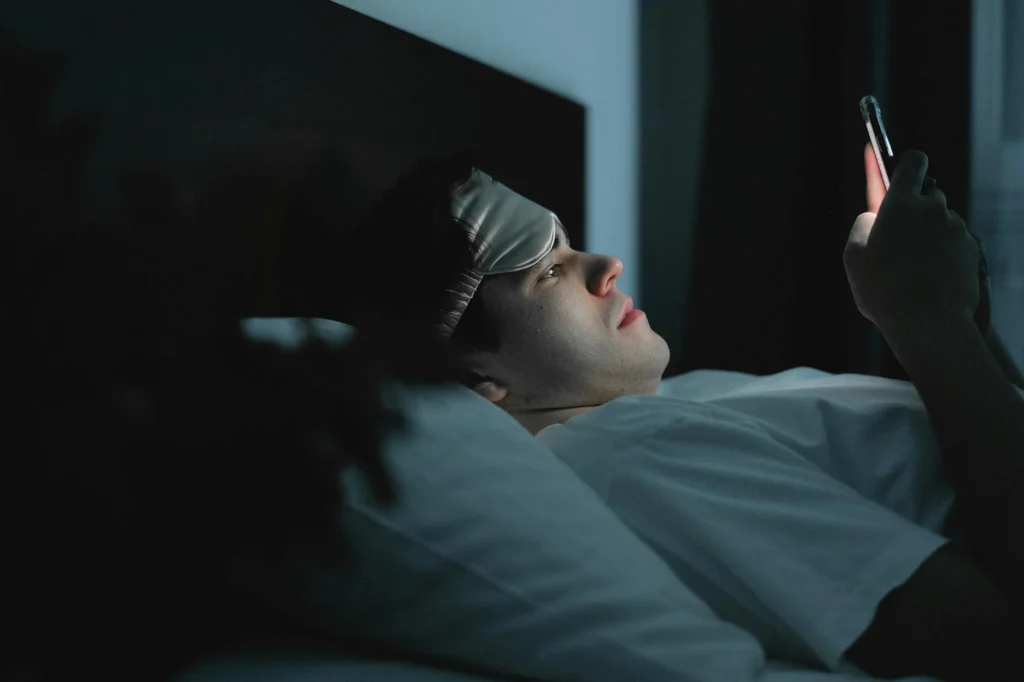
White LEDs, now ubiquitous in homes and devices, emit a significant peak in the blue spectrum around 450 to 470 nanometers[s]. This happens to be almost exactly the wavelength that suppresses melatonin most effectively. Every television, computer, tablet, and smartphone bombards your ancient circadian system with the signal: it’s daytime, stay awake[s].
The CDC states it clearly: blue light has the strongest impact on circadian rhythms[s]. Harvard researchers found that 6.5 hours of blue light exposure suppressed melatonin for twice as long as green light and shifted circadian rhythms by twice as much: 3 hours versus 1.5 hours[s].
Even ordinary room lighting matters. Exposure to room light before bedtime suppressed melatonin onset in 99% of study participants and shortened melatonin duration by about 90 minutes[s]. A mere 8 lux, less than most table lamps produce, can interfere with your circadian rhythm[s].
Shift Work: Fighting Your Own Biology
Approximately 22% of the population in industrialized countries performs some type of shift work[s]. In North America, 12% to 13% of workers maintain rotating or regular night-shift schedules[s]. These workers face a biological impossibility: their bodies are designed to sleep when it’s dark, but their jobs demand otherwise.
Research consistently shows that the circadian system resists adaptation to night schedules[s]. This resistance makes circadian rhythm disruption essentially unavoidable for night workers. Night-shift work causes not just misalignment between your internal clock and the external world, but internal desynchronization between different circadian systems within your own body[s]. Your liver clock, your heart clock, and your brain clock all fall out of sync with each other.
The Health Toll of Circadian Rhythm Disruption
The consequences extend far beyond feeling tired. Research links circadian rhythm disruption to cancer, diabetes, heart disease, and obesity[s]. A review of 17 studies found that shift workers face a 40% increased risk of cardiovascular disease compared to day workers[s]. Those who perform shift work for more than six years face even higher cardiovascular risk[s].
Evening light exposure disrupts melatonin signaling in ways that can affect sleep, body temperature regulation, blood pressure, and glucose homeostasis[s]. Disruptions in the SCN circadian system correlate with various mood disorders and sleep disorders[s].
What Natural Sleep Looks Like
Researchers studying three pre-industrial societies, the Hadza of Tanzania, the San of Namibia, and the Tsimané of Bolivia, found striking patterns. These groups, living without electricity, sleep between 5.7 and 7.1 hours per night[s]. They don’t go to bed at sunset; sleep onset occurs on average 3.3 hours after sundown, and awakening typically happens before sunrise[s].
Most remarkably, their sleep tracks temperature rather than light. Sleep consistently occurred during the period of falling environmental temperature and ended near the daily temperature minimum[s]. Neither the Hadza nor the San have a word for insomnia in their language[s].
The Modern Mismatch
In the United States, between 30% and 46% of adults get insufficient sleep, depending on state[s]. This rate has remained stubbornly stable from 2013 through 2022[s], suggesting that circadian rhythm disruption isn’t a trend. It’s a structural feature of modern existence.
The problem isn’t willpower or sleep hygiene tips. The problem is that modern life demands we override biology: work when we should sleep, stare at screens when we should see darkness, maintain identical schedules regardless of season. Our circadian system evolved for a world that no longer exists, and we pay the price in sleepless nights and shortened lives.
Neuroanatomy of the Master Oscillator
The suprachiasmatic nucleus consists of approximately 10,000 neurons on each side of the third ventricle, positioned directly above the optic chiasm[s]. This bilateral structure functions as the central pacemaker of the circadian timing system[s]. The SCN divides into core and shell subregions: vasoactive intestinal peptide (VIP) and gastrin-releasing peptide (GRP) concentrate in the retino-recipient core, while arginine vasopressin (AVP) expressing cells populate the shell.
The molecular clockwork underlying circadian oscillations, for which the 2017 Nobel Prize in Physiology or Medicine was awarded[s], involves transcriptional autoregulated feedback loops. The core clock genes CLOCK and BMAL1 encode transcriptional activators, while PER1, PER2, PER3 and CRY1, CRY2 encode repressors. These feedback loops generate self-sustained oscillations with a period of approximately 24 hours.
Photic Input and Melanopsin Photoreception
Light information reaches the SCN via specialized intrinsically photosensitive retinal ganglion cells (ipRGCs) containing the photopigment melanopsin[s]. Melanopsin is expressed in approximately 3% to 5% of retinal ganglion cells, with peak absorption around 470 to 480 nanometers[s]. The action spectrum for melatonin suppression in humans shows a lambda max of approximately 460 nanometers[s], confirming melanopsin’s role in photic regulation of pineal function.
The retinohypothalamic tract (RHT) transmits glutamate to VIP-containing neurons in the SCN core, mediating photic regulation of circadian rhythmicity. Pituitary adenylate cyclase-activating polypeptide (PACAP), co-released with glutamate, potentiates light’s phase-shifting effects.
Spectral Characteristics of Modern Light Sources
White-light LEDs are bichromatic sources coupling blue LED emission (peak 450 to 470 nanometers with 30 to 40 nanometer full width at half maximum) with a yellow phosphor (peak around 580 nanometers)[s]. This spectral composition creates substantial overlap with melanopsin’s sensitivity curve. Blue light has the strongest impact on circadian rhythms among visible wavelengths[s].
Comparative studies demonstrate blue light’s potency: 6.5 hours of blue light exposure suppressed melatonin for twice the duration of comparable green light exposure and induced phase shifts of 3 hours versus 1.5 hours[s]. The system shows remarkable sensitivity; even 8 lux can interfere with circadian phase[s].
Room Light and Melatonin Suppression
Research from Brigham and Women’s Hospital quantified the effects of ordinary room light (less than 200 lux) on melatonin dynamics. Compared with dim light conditions (less than 3 lux), room light exposure before bedtime suppressed melatonin onset in 99.0% of individuals and shortened melatonin duration by approximately 90 minutes[s]. Room light exerts a profound suppressive effect that shortens the body’s internal representation of night duration[s].
Chronic evening light exposure disrupts melatonin signaling with downstream effects on sleep architecture, thermoregulation, blood pressure regulation, and glucose homeostasis[s]. This pathway represents one of the primary mechanisms through which artificial lighting produces circadian rhythm disruption.
Shift Work and Internal Desynchronization
Approximately 22% of the industrialized workforce performs shift work[s], with 12% to 13% of North American workers on rotating or night schedules[s]. Field studies and simulated night-shift experiments indicate that the circadian system is resistant to adaptation from day-oriented to night-oriented schedules[s].
Circadian rhythm disruption from night-shift work produces both external misalignment (between internal clocks and environmental light-dark cycles) and internal desynchronization (between central SCN rhythms and peripheral clock gene expression in tissues including peripheral blood mononuclear cells, hair follicle cells, and oral mucosa)[s]. After several days of nocturnal schedules, most rhythmic transcripts in the human genome remain adjusted to day-oriented timing with dampened amplitudes.
Cardiovascular and Metabolic Consequences
Meta-analysis of 17 studies calculated a 40% increased cardiovascular disease risk among shift workers compared to day workers[s]. Risk increases further after six or more years of shift work exposure[s]. Disruptions in the SCN circadian system correlate with mood disorders and sleep disorders[s].
Circadian rhythm disruption is implicated in cancer, type 2 diabetes, cardiovascular disease, and obesity[s]. Mechanistically, circadian misalignment affects clock-controlled gene expression in cardiac tissue, disrupts PAI-1 rhythmicity in vascular endothelium, and alters glucose and lipid metabolism pathways.
Sleep in Pre-Industrial Populations
Actigraphy studies of three pre-industrial societies (Hadza, San, Tsimané) revealed sleep durations of 5.7 to 7.1 hours[s], with sleep period onset averaging 3.3 hours after sunset and offset typically before sunrise[s]. Sleep timing correlated strongly with environmental temperature rather than light: sleep consistently occurred during falling ambient temperature and terminated near the daily temperature nadir[s].
These populations show minimal insomnia; neither Hadza nor San languages contain a word for the concept[s]. The daily temperature cycle, largely eliminated from climate-controlled modern environments, may serve as a potent natural sleep regulator.
Population-Level Sleep Insufficiency
CDC data indicate 30% to 46% of U.S. adults report insufficient sleep, varying by state[s]. Between 50 and 70 million adults live with chronic sleep disorders[s]. Insufficient sleep prevalence remained stable from 2013 through 2022[s], indicating a persistent structural mismatch between biological sleep requirements and social demands.
Modern circadian rhythm disruption represents an evolutionary mismatch: photoreceptive and thermoregulatory systems calibrated over millions of years for predictable environmental cycles now operate in artificially lit, temperature-controlled environments with socially determined schedules bearing no relationship to solar or thermal zeitgebers.