The United States has moved roughly one-third of its operational naval surface fleet to the Middle East since late January 2026. Three carrier strike groups, THAADTerminal High Altitude Area Defense—an air defense system designed to intercept aircraft, cruise missiles, and ballistic missiles at high altitudes. Mobile system deployed by the US military in forward positions. anti-missile batteries pulled from South Korea, Patriot systems relocated from allied bases, and at least two destroyers redeployed from Japan now sit thousands of miles from the Pacific theater they were positioned to defend. The result is a China strategic windfall that is reshaping the balance of power across Asia.
The China strategic windfall is not a single dramatic event. It is a slow accumulation of advantages: fewer American ships in the Western Pacific, depleted munitions stockpiles that will take years to replenish, strained alliance credibility, and a live-fire laboratory from which the People’s Liberation Army is extracting operational data it could never have generated on its own. Analysts across Washington, Tokyo, and Taipei are watching the same math and reaching the same uncomfortable conclusion.
The China Strategic Windfall Starts With Ships and Missiles
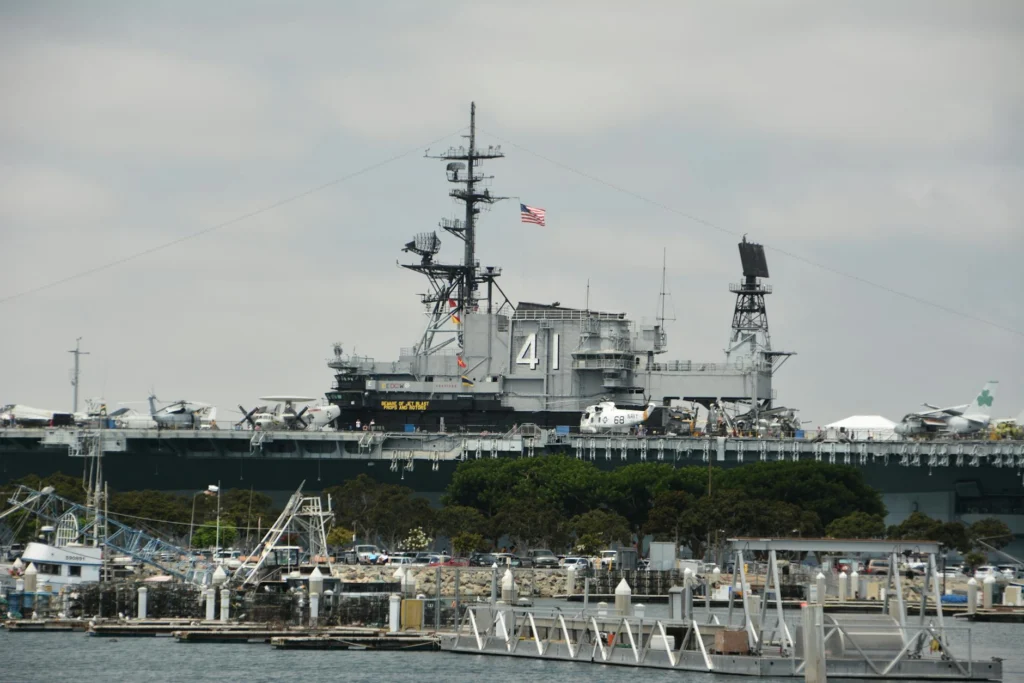
The scale of the redeployment is the largest since the 2003 invasion of Iraq. The USS Abraham Lincoln carrier strike groupA naval military formation centered on an aircraft carrier, containing destroyers, cruisers, submarines, and support ships that project power and provide defense across hundreds of miles of ocean., previously operating in the South China Sea, transited to the Middle East in late January. Destroyers USS Spruance, USS Michael Murphy, and USS Frank E. Petersen Jr. left their positions in the Western Pacific to join it. The USS Gerald R. Ford arrived in the Mediterranean in mid-February, creating a two-carrier presence in the theater. Reports indicate a third carrier may follow.
The hardware losses in Asia go beyond ships. THAAD units, the Terminal High Altitude Area Defense systems originally deployed to South Korea to counter North Korean missiles, have been moved to the Gulf region. Patriot missile defense batteries previously stationed at allied bases across the Pacific have followed. John Delury, senior fellow at the Asia Society, told Stars and Stripes: “It’s hard to overstate the irony of THAAD, a symbol of the pivot to Asia, being removed.”
The consumption rate of munitions compounds the problem. According to Stars and Stripes reporting, the US and Gulf allies expended over 580 Patriot and interceptor missiles in the first 36 hours of the Iran campaign alone. Lockheed Martin produces roughly 620 Patriot missiles per year. The arithmetic is stark: the opening salvos of one conflict have consumed nearly a full year’s production capacity of a weapon system that is also central to Pacific defense planning.
The Munitions Gap Behind the China Strategic Windfall
The Iran war did not create America’s munitions vulnerability in the Pacific. It accelerated it. A series of CSIS war games conducted before the current conflict found that the United States would likely run out of long-range precision-guided munitionsAdvanced missiles and ordnance that use GPS, radar, or other guidance systems to strike targets with high accuracy, reducing collateral damage but requiring substantial production resources. in less than one week in a Taiwan Strait scenario. The number of Long Range Anti-ship Missiles available to the US military is estimated at fewer than 500 in 2026, and they can only be launched from a limited number of aerial platforms.
CSIS researchers warned that a Chinese blockade and long-range fire capabilities would make it “difficult, and perhaps impossible, to get weapons systems and munitions into the area once war has started,” requiring larger pre-positioned stockpiles in the theater. Those stockpiles are now being drawn down for a different war, in a different theater, with no clear timeline for replenishment.
Lindsey Ford, former Deputy Assistant Secretary of Defense, told Stars and Stripes: “Anytime we’re pulling air and missile defenses out of theater, that creates obvious concerns. They give countries reassurance.” Hirohito Ogi, a former Japanese Defense Ministry official, said the missile depletion “could have serious impact on readiness in the Indo-Pacific, including Taiwan’s defense.”
What Beijing Is Doing With the Window
China’s response has been calibrated and, analysts argue, strategically patient. Beijing has not escalated military pressure on Taiwan during the Iran conflict. It has, in some respects, tightened its domestic grip while easing the external temperature. The PLA has not launched new large-scale exercises around the island since the war began.
But the baseline it is operating from was already elevated. The December 2025 Justice Mission exercises rehearsed a full maritime blockadeMilitary operation that prevents all ship movement into or out of ports and coastal waters, effectively isolating a region from sea-based commerce and military reinforcement. of Taiwan, deploying more than 130 aircraft sorties, 14 warships, and 15 coast guard vessels across a larger area than any PLA exercise since 2022. Average monthly PLA air incursions into Taiwan’s air defense identification zoneAirspace surrounding a nation where aircraft are subject to identification and control procedures; distinct from territorial waters but claimed for defensive purposes. Often abbreviated as ADIZ. reached 319 between May 2024 and December 2025, a 129 percent increase from the prior period. Naval vessel activity rose 42 percent over the same window.
China’s 2026 defense budget increased 7 percent. Premier Li Qiang told the National People’s Congress that Beijing would “resolutely crack down on separatist activities,” language notably stronger than previous commitments to merely “oppose” them.
The more significant development may be what the PLA is learning. The Jerusalem Post reported that Chinese military analysts are treating the Iran conflict as a live-fire laboratory, studying every engagement involving US carrier strike groups for targeting data, intercept patterns, and electronic warfareMilitary operations using electromagnetic signals to jam, deceive, or intercept an adversary's radar, communications, or navigation systems. signatures. Beijing cannot generate this data through exercises. The war is providing it for free.
The Allies Are Worried
The China strategic windfall is not lost on Washington’s Asian partners. The reaction across the First Island ChainThe arc of nations from Japan through Taiwan to the Philippines that forms the geographic backbone of US Pacific military strategy and encircles China's eastern coast.Arc of nations from Japan through Taiwan to the Philippines that forms the geographic backbone of US Pacific military strategy and containment of China., the arc of nations from Japan through Taiwan to the Philippines that forms the geographic backbone of US Pacific strategy, has been measured in public and alarmed in private.
Taiwan’s government stated it has not been approached about any weapons redeployment, according to the Taipei Times. Lawmakers in Taipei have noted what is obvious: assets “cannot be deployed in two places simultaneously.”
Japan, which hosts the largest concentration of US military forces outside the continental United States, is watching destroyer deployments from its own bases head west toward Iran. Tokyo has signaled it intends to raise defense spending to 2 percent of GDP by March 2027, an acknowledgment that reliance on American forward posture is becoming riskier. South Korea agreed to an 8.2 percent defense spending increase for 2026. Australia moved toward a 7.3 percent nominal rise.
The Philippines, which hosts rotational US forces rather than permanent bases, faces a different calculus. US Undersecretary of Defense Elbridge Colby reportedly said his first call after strikes on Iran was to the Philippine defense minister, insisting the US remains “laser-focused on the First Island Chain.” The reassurance itself signals the concern it is meant to address.
The Counterargument: Deterrence Through Demonstration
Not all analysts accept that the China strategic windfall is as decisive as the hardware numbers suggest. A counterargument, articulated in TIME and by scholars including Steve Tsang of the SOAS China Institute, holds that the speed and precision of US operations against Iran may have reinforced deterrence rather than weakened it.
The rapid strikes against Iranian leadership demonstrated intelligence capabilities and operational reach that contrast sharply with the PLA’s lack of major combat experience since the 1979 war with Vietnam. Chinese-made military equipment deployed in Iran and Venezuela reportedly performed poorly, raising questions about Beijing’s own hardware reliability.
An unprecedented purge of nine PLA officials in recent months has created uncertainty within China’s own command structure. Taiwan’s domestic politics may also be drifting in Beijing’s favor without military action, as the pro-Beijing Nationalist Party gains traction against a weakened DPP government.
Tsang concluded: “It will be reckless for Xi to order an invasion unless he is absolutely sure the U.S. cannot interfere.” That threshold, he argues, has not been met.
The Signal Washington Is Sending
The 2026 National Defense Strategy, released before the Iran war escalated, ordered US forces to “build, posture, and sustain a strong denial defence along the First Island Chain.” But the document does not mention Taiwan by name. It does not list the Taiwan Strait among the five areas where the US will prioritize “critical but limited support.” The Atlantic Council noted that the strategy’s emphasis on “strategic restraint,” where the use of force depends on American interests at a specific moment, “generates dangerous ambiguity.”
The gap between stated commitment to Pacific alliances and the observable movement of military assets deepens the China strategic windfall. Europe learned this lesson first: alliance structures can pull resources away from a region as easily as they can concentrate them.
The Long Game
The China strategic windfall is not primarily about Taiwan invasion risk in the next six months. It is about the medium-term erosion of American deterrence credibility in the Pacific over the next five to ten years.
Munitions stockpiles that took a decade to build are being consumed in weeks. CSIS has estimated that rebuilding depleted reserves for a Pacific contingency could take years even at accelerated production rates. Every Patriot missile fired at an Iranian drone is a Patriot missile that does not exist for a Taiwan scenario. Every destroyer on station in the Persian Gulf is a destroyer not available for the Bashi Channel.
China, meanwhile, is building. The PLA Navy now operates the world’s largest fleet by hull count. Its shipbuilding capacity dwarfs that of the United States. Its anti-ship missile inventory is not being expended in a foreign war.
The oil price shock from the Iran conflict has created its own asymmetry. While global energy markets face disruption, China has increased imports of discounted Russian crude, which nearly doubled year-on-year in February 2026. Russian oil arrives at Chinese ports $5-6 per barrel below Brent; Iranian crude, for buyers willing to handle the sanctions risk, comes at a $6-8 discount. The war that raises energy costs for most of the world is lowering them for China.
Foreign Affairs published an analysis in January titled “A Perfect Storm for Taiwan in 2026,” identifying the convergence of US strategic distraction, shifting cross-strait military capabilities, and Taiwan’s diplomatic isolation as creating a moment of particular vulnerability. The Iran war has made each of those factors worse.
Whether Beijing exploits the China strategic windfall militarily or simply uses it to consolidate regional influence through economic leverage, diplomatic pressure, and quiet observation of American operational methods may depend less on Xi Jinping’s appetite for risk than on how long the United States remains committed to a war 7,000 miles from the theater it designated as its strategic priority.
Sources
- Stars and Stripes: US allies near China on edge as weapons shift from Asia to Iran (March 12, 2026)
- South China Morning Post: Why China stands to gain from US moving military assets for Iran war (March 2026)
- TIME: How Trump’s War With Iran Could Be Good for Taiwan (March 2026)
- Foreign Affairs: A Perfect Storm for Taiwan in 2026? (January 23, 2026)
- CSIS: The U.S. Industrial Base Is Not Prepared for a Possible Conflict with China
- CSIS: Empty Bins in a Wartime Environment (2023)
- CSIS ChinaPower: Tracking China’s Increased Military Activities in the Indo-Pacific in 2025
- Atlantic Council: What the Indo-Pacific thinks of the new US National Defense Strategy (2026)
- Bloomberg: Russia, Iran Cut Oil Prices for China as Unsold Barrels Accumulate at Sea (February 25, 2026)
- Jerusalem Post: China sees Iran war as a live lab for future US conflict (2026)
- IISS: The Military Balance 2026
- Taipei Times: US has not approached Taiwan on weapons redeployment (March 11, 2026)