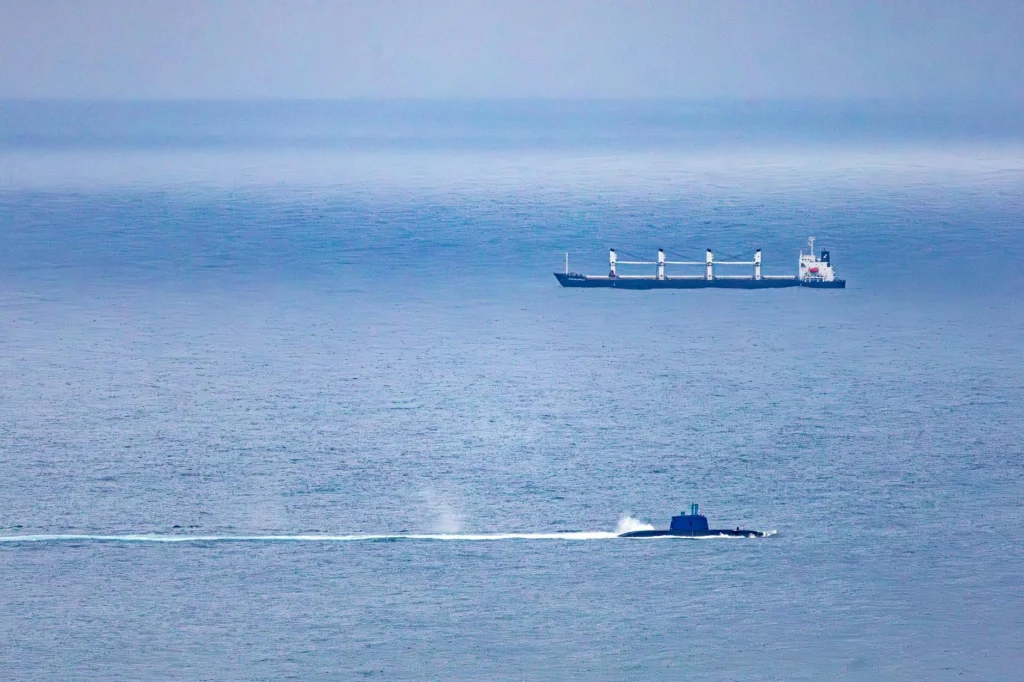
A Virginia-class submarine with the Virginia Payload Module displaces about 10,200 tons of water when submerged.[s] That’s more than 20 million pounds of vessel, machinery, weapons, and crew, yet it floats when it wants to and sinks when it chooses. The same buoyancy physics that keeps a wooden toy bobbing in a bathtub governs this engineering feat, scaled up by a factor of millions.
Buoyancy Physics and the Archimedes Principle
Every object submerged in a fluid experiences an upward push. This is the buoyant force, and its magnitude equals the weight of the fluid displaced by the object.[s] The Greek mathematician Archimedes identified this relationship around 250 BCE, and it remains the foundation of buoyancy physics today.
The principle works because fluid pressure increases with depth.[s] The bottom of a submerged object experiences greater pressure than the top, producing a net upward force. If this buoyant force exceeds the object’s weight, the object rises. If the weight exceeds the buoyant force, it sinks.[s]
Why Steel Ships Float
Steel is denser than water. A solid steel ball sinks. Yet steel ships float. The resolution lies in average density, not material density.
If you drop a lump of clay in water, it sinks. Mold that same clay into a boat shape, and it floats.[s] The boat shape encloses air, reducing the average density below that of water. The buoyancy physics remain identical; the geometry changes everything.
A ship sinks into the water until the weight of displaced water equals the ship’s own weight.[s] Load cargo onto the ship and it sinks deeper, displacing more water, until equilibrium is restored. The buoyant force continuously matches the total weight.
A related fluid-mechanics idea appears in aerodynamic lift: pressure differences around a wing can generate upward force, though lift is not simply Archimedes’ principle applied to air. Both phenomena belong to fluid mechanics, whether the fluid is water or air.
How Submarines Control Buoyancy Physics
Submarines do what surface ships cannot: they manipulate their average density on demand. The mechanism is straightforward. In typical designs, main ballast tanks sit outside the pressure hull under the outer fairing.[s]
On the surface, these tanks contain air, keeping the submarine buoyant. To dive, the crew opens vents at the top of the tanks, releasing air while flood ports at the bottom admit seawater.[s] As water replaces air, the submarine’s average density rises above seawater’s density, and the vessel sinks.
To surface, compressed air is admitted to the tanks, expelling water and restoring positive buoyancy.[s] Propulsion and diving planes help control the rate and angle of the maneuver.
Staying Level: Trim and Depth Control
Main ballast tanks handle the major transitions between surface and submerged states. Finer adjustments require additional systems. Trim tanks at the bow and stern allow crews to level the submarine’s angle. Depth control tanks compensate for changes in seawater density and other buoyancy shifts during a voyage.[s]
Engineers also install lead ballast along the keel when they need to lower the submarine’s center of gravity and improve stability.[s]
Pressure and the Limits of Buoyancy Physics
Hydrostatic pressure rises by about 44 psi per 100 feet of depth, roughly one atmosphere per 10 meters.[s] At 1,000 feet, the hull endures roughly 440 psi of external hydrostatic pressure. Depth changes and seawater-density changes can shift the vessel’s buoyancy balance, requiring active compensation from the ballast systems.
If flooding exceeds the reserve buoyancy the hull was designed to handle, compressed air alone may not restore enough positive buoyancy to surface. The buoyancy physics that enable controlled diving also define the limits beyond which recovery becomes far harder.
A Virginia-class submarine with the Virginia Payload Module displaces about 10,200 tons of water when submerged.[s] This massive displacement produces an equally massive buoyant force, governed by the same buoyancy physics that applies to any object in any fluid. The engineering challenge lies not in making steel float, but in controlling when it does.
The Mathematics of Buoyancy Physics
Archimedes’ principle states that any body submerged in a fluid experiences an upward force equal to the weight of the fluid it displaces.[s] The mathematical expression for buoyant force is:
FB = ρ × V × g[s]
where ρ is the fluid density, V is the displaced volume, and g is gravitational acceleration. In a fluid of fixed density, the force is set by displaced volume and gravity, not by the object’s mass distribution.
The buoyancy physics derive from the pressure gradient. Fluid pressure increases with depth because of the gravitational weight of the fluid above.[s] The bottom of a submerged object experiences greater pressure than the top, producing the net upward force we call buoyancy.
Density and the Floating Condition
An object floats when its average density is less than the surrounding fluid’s density.[s] For a floating body, the fraction submerged equals the ratio of object density to fluid density:
Fraction submerged = ρobj / ρfl
A ship sinks into the water until the weight of displaced water equals its own weight, then stabilizes.[s] Loading cargo increases the weight; the ship settles deeper until the buoyant force matches the new total. Aerodynamic lift is another fluid-mechanics effect involving pressure differences, but it is not the same mechanism as buoyancy.
Submarine Ballast Systems
Submarines achieve variable buoyancy through main ballast tanks positioned outside the pressure hull, often under the hydrodynamic fairing.[s] On the surface, these tanks contain air, yielding positive buoyancy. To dive, vents at tank tops release air while flood ports admit seawater.[s] The average density increases until it exceeds the surrounding seawater’s density, and the vessel descends.
Surfacing reverses the process: compressed air forces water out through the flood ports, restoring positive buoyancy.[s] Propulsion and diving planes help control the maneuver.
Variable ballast tanks and trim tanks provide fine adjustments. Engineers compensate for shifting loads, weight additions or removals, and varying seawater properties using these secondary systems.[s] Lead ballast along the keel can lower the center of gravity.[s]
Stability: Metacentric Height and Pendulum Stability
Buoyancy physics alone do not guarantee a vessel stays upright. Stability depends on the relationship between the center of gravity (G) and the center of buoyancy (B), which is the centroid of the underwater volume.[s]
When a surface ship heels, the center of buoyancy shifts toward the low side as the underwater volume reshapes. The buoyant force and weight create a righting moment that returns the ship upright.[s] The righting moment equals:
RM = GZ × Δ[s]
where GZ is the righting arm (perpendicular distance between G and the line of buoyant force) and Δ is displacement.
Submerged submarines operate differently. With no waterplane area, the metacenter and center of buoyancy coincide. Instead, submarines rely on pendulum stability: the center of buoyancy sits above the center of gravity, and any tilt produces a restoring torque.[s] This configuration requires careful weight distribution, hence the lead ballast in the keel.[s]
Depth, Pressure, and System Limits
Hydrostatic pressure increases by about 44 psi per 100 feet of depth, roughly one atmosphere per 10 meters.[s] At extreme depths, that pressure loads the pressure hull; the submarine must actively manage buoyancy changes through its variable ballast systems as depth and seawater conditions change.
Reserve buoyancy, the volume above the waterline when surfaced, provides the margin for emergency scenarios. If flooding exceeds this reserve, recovery becomes far more difficult. The same elegant buoyancy physics that permit a 10,200-ton VPM-equipped submarine to move between surface and depth also define the envelope beyond which the depths win.