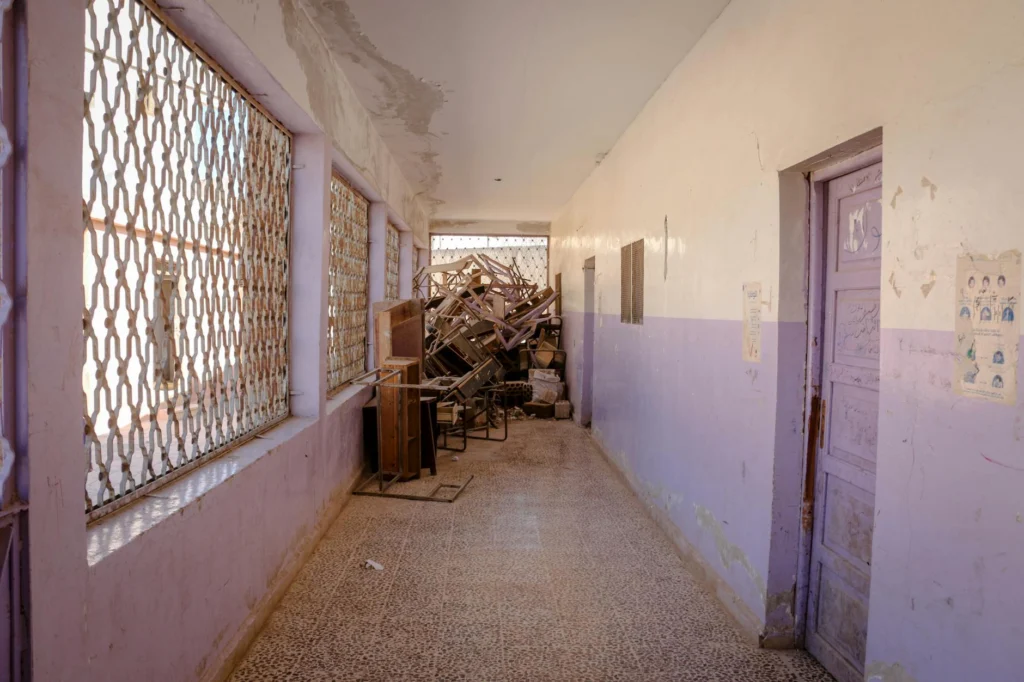
On the morning of February 28, 2026, a US-manufactured Tomahawk cruise missile struck Shajareh Tayyebeh Elementary School in Minab, a city in Iran’s southern Hormozgan province. The attack killed 168 people, according to Iranian authorities. At least 110 of the dead were schoolchildren. The rest were teachers and parents who had come to pick up their children.
The strike occurred on the first day of the US-Israeli military operation against Iran, which has prompted significant international responses from neutral nations. It has since become the subject of investigations by Amnesty International[s], Human Rights Watch[s], and multiple news organizations, all pointing to a failure of US intelligence and targeting procedures. The question now is whether what happened constitutes a war crime.
What Happened
US and Israeli airstrikes across Iran began at 9:45 a.m. local time[s] on February 28. By 10 a.m., staff at the Shajareh Tayyebeh school had begun contacting parents to come collect their children. The governor of Hormozgan province later confirmed the school was struck at 10:45 a.m., one hour into the operation.
Many parents were still on their way when the missile hit. Some students came from surrounding villages, and the travel time proved fatal. According to Amnesty International’s sources, teachers and the school principal stayed behind to get children out. Most of them were killed.
Iran’s judiciary announced on March 3 that the dead included at least 110 children, 26 teachers, and four parents. Due to a nationwide internet blackout imposed by Iranian authorities since the start of hostilities, Amnesty International was unable to independently verify the death toll.
The School and the Military Compound
The school sits in the Shahrak-e Al-Mahdi neighbourhood of Minab, adjacent to a compound belonging to the Seyyed al-Shohada Asif Missile Brigade, an IRGC naval unit responsible for coastal defence along southern Iran. This proximity is central to understanding how the strike happened.
Amnesty’s analysis of satellite imagery dating back to 2013[s] shows that the school building was once within the perimeter of the IRGC compound. But by 2016, it had been physically separated through boundary walls and three new gated entrances. By 2017, satellite images reviewed by Human Rights Watch showed a soccer pitch clearly visible in the school courtyard[s]. Walls and grounds were painted with features typical of schools in the area. As recently as December 2025, satellite imagery showed dozens of people in the courtyard, apparently playing[s].
The building had previously served as the command headquarters of the IRGC compound before its conversion into a school. The school served both children of IRGC personnel and low-income families from the area, including members of Iran’s Baluchi ethnic minority.
The Evidence: A Tomahawk
In the days following the strike, a body of physical and visual evidence emerged identifying the weapon used.
A video released by Iranian news agency Mehr News and geolocated by Bellingcat[s] shows a missile striking a clinic adjacent to the school on February 28. Two munitions experts interviewed by TIME identified the weapon as a Tomahawk. John Gilbert, Senior Science Fellow at the Center for Arms Control and Non-Proliferation, told the magazine the video “conclusively shows a Tomahawk cruise missile diving almost vertically” into the area. In the footage, smoke is already visible rising from the direction of the school.
Photographs of missile fragments published by Iran’s state broadcaster showed components marked “Made in USA”[s] with the name of Ohio-based manufacturer Globe Motors and a satellite data link antenna made by Ball Aerospace. These are consistent with known Tomahawk components, according to CNN analysis and multiple independent experts.
Tomahawk missiles are in the arsenals of only three countries: the United States, Australia, and the United Kingdom. Japan and the Netherlands have been approved to purchase the weapon. None of these countries, besides the United States, is a party to the conflict. Iran does not have them, despite President Trump’s false claim to the contrary on March 9.
Outdated Intelligence
On March 11, CNN reported[s], citing two sources briefed on preliminary findings of an ongoing military investigation, that US Central Command created target coordinates for the strike using outdated information provided by the Defense Intelligence Agency. The New York Times published similar findings the same day, reporting that the investigation had preliminarily determined the US was responsible[s].
The core problem: the DIA’s data apparently still classified the school building as part of the IRGC compound, despite a decade of publicly observable changes. Commercially available satellite imagery from 2016 onward clearly showed the separation. A Reuters investigation found the school had maintained a years-long online presence[s], with photos of girls in uniform and student drawings.
As Amnesty International noted, “media and other organizations were able to promptly verify that the building hosting the school had been separated from the rest of the compound since at least 2016. This indicates that parties to the conflict, with much more advanced intelligence-gathering capabilities and technologies, were undoubtedly in a position to collect and verify this same information.”
The Weakening of Safeguards
The strike did not occur in a vacuum. Multiple analysts have pointed to a broader erosion of civilian protection mechanisms within the US military under the current administration.
Michael Page, Deputy Middle East Director at Human Rights Watch, told The American Prospect that the Trump administration “has weakened all of these protections”[s]: terminating senior military lawyers, loosening targeting protocols, and removing civilian environment teams and red teams from the operational chain of command. These are the safeguards designed to prevent exactly this kind of outcome. The targeting of human rights groups investigating such incidents has also been documented, as seen in recent cases involving Palestinian rights organizations.
HRW’s Akshaya Kumar noted that proceeding with the strike without conducting a “pattern of life study”[s] to observe activity around the target constitutes recklessness, a legal basis for war crime charges “even if you weren’t necessarily intentionally or deliberately seeking to hit a school.”
The tone set by leadership matters too. On March 2, just two days after the school strike, Defense Secretary Pete Hegseth told reporters: “No stupid rules of engagement, no nation-building quagmire, no democracy-building exercise, no politically correct wars.”[s]
The US also signed the Safe Schools Declaration in January 2025, a political commitment endorsed by 123 nations to protect education from attack during armed conflict. The Minab strike violated that agreement[s], though the declaration is non-binding.
The AI Question
On March 11, CENTCOM Commander Brad Cooper confirmed that the US was using “advanced artificial intelligence tools”[s] to process data related to operations in Iran. Amnesty International explicitly called for investigations to consider “how artificial intelligence may have been employed” in intelligence gathering, targeting decisions, and precautions.
Initial reports suggesting AI was to blame for the bad targeting were subsequently dismissed[s]. But the broader concern remains: when AI systems are trained on or fed outdated data, they can automate and accelerate errors that human review might have caught. HRW has called for Congress to hold a hearing on the role of AI in military targeting.
Official Responses
President Trump initially blamed Iran for the strike on March 7, saying “they are very inaccurate with their munitions.” He later falsely claimed Iran possesses Tomahawk missiles. By March 11, when asked about preliminary findings of US responsibility, he told CNN: “I don’t know about that.”[s]
White House Press Secretary Karoline Leavitt said the investigation “is still ongoing.” Defense Secretary Hegseth said on March 11 that the strike would be “thoroughly” investigated, adding that the US has “attempted in every way possible to avoid civilian casualties.”
Ten US Democratic senators released a joint statement calling themselves “horrified” by analysis[s] that “credibly suggests the strike may have been conducted by U.S. forces, which if true, would make it one of the worst cases of civilian casualties in decades of American military action in the Middle East.”
The Legal Framework
Amnesty International laid out two legal scenarios. If US forces failed to identify the building as a school and proceeded with the strike anyway, this would indicate “gross negligence”[s] and a serious violation of international humanitarian law. If the US knew the school was adjacent to the compound and attacked without feasible precautions, such as striking at night or giving advance warning, “this would amount to recklessly launching an indiscriminate attack which killed and injured civilians and must be investigated as a war crime.”
Human Rights Watch’s Sarah Yager was more direct: “The findings of the US military investigation into the Minab school attack show a violation of the laws of war that cannot be boiled down to a blameless mistake.”[s]
Under customary international humanitarian law, an attacking force must do everything feasible to verify that targets are military objectives. The laws of war prohibit indiscriminate attacks and require that anticipated civilian harm not be disproportionate to the expected military advantage. Serious violations committed deliberately or recklessly constitute war crimes. History provides sobering precedents for such targeting, including cases like the deliberate targeting of civilian infrastructure to achieve military or political objectives.
Iran’s Role
Amnesty International also directed demands at Tehran. The organization called on Iranian authorities to remove civilians from the vicinity of military objectives “to the extent feasible” and to allow independent monitors into the country. It noted that the school’s location next to an active IRGC compound placed civilians at risk.
The internet blackout imposed since February 28 has prevented independent verification of casualties and cut 92 million Iranians off from life-saving information. Amnesty also noted that Iranian authorities “have exploited the suffering of victims’ families and surviving children for propaganda purposes.”
What Comes Next
As of late March, the Pentagon’s full investigation has not been released. The preliminary findings point clearly to US responsibility, but the critical details, including exactly how the school ended up on the target list, who approved the strike, and whether AI systems played a role, remain unclear.
Wes Bryant, a former adviser on precision warfare and civilian harm mitigation at the Pentagon’s Civilian Protection Center, described the strike as “a troubling departure from foundational US targeting doctrine and practices”[s] and called it “indicative of a recklessly planned and executed campaign in which attention to precision and the legal and moral obligations to protect civilians clearly took a backseat.”
The Minab school strike is not just a story about one missile hitting one building. It is a test case for whether the US will hold itself accountable when its weapons kill children in a school that anyone with access to Google Earth could have identified as such.
On the morning of February 28, 2026, a US-manufactured Tomahawk cruise missile struck Shajareh Tayyebeh Elementary School in Minab, a city in Iran’s southern Hormozgan province. The attack killed 168 people, according to Iranian authorities. At least 110 of the dead were schoolchildren. The rest were teachers and parents who had come to pick up their children.
The strike occurred on the first day of the US-Israeli military operation against Iran, which has prompted significant international responses from neutral nations. It has since become the subject of investigations by Amnesty International[s], Human Rights Watch[s], and multiple news organizations, all pointing to a failure of US intelligence and targeting procedures. The question now is whether what happened constitutes a war crime.
Content warning: This version includes graphic eyewitness testimony and descriptions of injuries to children.
What Happened
US and Israeli airstrikes across Iran began at 9:45 a.m. local time[s] on February 28. By 10 a.m., staff at the Shajareh Tayyebeh school had begun contacting parents to come collect their children, apparently before an official nationwide school closure alert was issued around 15 minutes later. The governor of Hormozgan province later confirmed the school was struck at 10:45 a.m.
Many parents were still on their way when the missile hit. Students came from surrounding villages, and travel time proved fatal. A Minab resident who spoke to Amnesty International, identified by the pseudonym Sohrab, relayed accounts from four independent sources: “People from nearby streets and those who had time rushed over and tried to take children whose families hadn’t arrived yet. Many students were from surrounding villages, and travel took time; those who lived further away faced long delays for a car to come from the village. That delay was fatal. The principals and teachers stayed to get the children out. Most of them were killed.”
The Double-Tap
The destruction was not caused by a single strike. According to an exclusive investigation by Middle East Eye[s], based on testimony from two Red Crescent medics and the parent of a slain child, the school was hit twice.
A Red Crescent medic told MEE: “When the first bomb hit the school, one of the teachers and the principal moved a group of students to the prayer hall to protect them. The principal called the parents and told them to come and pick up their children. But the second bomb hit that area as well. Only a small number of those who had taken shelter survived.”
Rohollah, the father of a girl killed in the second strike, told MEE he was contacted by the school after the first attack: “They told us the school had been attacked. They asked us to come as quickly as possible and take our daughter home.” His daughter survived the first strike and was moved to the prayer hall. The second strike hit before he could reach her. “My little girl was completely burned. There was nothing left of her. We could only identify her from her school bag, which she was still holding.”
His daughter had wanted to become a doctor. “She used to tell me, ‘I promise I will become a doctor so you won’t have to pay medical bills anymore.’ I would hold her and say, ‘You are already my little doctor.'”
The Aftermath
First responder Jafar Qasemi, who helped retrieve bodies from the rubble, told NBC News[s]: “Most of them were children. No one spoke at first. It was like being in a silent film. Even a child sitting by the school wall whose face was completely burned.”
He described opening a child’s bag covered in blood, struck that the child never had the chance to eat their school snack. “I still haven’t been able to come to terms with it. I can still smell blood and gunpowder, and the images of that day pass by me constantly.”
A Red Crescent medic told Middle East Eye: “We saw bodies without heads, without hands, without legs.” Dozens of severed limbs were scattered around the school grounds. Some children were so badly burned that parents could only identify them by gold bracelets they were wearing. According to an education ministry spokesperson, 69 schoolgirls remained unidentified[s] as of early March, with remains undergoing DNA testing.
Iran’s judiciary announced on March 3 that the dead included at least 110 children, 26 teachers, and four parents. Both boys and girls attended the school and were taught on separate floors. Due to a nationwide internet blackout imposed by Iranian authorities, Amnesty International was unable to independently verify the death toll.
Zahra Monazzah’s son Soheil was among the dead, killed two days before his eighth birthday. She told NBC News[s]: “Trump should not think that killing our children has made us despair. He should cry for himself, because he will end up in hell.”
The School and the Military Compound
The school sits in the Shahrak-e Al-Mahdi neighbourhood of Minab, adjacent to a compound belonging to the Seyyed al-Shohada Asif Missile Brigade, an IRGC naval unit responsible for coastal defence along southern Iran. This proximity is central to understanding how the strike happened.
Amnesty’s analysis of satellite imagery dating back to 2013[s] shows that the school building was once within the perimeter of the IRGC compound, where it previously served as the command headquarters. But by 2016, it had been physically separated through boundary walls and three new gated entrances. Elevated guard posts visible in 2013 imagery had been removed. By 2017, satellite images reviewed by Human Rights Watch showed a soccer pitch clearly visible in the school courtyard[s]. Walls and grounds were painted with features typical of schools in the area. As recently as December 2025, satellite imagery showed dozens of people in the courtyard, apparently playing[s].
The school served both children of IRGC personnel and low-income families from the area, including members of Iran’s Baluchi ethnic minority, drawn by low tuition fees. There were around 170 girls at the school at the time of the strike, according to local officials cited by Middle East Eye.
The school building is approximately 74 metres from the nearest structure that was targeted in the adjacent IRGC compound. In total, 12 structures within the compound were damaged or destroyed alongside the school.
The Evidence: A Tomahawk
In the days following the strike, a body of physical and visual evidence emerged identifying the weapon used.
A video released by Iranian news agency Mehr News and geolocated by Bellingcat[s] shows a missile striking a clinic adjacent to the school on February 28, filmed from a construction site across the street. Two munitions experts interviewed by TIME identified the weapon as a Tomahawk. John Gilbert, Senior Science Fellow at the Center for Arms Control and Non-Proliferation, told the magazine the video “conclusively shows a Tomahawk cruise missile diving almost vertically into the area of the medical clinic adjacent to an IRGC facility. The black color, ‘cruciform’ wings, and small tail fins match known imagery of Tomahawks.” In the footage, smoke is already visible rising from the direction of the school.
Photographs of missile fragments published by Iran’s state broadcaster showed components marked “Made in USA”[s] with the name of Ohio-based manufacturer Globe Motors and a satellite data link antenna made by Ball Aerospace. Markus Schiller, a rocket expert at the Stockholm International Peace Research Institute, identified one part as a Globe Motors actuator motor consistent with a Tomahawk. Trevor Ball of Bellingcat also assessed the fragments as Tomahawk components.
Tomahawk missiles are in the arsenals of only three countries: the United States, Australia, and the United Kingdom. Japan and the Netherlands have been approved to purchase the weapon. None of these countries, besides the United States, is a party to the conflict. Iran does not have them, despite President Trump’s false claim to the contrary on March 9. Even Israel does not possess the weapon.
Videos and images of the school’s destruction show distinctive pancaking of the roof, evidence of a top-down airstrike affecting much of the building.
Outdated Intelligence
On March 11, CNN reported[s], citing two sources briefed on preliminary findings of an ongoing military investigation, that US Central Command created target coordinates for the strike using outdated information provided by the Defense Intelligence Agency. The New York Times published similar findings the same day, reporting that the investigation had preliminarily determined the US was responsible[s].
The core problem: the DIA’s data apparently still classified the school building as part of the IRGC compound, despite a decade of publicly observable changes. Commercially available satellite imagery from 2016 onward clearly showed the separation. A Reuters investigation found the school had maintained a years-long online presence[s], with photos of girls in uniform and student drawings on its website.
As Amnesty International noted, “media and other organizations were able to promptly verify that the building hosting the school had been separated from the rest of the compound since at least 2016. This indicates that parties to the conflict, with much more advanced intelligence-gathering capabilities and technologies, were undoubtedly in a position to collect and verify this same information, which should have led to the decision not to attack the school.”
HRW’s analysis was pointed. The organization noted that US forces had improved targeting processes in recent years[s] to minimize civilian harm, including reliance on multiple intelligence sources, civilian environment teams, and confirmation that targets are lawful military objectives before strike approval. “If the attack on the military base in Minab relied on outdated or incomplete information about the site or if other changes in the targeting process resulted in less oversight of strikes, it suggests a breakdown in those safeguards.”
The Weakening of Safeguards
The strike did not occur in a vacuum. Multiple analysts have pointed to a broader erosion of civilian protection mechanisms within the US military under the current administration.
Michael Page, Deputy Middle East Director at Human Rights Watch, told The American Prospect that the Trump administration “has weakened all of these protections”[s]: terminating senior military lawyers, loosening targeting protocols, and removing civilian environment teams and red teams from the operational chain of command. “All of those are really essential safeguards in place if you are going to carry out this large-scale countrywide campaign over a country of 92 million people.” The targeting of human rights groups investigating such incidents has also been documented, as seen in recent cases involving Palestinian rights organizations.
HRW’s Akshaya Kumar noted that proceeding with the strike without conducting a “pattern of life study”[s] to observe activity around the target constitutes recklessness, a legal basis for war crime charges “even if you weren’t necessarily intentionally or deliberately seeking to hit a school.”
The tone set by leadership matters too. On March 2, just two days after the school strike, Defense Secretary Pete Hegseth told reporters: “No stupid rules of engagement, no nation-building quagmire, no democracy-building exercise, no politically correct wars. We fight to win, and we don’t waste time or lives.”[s]
The US also signed the Safe Schools Declaration in January 2025, a political commitment endorsed by 123 nations to protect education from attack during armed conflict. The Minab strike violated that agreement[s], though the declaration is non-binding.
The AI Question
On March 11, CENTCOM Commander Brad Cooper confirmed that the US was using “advanced artificial intelligence tools”[s] to process data related to operations in Iran. Amnesty International explicitly called for investigations to consider “how artificial intelligence may have been employed” in intelligence gathering, targeting decisions, and precautions.
Initial reports suggesting AI was to blame for the bad targeting were subsequently dismissed[s]. But the broader concern remains: when AI systems are trained on or fed outdated data, they can automate and accelerate errors that human review might have caught. HRW has called for Congress to hold a hearing on the role of AI in military targeting, arguing that “military targeting decisions should not be made based solely on automated or AI-generated recommendations.”
Official Responses
President Trump initially blamed Iran for the strike on March 7, saying “they are very inaccurate with their munitions.” He later falsely claimed Iran possesses Tomahawk missiles. By March 11, when asked about preliminary findings of US responsibility, he told CNN: “I don’t know about that.”[s]
White House Press Secretary Karoline Leavitt said the investigation “is still ongoing.” Defense Secretary Hegseth said on March 11 that the strike would be “thoroughly” investigated, adding that the US has “attempted in every way possible to avoid civilian casualties.” He accused Iran, meanwhile, of targeting civilians “indiscriminately.”
Ten US Democratic senators released a joint statement calling themselves “horrified” by analysis[s] that “credibly suggests the strike may have been conducted by U.S. forces, which if true, would make it one of the worst cases of civilian casualties in decades of American military action in the Middle East.” The statement specifically cited Hegseth’s “openly cavalier approach to the use of force.”
The Legal Framework
Amnesty International laid out two legal scenarios. If US forces failed to identify the building as a school and proceeded with the strike anyway, this would indicate “gross negligence”[s] and a serious violation of international humanitarian law. If the US knew the school was adjacent to the compound and attacked without feasible precautions, such as striking at night or giving advance warning, “this would amount to recklessly launching an indiscriminate attack which killed and injured civilians and must be investigated as a war crime.”
Human Rights Watch’s Sarah Yager was more direct: “The findings of the US military investigation into the Minab school attack show a violation of the laws of war that cannot be boiled down to a blameless mistake.”[s]
Under customary international humanitarian law, an attacking force must do everything feasible to verify that targets are military objectives. The laws of war prohibit indiscriminate attacks and require that anticipated civilian harm not be disproportionate to the expected military advantage. Serious violations committed deliberately or recklessly constitute war crimes. History provides sobering precedents for such targeting, including cases like the deliberate targeting of civilian infrastructure to achieve military or political objectives. Amnesty and Human Rights Watch have both called for accountability, including prosecutions where appropriate.
Iran’s Role
Amnesty International also directed demands at Tehran. The organization called on Iranian authorities to remove civilians from the vicinity of military objectives “to the extent feasible” and to allow independent monitors into the country. The school’s location next to an active IRGC compound placed civilians at risk, and Iran has an obligation under international humanitarian law to take precautions to protect its own population.
The internet blackout imposed since February 28 has prevented independent verification of casualties and cut 92 million Iranians off from life-saving information and contact with loved ones. Amnesty also noted that Iranian authorities “have exploited the suffering of victims’ families and surviving children for propaganda purposes.”
What Comes Next
As of late March, the Pentagon’s full investigation has not been released. The preliminary findings point clearly to US responsibility, but the critical details, including exactly how the school ended up on the target list, who approved the strike, and whether AI systems played a role, remain unclear.
Wes Bryant, a former adviser on precision warfare and civilian harm mitigation at the Pentagon’s Civilian Protection Center, described the strike as “a troubling departure from foundational US targeting doctrine and practices”[s] and called it “indicative of a recklessly planned and executed campaign in which attention to precision and the legal and moral obligations to protect civilians clearly took a backseat.”
The Minab school strike is not just a story about one missile hitting one building. It is a test case for whether the US will hold itself accountable when its weapons kill children in a school that anyone with access to Google Earth could have identified as such. As of this writing, 168 people are dead, the investigation remains ongoing, and no one has been held responsible.