On January 17, 1961, a firing squad in Katanga province executed Patrice Lumumba, the first prime minister of the newly independent Congo. Belgian officers supervised the killing. Belgian police later dug up his body, hacked it apart, and dissolved what remained in sulphuric acid. A single gold-capped tooth survived, kept as a souvenir by a Belgian police commissioner. For 65 years, nobody in Belgium faced criminal charges for any of it. The Lumumba trial Belgium has waited 65 years for begins in 2027.
That changed on March 17, 2026, when the Council Chamber of the Brussels Court of First Instance ordered Étienne Davignon, a 93-year-old former European Commissioner, to stand trial for war crimes connected to Lumumba’s assassination. Davignon is the last surviving suspect among the Belgians accused by the Lumumba family. The trial, expected to begin in 2027, marks the first criminal proceeding in Belgium’s history over the murder that defined its relationship with its largest former colony.
The Assassination
The Congo declared independence from Belgium on June 30, 1960. Patrice Lumumba, a 34-year-old who had been imprisoned by the colonial administration just months earlier, became prime minister after his party won the May elections. His tenure lasted 81 days.
Lumumba’s sin, from the perspective of Brussels, Washington, and the mining interests that had built fortunes on Congolese resources, was straightforward: he was a nationalist who meant what he said. His independence day speech, delivered in front of King Baudouin, catalogued the “ironies, insults, blows that we endured morning, noon, and night, because we were Negroes.” It was not diplomatic. It was honest. It made him dangerous.
Within weeks, Katanga province, the mineral-rich southeast, declared secession under Moïse Tshombe with Belgian support. The army mutinied. In September, President Joseph Kasavubu dismissed Lumumba, and Colonel Joseph Mobutu (later Mobutu Sese Seko) seized power in a military coup. Lumumba was placed under house arrest, guarded by United Nations peacekeepers and Mobutu’s soldiers simultaneously, in a situation that satisfied nobody.
On November 27, 1960, Lumumba attempted to flee toward Stanleyville, where his supporters still held power. He was captured. On January 17, 1961, he and two associates, Maurice Mpolo and Joseph Okito, were flown to Elisabethville, the capital of secessionist Katanga. They were beaten on the plane. They were beaten again at a villa upon arrival. That evening, a Katangan firing squad executed all three, under Belgian supervision, in the presence of Belgian and Katangan officials.
What happened next was designed to erase them from the physical world. A Belgian police commissioner named Gérard Soete led a team that exhumed the bodies, dismembered them, and dissolved the remains in sulphuric acid. Soete kept a tooth as a trophy. He admitted this publicly in 1999, nearly four decades later, with the casualness of a man describing a holiday souvenir.
The Man Going to Trial
Étienne Davignon was 28 years old in 1960, a junior diplomatic attaché in the Belgian Foreign Ministry’s Congo unit, working under Foreign Minister Pierre Wigny. His assignment, according to the Belgian parliamentary inquiry, included providing legal arguments to convince President Kasavubu to dismiss Lumumba as prime minister. In September 1960, Davignon wrote that it “appears to be a fundamental problem to remove Lumumba and achieve unity among the Congolese leaders against him.”
After the Congo, Davignon’s career ascended with remarkable speed. He became the first head of the International Energy Agency in 1974. Between 1977 and 1985, he served as a European Commissioner, including as vice-president of the Commission from 1981. He authored the Davignon Report, a foundational document for European foreign policy coordination. He became one of the most connected figures in European governance, born into Belgian nobility, decorated by multiple governments, a fixture at Bilderberg meetings.
And throughout all of it, hanging over his biography like a footnote nobody wanted to read, was his role in the events that killed Patrice Lumumba.
Davignon denies wrongdoing. His legal team says his role was “limited to routine diplomatic paperwork” and argues that the case is “politically motivated,” with evidence spanning 65 years insufficient for a fair proceeding.
The Lumumba Trial Belgium Has Waited 65 Years For
The short answer is that Belgium did not want to look. The longer answer involves the specific mechanisms by which a state avoids accountability for its own crimes.
For decades, Belgium treated the Lumumba assassination as an embarrassing historical episode rather than a crime requiring investigation. The breakthrough came in 2001, when a parliamentary commission, prompted by Ludo De Witte’s research, concluded that Belgium bore “moral responsibility” for Lumumba’s death and that “Lumumba’s transfer to the hostile province of Katanga had been organized with the support of Belgian government representatives.” In February 2002, the Belgian government formally apologised, admitting “an irrefutable portion of responsibility in the events that led to the death of Lumumba.”
“Moral responsibility” is a useful phrase for governments. It acknowledges that something happened without admitting that what happened was a crime. The 2001 commission was designed, in part, to provide closure without prosecution. It did not work.
In June 2011, Lumumba’s son François filed a criminal complaint against eleven Belgian citizens, including Davignon. Fifteen years of procedural maneuvering followed. In June 2025, the Federal Prosecutor finally requested Davignon’s referral to the Brussels Criminal Court. In January 2026, the case was heard by the Brussels Court of First Instance, with ten additional family members joining as civil parties. On March 17, the court ruled the trial would proceed.
The court also went beyond the prosecutor’s original scope, extending the charges to cover the murders of Mpolo and Okito alongside Lumumba.
What This Trial Is and Is Not
There is an obvious question about prosecuting a 93-year-old man for events that occurred 65 years ago. Davignon’s lawyers have raised it. It deserves a serious answer.
The trial is not, realistically, about punishment. If convicted, Davignon would face sentencing at an age when the concept of imprisonment is largely theoretical. What the trial offers is something Belgium’s long history of avoiding colonial accountability has never produced: a judicial record. A court proceeding with evidence, cross-examination, and a verdict. Not a parliamentary report with carefully chosen language about “moral responsibility.” A criminal trial that calls what happened by its legal name.
“It’s a gigantic victory,” said Christophe Marchand, the Lumumba family’s lawyer. “It’s very hard for a country to judge its own colonial crimes.”
Lumumba’s granddaughter, Yema, put it more precisely: the family seeks “truth and to establish different responsibilities.” Not vengeance. Differentiation. Who did what. Who ordered what. Who knew.
The broader context matters too. Belgium has never held a criminal trial over any act committed during its colonial rule of the Congo, a period stretching from King Leopold II’s personal ownership of the territory beginning in 1885 through independence in 1960. The colonial regime’s atrocities, from the mass amputations of the rubber terror under Leopold to the systematic exploitation of the Belgian Congo’s mineral wealth, have been the subject of apologies, commissions, and museum renovations. Never a courtroom. The Lumumba trial Belgium needs is, at last, happening.
The Tooth and the Archive
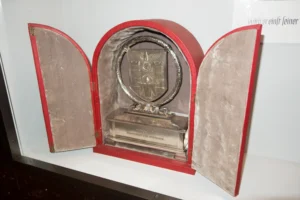
In June 2022, at the Egmont Palace in Brussels, Belgium’s chief prosecutor handed a small blue box to the Lumumba family. Inside was a gold-capped tooth, the only physical remnant of Patrice Lumumba, seized by Belgian authorities from the daughter of the man who had dissolved the body in acid. Belgian Prime Minister Alexander De Croo reiterated Belgium’s apologies at the ceremony.
The tooth was subsequently buried in Kinshasa, 61 years after Lumumba’s death. It is worth sitting with that detail. The entirety of a man’s physical remains, a man who led a country, who represented the aspirations of millions, reduced to a single tooth kept as a trophy by one of the men who destroyed the rest of him.
The archive tells a different story of survival. De Witte’s research, the parliamentary documents, the d’Aspremont Lynden cable ordering “definitive elimination,” Davignon’s own 1960 correspondence: these survived because bureaucracies document everything, even their crimes. The Lumumba trial will test whether those documents, which were sufficient for a parliamentary commission to assign “moral responsibility,” are also sufficient for a court to assign criminal liability.
The Congo achieved independence from Belgium on June 30, 1960. Patrice Lumumba became prime minister following his Mouvement National Congolais party’s victory in the May 1960 elections. He was 34 years old and had spent the previous year in colonial prison for inciting anti-colonial sentiment.
Lumumba’s independence day speech, delivered before King Baudouin, broke protocol by listing specific colonial abuses: forced labour, land seizures, racial segregation in law and daily life. The speech established him as an uncontrollable figure in the eyes of Belgian officials who had expected a more cooperative transition.
The crisis escalated rapidly. Katanga province declared secession on July 11, 1960, under Moïse Tshombe, with direct Belgian military and administrative support. The Congolese army mutinied against its remaining Belgian officers. The United Nations deployed peacekeepers. In September, President Kasavubu dismissed Lumumba from office. On September 14, Colonel Joseph Mobutu staged a military coup, sidelining both Lumumba and parliament.
The Belgian government’s posture toward Lumumba hardened from political opposition to something more direct. On October 6, 1960, the Belgian Minister of African Affairs, Count Harold d’Aspremont Lynden, sent a cable to Belgian officials in Katanga stating that the policy would now be “the definitive elimination of Patrice Lumumba.” On January 15, 1961, d’Aspremont Lynden insisted that the imprisoned Lumumba be transferred to Katanga.
Lumumba had attempted to flee house arrest on November 27, 1960, heading toward Stanleyville where his supporters held power. He was captured by Mobutu’s forces on December 1. On January 17, 1961, he and two associates, Joseph Okito (deputy president of the Senate) and Maurice Mpolo (minister of youth), were flown to Elisabethville, capital of secessionist Katanga. They were beaten by soldiers during the flight and again upon arrival. That evening, a Katangan firing squad executed all three under Belgian supervision, in the presence of Belgian and Katangan officials and officers.
The disposal of the remains was systematic. Belgian police commissioner Gérard Soete led a team that dug up the bodies, dismembered them with hacksaws, and dissolved the remains in sulphuric acid. Soete retained a gold-capped tooth, which he admitted possessing in a 1999 interview. Belgian authorities seized the tooth from Soete’s daughter in 2016. In June 2022, the tooth was returned to the Lumumba family in a ceremony at the Egmont Palace in Brussels, and subsequently buried in Kinshasa.
The Man Going to Trial
Étienne Davignon, born in 1932 into the Belgian nobility, joined the Belgian Foreign Ministry in 1959 after completing a Doctorate of Law at the Catholic University of Louvain. By 1960, he was serving as a junior diplomatic attaché in the ministry’s Congo unit under Foreign Minister Pierre Wigny.
The 2001 Belgian parliamentary commission found that Davignon was tasked with providing legal arguments to justify Lumumba’s removal from the prime ministership. Congo specialist and historian Ludo De Witte, whose 1999 book The Assassination of Lumumba triggered the parliamentary inquiry, has argued that Davignon’s role extended beyond what the commission documented. In September 1960, Davignon wrote that it “appears to be a fundamental problem to remove Lumumba and achieve unity among the Congolese leaders against him.”
A critical point of contention involves the Belgian foreign ministry’s approval of Lumumba’s transfer to Katanga, the decision that directly preceded the assassination. Davignon later contradicted elements of the ministry’s documented role in this transfer.
Davignon’s subsequent career placed him at the centre of European institutional power. He chaired the committee that produced the 1970 Davignon Report on European foreign policy cooperation. He served as the first head of the International Energy Agency (1974-1977) and as European Commissioner (1977-1985), including as vice-president from 1981. He has been associated with the Bilderberg Group and various corporate boards.
His defence rests on two pillars: that his role as a junior attaché was “limited to routine diplomatic paperwork,” and that the prosecution is “politically motivated,” with evidence from 65 years ago insufficient for a fair proceeding.
The Lumumba Trial Belgium Has Waited 65 Years For
Belgium’s avoidance of criminal accountability for the Lumumba assassination operated through several distinct mechanisms.
First, institutional silence. From 1961 to 1999, no official Belgian investigation examined the assassination. The Cold War consensus treated Lumumba’s removal as a regrettable but defensible act of Western geopolitical interest. Belgian historiography largely treated the subject as contested rather than documented.
Second, the parliamentary commission as substitute for prosecution. Ludo De Witte’s 1999 book The Assassination of Lumumba (published in Dutch as De moord op Lumumba) presented documentary evidence that forced the Belgian parliament to act. The resulting 2001 commission concluded that Belgium bore “moral responsibility” and that “Lumumba’s transfer to the hostile province of Katanga had been organized with the support of Belgian government representatives.” In February 2002, the government formally apologised, admitting “an irrefutable portion of responsibility.”
The commission’s framework of “moral responsibility” was deliberately calibrated to preclude legal consequences. It acknowledged Belgian involvement while avoiding the language of criminal liability. This distinction held for a decade.
Third, procedural attrition. The criminal complaint filed by François Lumumba in June 2011 named eleven Belgian citizens. Over the following fifteen years, most suspects died. Davignon, at 93, is the last survivor. The timeline of the case: complaint filed June 2011; Federal Prosecutor requests Davignon’s referral to criminal court June 2025; hearing before Brussels Court of First Instance January 20, 2026; trial ordered March 17, 2026; trial expected 2027.
The European Center for Constitutional and Human Rights (ECCHR) has supported the case since its inception, filing an amicus curiae brief on statute of limitations questions. ECCHR General Secretary Wolfgang Kaleck was formally appointed as legal counsel for the Lumumba family in summer 2025. In its March 2026 ruling, the court expanded the scope of charges beyond what the Federal Prosecutor had requested, extending the trial to also cover the assassinations of Maurice Mpolo and Joseph Okito.
The legal basis for the prosecution rests on the Geneva Conventions: both Belgium and the Democratic Republic of Congo were contracting parties at the time of the killings. Violations of the conventions constitute war crimes, which are not subject to standard statutes of limitations under Belgian law.
What This Trial Is and Is Not
The trial’s significance is structural rather than punitive. A conviction of a 93-year-old defendant would carry limited practical consequences. What the proceeding establishes is judicial precedent: a Belgian court formally adjudicating Belgian complicity in a colonial-era political assassination.
Belgium has never held a criminal trial for any act committed during its colonial administration of the Congo (1885-1960). The Lumumba case, if it reaches a verdict, would be the first. The parliamentary commission model, used in 2001, offers states a mechanism for acknowledgment without legal consequences. The distinction between “moral responsibility” (the commission’s finding) and criminal liability (the court’s domain) is not semantic; it determines whether the state’s reckoning with its past involves the evidentiary and procedural rigour of a trial or the political calibration of a committee report.
Christophe Marchand, the family’s lawyer, described the ruling as “a gigantic victory,” noting that “it’s very hard for a country to judge its own colonial crimes.” Lumumba’s granddaughter Yema stated that the family seeks “truth and to establish different responsibilities.” Grandson Yvan said: “We are relieved; we have got what we had hoped for. It is a step forward; we are a little closer to justice.”
The trial also raises questions about the broader Belgian colonial record. Leopold II’s personal rule of the Congo Free State (1885-1908) and the subsequent Belgian Congo administration (1908-1960) involved well-documented atrocities, forced labour, and systematic resource extraction. None have been the subject of criminal proceedings. This Lumumba trial Belgium has pursued for fifteen years, however narrow in scope, tests whether Belgian courts will apply the Geneva Conventions to Belgium’s own conduct during the colonial period and its immediate aftermath.
The Tooth and the Archive
The return of Lumumba’s remains followed a specific chain of custody. Gérard Soete, the Belgian police commissioner who led the destruction of the bodies, retained a gold-capped tooth. He disclosed this in a 1999 interview. Belgian judicial authorities seized the tooth from Soete’s daughter in 2016, following a complaint by the Lumumba family. On June 20, 2022, Chief Prosecutor Frédéric Van Leeuw formally returned the tooth to the family at a ceremony in the Egmont Palace in Brussels. The tooth was repatriated to the Democratic Republic of Congo and buried in Kinshasa on June 30, 2022.
The documentary record is substantially more robust than the physical remains. The key documents include: d’Aspremont Lynden’s October 6, 1960 cable ordering the “definitive elimination” of Lumumba; his January 15, 1961 instruction insisting on Lumumba’s transfer to Katanga; Davignon’s September 1960 memorandum on the necessity of “removing” Lumumba; the 2001 parliamentary commission’s report and supporting documentation; and De Witte’s archival research across Belgian, Congolese, and United Nations sources.
Whether these documents support conviction under the specific charges, participation in war crimes under the Geneva Conventions, will be determined at trial. The evidentiary standard for criminal conviction exceeds that of a parliamentary finding. The prosecution must demonstrate individual participation, not merely institutional complicity.