The Iran Fujairah strike on the oil terminal and Dubai International Airport on March 16 did not just damage infrastructure. They dismantled the operating assumption behind the UAE’s most important insurance policy: that oil could still leave the Gulf even if Iran closed the Strait of Hormuz.
Fujairah sits at the end of the Abu Dhabi Crude Oil Pipeline (ADCOP), a 380-kilometer bypass route built for exactly this scenario. By hitting the endpoint, Tehran demonstrated it can threaten Gulf energy exports with or without control of the strait. Combined with the fourth drone strike on Dubai’s main airport in less than three weeks of war, the attacks represent a strategic escalation: Iran is no longer just blocking the chokepoint. It is hunting down the exit ramps.
The Iran Fujairah Strike: What Happened
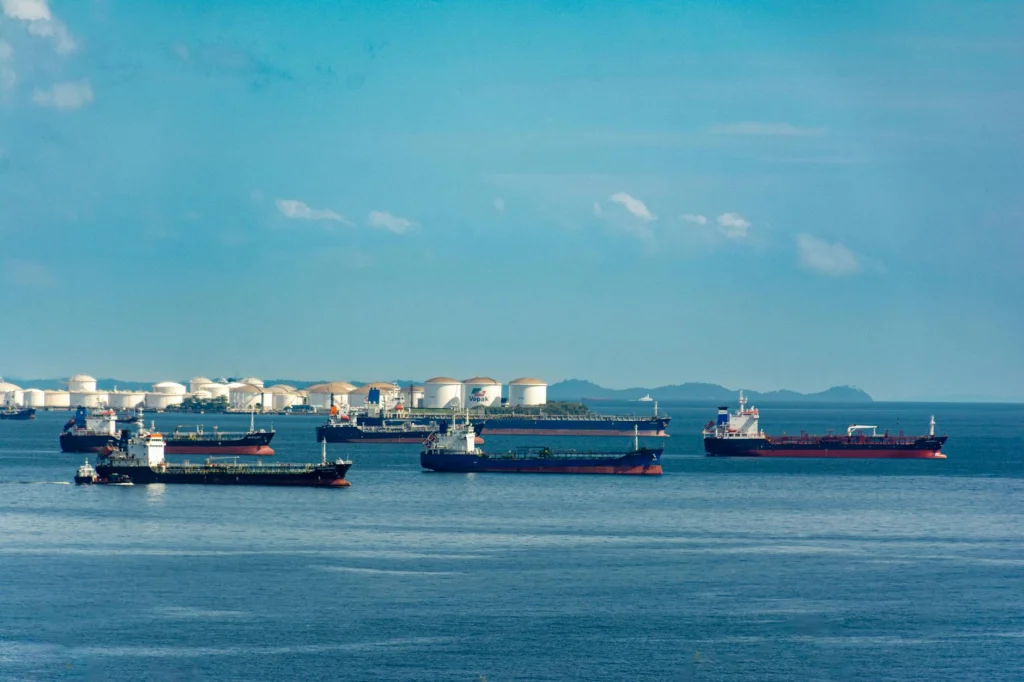
In the early hours of Monday, March 16, Iranian drones struck Fujairah’s oil terminal, igniting a large fire and forcing the port to suspend oil loadings[s] for the second time in as many days. No casualties were reported. The Fujairah Oil Terminal handles crude and fuel storage for one of the world’s top three bunkering hubs[s], alongside Singapore and Rotterdam.
Separately, a drone struck a fuel tank at Dubai International Airport, triggering a fire that suspended all flights for several hours[s], the longest halt since the war began on February 28. Emirates resumed limited operations after 10 a.m. local time. Foreign airlines were subsequently banned from operating into Dubai[s] until further notice. It was the fourth drone-related incident at the airport since the conflict started.
UAE air defense systems intercepted six ballistic missiles and 21 drones on the same day, according to UAE authorities. At least one person, a Palestinian civilian, was killed when a missile struck a vehicle in Abu Dhabi’s Al Bahyah area.
Why Fujairah Matters More Than Other Targets
The Strait of Hormuz is a narrow waterway between Iran and Oman through which roughly one-fifth of the world’s oil passes every day. For decades, energy planners have worried about what happens if Iran blocks it. The answer was supposed to be pipelines that route oil around the strait to ports on the other side.
Fujairah is the most important of those alternate ports. The ADCOP pipeline, completed in 2012 at a cost of $4.2 billion, carries crude oil from Abu Dhabi’s inland fields to Fujairah, bypassing Hormuz entirely. It can move about 1.5 million barrels per day, with a surge capacity of 1.8 million barrels. That represents roughly 60% of the UAE’s normal export volume.
By striking Fujairah directly, Iran sent a message: bypass pipelines do not matter if the destination port is within drone range. The same logic drove Iran’s earlier attack on Salalah in Oman[s], another port developed specifically as a Hormuz alternative. Tehran is systematically targeting the infrastructure that was built to make the strait less important.
As Engineering News-Record noted[s], the ADCOP pipeline and its Saudi equivalent (the East-West pipeline to Yanbu) were designed to manage short disruptions, not replace the strait during a prolonged war. Their combined capacity covers a fraction of the roughly 20 million barrels per day that normally transit Hormuz. With both bypass endpoints now under attack, the fraction shrinks further.
The Strait of Hormuz, a 33-kilometer-wide passage between Iran’s coast and Oman’s Musandam Peninsula, handles roughly 20 million barrels per day of crude and petroleum products, according to the U.S. Energy Information Administration[s]. That is approximately one-fifth of global oil consumption.
The ADCOP pipeline (formally the Habshan-Fujairah pipeline) was commissioned in 2012 precisely to reduce dependence on this chokepoint. Built by China Petroleum Engineering and Construction Corporation at a final cost of $4.2 billion, it runs 380 kilometers from Abu Dhabi’s Habshan oil fields to Fujairah on the Gulf of Oman. Its nameplate capacity of 1.5 million barrels per day (with surge capability to 1.8 million) represents about 60% of the UAE’s typical export volume, meaning the other 40% was always assumed to move through Hormuz.
Before the war, ADCOP was operating at roughly 71% utilization, leaving approximately 440,000 barrels per day of spare capacity. ADNOC was also developing underground storage caverns at Fujairah capable of holding 42 million barrels, part of a plan to make the port the world’s largest crude storage facility.
Iran’s targeting logic is now clear, and it extends beyond the UAE. The March 12 strike on Salalah port in Oman[s] followed the same pattern: Salalah was earmarked for decades as an alternative to Hormuz-dependent shipping. By attacking both Fujairah and Salalah, Iran is methodically degrading every alternative export route in the region. The message to Gulf producers is that no pipeline or port is safe merely because it sits outside the strait.
As Engineering News-Record’s analysis pointed out[s], the bypass infrastructure was dimensioned for a short disruption scenario. The ADCOP and Saudi Arabia’s East-West pipeline to Yanbu (capacity: roughly 5 million barrels per day) together cover a fraction of normal Hormuz traffic. With Fujairah under sustained attack and Salalah already hit, even that fraction is unreliable.
Fujairah’s role is not limited to crude exports. The port is the world’s second-largest bunkering hub, a refueling point for commercial shipping across the Indian Ocean. Its storage infrastructure holds nearly 18 million cubic meters of petroleum products. Disrupting Fujairah does not just affect UAE oil exports; it creates ripple effects across global maritime logistics.
Dubai Airport: From Safe Haven to War Zone
Dubai International Airport (DXB), the world’s busiest for international passengers before the war, has now been struck four times since February 28. The March 16 attack was the most disruptive: a drone hit a fuel depot, causing a fire that grounded all flights for several hours.
The aviation fallout has been severe. Foreign airlines have been banned from DXB until further notice. Air India, Air India Express, and IndiGo have all canceled or suspended flights[s] to the UAE. Some services were diverted to Al Maktoum International Airport, Dubai’s smaller secondary hub.
Dubai built its economic model on being the world’s connecting hub: a stable, neutral node in a volatile region. The airport alone handled over 86 million passengers in 2024. The repeated strikes and flight suspensions threaten that model at its foundation. If airlines and passengers conclude that DXB is no longer reliably operational, the damage extends far beyond the aviation sector into tourism, trade, and foreign investment.
Iran’s Justification and the UAE’s Position
Tehran’s stated rationale for striking the UAE is that the United States used Emirati territory to launch attacks on Iran, including strikes on Kharg Island, Iran’s main oil export terminal. Foreign Minister Abbas Araghchi specifically cited locations near Ras Al-Khaimah and “very close to Dubai”[s] as alleged staging points, though Iran has not provided evidence.
On March 14, Iran issued evacuation warnings for three major UAE ports[s], including Jebel Ali (the Middle East’s busiest commercial port) and Khalifa Port in Abu Dhabi. It was the first time Tehran openly threatened a neighbor’s non-military assets.
The UAE has not confirmed hosting U.S. offensive operations. A diplomatic adviser to the UAE president stated the country “still prioritizes reason and logic, and continues exercising restraint.” The gap between Iran’s allegations and the UAE’s denials has not prevented the strikes from continuing. Since February 28, Iran has launched more than 1,800 missiles and drones at the UAE, more than at any other country in the conflict, according to Al Jazeera[s].
Oil Markets and the Energy Fallout
The Iran Fujairah strike pushed Brent crude 3% higher on Monday to $106.18 per barrel, with WTI reaching $100.66. Both benchmarks have surged more than 40% since February 27[s], when Brent was trading near $72.
The broader energy picture is worse than the headline crude numbers suggest. Gulf oil production from Kuwait, Iraq, Saudi Arabia, and the UAE has dropped by at least 10 million barrels per day[s] since the conflict began, the largest supply disruption in the history of the global oil market. LNG prices have risen nearly 60% after QatarEnergy suspended production following an Iranian drone attack, cutting off a country that supplies 20% of the world’s liquefied natural gas.
U.S. gasoline prices are up nearly 80 cents from a month ago. Diesel has climbed to just under $5 per gallon, up $1.34 from last month[s], according to NPR. Analysts estimate that if the conflict persists, Brent could reach $130 in the second quarter.
What the Iran Fujairah Strike Changes
The Iran Fujairah strike and the Dubai airport attack mark a shift in the conflict’s strategic calculus. Before March 16, energy planners could still argue that bypass infrastructure offered partial insurance against a Hormuz closure. That argument is now much harder to sustain.
Iran has demonstrated three things simultaneously. First, it can reach targets on the Gulf of Oman coast, not just in the Persian Gulf. Second, it can disrupt civilian aviation at the region’s most important hub. Third, it is willing to escalate against a neighbor it accuses of complicity, regardless of evidence.
The U.S. has responded by deploying 2,500 additional Marines and the USS Tripoli to the region. President Trump has called for allied naval support to secure shipping routes. But the Iran Fujairah strike exposed a problem that naval patrols cannot solve: pipelines bypass the sea, but their endpoints do not bypass geography. As long as Fujairah is within drone range of Iran (or Iranian-allied territory), the ADCOP pipeline’s value as a strategic hedge is compromised.
For the global economy, the implications are straightforward. The world’s Plan B for a Hormuz disruption was always “route oil through Fujairah.” Tehran just showed that Plan B has the same vulnerability as Plan A. Until either the conflict ends or the UAE develops air defenses capable of reliably intercepting every incoming drone (a standard no country has yet achieved against sustained saturation attacks), the energy market has no safe exit from this war.
The broader strategic dynamics of this conflict suggest that both sides are locked into escalation cycles that grow harder to exit with each passing week. Iran’s systematic targeting of bypass infrastructure, rather than just Hormuz itself, indicates Tehran is planning for a long war, one in which every alternative route is a target. The financial markets have already priced in weeks of disruption. Whether they have priced in the collapse of the bypass strategy is another question.