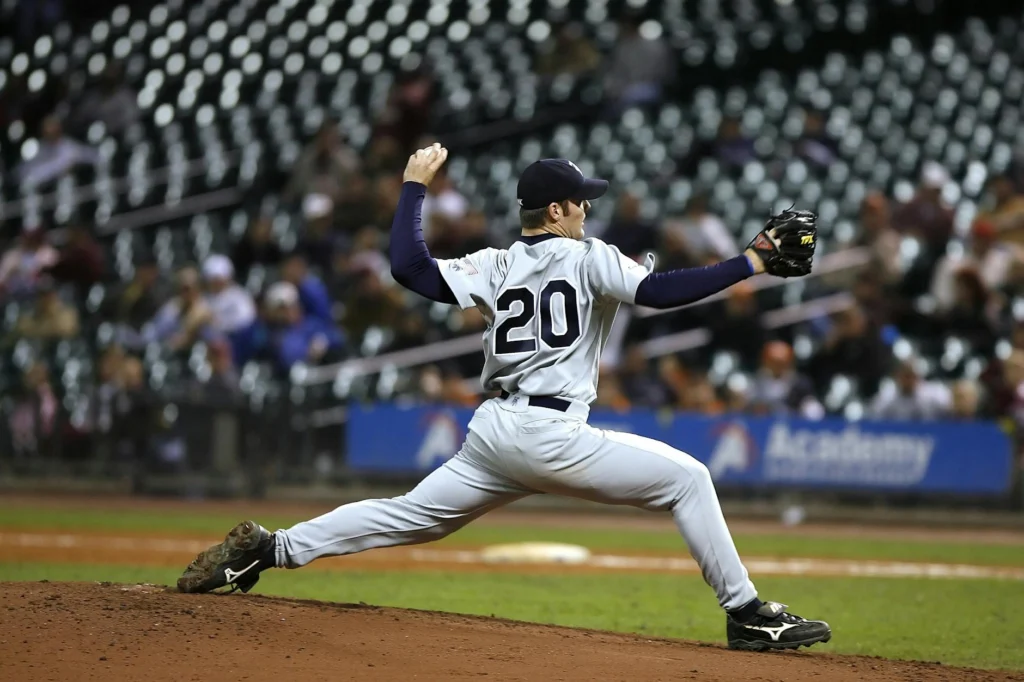
Mason Miller opened 2026 doing something that shouldn’t be possible. Through his first 24 batters faced, the San Diego Padres closer had struck out 19 of them, a 79.2% strikeout rate that FanGraphs described as “technically feasible” but hard to process.[s] Baseball Savant listed his 2026 four-seam fastball at 101.4 mph and his slider at 87.7 mph; when batters swung at the slider, they missed 75.6% of the time.[s] FanGraphs’ early-season sample described hitters as essentially guessing.[s]
Miller represents an extreme version of what modern bullpen optimization can produce: a pitcher whom FanGraphs described as roughly a coin flip to strike out the side when he enters.[s] After his 2023 UCL sprain, Oakland activated him in a relief role rather than returning him immediately to the rotation.[s] Now he throws harder than he did in his 2023 season average, and his slider is generating elite swing-and-miss results.
But Miller’s success story sits inside a troubling pattern. The same velocity-and-stuff incentives surrounding modern pitching also coincide with a surge in arm injuries across professional baseball.
The Paradox of Modern Pitching
Here are the facts that don’t add up. Workload analysts argue that pitchers today throw fewer pitches, get more rest between appearances, and use fastballs at historically low rates.[s] Teams also employ biomechanists, sports scientists, and data analysts to protect their investments.[s]
Yet ulnar collateral ligament reconstruction surgeries, commonly called Tommy John surgery, have more than doubled in Major League Baseball since 2010. The number jumped from 21 procedures that year to 46 in 2024.[s] In the minor leagues, where the real developmental grind happens, procedures surged from 83 to 240 over the same period.
The baseball industry has responded with exactly the interventions you would expect: shorter outings, reduced workloads, more pitchers per roster to spread the burden. Those changes have not stopped UCL surgery counts from rising.
The reason, according to emerging research, is that baseball has been optimizing for the wrong thing.
What Bullpen Optimization Actually Measures
One common way to describe modern pitch optimization is Stuff+, a metric that evaluates the physical qualities of a pitch: velocity, spin rate, movement, approach angle. The most effective pitchers in MLB tend to grade high in Stuff+, and teams now train pitchers specifically to improve these measurable characteristics.[s]
A case-control study published in 2026, examining 35 MLB pitchers who underwent shoulder surgery matched against 70 healthy controls, found something troubling. Pitchers with higher Stuff+ scores, the ones producing exactly the performance teams want, were at significantly elevated risk for shoulder instability requiring surgical intervention.[s]
The researchers concluded that “the pursuit of elite performance is linked to a greater likelihood of injury.” The study does not prove Stuff+ causes injuries, but it suggests that the composite traits teams prize may carry risk beyond velocity alone.
The Real Predictor of Injury
A prospective longitudinal study from the American Sports Medicine Institute, tracking 305 professional pitchers over multiple years, identified a measurable biomechanical risk factor: elbow varus torque, the rotational stress on the ulnar collateral ligament during the throwing motion.[s]
Pitchers who later required UCL surgery showed significantly higher torque values (100.8 ± 18.1 Nm) compared to those who stayed healthy (94.3 ± 16.1 Nm). For every 10 Newton-meter increase in elbow varus torque, the risk of needing surgery increased by 26%.[s]
Velocity alone was not significantly associated with injury. The problem isn’t throwing hard. The problem is how you throw hard.
The Youth Development Crisis
Perhaps the most sobering finding comes from tracking when these injuries actually happen. According to Dr. Nick Serio of VeloU, 54% of all UCL injuries occur in athletes aged 15 to 19, not in the major leagues or even college, but in high school.[s]
A survey of 214 professional and amateur pitchers found that 55% of those who suffered UCL injuries during their professional careers had a history of elbow injuries as adolescents or children. Among pitchers who never injured their UCL professionally, only 18% had childhood elbow problems.[s]
The bullpen optimization crisis may not originate in major league bullpens at all. It may begin in travel ball tournaments and showcase events, where teenage pitchers are pushing for velocity numbers that will get them recruited. The damage accumulates silently until it surfaces years later in a professional career.
The Strategic Misallocation
Modern closer usage can also leave elite relief arms for lower-leverage situations. The one-inning closer model, pioneered when Tony LaRussa made Dennis Eckersley a ninth-inning specialist in the late 1980s, confined the closer mainly to protecting leads in the final frame.[s]
But baseball analysts have argued that the highest leverage point in a game can arrive in the sixth inning with two runners on and one out, not the ninth with the bases empty.[s] SABR’s saves-above-expected framework likewise treats easy bases-empty ninth-inning saves as far less difficult than messier inherited-runner spots.[s]
Teams like Milwaukee have experimented with multi-inning relievers who can pitch the sixth and seventh innings efficiently, preserving other arms for later. One analyst noted that if a reliever can deliver 2⅓ clean innings on 28 pitches, that gives two other pitchers a full day off.[s] Over 162 games, those saved innings compound.
The Workload Paradox
An ArmCare workload essay challenged the entire premise of workload management in baseball, arguing that pitchers throw less, rest more, and use fastballs at historically low rates. This, as the essay put it, is “a paradox, basically a fancy word for indicating something is absolutely absurd.”[s]
The same essay cited seven years of minor league data in which teams restricting pitch counts at lower levels ended up with more injuries once players reached full-season leagues. The problem may be underloading, not overloading. Arms that never build capacity through progressive stress may fail when professional demands arrive.[s]
What Miller Tells Us
Mason Miller’s career offers both hope and warning. His UCL sprain in 2023 interrupted his trajectory as a starter.[s] Instead, Oakland brought him back in relief, where shorter outings and focused intensity preceded something extraordinary: a fastball that has gotten faster each year, from a 97.6 mph 2023 season average to 101.4 mph in 2026.[s]
His 34⅔ consecutive scoreless innings broke a Padres record that stood for 20 years.[s] His slider’s early-season swing-and-miss numbers were at the top of baseball, showing what happens when a pitcher’s stuff is genuinely elite.[s] But the shoulder and UCL studies suggest that the traits behind dominance can also be tied to elevated risk.[s][s]
The bullpen optimization model has produced its most spectacular success in Miller. Whether it has also produced the conditions for its own failure remains baseball’s most pressing question.
Mason Miller’s early 2026 performance constitutes a statistical outlier of historic magnitude. Through 24 plate appearances, he had recorded 19 strikeouts for a 79.2% K-rate. His 33.3% swinging-strike rate led MLB by a wide margin, and FanGraphs noted that the gap between his slider’s swinging-strike numbers and second place matched the gap between second and 11th place.[s] Batters were swinging at pitches regardless of location: 47.6% swing rate in the heart of the zone (league average: 70.6%), 55.6% in the chase zone (league average: 25.7%), and 41.2% on waste pitches (league average: 7.6%). The distribution resembles random chance, suggesting pitch-recognition failure.
Miller’s pitch combination creates a cognitive problem with no solution. His four-seam fastball averages 101.4 mph with 17.1 inches of induced vertical break.[s] His slider sits at 87.7 mph with 9.7 inches of glove-side horizontal movement. The 13.7 mph velocity differential leaves hitters very little time to separate fastball timing from slider movement. When batters offer at his slider, they generate a 75.6% whiff rate and an 80.8% K-rate on that pitch alone.[s]
This represents peak bullpen optimization: a pitcher whose measurable characteristics, velocity, spin, movement, approach angle, have been refined to produce outcomes that approach the theoretical ceiling of reliever performance.
The Bullpen Optimization Paradox
The metrics powering this optimization, collectively captured in FanGraphs’ Stuff+ composite, appear to correlate with elevated injury risk. A 2026 case-control study (n=35 cases, n=70 matched controls) examining MLB pitchers who underwent capsulolabral surgery found that superior Stuff+ was an independent risk factor for shoulder instability requiring surgical intervention.[s]
The researchers noted that “injury rates have continued to rise despite pitch counts never being lower. The resources available to help pitchers throw harder, spin the ball faster, and generate more movement are greater than at any previous point in the sport’s history.”[s] The same tracking technologies used to optimize performance may identify the mechanical signatures that precede structural failure.
UCL reconstruction procedures in MLB increased from 21 in 2010 to 46 in 2024. Minor league procedures rose from 83 to 240 over the same period.[s] Standard workload interventions, reduced pitch counts, increased rest days, roster expansion, have not reversed the trend.
Biomechanical Predictors
A prospective longitudinal study from ASMI, tracking 305 professional pitchers enrolled at baseline and followed through the 2019 season, identified elbow varus torque as the primary biomechanical predictor of UCL surgery.[s]
Key findings:
- Pitchers requiring UCL surgery showed significantly higher baseline torque (100.8 ± 18.1 Nm) versus non-injured controls (94.3 ± 16.1 Nm)
- Hazard ratio: 1.26 per 10 Nm increase in elbow varus torque (26% risk increase)
- No statistically significant association between UCL surgery and fastball velocity, body size, history of previous surgery, or UCL abnormalities on MRI
The study concluded that “with motion capture technology and biomechanists now part of MLB organizations, teams can analyze and improve the biomechanics of their pitchers to reduce elbow varus torque and the injury risk.”[s] Velocity is the output; torque is one measured mechanism. Bullpen optimization strategies that increase velocity without addressing torque patterns may increase structural risk.
Developmental Origins
The injury epidemic may originate before pitchers reach professional baseball. A Baseball America essay by Dr. Nick Serio reported that 54% of all UCL injuries occur in athletes aged 15 to 19.[s] A retrospective survey (n=214 pitchers) showed 55% of professional UCL injury cases had documented childhood elbow problems, compared to 18% of never-injured professionals.[s]
Adolescent throwers face compounding vulnerabilities. Peak height velocity creates a temporary mismatch between skeletal growth and soft tissue adaptation. Showcase culture incentivizes maximum velocity during this vulnerability window. The reported relationship between velocity and elbow varus torque in high school pitchers (R² = 0.36) weakens through college (R² = 0.29) and nearly disappears at the professional level (R² = 0.076).[s] By the time pitchers reach MLB, survivorship bias has already filtered out some vulnerable arms.
Pitch Clock Effects
A cohort study examining 143 MLB UCL surgeries from 2018 to 2024 found that the 2023 Pitch Clock implementation did not increase total surgery rates compared to the prior four seasons (P = .64).[s] However, a significant shift emerged: surgeries now occur earlier in the season (P = .04), and a higher percentage affect starting pitchers rather than relievers.[s]
This pattern complicates the bullpen optimization narrative. If reduced recovery time between pitches disproportionately affects starters, the one-inning reliever model may provide inadvertent protection through its built-in rest periods.
Strategic Inefficiency
The modern closer role originated with LaRussa’s deployment of Dennis Eckersley in the late 1980s: a single inning, ninth-inning only, leads of three runs or fewer.[s] This specialization increased save totals (the single-season record climbed from 31 in 1965 to 62 in 2008) while potentially misallocating elite arms.
Baseball analysis often shows that high-leverage situations can occur in the sixth or seventh inning with runners on base, not just the ninth with bases empty.[s] The Brewers’ multi-inning reliever model represents an alternative: targeted deployment in middle innings can preserve other arms while capturing important win-expectancy swings.[s]
Workload Paradoxes
Standard Acute-to-Chronic Workload Ratio models compare short-term load with longer-term load. An ArmCare workload essay argues that this approach is incomplete for pitching unless it is paired with functional strength testing, calling exponential volume loading without those measurements “a disaster.”[s]
Minor league data showed that organizations restricting pitch counts at lower levels experienced more injuries when players reached full-season leagues. The hypothesis: underloading prevents the tissue adaptation necessary to withstand professional demands.[s]
Miller’s Trajectory
Miller’s career embodies both the potential and the risk. His 2023 UCL sprain preceded his return in a relief role.[s] Since then, his fastball velocity has increased each season: 97.6 mph (2023) -> 100.9 (2024) -> 101.2 (2025) -> 101.4 (2026).[s] His 34⅔ consecutive scoreless innings broke a 20-year Padres record.[s]
Whether this trajectory represents successful adaptation or deferred structural cost remains unknown. The bullpen optimization framework has produced its most extreme success case in Miller. The same developmental environment also coincided with 240 minor league UCL surgeries in a single year. Understanding why these outcomes coexist is the central challenge of modern pitching science.