A 2016 NACE IMPACT study estimated the global cost of corrosion at US$2.5 trillion a year, equivalent to 3.4% of 2013 world GDP.[s] Outokumpu compares that figure to more than the entire GDP of Italy, Brazil, or Canada.[s] The bridges you drive across, the pipelines carrying water to your home, the ships moving global trade: all slowly being eaten by chemistry.
This article explains why metal rusts, what determines which metals survive and which crumble, and how recent laser-processing research achieved protection levels far beyond earlier laser surface treatments.
What Metal Corrosion Chemistry Actually Is
Corrosion is not mysterious decay. It is a galvanic process: an electrochemical reaction where metals deteriorate through oxidation, usually forming oxides.[s] Related oxidation chemistry also appears in lithium battery fires, where uncontrolled reactions release energy catastrophically. In corrosion, the process is slower but equally destructive over time.
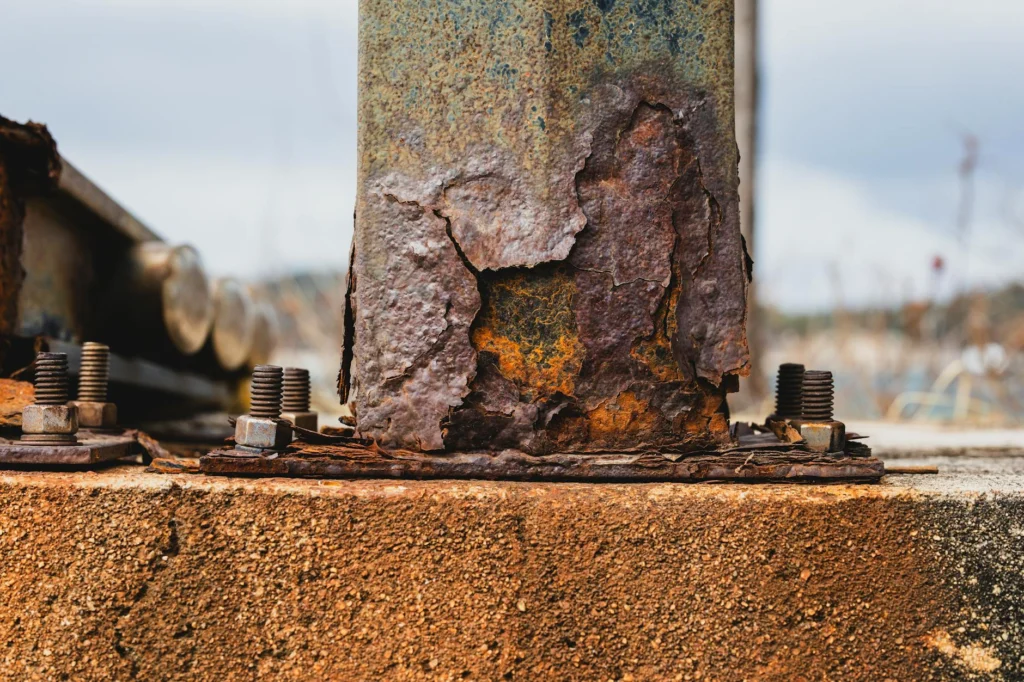
When iron rusts, it forms a red-brown hydrated metal oxide (Fe2O3·xH2O). Unlike the protective patina that forms on copper or the chromium oxide layer on stainless steel, iron rust does not shield the underlying metal. It continually flakes off, exposing fresh metal to oxygen and water.[s] This self-perpetuating cycle explains why rusted iron keeps degrading while bronze statues survive millennia.
The aqueous corrosion cell requires four elements: an anode (where metal dissolves), a cathode (where oxygen gets consumed), an electrolyte (water with dissolved salts), and an electrical connection between the sites. Remove any one, and that cell cannot continue.
Why Some Metals Survive and Others Crumble
Not all metal corrosion chemistry leads to destruction. Stainless steel resists rust because chromium atoms in the alloy react with oxygen first, forming a thin chromium oxide layer that seals the surface. As long as this passive layer remains intact, the metal underneath stays protected. Higher chromium content means stronger protection.[s]
Galvanic corrosion occurs when two dissimilar metals touch in the presence of an electrolyte. The more reactive metal (the anode) corrodes faster than it would alone, sacrificing itself to protect the less reactive metal (the cathode).[s] Engineers exploit this by attaching zinc blocks to ship hulls: the zinc corrodes preferentially, leaving the steel intact.
Even rust itself can become protective under certain conditions. Research on weathering steel in simulated sulfate-containing atmospheres shows that higher sulfate concentrations can trigger a transformation: the rust layer develops self-healing properties and forms a stable barrier.[s] The same chemistry that destroys ordinary steel protects specially formulated alloys.
The Hidden Climate Cost
Metal corrosion chemistry does not only cost money. Replacing corroded steel requires manufacturing new steel, and steel production generates enormous carbon emissions. A 2022 lifecycle analysis suggests that replacing corroded steel alone could account for 4.1 to 9.1 percent of total global CO2 emissions by 2030, even under climate-target scenarios.[s]
The oil and gas industry faces particularly severe corrosion challenges. Offshore platforms, oil wells, pipelines, and other infrastructure operate in aggressive environments combining saltwater, hydrogen sulfide, and carbon dioxide. Corrosion accounts for billions of dollars in annual production losses, repairs, and equipment failures.[s]
When Bacteria Become Allies
An estimated 20 to 40 percent of marine corrosion results directly or indirectly from microbial activity.[s] But microbiologically influenced corrosion is not always accelerating: some bacteria actually protect metal.
Researchers studying Arctic marine bacteria found that certain biofilms reduced corrosion rates by approximately 63 percent compared to sterile conditions.[s] The protective bacteria produce specific polysaccharides that form dense barrier films on the metal surface. Other bacteria produce polysaccharides that promote pitting corrosion instead. Understanding metal corrosion chemistry at the biological level could lead to engineered protective biofilms.
Prevention Methods: Old and New
Traditional protection strategies include coatings (paint, polymer films), cathodic protection (sacrificial anodes or impressed current), and alloying (adding chromium, nickel, or molybdenum to steel). These methods work, and the NACE IMPACT study estimated that available corrosion-control practices could reduce corrosion losses by 15 to 35 percent, translating to $375 to $875 billion in annual savings.[s]
Green corrosion inhibitors represent a newer approach. Plant extracts containing flavonoids, tannins, and phenolic compounds can adsorb onto metal surfaces and form protective films. Non-nano plant extracts achieve inhibition efficiencies of approximately 69 to 96 percent.[s] Combining these extracts with nanoparticles pushes efficiency to 85 to 99 percent. Silver nanoparticles synthesized from tobacco extract provide 98 percent protection for carbon steel in hydrochloric acid, while silica nanoparticles from rice husk ash achieve 99 percent inhibition.[s]
These hybrid green-nano systems show synergistic behavior, forming enhanced protective films that outperform either component alone.[s] The catch: important gaps remain, including limited industrial validation, inadequate environmental risk assessment, and the absence of standardized testing protocols.[s]
The 100,000-Fold Breakthrough
A dramatic recent advance in metal corrosion chemistry protection comes from femtosecond laser processing. Researchers developed a strong-field laser passivation strategy that creates a hybrid passivation layer containing iron and chromium oxides, with a unique structure mimicking taro leaves at the microscale.[s]
The results: up to 100,000-fold reduction in corrosion rate for stainless steel in saline, acidic, and alkaline solutions. This ultra-low corrosion rate persisted for over 6,500 hours of testing.[s] Previous laser surface treatments achieved one to two orders of magnitude improvement. This technique surpasses them by a factor of 1,000.
The laser processing works by transporting chromium atoms from the bulk steel to the surface and creating micro-scale structures that trap air and repel water. The result is both chemical protection (from the chromium-rich oxide layer) and physical protection (from the water-repelling surface).
What This Means
Metal corrosion chemistry will always operate according to the same electrochemical principles. But our ability to manipulate those principles keeps advancing. Green inhibitors offer sustainable protection where toxic chromates once dominated. Laser processing has achieved protection levels beyond earlier laser-treatment benchmarks. Even bacteria might become corrosion-fighting tools.
The estimated $2.5 trillion annual cost of corrosion is not inevitable. It reflects practice, not physical limits. The materials and design choices made at the start of a project determine not only durability but long-term economic and environmental impact. Longer-lasting infrastructure means less replacement, less manufacturing, and less carbon.
The NACE IMPACT study estimated the global cost of corrosion at US$2.5 trillion annually, representing 3.4% of 2013 world GDP.[s] This quantification, while contested in methodology, establishes corrosion as a materials degradation problem of first-order economic significance.
Electrochemical Mechanism of Corrosion
Metal corrosion chemistry is fundamentally a galvanic process: metals deteriorate through oxidation, typically forming oxides, hydroxides, or sulfides.[s] Related electrochemical and oxidation processes also matter in lithium battery fires, where thermal runaway can trigger uncontrolled reactions. In aqueous corrosion, the kinetics proceed more slowly.
For iron, the half-cell reactions are:
Anodic oxidation: Fe(s) → Fe2+(aq) + 2e− (E°ox = +0.44 V vs SHE; equivalent reduction potential Fe2+/Fe = −0.44 V)
Cathode: O2(g) + 4H+(aq) + 4e− → 2H2O(l) (E° = +1.23 V vs SHE)[s]
The positive cell potential (E°cell ≈ +1.67 V) confirms thermodynamic spontaneity. The Fe2+ ions subsequently oxidize to Fe3+ and precipitate as hydrated iron(III) oxide, Fe2O3·xH2O. This rust layer lacks adherence and porosity control: it continually spalls off, exposing fresh metal substrate to the corrosive environment.[s]
Galvanic Coupling and Dissimilar Metal Corrosion
Galvanic corrosion occurs when two dissimilar metals are electrically coupled in a conductive electrolyte. The more anodic (less noble) metal undergoes accelerated dissolution relative to the cathodic counterpart.[s]
That reactivity difference enables cathodic protection via sacrificial anodes. Zinc blocks attached to ship hulls corrode preferentially, maintaining the steel hull at a potential below its corrosion threshold. The technique extends to underground pipelines using magnesium anodes and impressed current systems for large structures.
Passivation Phenomena in Corrosion-Resistant Alloys
Stainless steels resist metal corrosion chemistry through spontaneous passivation. Chromium content above approximately 10.5 wt% enables formation of a chromium-rich passive film, about 2 nm thick, that dramatically reduces the anodic dissolution rate.[s] Nickel, molybdenum, and nitrogen additions enhance resistance to chloride-induced pitting and crevice corrosion.[s]
Weathering steels demonstrate an intermediate case. Research on atmospheric corrosion in sulfate-containing environments shows that higher SO42− concentrations promote conversion of metastable γ-FeOOH (lepidocrocite) to stable α-FeOOH (goethite). This phase transformation shifts the electrode potential positive and produces a rust layer with self-healing properties.[s] The protective mechanism depends critically on wet-dry cycling and pollutant composition.
Carbon Footprint of Corrosion-Induced Steel Replacement
Metal corrosion chemistry imposes indirect environmental costs through replacement steel manufacturing. A 2022 lifecycle analysis suggests that replacing corroded steel could account for 4.1-9.1% of total global CO2 emissions by 2030 under climate-target scenarios.[s] The oil and gas sector faces acute exposure: offshore platforms, pipelines, and wellhead equipment operate in environments combining chloride, H2S, and CO2 at elevated temperatures. Annual production losses reach billions of dollars.[s]
Microbiologically Influenced Corrosion: Acceleration and Inhibition
An estimated 20-40% of marine corrosion is directly or indirectly linked to microbial activity.[s] Microbiologically influenced corrosion (MIC) is not uniformly accelerating. Research on Arctic marine bacteria (Flavobacterium frigoris, Pseudomonas espejiana) found that biofilm formation reduced uniform corrosion rates by approximately 63% compared to abiotic controls (0.091 mm/y vs 0.251 mm/y).[s]
The protective mechanism involves exopolysaccharide (EPS) conformation. β-polysaccharide-rich biofilms form dense hydrophobic barriers that inhibit localized corrosion. α-polysaccharide-rich biofilms promote patchy colonization and accelerate pitting. Understanding metal corrosion chemistry at the biofilm level opens possibilities for engineered protective cultures.
Green and Nano-Enhanced Inhibitor Systems
Traditional chromate and phosphate inhibitors face regulatory pressure due to toxicity and environmental persistence. Green corrosion inhibitors derived from plant extracts (flavonoids, tannins, alkaloids, phenolic compounds) offer biodegradable alternatives. These organic molecules adsorb onto metal surfaces via heteroatom coordination (N, S, O donor atoms) and π-electron interactions, forming protective films.
Electrochemical testing shows that non-nano plant extracts achieve inhibition efficiencies of 69-96.41%, while nanoengineered systems reach 85-99% in aggressive media (1M HCl, 0.5M H2SO4).[s] Specific examples: green-synthesized silver nanoparticles from tobacco extract provide 98% protection for carbon steel in 0.5M HCl; SiO2 nanoparticles from rice husk ash achieve 99% inhibition efficiency.[s]
Hybrid green-nano systems exhibit synergistic behavior and enhanced film formation.[s] Critical gaps remain: limited industrial validation, inadequate long-term environmental risk assessment, and absence of standardized testing protocols.[s]
Femtosecond Laser Surface Passivation
A significant recent advance in metal corrosion chemistry protection employs strong-field laser filament (SLF) processing. The technique uses femtosecond laser pulses in the filamentation regime (50-100 TW·cm−2) to restructure stainless steel surfaces.[s]
SLF processing creates a hybrid µm-Fe3O4/Fe2O3/Cr2O3 passivation layer with hierarchically heterogeneous Cassie-state micro/nanostructures mimicking taro leaf morphology. Chromium atoms migrate from bulk to surface, enriching the passive layer. The microstructure produces superhydrophobicity (water contact angle >150°), creating a physical barrier in addition to electrochemical passivation.[s]
Electrochemical measurements show up to 100,000-fold reduction in corrosion current density for AISI 304 steel in saline (3.5% NaCl), acidic (pH 2 HCl), and alkaline (pH 12 NaOH) solutions. The ultralow corrosion rate persisted for >6500 hours of immersion testing.[s] Previous laser surface treatments achieved 1-2 orders of magnitude improvement; this technique exceeds prior results by approximately 103.
Implications for Infrastructure and Climate
The NACE IMPACT study estimated that available corrosion-control practices could reduce losses by 15-35%, yielding $375-875 billion in annual savings.[s] The primary barrier is not technology but lifecycle cost analysis adoption: initial material cost optimization frequently dominates over total cost of ownership.
Metal corrosion chemistry will always proceed according to electrochemical thermodynamics. But the kinetic barriers we can construct keep improving: green inhibitors replacing toxic alternatives, laser processing achieving protection levels beyond earlier laser-treatment benchmarks, and potentially engineered biofilms providing biological corrosion control. Each advance reduces the replacement steel burden, with compounding benefits for both economics and carbon emissions.