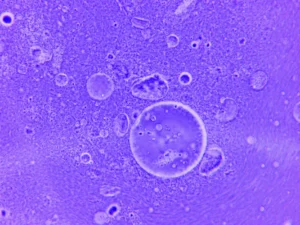
In March 2026, a petri dish containing 200,000 human brain cells learned to play Doom[s]. Australian startup Cortical Labs had previously taught similar cells to play Pong in 2022, and now calls their creation “the world’s first code-deployable biological computer.” Cortical’s CL1 uses lab-grown neurons on a chip rather than a 3D organoid, but it shares ambitions with brain organoid computing: the effort to harness living neurons as computational hardware. It promises machines that learn faster and consume far less energy than silicon. But before we celebrate, five major hurdles stand between today’s neural party tricks and tomorrow’s biological supercomputers.
Why Brain Organoid Computing Matters
The human brain runs on roughly 20 watts of power while matching the computational capacity of the Frontier supercomputer, which consumes 21 megawatts[s]. That’s a million-fold efficiency gap. Training GPT-3 required an estimated 1,300 megawatt-hours of electricity, enough to power 800 European households for a year[s]. If we could tap even a fraction of biological neural efficiency, the environmental calculus of artificial intelligence would change dramatically.
Brain organoids are tiny 3D clusters of human neurons grown from stem cells. Researchers extract blood cells, reprogram them into stem cells, and coax those into becoming neurons[s]. When placed on electrode-studded chips, these neurons can send and receive electrical signals, creating a primitive interface between biology and machine. The cells adapt. They learn. And unlike algorithms, they do it with remarkably little training data.
Hurdle 1: The Consciousness Question
When Cortical Labs published their Pong paper, they used the word “sentience” in the title. The backlash was immediate: 30 researchers argued the term was “not justified by the data presented”[s]. The debate isn’t merely semantic. If brain organoid computing produces systems that can suffer, the ethical stakes change entirely.
Philosopher Matthew Owen argues we should worry more about organoid consciousness than AI consciousness, because organoids share far more with human brains than artificial neural networks do[s]. Yet he suspects current organoids learn “in the same way that algorithms learn, or that we might say that plants learn in the sense that they adapt to their environment” rather than through any morally significant awareness. The problem is we have no agreed-upon test for where adaptation ends and experience begins.
Hurdle 2: They Don’t Live Long Enough
Brain organoids survive 100 days to 15 months in the lab, depending on maintenance methods[s]. Without blood vessels to deliver oxygen and nutrients, they eventually die. Modern supercomputers last years. A computing platform whose components last only months to a year requires constant maintenance and replacement, presenting obvious practical challenges for any serious application.
Hurdle 3: No Two Organoids Are Alike
Each organoid develops differently. The stem cell cultures self-organize, which means researchers cannot precisely control the resulting neural architecture. This variability makes reproducible experiments difficult and large-scale deployment harder still. Silicon chips are manufactured to identical specifications; neurons are not.
Hurdle 4: We Can’t Tell Them What to Do
Computational neuroscientist Tony Zador put it bluntly at a 2025 Asilomar conference: “Getting them to wire up to do what we want them to do is completely beyond what we could even conceive of right now. The challenge is that we still don’t understand which neurons are important and how to form models of computation with them”[s]. Data centers execute human instructions. Neural circuits do what evolution wired them to do. Bridging that gap remains an unsolved problem.
Hurdle 5: Ethics Frameworks Lag Behind
Most bioethics guidelines treat organoids as research tools, not computing components[s]. The Nuffield Council on Bioethics has called for new criteria to determine what “hallmarks” might indicate consciousness in neural organoids[s]. Stanford researcher Sergiu Pasca warned at Asilomar that “overly expansive claims can confuse the public and policymakers about what these systems actually do”[s]. Researchers fear a public backlash that triggers broad regulations, potentially hampering legitimate medical applications.
What Happens Next
Despite the hurdles, investment continues. The National Science Foundation committed $14 million to seven biocomputing projects in 2024, asking each team to establish frameworks for safe, ethical, and socially responsible research[s]. DARPA has also invested millions[s]. Companies like Cortical Labs and FinalSpark are selling access to their biological computing platforms.
The immediate future likely involves drug testing and disease modeling rather than replacing data centers. Brain organoid computing may help researchers understand autism, Alzheimer’s, and epilepsy without animal testing[s]. The grander vision of biological supercomputers remains decades away, if it arrives at all.
In March 2026, Cortical Labs demonstrated their CL1 biological computer playing Doom using 200,000 human neurons grown on a multielectrode array[s]. The neurons were derived from induced pluripotent stem cells reprogrammed from blood samples, then differentiated into cortical neurons and plated onto electrode-studded silicon. CL1 is a 2D culture rather than a 3D brain organoid, but it sits at the visible edge of biocomputing alongside brain organoid computing: biological neural networks interfaced with digital systems through bidirectional electrical signaling. The technical promise is substantial. The obstacles are equally formidable.
The Efficiency Argument for Brain Organoid Computing
The Frontier supercomputer achieves approximately 1.1 exaFLOPS at 21 megawatts. The human brain operates at roughly the same computational throughput using 20 watts[s]. This million-fold efficiency gap drives the entire field. Stanford’s Kwabena Boahen has estimated that replicating biological neural efficiency with silicon would require 10 megawatts for what the brain accomplishes on 20 watts[s].
The efficiency stems from fundamental architectural differences. Biological neurons operate through spike-based, event-driven computation rather than continuous clock-synchronized processing. They encode information in spike timing, amplitude, and waveform rather than binary states[s]. Each neuron functions simultaneously as processor and memory, eliminating von Neumann bottlenecks. And crucially, biological neural networks exhibit plasticity: they physically rewire in response to stimuli, enabling learning without backpropagation through millions of parameters.
The data efficiency advantage is equally striking. Humans master same-versus-different tasks with approximately 10 training samples; honeybees require roughly 100. Machine learning systems in 2018 still could not learn these distinctions with 10 million samples[s]. AlphaGo required 160,000 games of training data; a human playing five hours daily would need 175 years to accumulate equivalent experience.
Hurdle 1: Phenomenal Consciousness vs. Adaptive Behavior
The 2022 Cortical Labs Neuron paper describing neurons that “learned” to play Pong included “sentience” in its title, triggering a public letter from 30 researchers arguing the terminology was unjustified[s]. The core issue is disambiguating adaptive response from phenomenal experience.
Philosopher Matthew Owen distinguishes between functional learning and conscious learning: organoids likely learn “in the same way that algorithms learn, or that we might say that plants learn in the sense that they adapt to their environment”[s]. Yet he notes that organoids share far more mechanistically with conscious human brains than artificial neural networks do, making the consciousness question more urgent for brain organoid computing than for silicon AI.
The Nuffield Council on Bioethics has identified the need for “anatomical or functional hallmarks” that could serve as criteria for attributing consciousness to neural organoids[s]. No such criteria currently exist. Without them, determining moral status remains impossible, and ethical frameworks cannot specify appropriate research boundaries.
Hurdle 2: Biological Lifespan Constraints
Current brain organoids survive 100 days to 15 months depending on culture conditions and application[s]. The limiting factor is necrosis due to inadequate oxygen and nutrient diffusion in the absence of vascularization. This represents roughly 25% of the average supercomputer operational lifespan at maximum. While organoid generation costs are remarkably low (approximately €0.36 per organoid with €0.66 annual maintenance)[s], continuous replacement creates practical and potentially ethical complications.
Hurdle 3: Stochastic Self-Organization
Brain organoids develop through self-organization of stem cell cultures, producing significant variability in cellular composition and architecture between specimens. Each organoid develops unique connectivity patterns, making reproducible experiments challenging and scaled deployment impractical with current techniques. Silicon fabrication achieves nanometer-scale precision; biological development is inherently stochastic.
Hurdle 4: The Controllability Problem
Cold Spring Harbor computational neuroscientist Tony Zador articulated the fundamental challenge at the 2025 Asilomar conference: “Getting them to wire up to do what we want them to do is completely beyond what we could even conceive of right now. The challenge is that we still don’t understand which neurons are important and how to form models of computation with them”[s]. Data centers execute deterministic instructions; neural circuits execute whatever computation their connectivity pattern performs. Bridging this gap requires neuroscience advances that do not yet exist.
Hurdle 5: Regulatory and Governance Vacuum
Existing bioethics frameworks address organoids as biomedical research tools, not as computational substrates[s]. The November 2025 Asilomar meeting crystallized fears that biocomputing publicity “may draw attention in a way that leads to overly broad laws that may hamper medical applications of organoid research”[s]. Stanford’s Sergiu Pasca emphasized that “using accurate terms that neither hype nor misrepresent the work really does matter”[s].
The NSF’s 2024 EFRI BEGIN OI program represents one governance model: $14 million across seven interdisciplinary projects, each tasked with establishing frameworks for safe, ethical, and socially responsible research[s]. Whether this embedded ethics approach scales to commercial development remains untested.
Current Research Trajectory
Near-term applications focus on pharmaceutical toxicology screening and disease modeling rather than general-purpose computation. Johns Hopkins researchers envision organoid systems that compare typically developed versus autism-affected neural development without animal models[s]. Cortical Labs offers remote access to their biological computing platform, while FinalSpark provides similar access through their Neuroplatform.
Thomas Hartung, who coined “organoid intelligence” with colleague Lena Smirnova in 2023, estimates decades before systems approach mouse-level computation[s]. Brain organoid computing’s efficiency advantages remain theoretically compelling; its engineering challenges remain practically daunting.