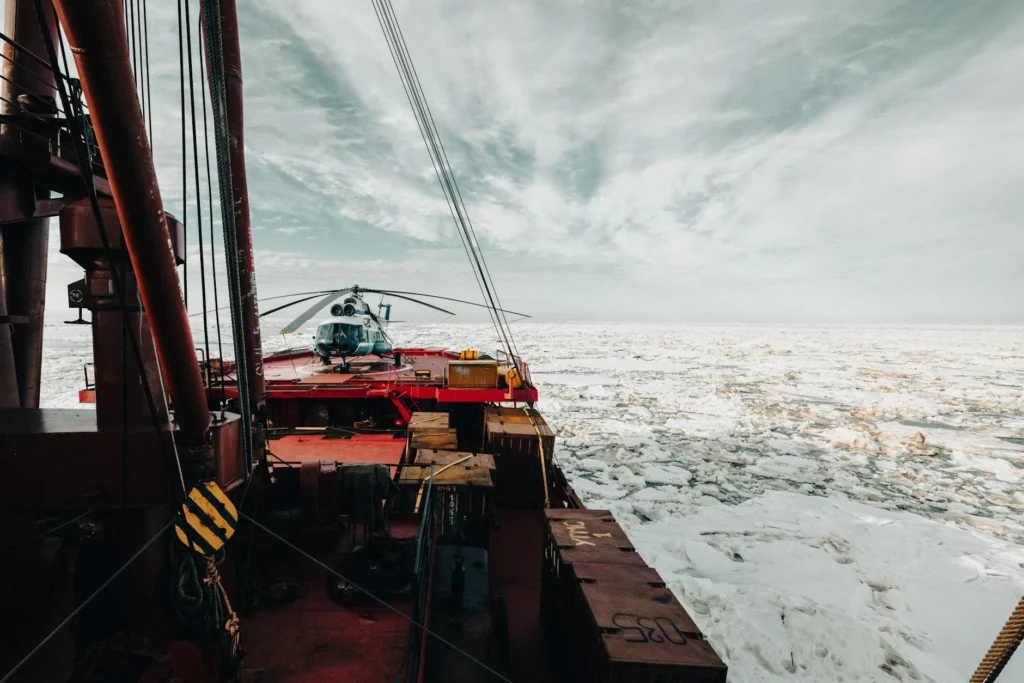
The Arctic Ocean, once a frozen barrier at the top of the world, is becoming navigable. As Arctic summer sea ice retreats at a rate of 12.1 percent per decade[s], Arctic shipping routes are opening to commercial traffic for longer periods each year. Eight nations now jostle for control over waterways that could reshape global trade, and the competition has already turned confrontational.
The transformation is not gradual. Arctic sea ice extent has dropped 27 percent compared to the 1981-2010 average[s], opening passages that were impassable a generation ago. Traffic through the Bering Strait, which separates Russia from Alaska, surged 175 percent between 2010 and 2024[s]. More than 1,800 ships used Arctic waterways in 2025, up 40 percent from 2013[s].
Arctic Shipping Routes Come of Age
In October 2025, a container ship called the Istanbul Bridge completed a voyage that would have been impossible a decade earlier. The vessel traveled from Ningbo, China, to Felixstowe, United Kingdom, via the Northern Sea Route in just 20 days[s]. The same journey through the Suez Canal takes 40 to 50 days. The Istanbul Bridge crossed Russia’s Arctic waters without icebreaker escort, navigating independently at 17 knots[s].
This was the first container liner service connecting Asia and Europe through the Arctic. It demonstrated that these routes are no longer experimental. The operator, Sealegend, now markets the service as the “China-Europe Arctic Express.”
Russia’s Arctic Fortress
Russia views Arctic shipping routes as national infrastructure and has moved aggressively to control them. Moscow requires foreign vessels to obtain prior permission and, depending on vessel class and ice conditions, may require Russian pilot guidance and icebreaker escort to transit the Northern Sea Route[s]. Critics argue these restrictions violate the 1982 UN Convention on the Law of the Sea[s].
The military dimension is harder to miss. Russia has reopened 50 Soviet-era military posts in the Arctic, including 13 air bases and 10 radar stations[s]. It operates the world’s largest icebreaker fleet: 45 vessels, including eight nuclear-powered ships[s]. Russia uses the Northern Sea Route as a naval mobility corridor, redeploying forces between the Arctic and Pacific without passing through waters where they could be intercepted[s].
China Stakes Its Claim
In 2018, China declared itself a “near-Arctic state”[s], despite having no Arctic territory. Beijing has built three icebreakers and is developing plans for a nuclear-powered vessel[s]. Its “Polar Silk Road” initiative integrates Arctic routes into China’s broader infrastructure ambitions.
Russia and China have deepened their Arctic partnership. Joint military exercises now take place off Chukotka and in the Bering Strait, and the two countries have conducted bomber patrols into Alaskan airspace[s]. Yet Russian officials remain wary of Chinese encroachment in what Moscow considers its sphere of influence.
NATO’s Northern Expansion
Russia’s 2022 invasion of Ukraine transformed Arctic diplomacy. The Arctic Council, which had brought together all eight Arctic states since 1996, suspended cooperation with Russia[s]. The model of “Arctic exceptionalism,” the idea that the region could remain insulated from global tensions, collapsed.
Finland and Sweden joined NATO in 2023 and 2024, extending the alliance’s presence deep into the Arctic[s]. Russia has responded by testing Nordic defenses with drones and fishing vessels while mapping undersea infrastructure[s]. The Arctic has become a theater of gray-zone conflict: not open warfare, but constant probing and positioning.
Greenland at the Center
President Trump’s 2025 and 2026 demands to acquire Greenland from Denmark, including threats of military force and punitive tariffs, triggered an international crisis[s]. The island sits between Arctic shipping routes, and its rare earth reserves, estimated at 1.5 million tonnes, rank eighth globally[s].
The pressure has not subsided. As traditional shipping lanes through Hormuz and Suez face disruption from conflict[s], the strategic value of northern alternatives grows. Control over Arctic passages and the minerals beneath them has become a matter of great-power competition.
What Comes Next
By 2100, the Arctic Sea Route could handle more traffic than the Suez Canal[s]. A Nature Communications study projects that oil, gas, and chemical tankers will account for most Arctic voyages, raising environmental concerns in one of Earth’s most fragile ecosystems. The same study finds that expanding Arctic shipping routes would increase global maritime emissions by 8.2 percent[s].
Armed conflict in the High North remains unlikely. There are few places where any nation would put boots on the ground. But the contest for control is real, and the stakes are rising with every fraction of a degree the planet warms.
Arctic shipping routes are transitioning from seasonal curiosities to strategic chokepoints. September sea ice extent has declined 12.1 percent per decade since 1979[s], and the last 18 September minimums are the 18 lowest in the satellite record. The structural change this represents, a 27 percent reduction in average ice extent compared to the 1981-2010 baseline[s], has opened passages that reconfigure global maritime logistics.
Bering Strait transits rose 175 percent between 2010 and 2024[s]. Arctic waterway traffic reached 1,800 vessels in 2025, a 40 percent increase from 2013[s]. The inflection point arrived in October 2025, when the container ship Istanbul Bridge completed a 7,500 nautical mile voyage from Ningbo to Felixstowe in 20 days without icebreaker escort[s]. A comparable Suez routing spans 11,000 nautical miles and takes 40 to 50 days.
Arctic Shipping Routes: The Control Question
Russia treats the Northern Sea Route as sovereign infrastructure. Its regulatory framework requires prior transit permission and can mandate Russian pilot guidance and icebreaker escort depending on vessel class and ice conditions[s]. Moscow’s legal position, that the NSR constitutes internal waters, conflicts with prevailing interpretations of UNCLOS, which would classify much of the route as international straits subject to transit passage rights[s].
The military overlay is substantial. Russia has reopened 50 Soviet-era posts: 13 air bases, 10 radar stations, 20 border outposts, and 10 emergency rescue stations[s]. Its 45-vessel icebreaker fleet, including eight nuclear-powered ships, dwarfs all competitors[s]. The Northern Fleet, headquartered on the Kola Peninsula, provides sea-based nuclear deterrence and can project power toward the GIUK-N gap, the maritime corridor linking North America and Europe[s].
The Sino-Russian Arctic Partnership
China’s 2018 “near-Arctic state” declaration[s] formalized ambitions that now manifest in hardware: three operational icebreakers with a nuclear-powered vessel in development[s]. The Polar Silk Road integrates Arctic routes into Belt and Road logistics, offering China a shorter maritime path to Europe that bypasses interdiction-vulnerable straits.
Operational cooperation has deepened. Joint Sino-Russian exercises off Chukotka and in the Bering Strait, along with bomber patrols into Alaskan airspace[s], signal coordinated posture. Yet the partnership is not unlimited. Russia remains sensitive to Chinese encroachment in what Moscow views as its Arctic sphere, and Chinese investors are cautious about exposure to sanctions risk and Arctic operational complexity.
Institutional Collapse and NATO Realignment
The Arctic Council, established in 1996 to advance sustainable development among the eight Arctic states[s], functioned as a model of pragmatic engagement. Russia’s 2022 invasion of Ukraine ended that. The other seven members suspended cooperation, and governance mechanisms remain strained[s].
Finland’s 2023 and Sweden’s 2024 NATO accession transformed the alliance’s northern flank[s]. Seven of eight Arctic states are now NATO members. Russia has responded with gray-zone operations: testing Nordic defenses with drones and fishing vessels, mapping undersea cables, and conducting surveillance of critical infrastructure[s].
Greenland: Geography as Leverage
President Trump’s 2025-2026 Greenland campaign, including explicit threats of military force and tariff coercion against European allies[s], exposed how rapidly Arctic geography has gained strategic salience. Greenland lies between the Northwest Passage and the Transpolar Route. Its rare earth reserves, 1.5 million tonnes ranking eighth globally[s], include deposits of interest to Chinese investors, notably a 6.5 percent stake by Shenghe Resources in the Kvanefjeld project.
Concurrent disruptions at traditional chokepoints, Hormuz closure and Houthi threats constraining Suez traffic[s], have accelerated interest in Arctic shipping routes among Indo-Pacific and Nordic partners seeking to reduce exposure to interdiction risk.
Projections and Emissions Implications
Trade-integrated modeling by Nature Communications projects Arctic Sea Route traffic could reach 2.25 percent of global maritime voyages by 2100, surpassing the Suez Canal under optimistic trade scenarios[s]. Oil and gas tankers would dominate Arctic voyages, with gas, oil, and chemical tankers together accounting for over 80 percent of Arctic shipping emissions.
The emissions profile is adverse. Global shipping emissions would rise 8.2 percent due to Arctic route expansion, with Arctic-specific emissions climbing from 0.22 percent to 2.72 percent of the global total[s]. The study finds that current IMO mitigation strategies are insufficient to achieve decarbonization targets in Arctic waters.
The Conflict Threshold
Direct military confrontation in the Arctic remains unlikely. The environment is punishing, population centers are sparse, and sustained operations would be extraordinarily difficult for any combatant. The more probable trajectory is continued gray-zone competition: control disputes over Arctic shipping routes, contested legal interpretations of transit rights, selective infrastructure sabotage, and asymmetric pressure campaigns.
The underlying dynamic is structural. Climate change is converting the Arctic from a barrier to a corridor, and the eight nations with claims in the region, along with China as an assertive newcomer, are repositioning accordingly. The era of Arctic exceptionalism is over. What replaces it will be negotiated in the coming decades, one transit, one military exercise, and one diplomatic confrontation at a time.