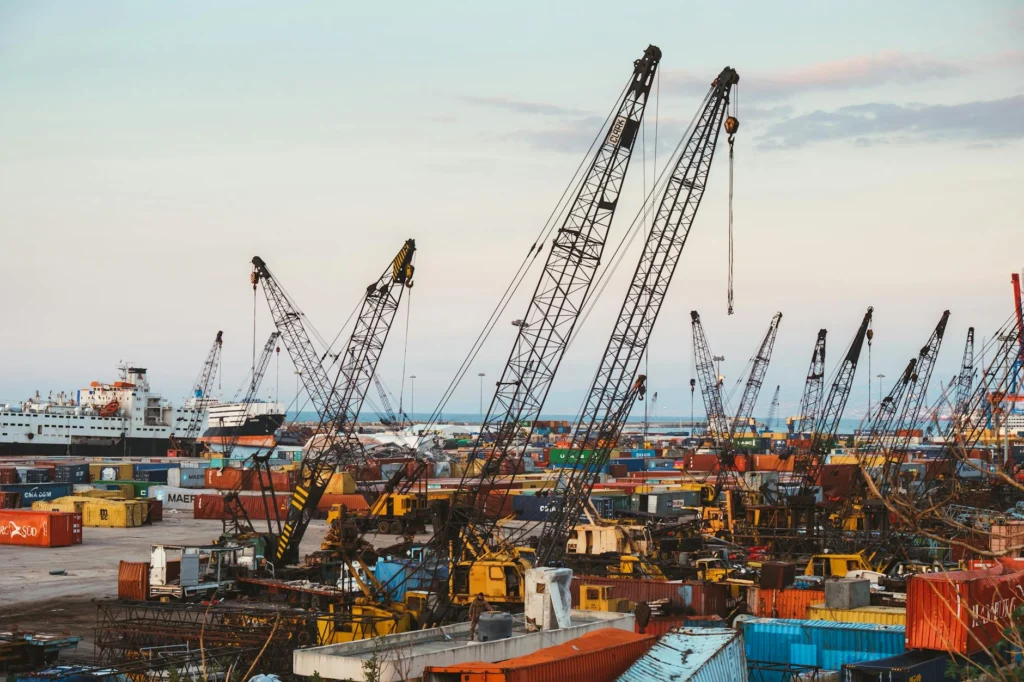
The sovereign debt trap has become the defining economic crisis of the 2020s. Developing countries paid out $741 billion more in debt payments than they received in new financing between 2022 and 2024, the largest gap in 50 years[s]. When nations cannot repay these loans, they are forced to hand over ports, railways, mines, and other critical infrastructure to creditors.
This is not a distant abstraction. External debt owed by developing countries has quadrupled over two decades to reach a record $11.4 trillion in 2023[s]. Today, 3.3 billion people live in countries that spend more on debt payments than on health or education.
The Sovereign Debt Trap in Action: Sri Lanka’s Lost Port
The most notorious example is Hambantota, a deepwater port on Sri Lanka’s southern coast. The Sri Lankan government borrowed over $1 billion from Chinese banks to build the facility, with Phase I financed at 6.3% interest, roughly double or triple the rates offered by multilateral development banks[s].
The port was a commercial failure. On most days, ships pass by rather than stop. By 2017, Sri Lanka could not service its foreign debt. The government signed a 99-year lease with China Merchants Port Holdings, surrendering a 70% stake in the $1.4 billion port for $1.12 billion[s]. On the day of the handover, China’s official news agency celebrated “another milestone along the path of Belt and Road.”
Sri Lankan officials have insisted the port will not become a Chinese naval base. But the agreement text was never made public, and suspicions persist. What is certain: a nation surrendered critical maritime infrastructure because it could not escape the sovereign debt trap.
Kenya’s Railway to Nowhere
Kenya’s Standard Gauge Railway tells a similar story. Built from 2013 to 2019 with roughly $5 billion in Chinese loans, the railway was supposed to connect the port of Mombasa to Uganda and eventually to the Democratic Republic of Congo, Rwanda, and South Sudan. The line now ends in a cornfield in Naivasha, 468 kilometers short of the Ugandan border[s].
Kenya spends over $1 billion annually servicing its railway debt to China. The line generates only $165 million in revenue[s]. Railway debt payments accounted for 81% of Kenya’s total foreign debt service in July 2025. Kenya’s auditor general found that more than $260 million had been wasted on penalties and interest from late payments alone.
Prominent Kenyan businessman Jimi Wanjigi estimates his country will pay more than double the railway’s original price tag. “It laid the foundation for what I call the ‘debt heist,'” he told The Telegraph.
The Global Pattern
These are not isolated cases. An Associated Press investigation found a dozen countries facing economic instability or collapse under hundreds of billions in foreign loans, much of it from China. Countries in the analysis had up to 50% of their foreign loans from Chinese lenders and devoted more than a third of government revenue to paying off foreign debt[s].
In 2020, Zambia became the first African nation to default during the pandemic[s]. After defaulting on a $42.5 million Eurobond payment, inflation soared to 50%, unemployment hit a 17-year high, and the kwacha lost 30% of its value in seven months. A UN estimate found 3.5 million Zambians not getting enough food.
In Pakistan, millions of textile workers have been laid off because the country cannot afford to keep electricity running. In Ecuador, Chinese banks provided loans repaid through discounted petroleum deliveries; Ecuador lost an estimated $4.2 billion via below-market oil prices[s].
Why Interest Rates Matter
The mechanics of the sovereign debt trap are straightforward. Developing countries borrow at rates two to four times higher than the United States and six to 12 times higher than Germany[s]. The average interest rate on newly contracted public debt in 2024 stood at a 24-year high for official creditors and a 17-year high for private creditors[s].
Rising interest payments reduced the share of government revenue available for other public spending in 99 developing countries between 2018 and 2024[s]. That is 73% of all developing nations.
The result: governments must choose between paying creditors and funding schools, hospitals, and infrastructure. Most avoid formal default at all costs, even if it means sacrificing development goals. As one UNCTAD report put it: “Countries may not default on their debt, but they default on their development.”
What Comes Next
Reform efforts are underway. Zambia has restructured its debt under the G20 Common Framework, with an IMF program now providing $1.7 billion in support[s]. Kenya has announced plans to transfer operations of the railway extension to private investors to ease its burden.
But critics argue these measures do not address the root cause. IMF conditionalities in Argentina, for example, have driven privatization of state companies and a 17% cut in social spending since 2023[s]. Carnegie Endowment researchers note that IMF debt sustainability analysis misses crises in one-third of cases[s].
The sovereign debt trap will continue claiming infrastructure until the international financial system changes how it lends to developing nations, and at what price.
The sovereign debt trap has evolved from a theoretical concern to a structural crisis reshaping the global economy. Between 2022 and 2024, developing countries paid out $741 billion more in principal and interest than they received in new financing, the largest net outflow in at least 50 years[s]. This hemorrhage of capital is now forcing debtor nations to liquidate strategic assets, from ports and railways to mineral extraction rights.
The aggregate figures are staggering. External debt owed by developing countries has quadrupled over two decades to a record $11.4 trillion in 2023, equivalent to 99% of their export earnings[s]. In 2023, these nations paid $847 billion in net interest payments, a 26% increase from 2021. Today, 54 developing nations dedicate at least 10% of government funds to interest payments alone, and 3.3 billion people live in countries that spend more servicing debt than on health or education.
Anatomy of the Sovereign Debt Trap: Hambantota
Sri Lanka’s Hambantota port remains the canonical example of how the sovereign debt trap operates. The project was part of Sri Lanka’s development plans since at least 2002, but Western lenders declined to finance it, citing questionable commercial viability. China stepped in with over $1 billion in construction loans, with Phase I financed at 6.3% interest[s]. Multilateral development banks typically offer rates between 2% and 3%.
The port proved commercially unviable. With Colombo Port handling 95% of Sri Lanka’s international trade and planning capacity expansion to 35 million TEU by 2040, Hambantota’s main competition came from within Sri Lanka itself. By 2015, approximately 95% of Sri Lanka’s government revenue was going toward debt servicing. Unable to service its foreign debt in 2017, Colombo signed a 99-year lease with China Merchants Port Holdings for $1.12 billion, surrendering a 70% stake in the port along with operating rights[s].
The contrast with recent developments is instructive. In April 2026, India’s Mazagon Dock Shipbuilders acquired a 51% stake in Sri Lanka’s largest commercial shipyard for $26.8 million through a transparent stock exchange process at Colombo’s invitation. China spent over $1 billion in construction loans to build a port that required a 99-year lease to stay solvent. India paid $26.8 million for controlling interest in a functioning yard at the region’s primary transshipment hub. The difference illustrates how debt-financed infrastructure can create dependencies that commercial acquisitions do not.
Kenya’s Standard Gauge Railway: Debt Servicing Exceeds Revenue
Kenya’s Standard Gauge Railway (SGR) demonstrates the sovereign debt trap at scale. The railway was built from 2013 to 2019 with approximately $5 billion in loans from China Exim Bank and other Chinese lenders, as part of the Belt and Road Initiative[s]. The ambitious plan envisioned connecting Mombasa to Uganda, Burundi, the DRC, Rwanda, and South Sudan. Today, the line ends in a cornfield in Naivasha, 468 kilometers short of the Ugandan border.
The financial arithmetic is brutal. Kenya spends over $1 billion annually servicing its SGR debt to China. The railway generates only $165 million in revenue[s]. Kenya’s auditor general revealed that for the 2025-2026 fiscal year, Kenya owes China Exim Bank $741 million in principal, $222 million in interest, and $41 million in penalties. Railway payments to China in July 2025 accounted for 81% of Kenya’s total foreign debt service.
Kenya’s debt-servicing costs in 2025 equate to approximately 67.1% of government revenue, well above the IMF’s recommended threshold of 30%. In March 2025, the IMF classified Kenya at high risk of debt distress and suspended the final review of its program, leaving the government without access to a final loan disbursement of nearly $850 million.
The Broader Pattern: From Zambia to Ecuador
An Associated Press investigation analyzed a dozen countries most indebted to China, including Pakistan, Kenya, Zambia, Laos, and Mongolia. The findings revealed a systemic pattern: countries had as much as 50% of their foreign loans from Chinese lenders and devoted more than a third of government revenue to foreign debt payments[s]. Hidden escrow accounts requiring borrowers to deposit foreign currency pushed China to the front of the creditor repayment line.
Zambia became the first African nation to default during the COVID-19 pandemic in November 2020, defaulting on a $42.5 million Eurobond payment[s]. Researchers later discovered Zambia owed $6.6 billion to Chinese state-owned banks, double what was previously known and roughly a third of the country’s total debt. Inflation soared to 50%, unemployment hit a 17-year high, and the kwacha lost 30% of its value in seven months. A UN estimate found 3.5 million Zambians lacking adequate food.
Ecuador illustrates a different mechanism: debt-for-petroleum arrangements. Chinese banks provided loans repaid through discounted oil deliveries over multiple years. Ecuador lost an estimated $4.2 billion through below-market prices for that oil[s]. The $2.45 billion Coca Codo Sinclair dam, built by Chinese companies, operates at less than half capacity due to shoddy planning and workmanship, yet Ecuador still owes approximately $3 billion to China for this and other projects.
The Interest Rate Mechanism
The sovereign debt trap operates through interest rate differentials. Developing nations borrow internationally at rates two to four times higher than the United States and six to 12 times higher than Germany[s]. The average interest rate on newly contracted public debt in 2024 reached a 24-year high for official creditors and a 17-year high for private creditors[s].
Between 2018 and 2024, rising interest payments reduced the share of government revenue available for other public spending in 99 developing countries, representing 73% of the total[s]. Current emerging market hard currency debt yields stand at 7.3%[s], reflecting both credit risk and the Fed’s sustained high-rate environment.
The mechanism creates a vicious cycle. High interest payments reduce fiscal space for development investments, which undermines growth prospects, which raises perceived credit risk, which increases borrowing costs further. Liquidity pressures harden into deeper crises; three quarters of countries judged by the IMF and World Bank to be in debt distress or at high risk of it in September 2025 had been in that position since at least 2018.
Structural Reform and Its Discontents
International financial institutions have responded with restructuring programs and reform conditionalities. Zambia restructured its debt under the G20 Common Framework, with an IMF Extended Credit Facility now providing $1.7 billion in support[s]. IMF Managing Director Kristalina Georgieva has acknowledged the need to “walk together” with China on debt relief, though progress remains slow.
Critics argue that IMF conditionalities often exacerbate the underlying problems. In Argentina, IMF programs have driven privatization of state-owned companies and a 17% reduction in social spending between 2023 and 2025[s]. Environmental programs were gutted: forest conservation funds cut by 80%, renewable energy promotion reduced by over two-thirds, fire management capacity down by more than 35%.
Carnegie Endowment researchers have documented that IMF debt sustainability analyses raise false alarms (type I errors) and miss crises (type II errors) each in about one-third of cases[s]. The discretionary “staff judgment” built into these frameworks has generated concerns about consistency across country cases and vulnerability to political pressure.
The sovereign debt trap will persist until creditor nations, international institutions, and debtor governments address the structural incentives that make high-interest infrastructure lending profitable for lenders and politically attractive for borrowers. As Harvard economist Ken Rogoff observed: “China has moved in and left this geopolitical instability that could have long-lasting effects.”