Something strange is happening in prestige television. Shows with budgets that could fund small nations are deliberately making themselves look broken. Scan lines interrupt pristine 4K footage. Home video grain smears across billion-dollar productions. Digital artifacts, the kind engineers spent decades learning to eliminate, are being lovingly reintroduced frame by frame.
This is glitch aesthetics at work, and it has become one of the defining visual strategies of contemporary prestige TV.[s]
The Paradox of Manufactured Imperfection
Glitch art emerged as a formal movement in the 1990s, when visual artists began embracing digital and analog errors for aesthetic purposes.[s] Rosa Menkman, a theorist central to the movement, described its essence as “destructive generativity,” an attitude that treats technological failure as a site of creative possibility.[s]
What began in experimental art circles has migrated into mainstream entertainment. The question is why. Why would showrunners with access to the most advanced imaging technology in history choose to make their work look worse?
The answer lies in a cultural moment where digital perfection has become synonymous with artificiality. As AI-generated imagery floods visual culture, senior motion designer Darryl Sharp of RCA Records puts it bluntly: “AI-generated art often lacks heart and depth because the one thing AI is always missing is imperfection. That’s what people really gravitate towards.”[s]
Severance: Surveillance as Visual Language
Apple TV+’s Severance provides a masterclass in using visual texture to externalize psychological states. Cinematographer Jessica Lee Gagné initially balked at the project. “If I’m being selfish, this seems like somewhere where I can’t have fun,” she admitted. An office drama shot in sterile corporate spaces seemed creatively limiting.[s]
What emerged was something far more sophisticated. Gagné developed a visual language of contrasts: the outside world shot with handheld intimacy, the Lumon offices rendered through static, surveillance-style framing. “The approach was to do a traditional, maybe even more human style on the outside and a robotic, mechanical, surveillance aesthetic inside,” she explained. “Inside, we wanted to take the humanity out of it. Like this observing machine that’s not necessarily controlled by humans.”[s]
The glitch aesthetics enter as the characters begin to resist. Handheld camera movement, that signature of documentary realism and human presence, gradually infiltrates the sterile Lumon environment. “It’s seeping in,” Gagné noted. “This perfect world is starting to fall apart.”[s]
The message is clear: imperfection equals humanity. The visual breakdown signals psychological breakthrough.
Twin Peaks: The Return and Digital Discomfort
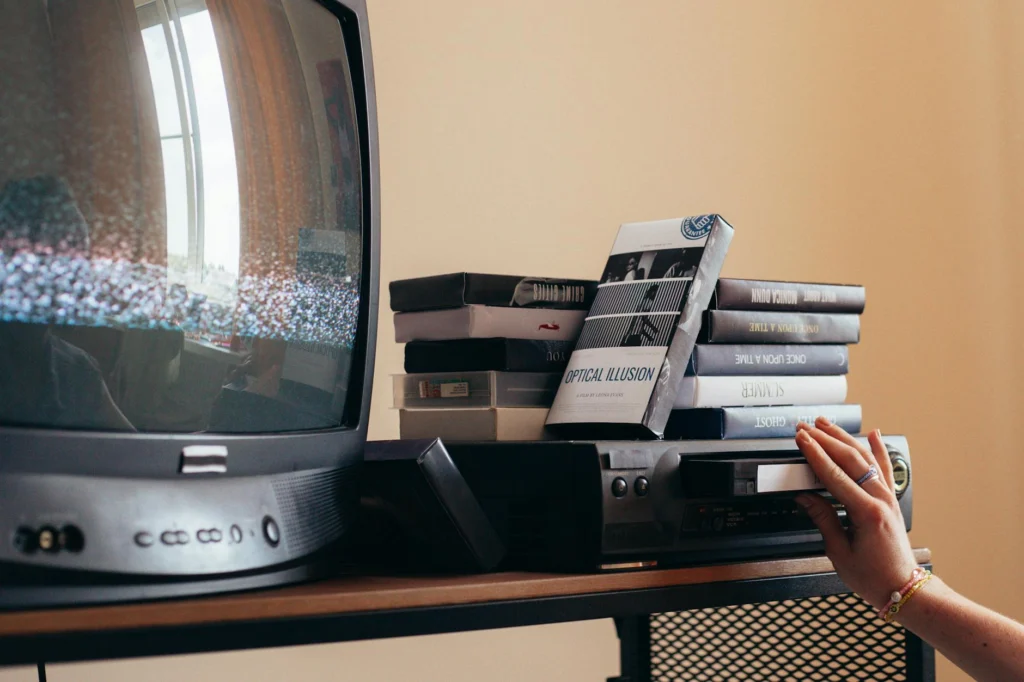
David Lynch’s 2017 return to Twin Peaks presented viewers with a deliberate assault on nostalgia. Fans expecting the warm, grainy texture of their VHS memories encountered something harsh and clinical. As one critic observed, “The digital texture feels decidedly off for a show that most of us remember in a glorified VHS/grandma’s busted tri-colour Panasonic TV haze.”[s]
Lynch wielded this dissonance as a weapon, deploying glitch aesthetics not through digital corruption but through texture itself. The Return deployed “vivid black and white ’50s sitcom-soap signifiers, and a harsh digital MacBook tactility in the show’s contemporary corporate sequences.”[s] The clash was purposeful, each texture carrying meaning about time, memory, and mediation.
This wasn’t new territory for Lynch. His 2006 film Inland Empire was shot entirely on a handheld digital camera in standard definition. GQ noted that “its texture and many of its settings clearly resemble those of home videos from the 1990s.”[s] Lynch understood that lo-fi imagery creates intimacy through its apparent artlessness, the aesthetic equivalent of a shaky voice or a crack in composure.
Euphoria’s Emotional Realism
Sam Levinson’s approach to HBO’s Euphoria represents another variation on this theme. The show’s visual language is aggressively stylized: bold colors, sweeping camera movements, elaborate makeup that no actual teenager would wear to school. Yet viewers consistently describe it as feeling authentic.
“I’m not interested in realism. I’m interested in an emotional realism,” Levinson told Vulture. He and cinematographer Marcell Rév focused on “how can we create a world that reveals the hopes and wishes of the characters that exist within it?”[s]
Levinson acknowledged the paradox directly: “It’s not real. Teenagers don’t do extravagant makeup like this, and so on. But at the same time, there’s people constantly saying how real the show feels.”[s] Euphoria’s visual excess functions similarly to glitch aesthetics, signaling authenticity through its very deviation from documentary norms.
The Analog Horror Connection
The prestige TV embrace of degraded imagery has a parallel in the analog horror movement that emerged on YouTube in the mid-2010s. This genre, popularized by series like Local 58 and The Mandela Catalogue, deliberately replicates the visual artifacts of VHS tapes, public access television, and emergency broadcast systems.[s]
Analog horror is “commonly characterized by low-fidelity graphics, cryptic messages, little to no traditional jump scares, and visual styles reminiscent of late 20th-century television.”[s] The genre uses “visual and audio distortion, as well as glitch-like effects that emphasize and replicate the technological limits the subgenre works with.” These creators pioneered glitch aesthetics for horror long before prestige TV adopted similar techniques.[s]
What makes this effective is counterintuitive. The found footage tradition established that “shaky camera work, improvisation and naturalistic acting” create the illusion of unmediated reality.[s] Imperfection becomes proof of presence. A perfectly stable image, by contrast, betrays the apparatus of production.
Why Imperfection Signals Truth
The lo-fi filmmaking movement articulates the underlying logic explicitly. “The retro lo-fi aesthetic takes the organic qualities of analog media and transforms them into a cinematic language that values authenticity over perfection.”[s]
This isn’t merely nostalgia for older technologies. It’s a response to a specific cultural crisis. When digital tools can create flawless images of anything, perfection ceases to be impressive. Worse, it becomes suspicious. Lo-fi aesthetics offer “a welcome alternative to today’s often excessively polished digital productions.”[s]
Sharp compares the phenomenon to live albums: “You can hear the crowd and the artist sharing that she wrote a song on a sad day. Those small moments of honesty reveal where the art came from. That vulnerability, the simple admission of feeling something real, is the kind of imperfection that makes art resonate.”[s]
The Critique of Technological Progress
Rosa Menkman saw this coming. In her Glitch Studies Manifesto, she argued that “the dominant, continuing search for a noiseless channel has been, and will always be no more than a regrettable, ill-fated dogma.”[s]
Glitch aesthetics represent a refusal of the upgrade culture that treats each new technology as an unambiguous improvement. Every medium has its “fingerprints of imperfection,” Menkman wrote, and these fingerprints carry meaning. They mark the human hand, the material substrate, the moment of creation.
When prestige television reaches for scan lines and VHS grain, it’s making a philosophical statement disguised as a visual choice. The statement is this: in an age of infinite digital perfection, the only thing that can signal authenticity is the willingness to be imperfect.
The Limits of the Strategy
There’s an obvious tension here. Manufactured imperfection is still manufactured. The glitch aesthetics in Severance or Succession’s opening credits are as carefully designed as any other element of production. The grain isn’t accidental; it’s art directed.
This doesn’t necessarily undermine the effect, but it does raise questions about sustainability. If glitch aesthetics become too familiar, too widely deployed, they risk losing their power to signal authenticity. They become just another visual convention, as slick in their own way as the perfection they ostensibly reject.
For now, though, the strategy works. When Succession opens with grainy home movie footage of the Roy children, the visual texture says: this is real, this happened, these people existed before the cameras arrived. The imperfection is the proof. Glitch aesthetics have become the visual language of trust.
In a media landscape saturated with algorithmic perfection, that proof is increasingly valuable. The glitch, once a malfunction to be corrected, has become a signal to be cultivated. Television’s most prestigious productions are betting that viewers, consciously or not, have learned to distrust anything that looks too clean.