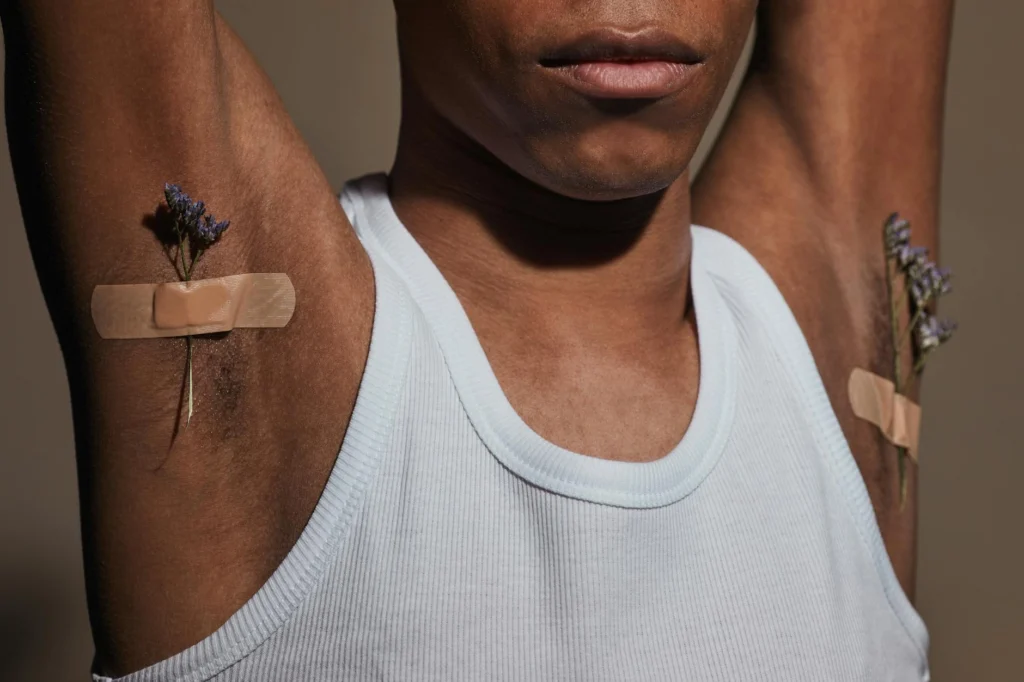
The boss asked a question that probably crosses your mind every time you raise your arm in front of a mirror: why, after millions of years of shedding fur, do humans still grow hair in their armpits? It is a fair question. We lost the thick coats our primate ancestors wore. We kept the hair on our heads, in our groins, and under our arms. The armpit hair purpose, it turns out, is more interesting than any razor commercial would suggest.
How We Lost Our Fur (But Not All of It)
Millions of years ago, early humans moved out of shady forests and onto the hot African savanna. Hunting and foraging under the sun required a way to cool down fast. The solution: losing most of our body fur and ramping up sweat production[s]. Less hair meant sweat could evaporate directly off the skin, cooling the body far more efficiently.
A 2018 study from Harvard[s] confirmed that humans have roughly 10 times the density of eccrine (cooling) sweat glands compared to chimpanzees and macaques. We did not just lose fur. We replaced it with a high-performance cooling system.
But the armpits, the groin, and the scalp kept their hair. Each patch survived for a reason.
Armpit Hair Purpose: Your Body’s Scent Broadcaster
The leading theory centers on smell. Your armpits contain a high concentration of apocrine sweat glands[s], a special type that produces a thick, oily secretion loaded with lipids and proteins. These glands are different from the watery eccrine glands that cover the rest of your body. They sit right next to hair follicles, and they switch on at puberty, exactly when armpit hair appears.
The secretion itself is odorless. It only becomes the familiar “body odor” after bacteria on the skin break it down. The hair provides a surface for this process. It traps moisture, increases surface area, and helps disperse volatile scent molecules[s] into the air.
In most mammals, apocrine glands produce compounds that act as pheromones, territorial markers, and warning signals[s]. In humans, the picture is less clear. No molecule has been conclusively identified as a “human pheromone” in the way scientists have pinpointed them in moths or mice. A 2015 review by Oxford zoologist Tristram Wyatt[s] found “no robust bioassay-led evidence” for the steroid molecules commonly called human pheromones.
But that does not mean armpit scent is meaningless. Research on the major histocompatibility complex (MHC)[s], a set of immune system genes, has explored whether body odor helps people detect genetic compatibility in potential partners. The famous “sweaty T-shirt” experiments found that some women rated the scent of men with different MHC profiles as more pleasant. However, a comprehensive 2020 meta-analysis found no overall significant effect of MHC-dissimilarity on actual mate selection. The science is suggestive but far from settled.
What is clear: armpit hair and apocrine glands both appear at puberty, both thin out after age 50, and both are concentrated in the same spots. That timing strongly suggests a reproductive function[s], even if we have not fully mapped what it is.
Friction, Protection, and the Practical Side
Scent is the main event, but armpit hair also does mechanical work. The armpit is a joint that moves constantly. Arms swing when you walk, pump when you run, and rotate when you reach for things. Without any buffer, skin rubbing against skin can cause chafing, rashes, and irritation[s].
Hair in the armpit acts as a natural lubricant layer, reducing friction between the surfaces. Anyone who has shaved and then gone for a long run on a hot day has likely experienced the alternative.
Armpit Hair Purpose: A Uniquely Human Feature
Here is a detail that surprises most people. Contrary to what you might assume, humans actually have relatively greater amounts of armpit hair than other apes[s]. The so-called “axillary organs”[s], zones where apocrine and eccrine glands exist in roughly equal numbers, are found only in humans, gorillas, and chimpanzees. We did not just keep armpit hair. We may have doubled down on it.
This makes the pheromone-adjacent theory more compelling. Evolution does not typically expand a feature unless it serves a function. If armpit hair were truly useless, natural selection had millions of years to get rid of it, just as it thinned the fur on our chests, backs, and arms.
Why We Started Removing It (A Very Recent Idea)
For most of human history, nobody thought twice about armpit hair. The idea that it needed to be removed is barely a century old in the United States[s]. In 1915, Gillette launched the first razor marketed to women. Advertising campaigns in women’s magazines described underarm hair as “objectionable” and “unsightly,” creating a market that had not existed before.
By the 1940s, leg and armpit shaving had gone from novelty to norm. A 1964 survey found that 98% of American women aged 15 to 44 routinely shaved their legs. What evolution spent millions of years perfecting, marketing departments undid in a single generation.
The Bottom Line
The armpit hair purpose is not one thing. It is a package: scent signaling infrastructure left over from (and possibly still serving) our deep evolutionary past, a mechanical buffer against friction, and a marker of sexual maturity. The science on whether armpit scent genuinely influences partner choice remains open. But the biology is unambiguous. Armpit hair is not random, it is not vestigial, and it is not a mistake. It is one of the few patches of fur that survived the great human de-hairing precisely because it was doing something worth keeping.
The boss asked a question that sits at the intersection of evolutionary biology and dermatology: why, given the dramatic reduction in body hair density across the genus Homo, have humans retained dense terminal hair in the axillae? The armpit hair purpose, examined through the lens of comparative anatomy and chemical ecology, involves overlapping functional hypotheses that remain actively debated.
The Thermoregulatory Trade-Off
The reduction of body hair in hominins is most commonly attributed to thermoregulatory pressures. As Homo erectus moved into open savanna environments between roughly 1.5 and 2 million years ago, the ability to dissipate heat through evaporative cooling became a critical survival advantage[s]. A 2011 editorial in the International Journal of Trichology[s] noted that “the reduction in density and size of hairs in humans helps in thermoregulation by evaporative loss of heat through sweating.”
Crucially, Kamberov et al. (2018)[s] quantified this trade-off in a comparative study across three primate species. Humans were found to have hair follicle density similar to chimpanzees (both significantly lower than macaques), but eccrine sweat gland density approximately 10-fold higher than either species. The authors concluded that “a decrease in hair density in the ancestors of humans and apes was followed by an increase in eccrine gland density and a reduction in fur cover in humans.” Hair loss and sweat gland proliferation evolved sequentially, not simultaneously.
Evolutionary scientist Mark Pagel at the University of Reading has additionally proposed that hair loss reduced ectoparasite load[s], with the remaining patches of hair (scalp, axillary, pubic) each serving distinct functions that justified their retention.
The Apocrine-Axillary Complex
The axilla is not simply a joint. It is a specialized secretory zone. Doty (2014)[s] describes the axillary region as containing the highest density of apocrine sweat glands in the human body, alongside eccrine and sebaceous glands, all associated with hair follicles in what has been termed the “pilosebaceous unit.” Apocrine glands produce a lipid-rich, initially odorless secretion composed of cholesterol, sterol esters, triglycerides, fatty acids, and wax esters. This secretion becomes odoriferous only after degradation by corynebacteria and other aerobic diphtheroids.
The “axillary organ”[s], the region where apocrine and eccrine glands coexist in approximately equal density, is found only in humans, gorillas, and chimpanzees. Apocrine glands become functional at puberty[s] and release secretions in response to emotional stimuli including anxiety, fear, pain, and sexual arousal. This timing mirrors the appearance of terminal axillary hair, driven by androgen activity (specifically the conversion of testosterone to dihydrotestosterone via 5-alpha reductase[s]).
The synchrony between apocrine activation and terminal hair growth is the strongest evidence for a linked function. Both armpit hair and apocrine output begin to decline significantly around age 50[s], correlating with the decline in reproductive hormone levels.
Armpit Hair Purpose: The Pheromone Question
In most non-primate mammals, apocrine secretions function as pheromones, territorial markers, and conspecific warning signals[s]. The extension of this model to humans has been widely proposed but never conclusively demonstrated.
Wyatt (2015)[s], in a rigorous review published in Proceedings of the Royal Society B, found “no robust bioassay-led evidence” for four steroid molecules (androstenone, androstenol, androstadienone, estratetraenol) commonly described as human pheromones. He noted that while puberty-linked changes in secretory output “would suggest a pheromonal role” if observed in any other mammal, no molecule meeting the classical definition of a pheromone has been isolated in humans.
The armpit hair purpose in scent signaling may not require classical pheromones, however. Hair increases the surface area available for bacterial metabolism of apocrine secretions, enhancing volatile compound dispersal. Havlíček and Lenochová (2012) demonstrated in a controlled experiment that women rated shaved male armpits as “more pleasant, attractive, and less intense” compared to unshaved armpits, though the effect was transient and relatively minor. Notably, these researchers observed that humans have relatively greater amounts of armpit hair than other apes[s], a counterintuitive finding suggesting positive selection for this trait.
MHC and Odor-Mediated Mate Preference
The major histocompatibility complex (MHC) hypothesis proposes that body odor encodes information about immune system genetics, potentially guiding mate preference toward immunologically complementary partners. Havlíček, Winternitz, and Roberts (2020)[s] conducted the most comprehensive meta-analysis to date, incorporating genomic studies, relationship satisfaction data, and odor preference experiments. Their findings were sobering: “combining effect sizes from all genomic, relationship satisfaction, odour preference and previous mate choice studies into an overall estimate showed no overall significant effect of MHC-similarity on human mate selection.”
The authors cautioned against concluding that MHC plays no role, noting methodological inconsistencies across studies, small sample sizes, and the confounding influence of ethnic homogamy in genetically diverse populations. The question remains genuinely open.
Mechanical Function: Friction Reduction
Beyond chemical ecology, axillary hair serves a straightforward mechanical role. The axilla experiences continuous skin-on-skin contact during arm movement. Hair in this region reduces friction[s], acting as a dry lubricant that prevents the chafing, intertrigo, and irritation that would otherwise result from repetitive motion, particularly in hot or humid conditions.
While this function alone would not explain the retention of terminal (rather than vellus) hair, it represents a plausible secondary benefit that may have contributed to the maintenance of the trait under selection.
Cultural Context: A Very Recent Rejection
The cultural practice of axillary hair removal is strikingly recent. In the United States[s], the removal of armpit hair by women was “practically unheard of” before the early 20th century. Gillette introduced the first women’s razor in 1915, and advertising campaigns in publications like Harper’s Bazaar framed underarm hair as “objectionable” and its removal as a marker of refined femininity. By 1964, 98% of American women aged 15 to 44 reported routine leg shaving. A trait shaped by millions of years of selection was culturally overridden in roughly 50 years.
Synthesis
The armpit hair purpose likely reflects overlapping selection pressures: facilitation of scent-based signaling (whether or not this constitutes “pheromone” function in the strict sense), friction reduction in a high-mobility joint, and possibly parasite defense through the retention of a specific bacterial microbiome. The synchrony of axillary hair with apocrine gland maturation and decline, the comparative enlargement of axillary hair relative to other great apes, and the unique structure of the human axillary organ all point to active selection rather than evolutionary inertia.
What remains missing is the identification of specific bioactive molecules and their demonstrated effects on human behavior or physiology. Until that work is done, the armpit remains what Wyatt called it: territory where we should treat ourselves “as if we were a newly discovered mammal” and start from first principles.