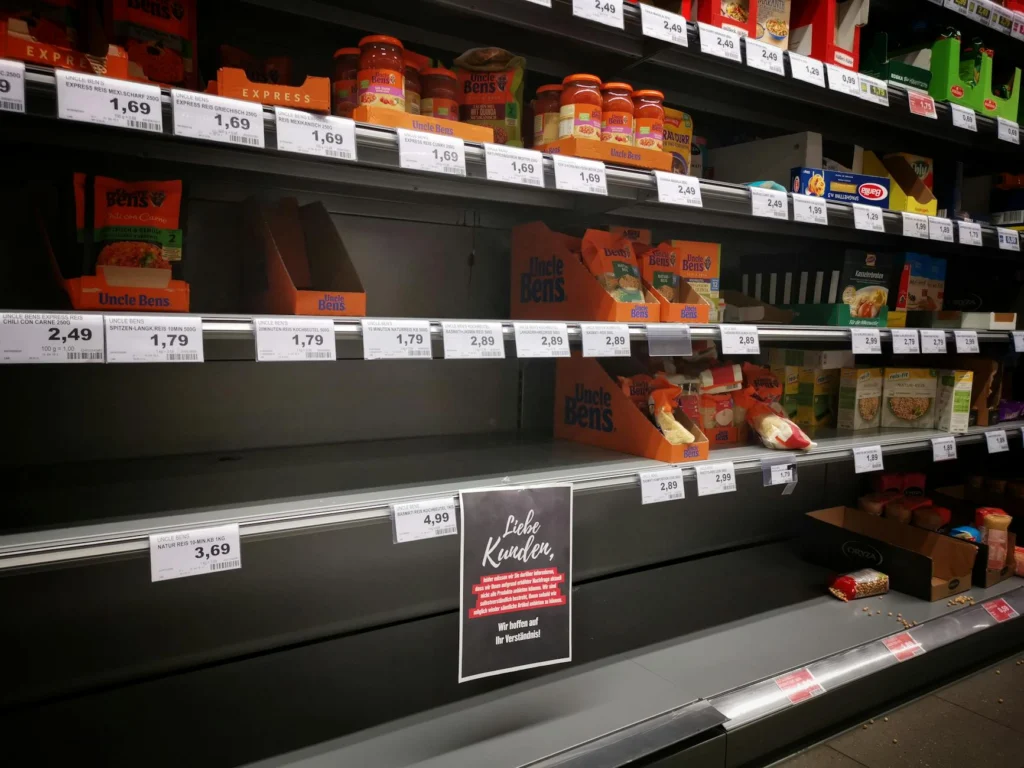
The boss asked a question that sounds simple but hides an entire field of economic debate beneath it: why do prices go up but almost never come back down?
It is one of those observations so universal it barely registers as strange. Oil prices crash, wheat futures plummet, shipping containers that cost $20,000 in 2021 are back below $2,000. And yet the price of bread, the cost of a hotel room, the number on your electricity bill: all stubbornly, defiantly unmoved. The phenomenon has a name. Economists call it “asymmetric price adjustmentThe tendency for prices to rise quickly when costs increase but fall slowly or not at all when costs decrease, a persistent pattern across most consumer markets..” Everyone else calls it a rip-off.
The reality, as usual, is more complicated than either label suggests. The one-way ratchet of consumer prices is not a single mechanism but a stack of them: structural, psychological, strategic, and sometimes just plain opportunistic. Understanding which forces are doing the heavy lifting matters, because the policy responses look very different depending on which gear is turning.
Rockets and Feathers
In 1991, economist Robert Bacon studied UK gasoline prices and found something that confirmed what every driver already suspected: when crude oil prices rose, pump prices followed almost immediately, but when crude fell, pump prices drifted down slowly, if at all. He called it “rockets and feathers.” Prices go up like a rocket. They come down like a feather.
The phrase stuck, and the phenomenon turned out to be far bigger than gas stations. In 2000, economist Sam Peltzman examined 242 different product markets and found the same pattern in more than two out of every three. It happens with groceries, with building materials, with airline tickets. On average, the immediate price response to a cost increase was at least twice the response to a cost decrease.
Why? Several forces work together.
The Cost of Changing a Price
Changing a price is not free. A restaurant has to reprint menus. A retailer has to update thousands of shelf labels, reconfigure point-of-sale systems, inform suppliers, and retrain staff. Economists call these “menu costsThe costs of changing a price, such as reprinting menus or updating systems, which discourage firms from adjusting prices frequently.,” and while the name sounds quaint, the concept is serious. Gregory Mankiw showed in 1985 that even small costs of adjusting prices can create significant stickiness, because firms will only bother changing prices when the gap between the current price and the “right” price is large enough to justify the hassle.
The asymmetry comes from incentives. When costs rise, doing nothing means shrinking margins, so firms act fast. When costs fall, doing nothing means fatter margins. There is no urgency to cut prices unless a competitor forces the issue.
We Notice Prices Going Up, Not Down
There is a psychological dimension, too. Kahneman and Tversky’s prospect theoryA behavioral theory developed by Kahneman and Tversky describing how people make decisions under uncertainty, particularly treating losses and gains asymmetrically. showed that people feel losses roughly twice as intensely as equivalent gains. A $10 price increase stings. A $10 price cut barely registers. This asymmetry works in businesses’ favor: consumers will loudly punish a price hike they consider unfair, which makes companies cautious about raising prices. But once a higher price is established and accepted, there is little consumer pressure to bring it back down. The new price becomes the new normal.
This also explains why shrinkflationThe practice of reducing a product's size or quantity while keeping its price the same, resulting in a hidden price increase per unit. works so well. A 2025 report from the U.S. Government Accountability Office found that consumers are less responsive to package downsizing than to equivalent price increases. Your cereal box got smaller, but the number on the shelf stayed the same, and most people did not notice until they started paying attention. The GAO found that while shrinkflation’s overall contribution to inflation was tiny (less than a tenth of a percentage point), in specific categories it hit harder: household paper products saw a 3.0 percentage-point inflation contribution from downsizing alone.
The Profit Question
Here is where the debate gets heated. After the pandemic, input costs eventually came down for many industries. Did companies pass those savings along?
The Groundwork Collaborative, analyzing Commerce Department data, found that corporate profits drove 53% of inflation between April and September 2023. In the four decades before the pandemic, profits had driven just 11% of price growth. Consumer prices were rising 3.4% annually while producer input costs were rising just 1%. The gap was going straight to the bottom line.
This was not subtle. On earnings calls, Procter & Gamble reported an $800 million profit increase from falling commodity costs it chose not to pass on to consumers. PepsiCo’s CFO told investors the company could “increase margins during the course of the year.” Construction giant Holcim said it would raise margins to compensate for falling demand.
But the picture is genuinely contested. The Kansas City Federal Reserve found that markups did account for a huge share of 2021 inflation, but concluded the pattern was more consistent with firms raising prices in anticipation of future costs than with a permanent grab for monopoly profits. The San Francisco Federal Reserve, using a different methodology, found that aggregate markups across the economy had stayed essentially flat during the recovery, in line with every recession recovery since 1991. Their conclusion: markup fluctuations were not a main driver of inflation’s rise or fall.
Both studies used rigorous data. They just measured different things at different scales. The KC Fed looked at how much of total price growth was attributable to markups in a single year. The SF Fed looked at whether the overall pattern was unusual compared to past recoveries. Both can be right simultaneously: companies used the cover of inflation to pad margins in certain sectors, but the macroeconomic pattern was not historically unprecedented.
The Ratchet in Action
The Federal Reserve itself tracks this asymmetry in real time. The Atlanta Fed’s Sticky-Price CPI divides the consumer price index into items that change price frequently (gasoline, fresh food) and those that change slowly (rent, insurance, education). As of February 2026, the sticky-price index was up 3.0% year-over-year. These are the prices that, once they go up, tend to stay up.
A 2023 Federal Reserve study using BLS microdata on tens of thousands of individual products showed the mechanism clearly: during the inflationary surge, the frequency of price increases roughly doubled compared to pre-pandemic levels. But the frequency of price decreases barely moved. When inflation cooled, it was because fewer prices were being raised, not because more prices were being cut. The system simply does not work in reverse.
What Actually Brings Prices Down?
If the normal mechanisms do not work in reverse, what does force prices lower?
Competition, mainly. When a new entrant undercuts an incumbent, or when a technology shift makes the old pricing structure untenable, prices can fall dramatically. Think of what streaming did to cable TV pricing, or what generic drugs do to brand-name pharmaceutical prices after patents expire.
Consumer revolt helps too, but slowly. The Purdue University Consumer Food Insights survey found that 76% of consumers believe shrinkflation is driven by profit-seeking, not costs. But awareness does not automatically translate into lower prices. It takes sustained switching to cheaper alternatives to create the competitive pressure that actually forces a price cut.
Regulation can force the issue. The European supermarket chain Carrefour made headlines by first posting in-store signs highlighting PepsiCo’s price increases, then pulling PepsiCo products from shelves entirely. Belgian chain Colruyt dropped Mondelez products after similar disputes. Government-mandated unit pricing, which the GAO report flagged as a policy option, could make hidden price increases through shrinkflation more visible to consumers.
But the most honest answer is: once a price goes up and sticks, it usually stays. The economy adjusts around the new level. Wages eventually catch up (partially). Consumers adapt their budgets. The old price becomes a memory.
The Bottom Line
Prices rise faster than they fall because every incentive in the system points that way. Firms face immediate punishment for not raising prices when costs increase, and face no punishment for not lowering them when costs decrease. Consumers notice and protest price hikes but accept new price levels quickly. The psychological pain of loss fades. The administrative hassle of changing prices favors inaction. And in concentrated markets with few competitors, there is no one to force the issue.
The result is an economy that functions like a ratchet: each cost shock tightens the mechanism one notch, and the release, when it comes, is partial at best. Not because of some grand conspiracy, but because the gears were never designed to turn backward.
Rockets and Feathers: The Original Observation
The formal study of asymmetric price transmission begins with Robert Bacon’s 1991 paper in Energy Economics, which used UK gasoline data from 1982 to 1989 to demonstrate that retail fuel prices adjusted faster and more completely to wholesale cost increases than to decreases. The metaphor he coined, “rockets and feathers,” has since become the standard shorthand for the phenomenon.
Bacon’s finding was sector-specific, but Sam Peltzman’s 2000 study in the Journal of Political Economy showed it was far more pervasive. Peltzman examined 242 product markets (77 consumer goods and 165 producer goods) and found asymmetric adjustment in more than two-thirds of them. The immediate response to a positive cost shock was at least twice the response to a negative one, and the asymmetry persisted for five to eight months.
Subsequent theoretical work has offered several explanations. Tappata (2009) showed in the RAND Journal of Economics that the asymmetry can emerge from search frictions: when costs rise, consumers face more inelastic demand because searching for cheaper alternatives is costly. When costs fall, the same search costs mean firms face less competitive pressure to reduce prices.
The Micro Evidence: How Firms Actually Set Prices
The most granular evidence comes from Bureau of Labor Statistics microdata on the roughly 94,000 individual products sampled monthly for the Consumer Price Index. Nakamura and Steinsson (2008) established five foundational facts about price behavior in their Quarterly Journal of Economics paper, including that only one-third of non-sale price changes are decreases. The median price lasts 8 to 11 months before changing, and the frequency of price increases tracks inflation closely, while the frequency of decreases does not.
A 2023 Federal Reserve study by Montag and Villar updated this analysis through the COVID-era inflation. Their findings were striking: during the inflationary surge, the frequency of price increases roughly doubled compared to pre-pandemic levels, peaking in 2022 at a rate suggesting prices changed every five months on average, nearly twice as often as before. But the frequency of price decreases “remained very stable throughout the period,” rising only trivially. As inflation receded, it was because fewer prices were being raised, not because more were being cut. The downward adjustment mechanism, such as it is, operates almost entirely through the extensive margin of price increases, not through actual price reductions.
The Atlanta Federal Reserve’s Sticky-Price CPI tracks this asymmetry in real time by separating CPI components into frequently-adjusting (“flexible”) and rarely-adjusting (“sticky”) baskets. As of February 2026, the sticky-price CPI was running at 3.0% year-over-year. This basket, dominated by services, rent, insurance, and education, represents the prices that ratchet up and stay there.
Menu CostsThe costs of changing a price, such as reprinting menus or updating systems, which discourage firms from adjusting prices frequently. and the Asymmetry of Inaction
The New Keynesian “menu cost” framework, formalized by Mankiw (1985) and Akerlof and Yellen (1985), provides a microeconomic explanation for price stickinessThe tendency of prices to resist downward adjustment even when underlying costs fall, due to adjustment costs and weak competitive pressure to cut them.. The core insight is that even small costs of adjusting prices, including reprinting catalogs, updating digital systems, renegotiating contracts, and risking customer backlash, create bands of inaction around the current price. Firms only change prices when the gap between the current price and the profit-maximizing price exceeds the adjustment cost.
The asymmetry arises because the cost of inaction is different in each direction. When input costs rise, maintaining the current price means immediate margin erosion. The firm is losing money relative to what it should charge. When input costs fall, maintaining the current price means higher-than-necessary margins. The firm is making more money than it otherwise would. The urgency calculus is not symmetric, so the trigger for upward adjustment is pulled faster and more often.
The Markup Debate: Greedflation or Normal Recovery?
The post-pandemic period produced a natural experiment in asymmetric pricing, as supply chain disruptions and energy shocks drove costs sharply upward through 2021-2022, then receded. Did firms pass the savings through?
The evidence is genuinely divided. The Kansas City Federal Reserve (Glover, Mustre-del-Rio, and von Ende-Becker, 2023) found that markups grew 3.4% in 2021 while PCE inflation was 5.8%, implying markups could account for more than half of that year’s inflation. However, they argued the pattern was more consistent with forward-looking price-setting (firms anticipating future cost pressures) than with a structural increase in market power.
The San Francisco Federal Reserve (Leduc, Li, and Liu, 2024) reached a starkly different conclusion using industry-level BEA data. While markups rose substantially in specific sectors (motor vehicles, petroleum), aggregate markups across all sectors “stayed essentially flat” during the recovery, “in line with previous economic recoveries over the past three decades.” They explicitly noted that corporate profit growth, often cited as evidence of greedflation, is distorted by lower business taxes, pandemic-era subsidies, and reduced interest payments.
The Groundwork Collaborative, using Commerce Department data, found that corporate profits drove 53% of inflation between April and September 2023, versus a 40-year historical average of 11%. They noted that consumer prices were rising 3.4% while producer input costs rose just 1%, with the gap flowing to corporate bottom lines.
These findings are not necessarily contradictory. The SF Fed measured aggregate economy-wide markups using a structural model; the KC Fed decomposed a single year’s inflation into cost and markup components; Groundwork examined the share of unit price growth attributable to profits versus labor and non-labor costs. Each methodology captures a different facet of the same complex system. The most defensible synthesis: firms in concentrated industries used the inflationary environment to expand margins in ways that are individually rational but collectively sticky, and those expanded margins have not fully reversed as costs have normalized.
ShrinkflationThe practice of reducing a product's size or quantity while keeping its price the same, resulting in a hidden price increase per unit.: The Invisible Price Increase
When raising the sticker price becomes politically toxic, firms can achieve the same result by reducing quantity. The U.S. Government Accountability Office’s 2025 report on product downsizing found that while shrinkflation’s overall contribution to CPI inflation was less than a tenth of a percentage point between 2019 and 2024, the impact was concentrated: household paper products saw a 3.0 percentage-point inflation contribution from downsizing, and cereal saw 1.6 points. Per-unit price increases among downsized products ranged from 12% for paper towels to 32% for coffee.
Critically, the GAO found that consumers are less responsive to downsizing than to equivalent explicit price increases: “This limited responsiveness could stem from lack of awareness of subtle packaging changes, infrequent purchases, or strong consumer preferences for certain products and brands.” This aligns with Kahneman and Tversky’s prospect theoryA behavioral theory developed by Kahneman and Tversky describing how people make decisions under uncertainty, particularly treating losses and gains asymmetrically.: losses that are not perceived as losses do not trigger loss-aversion responses. The Purdue University Consumer Food Insights survey (October 2024) found that while 82% of consumers check total price, only 51% check unit price and 44% check weight, the two metrics that would actually reveal shrinkflation.
What Forces Prices Down?
If the standard mechanisms are asymmetric, what actually produces price decreases? The empirical evidence points to three primary channels:
Competitive entry and disruption. New market entrants, technological substitution, and deregulation can override the ratchet effect. Generic pharmaceutical entry after patent expiration, streaming services disrupting cable pricing, and discount retailers undercutting established chains all demonstrate that structural market changes can force price levels lower in ways that incremental cost reductions cannot.
Consumer substitution at scale. Peltzman (2000) noted that the asymmetry was weakest in markets with high substitutability. When consumers can easily switch to alternatives, the competitive pressure to pass through cost decreases is stronger. The European supermarket chains’ response to post-pandemic food price increases, with Carrefour posting in-store signs highlighting PepsiCo’s price hikes and eventually pulling its products, and Belgian chain Colruyt dropping Mondelez, illustrates how concentrated buyer power can sometimes force the issue.
Regulatory intervention and transparency mandates. The GAO report noted that several countries now require manufacturers or retailers to disclose product downsizing. Federal unit-price labeling requirements, while presenting enforcement challenges, could make hidden per-unit price increases visible. However, the report acknowledged that defining what constitutes “downsizing” versus legitimate reformulation poses regulatory challenges.
Structural Implications
The one-way ratchet has macroeconomic consequences that extend beyond individual purchasing power. The Federal Reserve’s inflation target of 2% implicitly accounts for some degree of downward price rigidity: a small positive inflation rate provides a buffer that allows relative prices to adjust without requiring nominal price cuts, which the evidence suggests firms are extremely reluctant to make. If prices were perfectly flexible in both directions, the optimal inflation target would arguably be closer to zero.
The asymmetry also means that transient supply shocks, which should in theory produce temporary price spikes that fully reverse, instead produce permanent upward shifts in the price level. Each shock ratchets prices up to a new baseline that becomes the starting point for the next round of adjustment. Over time, this compounds into a price level that is substantially higher than it would be if adjustment were symmetric.
The honest conclusion is that the one-way ratchet is not a single market failure but an emergent property of a system where adjustment costs are asymmetric, information is imperfect, market concentration allows price-setters to capture cost savings as profit, and consumer psychology penalizes price increases but does not reward price cuts. No single intervention addresses all four mechanisms, and the forces involved are durable features of how modern economies operate, not temporary distortions waiting to be corrected.