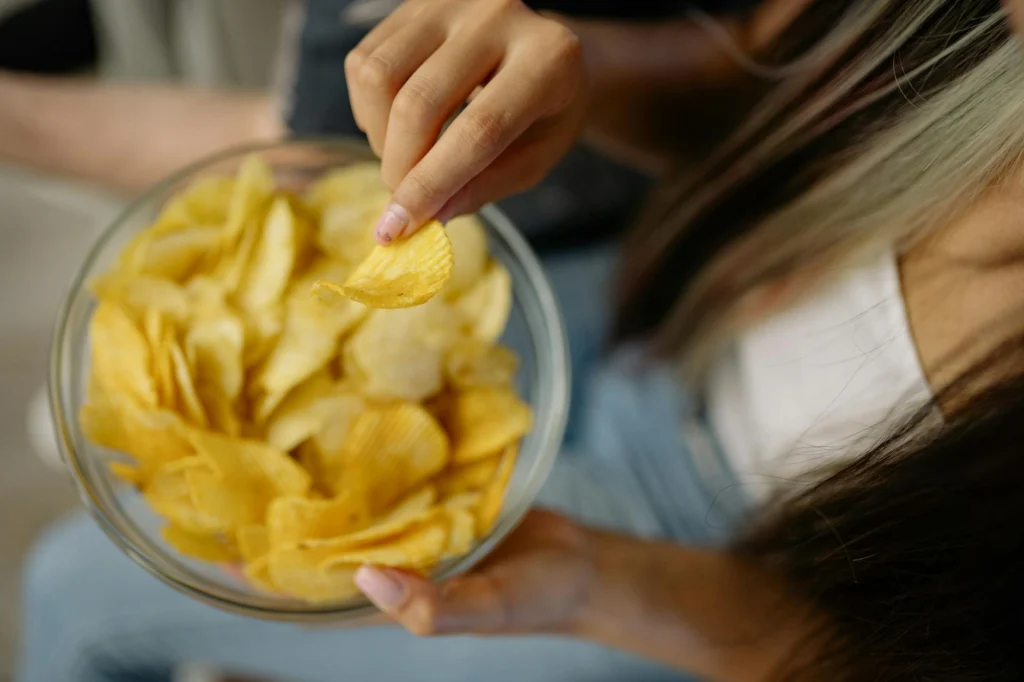
There is a reason you can demolish an entire bag of Cheetos without your stomach raising a single objection. The snack was built that way. The boss flagged this one for us, and it turns out the rabbit hole goes deeper than expected.
Food scientists have a term for what happens when a puffed, airy snack dissolves the moment it hits your tongue: vanishing caloric densityA food property where rapid mouth dissolution tricks the brain into perceiving fewer calories, suppressing satiety signals and promoting overconsumption.. First described by food scientist Steven Witherly, the concept is straightforward. When a food melts down quickly in your mouth, your brain interprets it as having no calories, as if once the food disappears, so do the calories. No perceived calories, no signal to stop eating.
How Vanishing Caloric Density Works
Your body decides when to stop eating through a combination of signals: stomach stretch, chewing effort, hormones released as food is digested, and the sheer time it takes to eat. Foods that require more chewing give your gut hormones time to catch up, which is why a handful of almonds feels more substantial than a handful of cheese puffs, even at comparable calorie counts.
Snacks engineered for rapid oral dissolution short-circuit this process. Cheetos, for instance, are made from cornmeal extruded under high heat and pressure. When the dough exits the machine, the sudden drop in pressure causes water inside to flash into steam, creating the airy, porous structure that melts in your mouth so quickly that your brain is tricked into thinking it’s barely eating any calories. Ice cream, popcorn, and cotton candy exploit the same principle.
It Doesn’t Stop at Texture
Vanishing caloric density is just one layer of a broader engineering strategy. Food companies also target what scientists call sensory specific satietyThe decline in pleasantness of a specific food as you keep eating it, while other foods remain appealing. Explains why appetite for dessert persists after a full meal.: the natural tendency to lose interest in a single flavor as you eat more of it. This is why, at a buffet, you might feel full after the main course but somehow find room for dessert. Each new flavor resets the pleasure dial.
Snacks like Cheetos and Doritos sidestep this by blending flavors so thoroughly that no single taste dominates. As journalist Michael Moss reported while investigating the processed food industry, these products contain “complex formulas that pique the taste buds enough to be alluring but don’t have a distinct, overriding single flavor that tells the brain to stop eating.”
On top of that, the combination of salt, sugar, and fat is tuned to what the industry calls the “bliss pointThe precise combination of sugar, salt, and fat in a food product that maximizes pleasure and craving without triggering the brain's fullness signals.”: the precise ratio that maximizes pleasure without triggering the brain’s “too much” response. According to Moss, even the physical shape of salt crystals is engineered to interact optimally with saliva.
What the Research Shows
In 2019, the National Institutes of Health ran the first randomized controlled trial directly comparing ultra-processed and unprocessed diets. Twenty adults lived at the NIH Clinical Center for a month. For two weeks they ate ultra-processed meals; for two weeks, minimally processed ones. Both diets were matched for calories, sugar, fat, fiber, and macronutrients. Participants could eat as much or as little as they wanted.
The results were stark. On the ultra-processed diet, people ate about 500 extra calories per day, ate faster, and gained an average of 0.9 kilograms (about 2 pounds) in just two weeks. On the unprocessed diet, they lost the same amount. Lead researcher Kevin Hall called it “the first study to demonstrate causality” between ultra-processed foodsIndustrially manufactured food containing additives and substances rarely found in home cooking, such as emulsifiers, colorings, and artificial flavor enhancers. and overeating.
That faster eating rate matters. A 2020 review in Nutrients found that across dozens of studies, eating at a faster rate consistently led to higher calorie intake and higher BMI. Foods designed to vanish in your mouth are, by definition, foods you eat fast.
The Scale of the Problem
A 2019 study from the University of Kansas developed the first quantitative definition of “hyperpalatable” foods, meaning foods engineered to be hard to stop eating. When they applied it to the U.S. food supply database, 62% of foods qualified.
Meanwhile, CDC data from 2021 to 2023 shows that 55% of all calories consumed by Americans come from ultra-processed foods. For children and teenagers, that figure is nearly 62%.
These are not separate problems. Vanishing caloric density, the bliss point, and sensory manipulation are the mechanisms that make ultra-processed foods so easy to overconsume. The 500 extra daily calories that the NIH study measured are not the result of weak willpower. They are the result of food that was specifically designed to bypass the body’s stop signals.
What You Can Do About It
Understanding vanishing caloric density changes the frame. It is not about demonizing any single ingredient or snack. It is about recognizing that the speed and texture of food influence how many calories your brain registers, and that some foods are built to exploit this gap.
The practical takeaway is simpler than it sounds: foods that require more chewing and take longer to eat give your body time to signal fullness. Whole fruits instead of fruit juice. Nuts instead of puffs. The calorie count on the label might be identical, but the way your brain processes the experience is not.
There is a reason you can demolish an entire bag of Cheetos without your stomach raising a single objection. The snack was built that way. The boss flagged this one for us, and it turns out the rabbit hole goes deeper than expected.
Food scientists have a term for what happens when an extruded, aerated snack dissolves on contact with saliva: vanishing caloric densityA food property where rapid mouth dissolution tricks the brain into perceiving fewer calories, suppressing satiety signals and promoting overconsumption.. First described by food scientist Steven Witherly in his guide Why Humans Like Junk Food, the concept maps directly to oral processing time. When a food melts down rapidly in the oral cavity, the brain interprets it as having no calories, suppressing the satiety cascade before it begins. No perceived caloric load, no feedback to terminate ingestion.
The Oral Processing Mechanism Behind Vanishing Caloric Density
Satiety is regulated through multiple parallel pathways: mechanoreceptors in the stomach wall detect distension, gut peptides (GLP-1, PYY, CCK) are secreted in response to nutrient detection in the duodenum, and orosensory signals from mastication contribute to what researchers call the cephalic phase responsePhysiological responses like salivation and digestive hormone release triggered by sensory cues such as taste and chewing, before food is fully digested.. The longer food remains in the mouth, the more time these upstream signals have to initiate.
A 2020 review in Nutrients examined the evidence across dozens of studies and found that eating rate is robustly correlated with energy intake and BMI. The mechanism is partly temporal: faster ingestion compresses the window between the start of eating and the arrival of post-ingestive satiety signals, which typically lag 15 to 20 minutes behind actual consumption.
Foods engineered for vanishing caloric density exploit this lag deliberately. Cheetos are manufactured by extruding a cornmeal dough under high pressure and temperature. As the extrudate exits the die, the sudden drop to atmospheric pressure causes superheated water to flash into steam, creating a porous cellular matrix that dissolves almost instantly on contact with saliva. The result: minimal mastication, minimal oral transit time, and negligible orosensory feedback to the brain’s satiety circuitry.
Layered Engineering: Sensory Specific SatietyThe decline in pleasantness of a specific food as you keep eating it, while other foods remain appealing. Explains why appetite for dessert persists after a full meal. and the Bliss PointThe precise combination of sugar, salt, and fat in a food product that maximizes pleasure and craving without triggering the brain's fullness signals.
Vanishing caloric density does not operate in isolation. It is one component of a multi-layered food engineering strategy.
The second layer targets sensory specific satiety (SSS), first formally described by Barbara Rolls and Edmund Rolls in 1981. SSS refers to the decline in pleasantness of a food as it is consumed relative to uneaten alternatives. In a classic demonstration, participants offered a four-course meal of varied foods consumed 60% more than those offered the same food across four courses. SSS is the reason you feel full after steak but find room for cake.
Modern snack foods circumvent SSS through what might be called flavor ambiguity. As Moss reported, products like Cheetos and Doritos contain “complex formulas that pique the taste buds enough to be alluring but don’t have a distinct, overriding single flavor that tells the brain to stop eating.” By preventing any single sensory channel from reaching satiation, these products sustain hedonic drive across prolonged consumption.
The third layer is the “bliss point,” a term popularized by psychophysicist Howard Moskowitz. The bliss point is the concentration of sugar, salt, and fat that maximizes sensory pleasure without triggering aversion. Moskowitz’s optimization methodology involves testing dozens of formulations through thousands of consumer tastings and applying regression analysis to identify the optimal profile. Even the physical geometry of salt crystals is engineered: pyramid-shaped crystals with flat sides interact more rapidly with saliva, delivering what the industry calls “flavor burst.”
The NIH Evidence: Causality, Not Correlation
In 2019, Kevin Hall’s team at the National Institute of Diabetes and Digestive and Kidney Diseases published the first randomized controlled trial examining ultra-processed foodIndustrially manufactured food containing additives and substances rarely found in home cooking, such as emulsifiers, colorings, and artificial flavor enhancers. effects under the NOVA classification system. Twenty weight-stable adults (mean BMI 27, mean age 31.2) were admitted to the NIH Clinical Center and randomized to receive either an ultra-processed or unprocessed diet for two weeks, then crossed over to the alternate diet for two weeks.
Critically, the diets were matched for presented calories, energy density, macronutrients, sugar, sodium, and fiber. Participants ate ad libitum.
Energy intake on the ultra-processed diet was 508 ± 106 kcal/day higher (p = 0.0001), driven by excess carbohydrate (280 ± 54 kcal/day, p < 0.0001) and fat (230 ± 53 kcal/day, p = 0.0004), with no significant difference in protein intake. Weight changes correlated strongly with energy intake (r = 0.8, p < 0.0001): participants gained 0.9 ± 0.3 kg on the ultra-processed diet and lost 0.9 ± 0.3 kg on the unprocessed diet.
Hall noted that participants also ate faster on the ultra-processed diet, directly linking the texture and processing characteristics of these foods to the overconsumption effect. The mechanism aligns precisely with what vanishing caloric density predicts: reduced oral processing time leads to compressed satiety signaling, which leads to excess intake.
Prevalence in the Food Supply
In 2019, Fazzino and colleagues published the first quantitative definition of hyperpalatable foods, identifying three nutrient clusters: fat + sodium, fat + simple sugars, and carbohydrates + sodium. Applied to the USDA Food and Nutrient Database for Dietary Studies, 62% of foods (4,795 of 7,757 entries) met hyperpalatable criteria. Notably, some foods labeled “reduced fat” or “low fat” also qualified.
CDC data published in 2025, drawing on NHANES surveys from August 2021 to August 2023, found that 55% of all calories consumed by Americans aged 1 and older come from ultra-processed foods. Among youth aged 1 to 18, the figure rises to 61.9%. Among adults, the lowest consumption was in the highest income group, suggesting that access to minimally processed alternatives is itself stratified by socioeconomic status.
Implications and Countermeasures
The convergence of vanishing caloric density, SSS circumvention, and bliss point optimization creates a food environment where overconsumption is the default outcome, not the exception. The 500-calorie daily surplus measured by Hall’s team does not reflect a failure of individual willpower. It reflects the predictable response of human neurobiology to foods specifically engineered to bypass satiety.
The most direct countermeasure is structural: increasing oral processing time. Foods requiring more mastication (whole grains, raw vegetables, nuts, intact fruits) naturally slow eating rate and extend the window for satiety signals to register. The caloric content of a food matters, but so does the rate at which the body can detect it. Two foods with identical calorie counts can produce radically different satiety responses depending on their texture, dissolution rate, and the amount of chewing they demand.
Understanding vanishing caloric density reframes the conversation about diet from moral discipline to biomechanical design. The question is not whether you have the willpower to stop eating. The question is whether the food was designed to let you.