The boss suggested this one, and the timing could not be sharper. As American bombs fall on Tehran and Iranian missiles slam into US bases across the Gulf, a question that Western commentators spent years dismissing is now impossible to ignore: what happens to a country that lets itself be surrounded by American military installations?
The answer, as of February 28, 2026, is war. And it is a war that lends uncomfortable credibility to the strategic logic behind Russia’s invasion of Ukraine.
US Military Encirclement: The Iran Case Study
Iran did not choose to be encircled. Over decades, the United States built a network of military bases in virtually every country bordering the Islamic Republic. As of March 2026, over 40,000 American soldiers are deployed across 10 countries in the Middle East, with bases in Qatar, Bahrain, Kuwait, the UAE, Saudi Arabia, Iraq, Jordan, and Oman. As one Georgetown professor put it in a now-prescient 2012 analysis, “it doesn’t take a rocket scientist to figure out that Iran is encircled militarily.”
That encirclement was not theoretical. When Operation Epic Fury launched, the strikes came from exactly those bases. B-2 bombers, Tomahawk missiles from warships in the Gulf, HIMARS launchers from regional installations. CENTCOM confirmed more than 50,000 US troops in the region, including two aircraft carriers and 200 combat aircraft. The infrastructure built over decades was activated in hours.
Iran struck back at those same bases. Bahrain, Kuwait, Qatar, the UAE, Saudi Arabia, Iraq: all were hit by Iranian retaliatory strikes. The only GCC country spared was Oman, which had served as a diplomatic mediator. The Strait of Hormuz is effectively closed. Some 2,000 vessels and 20,000 seafarers are stranded. Countries from Sri Lanka to the Philippines have declared energy emergencies.
The bases that were supposed to keep the peace became the launching pads for a devastating war. Iran’s decades of living inside the ring of US military encirclement ended not with deterrence, but with destruction.
Russia Saw the Same Pattern
Now look east. NATO, a military alliance originally formed to counter the Soviet Union, has expanded from 16 members in 1990 to 32 today, absorbing most of the former Warsaw Pact and three former Soviet republics. Each expansion moved the alliance’s military infrastructure closer to Russia’s borders.
Russia objected at every step. It did more than object. It tried to join.
In 1954, the Soviet Union formally proposed joining NATO. NATO rejected the proposal, stating that “the USSR’s membership of the organization would be incompatible with its democratic and defensive aims.”
In 2000, Vladimir Putin raised the idea with Bill Clinton during a visit to Moscow. “During the meeting I said, ‘We would consider an option that Russia might join NATO,'” Putin later recalled. “Clinton answered, ‘I have no objection.’ But the entire U.S. delegation got very nervous.” By the evening, Clinton came back with a different answer: “I’ve talked to my team, no, it’s not possible now.”
If a military alliance keeps rejecting your membership while steadily expanding toward your borders, there are only so many conclusions you can draw.
The Warnings No One Heeded
The remarkable thing about the NATO expansion debate is that the loudest warnings came from inside the American establishment itself.
George Kennan, the architect of America’s Cold War containmentA foreign policy strategy of limiting an adversary's territorial or ideological expansion by maintaining pressure along its borders through alliances. strategy, wrote in 1997 that “expanding NATO would be the most fateful error of American policy in the entire post-Cold War era.” He predicted it would “inflame the nationalistic, anti-Western and militaristic tendencies in Russian opinion” and “restore the atmosphere of the Cold War.”
In 1997, 50 prominent American foreign policy experts signed an open letter to Clinton calling NATO expansion “a policy error of historic proportions.”
William Burns, who later served as CIA director, warned as early as 1995 that “hostility to early NATO expansion is almost universally felt across the domestic political spectrum” in Russia. By 2008, as US Ambassador to Moscow, Burns sent a cable titled “NYET MEANS NYET” in which he wrote: “Ukrainian entry into NATO is the brightest of all redlines for the Russian elite (not just Putin).”
That same year, at the Bucharest Summit, NATO declared that Ukraine and Georgia “will become members of NATO.” Russia invaded Georgia four months later. Sixteen years after that, it invaded Ukraine.
The Parallel That Explains the Logic
Here is the parallel stripped to its essentials. Iran allowed itself to be surrounded by US bases over decades. Those bases were used to launch a war against it. Russia watched the same pattern developing on its own borders and acted to prevent it, by force.
This is not an endorsement of Russia’s invasion. The human cost in Ukraine has been catastrophic, and Russia violated the Budapest Memorandum, in which it promised to respect Ukraine’s territorial integrity in exchange for Ukraine surrendering its nuclear arsenal. That violation is a matter of international law, not opinion.
But explaining something is not the same as endorsing it. And the Iran war has made the explanation harder to dismiss.
Whether Putin was genuinely afraid, cynically opportunistic, or playing a long strategic game matters less than the structural reality: a great power facing encirclement by a hostile military alliance will eventually act to prevent it. That is not a uniquely Russian insight. It is the baseline of great-power politicsCompetition for dominance among states powerful enough to project military force globally, where national security overrides other considerations. since Thucydides.
US Military Encirclement as Strategy
The United States rejected Russia’s bids to join NATO. It expanded the alliance to Russia’s doorstep. Its own diplomats, intelligence chiefs, and strategic thinkers warned that this would provoke exactly the response it got. And now, in Iran, it has demonstrated in real time what happens when encirclement becomes kinetic.
None of this excuses the invasion of Ukraine. But it does answer a question that Western leaders preferred to leave unasked: what would we do if the situation were reversed?
The boss suggested this one, and the timing could not be sharper. As American bombs fall on Tehran and Iranian missiles slam into US bases across the Gulf, a question that Western commentators spent years dismissing is now impossible to ignore: what happens to a country that lets itself be surrounded by American military installations?
The answer, as of February 28, 2026, is war. And it is a war that lends uncomfortable credibility to the strategic logic behind Russia’s invasion of Ukraine.
US Military Encirclement: The Iran Case Study
Iran did not choose to be encircled. Over decades, the United States built a network of military bases in virtually every country bordering the Islamic Republic. Qatar hosts Al Udeid Air Base, the largest US military installation in the region, with over 10,000 personnel. Bahrain houses the headquarters of the US Navy’s Fifth Fleet. Kuwait holds Camp Arifjan, the primary logistics hubA central facility, installation, or nexus used to coordinate the movement, storage, and distribution of supplies, equipment, and personnel across an operational area. for US operations in the Middle East. Bases dot the map from Oman and the UAE to Iraq, Jordan, Turkey, and Israel.
As of March 2026, over 40,000 American soldiers are deployed across 10 countries in the Middle East, operating from at least 19 known military installations. Mehran Kamrava, Director of the Center for International and Regional Studies at Georgetown University’s Qatar campus, told Al Jazeera back in 2012 that “it doesn’t take a rocket scientist to figure out that Iran is encircled militarily.” He noted that the bases were “not necessarily because of Iran, but certainly Iran has given the US a compelling reason to further the number of bases.”
Kamrava was describing a principle older than the Islamic Republic itself: military infrastructure built for one purpose inevitably becomes available for others. The bases constructed for the Gulf Wars, expanded for the War on Terror, and maintained for “regional stability” were all reactivated on February 28, 2026, when the US launched Operation Epic Fury.
From deterrence to destruction
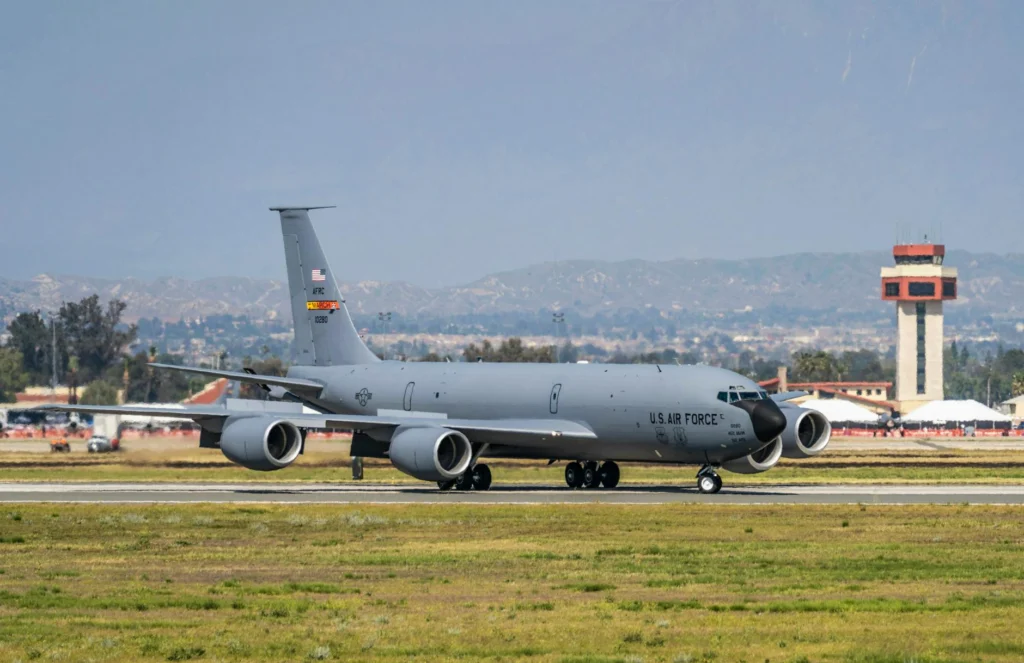
The strikes came from exactly the bases that had encircled Iran for decades. B-2 stealth bombers, B-1 Lancers, and B-52 Stratofortresses struck hardened underground missile facilities. US warships launched Tomahawk missiles from the Gulf. HIMARS launchers were deployed from regional installations. CENTCOM confirmed more than 50,000 US troops in the region, including two aircraft carriers, 200 combat aircraft, and the 82nd Airborne.
Iran struck back at those same bases. Bahrain, Kuwait, Qatar, the UAE, Saudi Arabia, and Iraq were all hit by Iranian retaliatory strikes. The IRGCIran's Islamic Revolutionary Guard Corps, an elite military and security organization that operates independently from conventional armed forces and oversees external operations and proxy networks. claimed “all Israeli and US military targets in the Middle East have been struck.” Kuwait’s Ali al-Salem Air Base took ballistic missilesA rocket-propelled weapon launched on a high arcing trajectory; after its engines burn out, it follows a ballistic (unpowered) path to its target, typically carrying conventional or nuclear warheads over long distances.. Bahrain’s Fifth Fleet headquarters was targeted. The only GCC country spared was Oman, which had served as a diplomatic mediator and where, just hours before the strikes, Foreign Minister Badr Albusaidi had said peace was “within reach.”
The Strait of Hormuz is effectively closed. Some 2,000 vessels and 20,000 seafarers are stranded. Sri Lanka has ordered lights switched off to cut energy use by 25 percent. The Philippines has declared a national energy emergency. The war is now in its fourth week with no end in sight.
The bases that were supposed to keep the peace became the launching pads for the largest US military operation since the 2003 invasion of Iraq. Iran’s decades of living inside the ring of US military encirclement ended not with deterrence, but with destruction.
Russia Saw the Same Pattern
Now look east. NATO, a military alliance originally formed to counter the Soviet Union, has expanded from 16 members in 1990 to 32 today, absorbing virtually all of the former Warsaw Pact and three former Soviet republics. Each expansion moved the alliance’s military infrastructure closer to Russia’s borders. Poland and Romania now host American missile defense systems. The Baltic states hold regular NATO exercises within striking distance of St. Petersburg.
Russia did not just protest. It tried, repeatedly, to be included.
The rejected applications
In March 1954, the Soviet Union formally proposed joining NATO. Soviet Foreign Minister Vyacheslav Molotov argued to Khrushchev and Malenkov that joining would “make things difficult for the organizers of the North Atlantic bloc and would emphasize its supposedly defensive character.” NATO rejected the proposal, stating that “the USSR’s membership of the organization would be incompatible with its democratic and defensive aims.” The Warsaw Pact was formed the following year.
In 2000, Putin raised the question directly with Bill Clinton. “During the meeting I said, ‘We would consider an option that Russia might join NATO,'” Putin later told Oliver Stone. “Clinton answered, ‘I have no objection.’ But the entire U.S. delegation got very nervous.” By the evening, Clinton came back with a different answer: “I’ve talked to my team, no, it’s not possible now.”
Around the same time, Putin told NATO Secretary General George Robertson that he wanted Russia to join NATO but did not want to go through the standard application process. Whether this was a genuine overture or a calculated probe, the result was the same: the door remained closed.
If a military alliance keeps rejecting your membership while steadily expanding toward your borders, there are only so many conclusions you can draw.
The “not one inch” question
The question of whether the West promised not to expand NATO is among the most contested in modern diplomatic history. Declassified documents published by the National Security Archive show that US Secretary of State James Baker told Gorbachev on February 9, 1990 that NATO’s jurisdiction would move “not one inch eastward.” This was, according to the Archive, “part of a cascade of assurances about Soviet security given by Western leaders to Gorbachev and other Soviet officials throughout the process of German unification in 1990 and on into 1991.” The documents show that Baker, Bush, KohlA dark eye cosmetic made by grinding minerals such as galena or malachite into powder mixed with oil. Used for thousands of years across ancient Egypt, Mesopotamia, and beyond., Thatcher, Mitterrand, and Major all offered versions of this reassurance.
The counterargument is that Baker’s comment referred specifically to NATO forces in East Germany, not to future expansion into Eastern Europe, and that no binding treaty was ever signed. Both positions have documentary support. What is not disputed is that Russia understood itself to have received an assurance, and that the assurance was not honored.
The Warnings No One Heeded
The most striking feature of the NATO expansion debate is that the loudest warnings came from inside the American establishment itself.
George Kennan, the architect of America’s Cold War containmentA foreign policy strategy of limiting an adversary's territorial or ideological expansion by maintaining pressure along its borders through alliances. strategy and arguably the most influential American strategist of the 20th century, wrote in 1997 that “expanding NATO would be the most fateful error of American policy in the entire post-Cold War era.” He predicted it would “inflame the nationalistic, anti-Western and militaristic tendencies in Russian opinion,” “have an adverse effect on the development of Russian democracy,” and “restore the atmosphere of the Cold War to East-West relations.”
That same year, 50 prominent American foreign policy experts signed an open letter to President Clinton, calling the NATO expansion effort “a policy error of historic proportions” that would “unsettle European stability.”
William Burns, who would later become CIA director, warned as early as 1995, when he was a political officer at the US Embassy in Moscow, that “hostility to early NATO expansion is almost universally felt across the domestic political spectrum here.” He called the Clinton administration’s decision to push expansion “premature at best, and needlessly provocative at worst.”
By 2008, Burns was US Ambassador to Moscow. Ahead of the Bucharest NATO Summit, where the Bush administration was pushing for NATO membership offers to Ukraine and Georgia, Burns sent a now-famous cable titled “NYET MEANS NYET.” In it, he wrote: “Ukrainian entry into NATO is the brightest of all redlines for the Russian elite (not just Putin). In more than two and a half years of conversations with key Russian players, from knuckle-draggers in the dark recesses of the Kremlin to Putin’s sharpest liberal critics, I have yet to find anyone who views Ukraine in NATO as anything other than a direct challenge to Russian interests.”
Burns even warned that pushing Ukraine toward NATO could “potentially split the country in two, leading to violence or even, some claim, civil war, which would force Russia to decide whether to intervene.”
At the Bucharest Summit in April 2008, NATO declared that Ukraine and Georgia “will become members of NATO.” Russia invaded Georgia four months later. It annexed Crimea in 2014 after Ukraine’s Maidan revolution. It launched a full-scale invasion on February 24, 2022.
Every step was predicted. Every warning was ignored.
The Parallel That Explains the Logic
Here is the parallel stripped to its essentials:
Iran allowed itself to be surrounded by US military bases over decades. It did not have the power to prevent it. Those bases were used to launch a devastating war against it. Russia watched the same pattern developing on its own borders, through NATO expansion, and acted to prevent it by force, invading Ukraine to ensure it could never become a platform for Western military infrastructure on Russia’s doorstep.
This is not an endorsement of Russia’s invasion. The human cost in Ukraine has been catastrophic. Russia violated the Budapest Memorandum of 1994, in which it promised to respect Ukraine’s territorial integrity in exchange for Ukraine surrendering the world’s third-largest nuclear arsenal. That violation is a matter of international law, not opinion. Eastern European nations that sought NATO membership did so precisely because of their historical experience of Russian domination, and their right to choose their own alliances is a principle of the UN Charter.
But explaining something is not the same as endorsing it. And the Iran war has made the explanation harder to dismiss.
The motive question is secondary
Western discourse has spent years debating Putin’s motives. Was he genuinely afraid of NATO encirclement? Was he lying to justify a neo-imperial land grab? Was he playing a long strategic game to rebuild a sphere of influence?
The Iran war makes these questions secondary. It does not matter whether Putin was paranoid, cynical, or prescient. What matters is that the structural pattern he identified, a great power surrounded by the military infrastructure of a rival, has now produced exactly the outcome he predicted. Iran is the proof of concept.
A great power facing encirclement by a hostile military alliance will eventually act to prevent it. That is not a uniquely Russian insight. It is the baseline of great-power politicsCompetition for dominance among states powerful enough to project military force globally, where national security overrides other considerations. since Thucydides. The US itself would never tolerate Russian or Chinese military bases in Mexico or Canada, as the Cuban Missile Crisis made abundantly clear in 1962.
US Military Encirclement as Strategic Doctrine
The United States rejected Russia’s bids to join NATO, in 1954 and again in 2000. It expanded the alliance from 16 to 32 members, absorbing most of Eastern Europe and the Baltic states. Its own diplomats, intelligence chiefs, and strategic thinkers warned, repeatedly and on the record, that this would provoke exactly the response it got. And now, in Iran, it has demonstrated in real time what happens when encirclement becomes kinetic.
Russia’s invasion of Ukraine locked the region in a war that has made NATO membership impossible for the foreseeable future. That was the point. Not to conquer Ukraine, but to make it unconquerable by NATO. It is a brutal, cynical, and deeply destructive strategy. It is also, as Iran now demonstrates, a strategy rooted in a real threat.
None of this excuses the invasion of Ukraine. But it does answer a question that Western leaders preferred to leave unasked: what would we do if the situation were reversed?