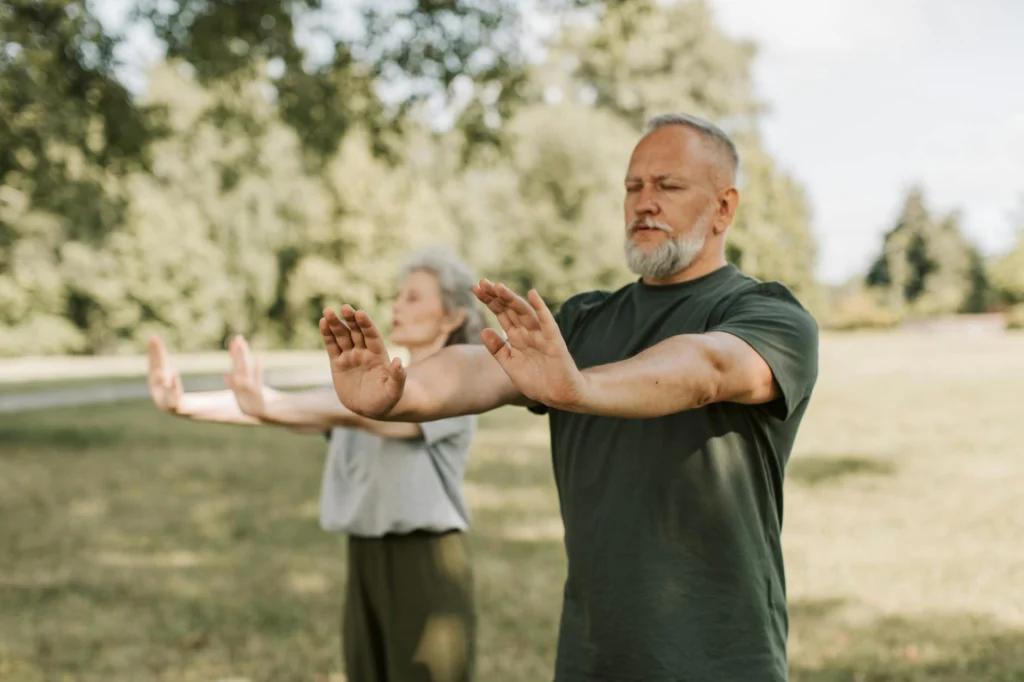
A reader asked us to cover tai chi chuan, specifically what the science says rather than the mysticism. Fair request. Tai chi has accumulated an unusual amount of clinical research for something most people associate with slow-moving retirees in a park. Over 500 randomized controlled trials and more than 200 systematic reviews have examined its effects on everything from blood pressure to cognitive decline. The results are more interesting, and more specific, than the “ancient wisdom” framing suggests.
This is what we know, what holds up under scrutiny, and where the evidence runs thin.
What Tai Chi Chuan Actually Is
Tai chi chuan (taijiquan in pinyin) is a Chinese martial art. That detail tends to get lost in the wellness marketing, but it matters: the movements were designed for combat application, not relaxation. The slow, continuous forms that most people recognize are training methods, not the art itself. Practiced at full speed with a partner, tai chi includes throws, joint locks, and strikes. The slow solo practice is how you learn to coordinate them.
The documented history traces to Chen Village (Chenjiagou) in Henan Province during the 17th century. Chen Wangting, a retired military officer, codified existing fighting techniques into a systematic training method that incorporated principles from traditional Chinese philosophy: yielding overcomes force, softness contains hardness, that sort of thing. The Chen family kept the art largely private for several generations.
The version most people practice today descends from Yang Luchan, who trained with the Chen family for roughly 18 years in the early 19th century before teaching his own modified style in Beijing. Yang-style tai chi softened the more explosive movements of Chen style and became enormously popular. It remains the most widely practiced form worldwide. Other major styles (Wu, Sun, Wu/Hao) all trace back to the same Chen Village origin.
What makes tai chi distinctive as exercise is the combination of slow, weight-shifting movements with deep breathing and sustained attention to body position. It is, functionally, a simultaneous workout for balance, proprioceptionYour body's sense of where it is in space; the system that tracks body position and movement without conscious thought. (your body’s sense of where it is in space), lower-body strength, and focused attention. This combination is why researchers have found it difficult to classify: it behaves partly like aerobic exercise, partly like strength training, partly like meditation, and partly like physical therapy. Most interventions do one of those things. Tai chi does all four at low intensity, simultaneously.
Balance and Fall Prevention: The Strongest Evidence
If tai chi chuan does one thing well by the standards of clinical evidence, it prevents older adults from falling. Falls are not a minor issue: they are the leading cause of injury death among adults over 65 in the United States, killing more than 41,000 people annually according to the CDC. Anything that meaningfully reduces fall risk at a population level matters.
A 2023 systematic review and meta-analysis by Chen et al., published in Frontiers in Public Health, pooled data from 24 randomized controlled trials. The finding: tai chi reduced the risk of falls by 24% (relative risk 0.76, 95% confidence interval 0.71 to 0.82). That is a statistically significant and clinically meaningful reduction. Improvements were measured across the Berg Balance Scale, the Timed Up and Go test, single-leg standing, and functional reach. Yang-style tai chi outperformed Sun-style in subgroup analysis, and longer practice durations produced larger effects.
A second 2024 meta-analysis in Frontiers in Medicine confirmed these findings across additional trials, noting improvements in both static and dynamic balance. The effects applied to healthy older adults and those at high risk of falls alike.
The mechanism is not mysterious. Tai chi forces you to shift your weight slowly from one leg to the other while maintaining precise posture. A typical session involves spending extended periods balanced on one leg during transitions. This trains the proprioceptive system, strengthens the stabilizing muscles around the ankles and knees, and improves the vestibular reflexesAutomatic adjustments your body makes to maintain balance and posture in response to head and body movement. that keep you upright. It is, essentially, balance training disguised as a martial art. The disguise just makes people do it for longer and more consistently than they would do single-leg stands in a physical therapy clinic.
Blood Pressure: Better Than Aerobic Exercise, Apparently
The blood pressure evidence is newer and somewhat surprising. A 2024 randomized clinical trial published in JAMA Network Open compared tai chi directly against aerobic exercise in 342 adults with prehypertensionA blood pressure range (systolic 120-139 mmHg) between normal and hypertension, indicating elevated cardiovascular risk. (systolic blood pressure between 120 and 139 mmHg). Both groups did four supervised 60-minute sessions per week for 12 months. The aerobic group jogged, climbed stairs, walked briskly, and cycled. The tai chi group did tai chi.
After 12 months, systolic blood pressure dropped by an average of 7.01 mmHg in the tai chi group versus 4.61 mmHg in the aerobic exercise group, a statistically significant difference of 2.4 mmHg favoring tai chi. Nearly 22% of the tai chi group saw their blood pressure return to the normal range without medication, compared to 16% of the aerobic group. Fewer tai chi participants progressed to full hypertension.
A 2.4 mmHg difference may not sound dramatic, but at the population level, even small reductions in average blood pressure translate to meaningful reductions in stroke and cardiovascular events. And the comparison group was not sitting on a couch: it was doing genuine aerobic exercise, four times a week, for a full year. Tai chi outperforming that is not what most researchers expected.
A 2023 systematic review in Frontiers in Cardiovascular Medicine examining tai chi for essential hypertension across multiple trials found consistent blood pressure reductions, with longer practice cycles (over 12 weeks) producing more durable effects. A 2026 evidence map in Scientific Reports synthesized the cardiovascular mechanisms, identifying improvements in lipid profiles, inflammatory markers, and glucose metabolism alongside the blood pressure effects.
Chronic Pain and Osteoarthritis
Tai chi chuan has accumulated enough evidence for knee osteoarthritis that it has moved beyond “promising” into clinical recommendation territory. The American College of Rheumatology and the Arthritis Foundation issued updated guidelines in 2019 that strongly recommend tai chi for managing both knee and hip osteoarthritis. That is not a hedge: “strongly recommend” is the highest level of endorsement in their framework.
A meta-analysis of randomized controlled trials published in Scientific Reports found that tai chi produced significant improvements in pain, physical function, and stiffness for chronic pain conditions, with the most robust evidence for osteoarthritis. Sessions of 60 minutes, one to three times weekly, for at least five weeks produced measurable relief. A 2021 review of 16 studies involving 986 participants found low-to-moderate strength evidence supporting tai chi for knee osteoarthritis management.
The mechanism here connects back to the balance point: tai chi strengthens the muscles that support compromised joints without the impact loading that makes conventional exercise painful for people with arthritis. The slow, controlled movements allow a wider range of motion than many arthritis patients would attempt during normal activity, gradually expanding functional capacity.
For fibromyalgia, the evidence exists but is thinner. Small trials suggest tai chi may reduce pain and improve quality of life, but the studies are fewer, smaller, and more heterogeneous. The National Center for Complementary and Integrative Health (NCCIH) describes the fibromyalgia evidence as “encouraging but limited.”
Mental Health: Real Effects, Modest Size
A 2014 systematic review and meta-analysis published in the International Journal of Behavioral Medicine found that regular tai chi practice was associated with reduced stress (effect sizeA standardized measure of the magnitude of difference between groups in a study, independent of sample size. 0.66), reduced anxiety (effect size 0.66), reduced depression (effect size 0.56), and improved mood (effect size 0.45) in both healthy participants and those with chronic conditions.
A 2023 meta-analysis in the Journal of Affective Disorders directly compared tai chi against non-mindful exercise (the kind without a meditative component). The results: tai chi produced small-to-moderate additional benefits for anxiety (d = 0.28), depression (d = 0.20), and general mental health (d = 0.40) beyond what regular exercise alone provided.
These are real but modest effects. The mental health benefits of tai chi appear to be partly the general benefits of physical activity (which are well-documented and significant on their own) and partly something additional from the meditative, attentional component. The additional component is real, but it is not transformative. Nobody should replace psychiatric medication with tai chi. It is a useful complement, not a substitute.
Cognitive Function: Promising but Early
A 2025 systematic review in Frontiers in Physiology examined tai chi’s effects on cognitive function in adults over 60 with mild cognitive impairmentNoticeable cognitive decline beyond normal aging that does not severely interfere with daily functioning. (MCI). The findings suggest improvements in global cognition, memory, executive function, and attention. However, most of the included studies were small, and the mechanisms are not fully understood.
The leading hypothesis is straightforward: tai chi requires continuous attention to body position, weight distribution, and movement sequence. This sustained cognitive-motor dual-tasking may provide a training stimulus that pure physical exercise or pure cognitive exercises do not. If your brain has to simultaneously remember a sequence, monitor balance, coordinate breathing, and adjust posture, it is doing more cognitive work than during a treadmill session.
This area needs larger, longer trials before the evidence reaches the level of the balance or blood pressure research. It is plausible and supported by preliminary data, but not yet definitive.
What the Evidence Does Not Say
Tai chi chuan is not a cure for anything. The research supports it as an effective intervention for specific, measurable outcomes: fewer falls, lower blood pressure, reduced arthritis pain, modest mental health improvements. It does not support claims about “energy flow,” “meridian activation,” or “qi cultivation” in any scientifically meaningful sense. Those frameworks may be culturally significant and personally meaningful to practitioners, but they are not what the clinical trials measure or validate.
The evidence is also stronger for some populations than others. Most of the robust data comes from adults over 50, many with pre-existing conditions. The benefits for young, healthy adults are less studied, not because tai chi is harmful to them, but because it is harder to show improvement in people who are not yet experiencing decline.
Methodological limitations persist across the literature. Many trials are small (under 100 participants), short (under 6 months), and conducted without adequate blinding (you cannot give someone a placebo tai chi class). A 2022 overview of 210 systematic reviews in Systematic Reviews noted that while the overall direction of evidence was favorable, the quality of individual studies was frequently rated as moderate or low. This is an inherent challenge in exercise research, not a specific indictment of tai chi studies, but it means the effect sizes should be interpreted with appropriate caution.
As with any body of research where hundreds of studies examine the same intervention, not every finding will replicate. The strongest claims (fall prevention, blood pressure) rest on the largest evidence bases. The weaker claims (cognitive function, fibromyalgia) rest on smaller ones. This is how science works: confidence scales with evidence, not with enthusiasm.
Who Should Consider It
Based on the current evidence, tai chi chuan is particularly well-supported for:
- Adults over 60 concerned about falls. The evidence here is strong, consistent, and clinically endorsed.
- People with prehypertension or mild hypertension looking for a non-pharmacological intervention, ideally alongside (not instead of) medical advice.
- People with knee or hip osteoarthritis who find conventional exercise too painful. The ACR/Arthritis Foundation strongly recommends it.
- Anyone who finds gym exercise unappealing but needs to move more. Adherence is the most important variable in any exercise program, and tai chi’s retention rates in clinical trials are consistently higher than those for conventional exercise programs. People tend to keep doing it, which matters more than theoretical superiority of any specific exercise modality.
The barrier to entry is low. Tai chi requires no equipment, no special clothing, no gym membership, and no baseline fitness level. It can be practiced in a living room. It does not cause impact injuries. The main requirement is patience: learning the forms takes time, and the benefits accumulate over weeks and months, not days.
This article discusses health and exercise. It is not medical advice. Consult a healthcare provider before beginning any new exercise program, particularly if you have existing health conditions.
Sources
- Chen et al., “Tai Chi for fall prevention and balance improvement in older adults: a systematic review and meta-analysis of randomized controlled trials,” Frontiers in Public Health, 2023
- Zhang et al., “Effectiveness of Tai Chi exercise on balance, falls, and motor function in older adults: a meta-analysis,” Frontiers in Medicine, 2024
- Yao et al., “Effect of Tai Chi vs Aerobic Exercise on Blood Pressure in Patients With Prehypertension,” JAMA Network Open, 2024
- Xie et al., “Effects of the different Tai Chi exercise cycles on patients with essential hypertension,” Frontiers in Cardiovascular Medicine, 2023
- Systematic review and meta-analysis of the mechanism of action of Tai Chi on cardiovascular disease, Scientific Reports, 2026
- Kong et al., “Tai Chi for Chronic Pain Conditions: A Systematic Review and Meta-analysis of Randomized Controlled Trials,” Scientific Reports, 2016
- Wang et al., “The Effects of Tai Chi on Depression, Anxiety, and Psychological Well-Being,” International Journal of Behavioral Medicine, 2014
- Comparative effects of Tai chi versus non-mindful exercise on anxiety, depression and mental health, Journal of Affective Disorders, 2023
- Effects of Tai Chi Chuan on cognitive function in adults 60 years or older with mild cognitive impairment, Frontiers in Physiology, 2025
- Guo et al., “Determining the safety and effectiveness of Tai Chi: a critical overview of 210 systematic reviews,” Systematic Reviews, 2022