Your body runs two independent systems to decide when you sleep and when you wake up. One tracks how long you have been awake. The other tracks what time it is. They do not communicate particularly well, and the tension between them explains most of what goes wrong with your sleep. This is the two-process model of sleep regulation, and understanding it changes how you think about sleep debt, napping, jet lag, and the comforting myth that sleeping in on Saturday fixes a week of five-hour nights.
The Two-Process Model: Process S and Process C
In 1982, sleep researcher Alexander Borbély proposed a model that remains the dominant framework in sleep science over four decades later. He called it the two-process model. It describes sleep regulation as the interaction between two independent biological mechanisms: Process S (the homeostatic sleep drive) and Process C (the circadian rhythm).
Process S is your sleep pressure. It builds the longer you stay awake, roughly like a tank filling with water. The primary molecular driver is adenosineA byproduct of cellular energy metabolism that accumulates in the brain during wakefulness. Adenosine concentration drives the homeostatic sleep drive (Process S); higher levels trigger sleep pressure., a byproduct of cellular energy metabolism. Every time your neurons burn adenosine triphosphate (ATP) for energy, adenosine accumulates in the extracellular space between brain cells. The more adenosine builds up, the stronger the signal to sleep. This is also why caffeine works: it is an adenosine receptor antagonist, meaning it physically blocks adenosine from binding to its receptors without actually clearing the adenosine itself. The pressure is still there. You just cannot feel it until the caffeine wears off.
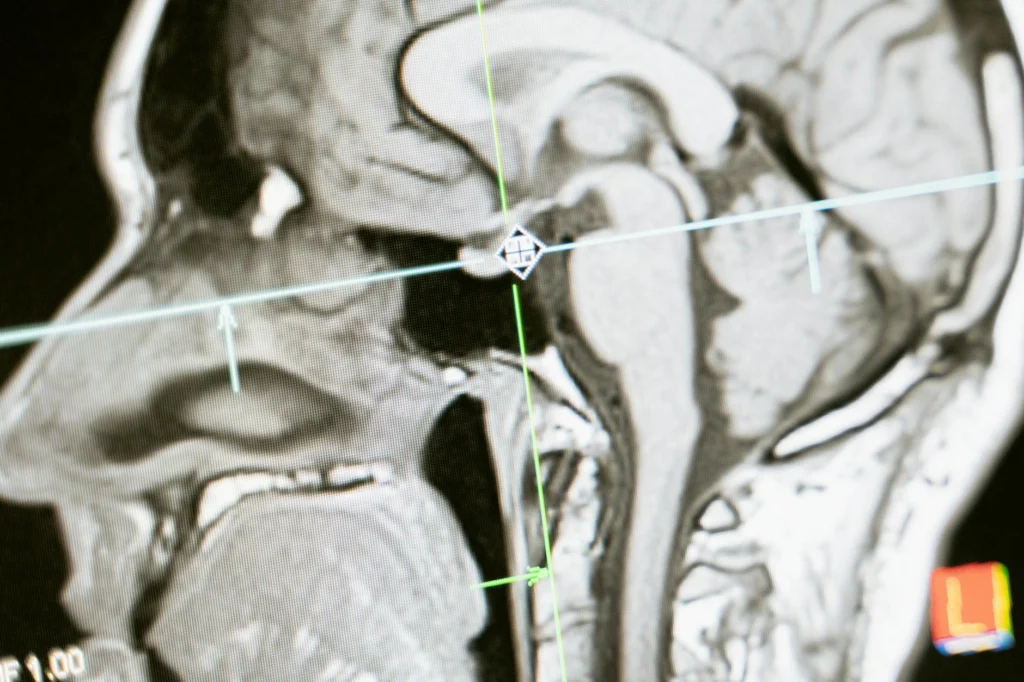
Process C is the circadian clock. It operates on an approximately 24-hour cycle governed by the suprachiasmatic nucleus (SCN), a cluster of about 20,000 neurons in the hypothalamus, positioned directly above the optic chiasm where the optic nerves cross. The SCN receives light information from specialized retinal ganglion cells containing a photopigment called melanopsin, and uses that signal to synchronize your internal clock with the external day-night cycle. Without light input, the human circadian period drifts to roughly 24.2 hours, which is why totally blind individuals often experience “free-running” sleep cycles that gradually shift out of alignment with social time.
The critical insight of the model is that Process S and Process C are independent. Process S does not know what time it is. Process C does not know how long you have been awake. Sleep onset occurs when the rising curve of Process S intersects with the declining alertness signal from Process C, typically in the evening. Waking occurs when Process S has discharged sufficiently (through sleep) and Process C’s alertness signal begins to rise, typically in the morning. A 2022 review by Borbély himself noted that the model’s core tenets have been confirmed repeatedly, including through forced desynchrony experiments where subjects live on artificial schedules to separate the two processes.
What Happens When You Sleep: The Architecture
Sleep is not a uniform state. It cycles through distinct stages in roughly 90-minute intervals, and each stage serves different biological functions. Understanding this architecture is necessary to understand why partial sleep loss causes the specific deficits it does.
Stage 1 (N1) is the transition from wakefulness to sleep. It lasts a few minutes, brain waves slow from alpha to theta frequencies, and you can be woken easily. It is not particularly interesting from a functional standpoint.
Stage 2 (N2) accounts for about 50% of total sleep time in adults. It features sleep spindlesBrief bursts of rapid brain-wave activity (12-14 Hz) that occur during stage 2 sleep (N2). Sleep spindles are actively involved in memory consolidation, particularly motor learning and procedural memory. (brief bursts of 12-14 Hz activity) and K-complexes (sharp negative waves followed by a slower positive component). Sleep spindles are not filler: they are actively involved in memory consolidation, particularly motor learning and procedural memory. The density of sleep spindles correlates with performance on memory tasks the following day.
Stage 3 (N3), or slow-wave sleep (SWS), is the deep sleep stage, characterized by delta waves (0.5-2 Hz, high-amplitude oscillations). This is where Process S primarily discharges. The amount of SWS you get in a night is directly proportional to how long you were awake before sleeping, which is the homeostatic system at work. SWS serves at least three documented functions:
- Memory consolidation: During SWS, the hippocampus replays recently encoded memories and transfers them to neocortical long-term storage through a process called systems consolidation. This is not metaphorical. Electroencephalography studies show coordinated replay of neural firing patterns from waking experience during slow-wave oscillations.
- Synaptic homeostasis: The synaptic homeostasis hypothesis, proposed by Giulio Tononi and Chiara Cirelli, holds that waking experience strengthens synaptic connections throughout the day, and SWS downscales them back to baseline. Without this recalibration, the brain would saturate. Think of it as defragmenting a hard drive, though with the caveat that the analogy understates the biological complexity by several orders of magnitude.
- Metabolic waste clearance: The glymphatic systemA metabolic waste clearance pathway in the brain that becomes active primarily during deep sleep. During slow-wave sleep, cerebrospinal fluid flushes through brain tissue to clear metabolic waste products, including amyloid-beta., a waste clearance pathway discovered in 2012 by Maiken Nedergaard’s lab, operates primarily during SWS. During deep sleep, norepinephrine levels drop, the interstitial spaces between brain cells expand by roughly 60%, and cerebrospinal fluid flushes through brain tissue, clearing metabolic waste products including amyloid-beta, the protein implicated in Alzheimer’s disease. A 2024 study in Cell showed that norepinephrine oscillations during NREM sleep drive rhythmic arterial constrictions that actively pump cerebrospinal fluid through perivascular spaces.
REM sleep is the stage associated with vivid dreaming, rapid eye movements, and voluntary muscle atonia (temporary paralysis, which prevents you from physically acting out dreams). REM sleep is under primarily circadian control, not homeostatic, which is why REM periods get longer toward morning as Process C’s influence increases. REM serves distinct functions from SWS:
- Emotional memory processing: REM sleep appears to strip the emotional charge from memories while preserving their informational content. Research from Matthew Walker’s lab at UC Berkeley has shown that REM sleep reduces amygdala reactivity to previously encountered emotional stimuli, essentially allowing you to remember what happened without re-experiencing the full emotional response.
- Creative integration: REM sleep facilitates the association of loosely related concepts. Studies show that subjects who reach REM sleep perform better on tasks requiring creative problem-solving and the detection of hidden patterns in data sets compared to those who sleep the same duration but are woken before REM onset.
The important structural point is this: SWS dominates the first half of the night, and REM dominates the second half. If you sleep five hours instead of eight, you get most of your SWS but lose a disproportionate amount of REM. If you go to bed three hours late, you shift the entire architecture. The loss is not evenly distributed.
Sleep Debt: What Accumulates and How
Sleep debt is not a metaphor. It is a measurable physiological deficit with documented cognitive, metabolic, and immunological consequences.
The most cited study on dose-response effects of chronic sleep restriction was published in 2003 by Hans Van Dongen, Greg Maislin, William Mullington, and David Dinges at the University of Pennsylvania. They randomized 48 healthy adults to one of three sleep conditions, maintained for 14 consecutive nights: 4 hours, 6 hours, or 8 hours of time in bed. Cognitive performance was tested daily using a battery that included the psychomotor vigilance task (PVT), a sustained attention test sensitive to sleep loss.
The results were striking. Subjects restricted to six hours per night showed a linear, cumulative decline in cognitive performance over the 14-day period. By day 14, their PVT performance was equivalent to someone who had gone 48 hours without any sleep at all. Subjects in the four-hour group declined faster and further. The eight-hour group showed no decline.
Here is what makes this study particularly important: subjects in the six-hour group rated their own sleepiness as only mildly elevated. They did not feel dramatically impaired. But their objective cognitive performance told a different story. Sleep debt accumulated steadily, and the subjective experience of sleepiness plateaued after a few days while the objective impairment kept getting worse. You stop feeling how impaired you are. This is the cognitive equivalent of a drunk person insisting they are fine to drive.
A 2023 study published in PLOS ONE by Ochab and colleagues attempted to quantify recovery dynamics from chronic sleep restriction. They found that after five nights of four-hour sleep, a single night of recovery sleep improved performance, but the improvement followed a dose-response curve: more recovery sleep produced more recovery, but even 10 hours of recovery sleep did not fully restore performance to baseline after just five days of restriction. The deficits were partially, not fully, reversible in the short term.
Why Weekend Recovery Sleep Does Not Fix the Problem
This brings us to the most practically important finding in modern sleep research, and the one most people do not want to hear.
In 2019, Kenneth Wright’s lab at the University of Colorado Boulder published a study in Current Biology titled “Ad libitum Weekend Recovery Sleep Fails to Prevent Metabolic Dysregulation during a Repeating Pattern of Insufficient Sleep and Weekend Recovery Sleep.” The experimental design was straightforward: three groups over a nine-day protocol. One group slept normally (9 hours). One was restricted to 5 hours per night for the duration. The third was restricted to 5 hours on weeknights but allowed to sleep as much as they wanted on the weekend, then returned to 5-hour nights.
The findings were bad news for the weekend recovery group:
- They did not fully recover their sleep debt during the weekend. They slept in, but not enough to erase the deficit.
- During the weekend, some metabolic markers improved modestly (reduced after-dinner snacking, slight improvements in insulin sensitivity).
- When they returned to restricted sleep on Monday, all improvements vanished. Worse, their insulin sensitivity was 9-27% lower than the group that had been sleep-restricted the entire time, with liver and muscle insulin sensitivity performing worse than the continuously restricted group.
The researchers’ interpretation was that the oscillation itself, the yo-yo pattern of restricting and recovering, may be independently harmful. Shifting meal timing, altering circadian alignment, then snapping back to restriction disrupts metabolic regulation in ways that steady (if insufficient) sleep does not.
A 2020 study of 12,637 adults in the general French population, published in Sleep Medicine, reinforced this at scale: only 16.8% of subjects with sleep debt managed to fully compensate via weekend catch-up sleep. Napping and weekend sleep combined still left the majority of the population carrying measurable deficits.
The picture is not entirely bleak. A 2024 study published in the European Heart Journal using UK Biobank accelerometer data from nearly 91,000 participants found that weekend catch-up sleep was associated with a 19% lower risk of heart disease among those who were sleep-deprived during the week. This suggests some cardiovascular benefit even from imperfect recovery. But the metabolic and cognitive data consistently show that weekend recovery is a partial patch, not a fix, and the pattern of restricting and recovering may carry its own costs.
The Circadian Dimension: Why Timing Matters as Much as Duration
Duration is only half the story. The circadian system means that when you sleep matters independently of how long you sleep.
Your SCN coordinates not just sleepiness and alertness but body temperature, cortisol release, melatonin secretion, immune function, and metabolic activity across every organ. All of these follow circadian rhythms. Shift workers who sleep adequate hours but at the wrong circadian phase show elevated rates of metabolic syndrome, cardiovascular disease, and certain cancers, even when total sleep duration is comparable to day workers. A 2022 meta-analysis of 32 observational studies found that night shift work was associated with a statistically significant increase in breast cancer risk (pooled odds ratio 1.11), with longer exposure durations carrying higher risk, likely mediated by circadian disruption of melatonin secretion and immune surveillance.
This is also why jet lag feels worse than simple sleep deprivation. When you fly across time zones, Process C is locked to your departure city’s light cycle while Process S responds to your actual wakefulness. The two processes are temporarily decoupled, and every system they regulate (digestion, alertness, hormone release) is receiving conflicting timing signals. Recovery takes roughly one day per time zone crossed eastward and slightly less westward, because the human circadian period is naturally slightly longer than 24 hours, making it easier to delay than to advance.
Social jet lagA chronic misalignment between a person's biological sleep-wake cycle (chronotype) and their social schedule. For example, a night owl forced to wake at 6 AM for work experiences daily jet-lag-like effects., a term coined by Till Roenneberg, describes the chronic version: the discrepancy between your biological chronotype (when your body wants to sleep) and your social schedule (when you have to sleep). An extreme night owl forced to wake at 6 AM for work is functionally jet-lagged every weekday. Studies have linked chronic social jet lag to higher BMI, increased depression risk, and worse academic performance, effects that persist even when total sleep duration is controlled for. The problem is not how much they sleep. It is when the sleeping happens relative to their internal clock, a misalignment that has downstream effects on everything from memory consolidation to metabolic regulation.
What Actually Works
If weekend catch-up sleep is a partial solution at best and potentially counterproductive at worst, the evidence points toward a less satisfying but more effective approach: consistency.
Consistent sleep schedule. Going to bed and waking up at roughly the same time every day (including weekends) keeps Process C properly aligned. The SCN responds to regularity. The most powerful zeitgeber (time-giver) is morning light exposure, so consistent wake times with early light exposure anchor the circadian system more effectively than any supplement.
Protecting the first half of the night. Because SWS is concentrated early and is homeostatically driven, the most damaging schedule change is going to bed late. A late bedtime truncates SWS, impairs glymphatic clearance, and disrupts the synaptic downscaling that prepares the brain for the next day’s learning. If you must lose sleep, losing it from the end of the night (waking early) preserves more SWS than losing it from the beginning.
Strategic napping. Brief naps (20-30 minutes) can partially offset accumulated sleep pressure without disrupting nighttime sleep architecture. Longer naps enter SWS and produce sleep inertia (the groggy period after waking from deep sleep). Napping does not repay sleep debt in full, but it reduces the acute cognitive impairment, particularly for tasks requiring sustained attention.
Light discipline. The SCN’s sensitivity to light means that evening light exposure (particularly blue-enriched light from screens) delays melatonin onset and shifts the circadian phase later. The practical implication is straightforward: bright light in the morning, dim light in the evening. This is one of the few sleep recommendations with an unambiguous mechanistic basis and strong experimental support.
There is no shortcut that replaces adequate, well-timed sleep. The two-process model explains why: Process S accumulates debt that must be repaid through actual sleep, and Process C punishes irregular timing independently of duration. The weekend catch-up strategy addresses neither process effectively. It partially reduces Process S pressure while actively disrupting Process C alignment, which is roughly equivalent to paying off one credit card by running up another. The nutrients your body needs for proper sleep regulation are part of the picture, but the regulatory architecture itself demands consistency above all.
This article covers general sleep science and is not medical advice. Individual sleep needs vary, and sleep disorders such as insomnia, sleep apnea, or circadian rhythm disorders require professional medical evaluation.
Sources
- Borbély, A. A. (2022). The two-process model of sleep regulation: Beginnings and outlook. Journal of Sleep Research.
- Van Dongen, H. P. A., et al. (2003). The cumulative cost of additional wakefulness: Dose-response effects on neurobehavioral functions. Sleep, 26(2), 117-126.
- Depner, C. M., et al. (2019). Ad libitum weekend recovery sleep fails to prevent metabolic dysregulation. Current Biology, 29(6), 957-967.
- Ochab, J. K., et al. (2023). Dynamics of recovery sleep from chronic sleep restriction. PLOS ONE.
- Léger, D., et al. (2020). Napping and weekend catchup sleep do not fully compensate for high rates of sleep debt. Sleep Medicine, 74, 261-268.
- Hauglund, N. L., et al. (2024). Norepinephrine-mediated slow vasomotion drives glymphatic clearance during sleep. Cell.
- Reddy, O. C. & van der Werf, Y. D. (2020). The sleeping brain: Harnessing the power of the glymphatic system through lifestyle choices. Brain Sciences, 10(11), 868.
- Purves, D., et al. (2001). Stages of Sleep. Neuroscience, 2nd edition. NCBI Bookshelf.
- Dun, A., et al. (2022). The relationship between night shift work and breast cancer incidence: A systematic review and meta-analysis of observational studies. Cancer Epidemiology.
- Song, Y., et al. (2024). Weekend compensatory sleep is associated with reduced risk of heart disease: a prospective UK Biobank-based cohort study. ESC Congress 2024.