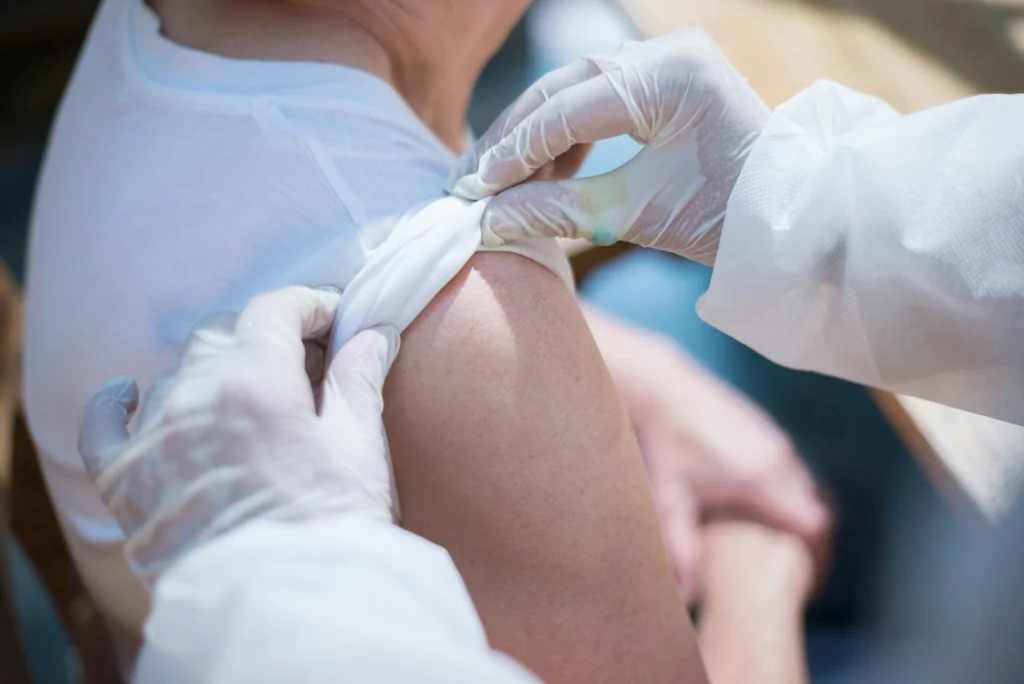
A vaccine designed to prevent a painful rash may be one of the most potent heart-protecting interventions discovered in years. A large study presented at the American College of Cardiology’s 2026 annual meeting found that people with heart disease who received a shingles vaccine were 46% less likely to suffer a major cardiac event within a year, and 66% less likely to die from any cause. The effect rivals what you would get from quitting smoking.
This is not an isolated finding. Over the past two years, studies spanning millions of patients across multiple countries have converged on the same signal: the shingles vaccine does something far beyond preventing shingles. It appears to protect against heart attacks, strokes, dementia, and possibly even biological aging itself. The question is no longer whether the association exists. It is why, and what it means for how we think about vaccines.
What the New Study Found
The study, led by Robert Nguyen, MD, a resident physician at the University of California, Riverside, analyzed the health records of 246,822 U.S. adults with atherosclerotic heart disease using the TriNetX database. Half had received at least one dose of either the Shingrix or Zostavax shingles vaccine. The other half had not. The two groups were matched for demographics and health conditions.
Between one month and one year after vaccination, the vaccinated group showed lower risk across every outcome measured:
- 46% lower risk of any major adverse cardiac event
- 66% lower risk of death from any cause
- 32% lower risk of heart attack
- 25% lower risk of stroke
- 25% lower risk of heart failure
“This vaccine has been found over and over again to have cardioprotective effects for reducing heart attack, stroke and death,” Nguyen said. “Looking at the highest risk population, those with existing cardiovascular disease, these protective effects might be even greater than among the general public.”
Why a Rash Vaccine Would Protect the Heart
Shingles is caused by varicella-zoster virus (VZV), the same virus behind chickenpox. After a childhood chickenpox infection, the virus retreats into nerve cells and stays dormant, sometimes for decades. When it reactivates, it causes shingles, a painful, blistering rash that can lead to lasting nerve pain.
But the damage is not limited to nerves. VZV can invade blood vessels, triggering inflammation, damaging vessel walls, and promoting blood clot formation. This vascular assault can lead to heart attacks, strokes, and venous blood clots. Even subclinical reactivations, where the virus stirs without producing a visible rash, may contribute to chronic vascular inflammation.
By preventing the virus from reactivating, the shingles vaccine may be cutting off this cascade of vascular damage at its source.
This is Not a Single Study
The ACC.26 findings land on top of a growing pile of evidence:
In May 2025, a Korean study of more than 1.27 million people published in the European Heart Journal found that shingles vaccination was associated with a 23% lower risk of cardiovascular events overall. The protection lasted up to eight years and was strongest in men, people under 60, and those with unhealthy lifestyles like smoking or inactivity.
In August 2025, a global systematic review presented at the European Society of Cardiology Congress analyzed 19 studies and found, in a meta-analysis of nine that met inclusion criteria, an 18% reduction in cardiovascular events among vaccinated adults aged 18 and older, with 1.2 to 2.2 fewer events per 1,000 person-years.
The new ACC.26 study is notable because it focused specifically on the highest-risk group: people who already have atherosclerotic heart disease. And in that population, the effect was roughly twice as large as in the general population.
The Dementia Connection
Cardiovascular protection is only part of the story. A Stanford-led study published in Nature in 2025 exploited a natural experiment in Wales where a sharp age cutoff determined who could receive the shingles vaccine. People born just one week apart ended up on opposite sides of vaccine eligibility, creating conditions close to a randomized trial.
The result: vaccinated individuals were 20% less likely to develop dementia over seven years. A follow-up study in Cell found that among people who already had dementia, those who received the vaccine were significantly less likely to die from the disease, suggesting the vaccine may slow its progression.
The research team has since replicated the Wales findings in health records from England, Australia, New Zealand, and Canada. “We just keep seeing this strong protective signal for dementia in dataset after dataset,” said Pascal Geldsetzer, the Stanford researcher leading the work.
Slowing Aging Itself?
In January 2026, a USC study published in the Journals of Gerontology added another dimension. Researchers examined over 3,800 Americans aged 70 and older and found that those who had received the shingles vaccine showed slower biological aging on multiple measures: lower inflammation, slower epigenetic agingThe gradual accumulation of changes in gene activity patterns over time, used as a biological clock to estimate how fast the body is aging at a molecular level. (changes in how genes are switched on and off), and slower transcriptomic aging (changes in gene activity).
The researchers pointed to “inflammagingChronic, low-level inflammation that accumulates with age and drives age-related diseases such as heart disease, dementia, and frailty.,” the chronic, low-level inflammation that drives many age-related diseases, including heart disease, frailty, and cognitive decline. By preventing viral reactivation, the vaccine may be tamping down this background inflammation, producing health benefits that extend well beyond rash prevention.
The Catch: Healthy User BiasThe tendency for people who seek preventive health measures to also have healthier overall lifestyles, making those interventions appear more effective than they actually are.
There is a real limitation that runs through nearly all of this research, and the study authors are upfront about it. People who get vaccinated tend to be healthier in general. They visit doctors more often, exercise more, eat better. This “healthy user bias” means that some of the observed benefit may reflect the overall health of vaccinated people rather than the vaccine itself.
The ACC.26 researchers controlled for several socioeconomic and health factors, but acknowledged that the study may overestimate benefits independently attributable to preventing shingles. The ESC meta-analysis noted the same limitation: almost all evidence comes from observational studies, which cannot prove causation.
The Wales dementia study offers the strongest counterargument. Its natural experiment design, where a one-week age difference determined vaccine eligibility, largely neutralizes healthy user bias because both groups were equally likely to want the vaccine. Only one group was allowed to get it.
What This Means
No one is suggesting the shingles vaccine will replace statins or blood pressure medication. But the convergence of evidence from cardiac, neurological, and aging research points to a broader principle: chronic viral infections exact a slow, hidden toll on the body, and preventing them may yield benefits far beyond the obvious.
The CDC already recommends the shingles vaccine for all adults 50 and older. For the roughly one in three people who will develop shingles in their lifetime, the vaccine prevents a painful illness. For a potentially much larger group, it may be quietly reducing the risk of the leading killers of older adults.
Randomized controlled trials, the gold standard, are now being planned. Until those results arrive, the observational evidence is the most consistently positive signal in preventive cardiology in years.
This article is for informational purposes only and does not constitute professional advice.
A retrospective cohort study presented at ACC.26 found that herpes zoster vaccination in patients with established atherosclerotic cardiovascular disease (ASCVD) was associated with a 46% relative risk reduction in major adverse cardiac events (MACE) and a 66% reduction in all-cause mortality at one year. The effect sizesA standardized measure of the magnitude of difference between groups in a study, independent of sample size. substantially exceed prior population-level estimates and raise important questions about the mechanisms linking varicella-zoster virus (VZV) reactivation to cardiovascular pathology.
Study Design and Results
Robert Nguyen, MD (University of California, Riverside) and colleagues queried the TriNetX federated electronic health record database, identifying 246,822 U.S. adults aged 50+ with diagnosed ASCVD between 2018 and 2025. Propensity-matched cohorts of 123,411 vaccinated (at least one dose of Shingrix or Zostavax) and 123,411 unvaccinated individuals were compared on outcomes occurring between 1 and 12 months post-vaccination.
Hazard ratios for the vaccinated group:
- MACE: HR 0.54 (46% relative risk reduction)
- All-cause mortality: HR 0.34 (66% RRR)
- Myocardial infarction: HR 0.68 (32% RRR)
- Stroke: HR 0.75 (25% RRR)
- Heart failure: HR 0.75 (25% RRR)
Nguyen characterized these reductions as “comparable to what would be expected from quitting smoking.”
Context: Prior Cardiovascular Evidence
The ACC.26 data follows two major prior findings:
Korean population cohort (European Heart Journal, 2025). Lee et al. analyzed 1,271,922 South Korean adults aged 50+ who received the live zoster vaccine (ZVL). Vaccination was associated with a 23% lower risk of any cardiovascular event (HR ~0.77), a 26% lower risk of MACE, and a 26% lower risk of heart failure. The protective effect persisted for up to eight years, with strongest efficacy in the two-to-three-year window post-vaccination. Subgroup analysis showed stronger associations in men, adults under 60, and individuals with unhealthy lifestyle profiles (smokers, heavy drinkers, sedentary).
ESC 2025 global meta-analysis. Williams et al. (GSK/ESC) conducted the first systematic review and meta-analysis assessing herpes zoster vaccination and cardiovascular outcomes. The systematic review identified 19 studies; nine met meta-analysis inclusion criteria (eight observational, one pooled RCT safety analysis). Vaccination with either RZV or ZVL was associated with pooled risk ratios of 0.82 (95% CI 0.76-0.87) in adults 18+ and 0.84 (0.82-0.87) in adults 50+. The absolute rate difference was 1.2 to 2.2 fewer cardiovascular events per 1,000 person-years.
The new ACC.26 study extends this by focusing specifically on the ASCVD population, where baseline cardiovascular risk is highest, and finding effect sizes roughly double those seen in general-population studies. This dose-response pattern, where sicker patients show larger absolute and relative benefit, is consistent with a genuine biological effect rather than pure confounding.
Proposed Mechanisms
Multiple pathways have been proposed for VZV-mediated cardiovascular damage:
Direct vascular invasion. VZV can reactivate from trigeminal and autonomic ganglia and travel transaxonally to cerebral and coronary arteries. Virus in the vessel wall induces a noncytolytic infection of smooth muscle cells and functional damage to the vascular endothelium, promoting thrombosis and pathological vascular remodeling.
Systemic inflammation. Herpes zoster infection triggers release of proinflammatory cytokinesSmall signaling proteins released by immune cells to coordinate inflammation. Elevated levels are consistently found in patients with depression. (IL-6, IL-1-beta, TNF-alpha, IFN-gamma), IL-8 as a neutrophil chemoattractant, and matrix metalloproteinases that can destabilize atherosclerotic plaqueBuildup of fatty deposits, cholesterol, and other substances in artery walls that narrows blood vessels. The primary cardiovascular evidence linking microplastics to heart disease comes from studies of plaque removed during surgery.. This inflammatory cascade may trigger plaque rupture and acute coronary events.
InflammagingChronic, low-level inflammation that accumulates with age and drives age-related diseases such as heart disease, dementia, and frailty. suppression. A January 2026 USC study (Kim and Crimmins, Journals of Gerontology Series A) examined 3,800+ Americans aged 70+ from the Health and Retirement Study. Vaccinated individuals showed significantly lower inflammatory markers, slower epigenetic agingThe gradual accumulation of changes in gene activity patterns over time, used as a biological clock to estimate how fast the body is aging at a molecular level. (DNA methylation clocks), and slower transcriptomic aging. The authors attributed this to reduced “inflammaging,” the chronic low-grade inflammation driven partly by persistent viral reactivation that accelerates cardiovascular disease, frailty, and neurodegeneration. The effect persisted four or more years post-vaccination.
Trained immunityThe ability of innate immune cells to respond more effectively to future infections after prior exposure, without relying on classical antibody-based memory.. Some evidence suggests that vaccination may reprogram innate immune cells to respond more effectively to future threats, a phenomenon called trained immunity. Whether Shingrix’s adjuvantA substance added to vaccines to enhance the immune response, improving protection without being the target antigen itself. system (AS01B, containing MPL and QS-21) contributes to this effect beyond VZV-specific immunity is an open question.
The Dementia Signal
The cardiovascular findings intersect with a parallel line of evidence on neurodegeneration. Geldsetzer et al. (Stanford) exploited a natural experiment in Wales where a sharp birth-date cutoff on September 1, 2013 determined eligibility for the ZVL. Using regression discontinuity analysis on 280,000+ health records, they found a 20% reduction in dementia diagnosis over seven years among those eligible for vaccination (published in Nature, April 2025).
A follow-up study in Cell (December 2025) extended this to patients with existing dementia, finding that vaccinated individuals were significantly less likely to die from dementia. Among the 7,049 individuals who had dementia at program onset, roughly 30% of vaccinated patients died from dementia during follow-up versus approximately half of unvaccinated patients.
The Wales design is methodologically significant because it largely eliminates healthy user biasThe tendency for people who seek preventive health measures to also have healthier overall lifestyles, making those interventions appear more effective than they actually are.: both groups were equally likely to want the vaccine, but only one group was permitted to receive it. The findings have been replicated in datasets from England, Australia, New Zealand, and Canada.
Limitations and the Confounding Problem
The dominant limitation across this literature is confounding by health-seeking behavior. The ACC.26 researchers explicitly acknowledged that vaccinated individuals may tend toward healthier behaviors, and that controlling for socioeconomic variables (housing, employment, education) may not fully capture these differences. The 66% all-cause mortality reduction is particularly striking and may partly reflect residual confounding.
The ESC meta-analysis noted that almost all included evidence was observational, with only one pooled RCT safety analysis, which was not designed or powered to evaluate cardiovascular endpoints.
However, several features of the evidence argue against pure confounding:
- The Wales natural experiment design, which approximates randomization, shows a consistent protective signal for dementia
- Effect sizes are larger in higher-risk populations (ASCVD patients), consistent with a biological mechanism rather than healthy-user artifact
- The Korean study found stronger effects in people with unhealthy lifestyles, the opposite of what healthy user bias would predict
- The USC biological aging study identifies plausible molecular mediators (reduced inflammation, slower epigenetic drift)
- Replication across multiple countries, healthcare systems, and populations
Clinical Implications
The CDC recommends herpes zoster vaccination for all adults 50+ and immunocompromised younger adults. The current evidence does not yet justify changing these guidelines based on cardiovascular indication alone, as no RCT has been powered for cardiovascular endpoints.
What it does suggest is that the benefit-to-risk calculation for the shingles vaccine is substantially more favorable than its approved indication alone would imply. For clinicians encountering vaccine hesitancyReluctance or refusal to vaccinate despite vaccine availability, driven by factors such as distrust, safety concerns, or complacency rather than lack of access. in patients with established cardiovascular disease, the accumulating evidence provides a meaningful additional argument for vaccination.
Geldsetzer’s group at Stanford is pursuing a randomized controlled trial of the live-attenuated vaccine (now off-patent) with dementia as a primary endpoint. If similar trials for cardiovascular endpoints follow, they would either confirm one of the most cost-effective cardiovascular interventions available or reveal healthy user bias as the primary driver. Either outcome would be valuable.
This article is for informational purposes only and does not constitute professional advice.