Every satellite circling Earth right now is falling. Not drifting. Not floating. Falling. The International Space Station, GPS satellites, weather monitors: all of them are in a constant, uninterrupted free fall toward the planet’s surface. The reason they never hit the ground is one of the most elegant ideas in physics, and it starts with a cannon on top of an impossibly tall mountain.
Newton’s Cannonball: The Thought Experiment That Changed Everything
In the early 18th century, Isaac Newton proposed a thought experiment in his work De mundi systemate. Imagine placing a cannon on a mountain so tall it pokes above the atmosphere. Fire the cannonball horizontally. At low speed, it arcs downward and hits the ground. Fire it faster, and it travels farther before landing. But Newton realized that at just the right velocity, the cannonball’s curved path would match the curvature of the Earth itself. The ground would keep falling away beneath it at exactly the same rate the ball fell toward it.
The cannonball would never land. It would just keep falling, endlessly, in a circle around the planet. That is an orbit.
The Balancing Act: Speed vs. Gravity
An orbit is a tug-of-war between two things: the object’s forward momentum (its tendency to keep moving in a straight line) and gravity (the force pulling it toward Earth). As NASA explains, if the forward momentum is too great, the object speeds past Earth and escapes. If momentum is too small, the object falls and crashes. When the two are balanced, the object continuously falls toward the planet but moves sideways fast enough that it never makes contact.
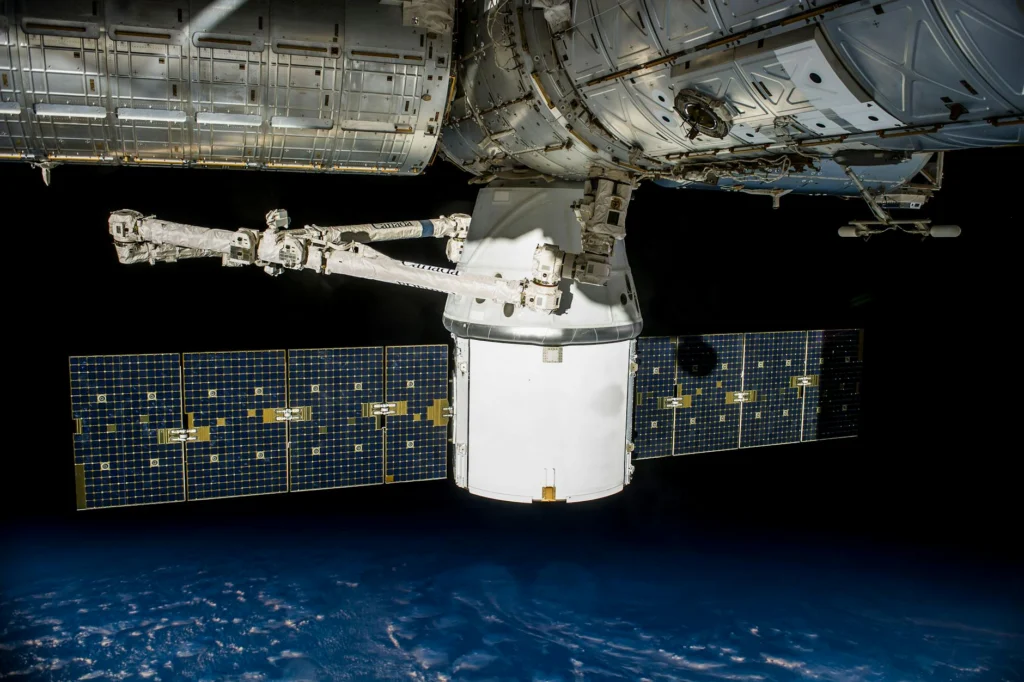
This is why astronauts on the ISS experience weightlessness. They are not beyond the reach of gravity. At the station’s altitude, Earth’s gravitational pull is still about 90% as strong as on the surface. The astronauts feel weightless because they, and the station, are all falling together at the same rate. It is the same sensation you feel at the top of a roller coaster drop, except it never ends.
How Fast Is Fast Enough?
The speed needed to stay in orbit depends on how close you are to Earth. According to the European Space Agency, satellites in low Earth orbit travel at approximately 7.8 kilometers per second, completing one lap around the planet in about 90 minutes. That is roughly 28,000 km/h. The ISS circles Earth about 16 times every day.
Go higher, and the required speed drops. NOAA notes that a satellite orbiting closer to Earth needs more velocity to resist the stronger gravitational pull. At geostationary altitude (about 35,786 km up), satellites travel at about 3 km/s and take nearly 24 hours to complete one orbit, which is why they appear to hover over the same spot on Earth’s surface.
This is not a coincidence. It is the fundamental relationship between altitude and orbital speed: the farther from Earth, the weaker the gravitational pull, so the less speed is needed to balance it.
No Engine Required
One of the most common misconceptions about satellites is that they need constant thrust to stay up. They do not. As the Institute of Physics explains, once a satellite is released from its rocket at the correct speed and altitude, it continues at that speed on its own. “The satellite speeds up only for as long as the rocket thrust is acting. Once the rocket motor is switched off the satellite continues at the final speed achieved, neither speeding up nor slowing down.”
NOAA confirms that the initial speed a satellite has when it separates from the launch vehicle “is enough to keep a satellite on orbit for hundreds of years.” Satellites carry fuel, but not for maintaining their orbit. It is reserved for occasional adjustments: changing orbit, avoiding debris, or compensating for subtle drag effects.
The Atmosphere Still Reaches Up
Even hundreds of kilometers above the surface, traces of Earth’s atmosphere persist. For satellites in low Earth orbit, this thin air creates drag, slowly pulling them closer to Earth. NOAA’s Space Weather Prediction Center reports that during quiet solar periods, LEO satellites need to boost their orbits about four times per year. But when the Sun is active, heating and expanding the upper atmosphere, satellites may need maneuvers every two to three weeks.
Solar storms can make things dramatically worse. During the March 1989 geomagnetic storm, NASA’s Solar Maximum Mission spacecraft reportedly “dropped as if it hit a brick wall” from the sudden spike in atmospheric drag.
The Speed Paradox
Orbital mechanics produces one truly head-scratching result. If a satellite operator wants to catch up to another object ahead in the same orbit, firing the thrusters forward will not work. NASA’s Earth Observatory explains the paradox: firing thrusters forward boosts the satellite to a higher orbit, which actually slows it down. To speed up, the operator must fire thrusters backward, dropping the satellite to a lower orbit where it moves faster.
This is why orbital rendezvous maneuvers, like docking with the ISS, are not as simple as pointing and accelerating. Every intuition from driving a car on a highway breaks down in orbit.
Why It Matters
Understanding orbits is not just academic. Over 20,000 tracked objects now orbit Earth, and that number grows every year. Weather forecasting, GPS navigation, internet connectivity, climate monitoring, and military surveillance all depend on satellites maintaining precise orbits. The physics of controlled falling is the invisible infrastructure beneath modern civilization.
Every one of those satellites shares a secret with Newton’s imaginary cannonball: they stay up by falling down, fast enough that the ground never arrives.
Every artificial satellite in Earth orbit is in continuous free fall toward Earth’s center of mass. What prevents impact is tangential velocity: the satellite’s horizontal speed is sufficient that the surface curves away at the same rate the satellite descends. This condition, first formalized by Newton and refined by Kepler’s laws and Newtonian gravity, is the foundation of all orbital mechanics.
Newton’s Cannonball and the Orbital Velocity Condition
In De mundi systemate (published posthumously in 1728), Newton described a cannon firing horizontally from a mountaintop above the atmosphere. At a specific velocity, “the trajectory of the cannonball would curve at exactly the same rate the Earth (being spherical) curves, and therefore the cannonball would always stay the same height above the ground.” The result: the cannonball “orbits the Earth, always accelerating toward the Earth, but never getting any closer.”
This is the key insight. The acceleration is centripetal, directed radially inward. It changes the velocity vector’s direction without changing its magnitude. For a circular orbit, the relationship between orbital velocity, gravitational acceleration, and orbital radius is:
v² = a × r
Where a is the gravitational acceleration at radius r from Earth’s center. Since gravitational acceleration follows the inverse-square law (a = GM/r²), the orbital velocity for a circular orbit simplifies to:
v = √(GM/r)
Where G is the gravitational constant (6.674 × 10⁻¹¹ N·m²/kg²) and M is Earth’s mass (5.972 × 1024 kg). This single equation governs every circular orbit around Earth.
Velocity-Altitude Relationship: The Numbers
Plugging in the numbers for different altitudes reveals the inverse relationship between orbital height and speed:
- Surface level (theoretical): 7.91 km/s
- ISS orbit (408 km): 7.67 km/s, period 92.6 minutes
- Sun-synchronous orbit (~800 km): approximately 7.5 km/s
- GPS constellation (~20,200 km): ~3.87 km/s, period 12 hours
- Geostationary orbitAn orbit at ~35,786 km altitude where a satellite's orbital period matches Earth's rotation, making it appear stationary above one point. (35,786 km): approximately 3.07 km/s, period 23h 56m 4s (one sidereal day)
NASA’s Earth Observatory confirms this inverse relationship: “As satellites get closer to Earth, the pull of gravity gets stronger, and the satellite moves more quickly.”
Kepler’s Laws and Elliptical Orbits
Circular orbits are a special case. Most real orbits are elliptical, governed by Kepler’s three laws: (1) orbits are ellipses with the central body at one focus, (2) a line from the orbiting body to the central body sweeps equal areas in equal time intervals, and (3) the square of the orbital period is proportional to the cube of the semi-major axis.
Kepler’s second law (the equal-area law) is a direct consequence of conservation of angular momentum. For an elliptical orbit, this means the satellite moves fastest at periapsisThe closest point in an orbit to the body being orbited. A satellite moves fastest here due to conservation of angular momentum. (closest approach) and slowest at apoapsis (farthest point). The Molniya orbit exploits this: its high eccentricity (0.722) means the satellite spends roughly two-thirds of its 12-hour period over high latitudes, moving slowly near apogee, then swinging rapidly through perigee.
The Velocity Threshold Spectrum
The Institute of Physics identifies three regimes: below orbital velocity, the object falls to Earth; at orbital velocity, it maintains a stable orbit; above escape velocity, it leaves Earth’s gravitational influence entirely.
Escape velocity is exactly √2 times the circular orbital velocity at any given altitude. At Earth’s surface, orbital velocity is 7.91 km/s and escape velocity is 11.19 km/s. The ratio is precisely √2 ≈ 1.414, a consequence of the relationship between kinetic energyThe energy an object possesses due to its motion. A mass moving at high speed carries kinetic energy proportional to its mass and the square of its velocity, determining its destructive capacity upon impact. in a circular orbit and the gravitational potential energy that must be overcome. Between these two thresholds, the object follows an elliptical orbit. At exactly escape velocity, the trajectory is parabolic; above it, hyperbolic.
Perturbations: Why Orbits Are Not Perfect
In a two-body point-mass system, orbits are stable indefinitely. Real orbits degrade because of perturbations:
Atmospheric drag is the dominant perturbation for LEO satellites. NOAA’s Space Weather Prediction Center notes that “although the air density is much lower than near the Earth’s surface, the air resistance in those layers of the atmosphere where satellites in LEO travel is still strong enough to produce drag and pull them closer to the Earth.” The drag force varies with the solar cycle: during solar maximum, UV radiation heats and expands the thermosphere, increasing density at orbital altitudes. LEO satellites need reboosts about four times per year during solar minimum, escalating to every two to three weeks during solar maximum.
Orbital decay creates a positive feedback loop: lower altitude means denser atmosphere, which means more drag, which means faster descent. During the March 1989 geomagnetic storm, the sudden expansion of the upper atmosphere caused NASA’s Solar Maximum Mission to “drop as if it hit a brick wall.”
Earth’s oblateness (the J2 perturbation) causes orbital plane precession, which is actually exploited for Sun-synchronous orbits. Third-body effects from the Moon and Sun become significant for high-altitude orbits. Solar radiation pressure affects satellites with large surface-area-to-mass ratios.
The Orbital Speed Paradox
One of the most counterintuitive results in orbital mechanics: to go faster, you must first slow down. NASA explains that firing thrusters in the direction of travel raises the orbit, which decreases average orbital speed. To increase speed, you fire thrusters retrograde (against the direction of motion), dropping to a lower orbit where the required velocity is higher.
This is why orbital rendezvous is non-trivial. To catch an object ahead of you in the same orbit, you must drop to a lower, faster orbit, gain ground, then raise your orbit back up when you are in position. The Hohmann transferA fuel-efficient orbital maneuver using two engine burns to move a spacecraft between two circular orbits at different altitudes., the most fuel-efficient two-impulse maneuver between circular coplanar orbits, relies on this principle: a retrograde burn at the higher orbit drops to an elliptical transfer orbit, followed by a prograde burn at the lower orbit to circularize.
Propellantless Orbits and the Conservation Principle
The Institute of Physics emphasizes the fundamental principle: once at orbital velocity, a satellite requires no propulsion to maintain its orbit. “Once the rocket motor is switched off the satellite continues at the final speed achieved, neither speeding up nor slowing down.” In a vacuum, with no perturbations, an orbit persists indefinitely by the conservation of energy and angular momentum.
NOAA reports that the initial velocity from launch “is enough to keep a satellite on orbit for hundreds of years.” The GOES-3 satellite operated for 38 years before being decommissioned to a graveyard orbit. At geostationary altitude, atmospheric drag is negligible, and the primary perturbations are gravitational (lunisolar effects and Earth’s triaxiality).
The Crowded Sky
The practical consequence of these physics is that Earth orbit is filling up. More than 25,000 artificial objects have been catalogued since 1957, with approximately 500,000 fragments in the 1-10 cm “lethal” range that cannot be individually tracked but can destroy a satellite on impact. The 2009 collision between an Iridium and a Cosmos satellite at 790 km altitude demonstrated that the physics of orbital velocity cuts both ways: the same speeds that keep objects in orbit make collisions catastrophically energetic.
Every satellite, every piece of debris, every bolt lost during a spacewalk follows the same Newtonian mechanics. They are all Newton’s cannonballs, perpetually falling around a planet that perpetually curves away beneath them.