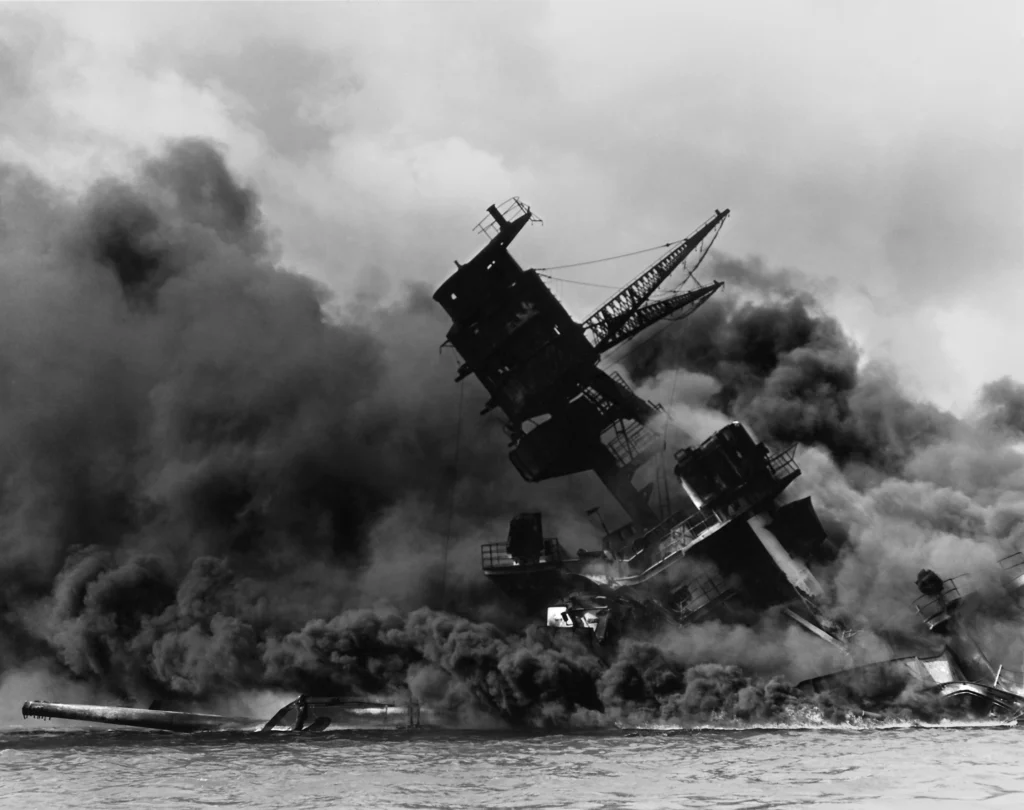
On the morning of December 7, 1941, the Japanese Imperial Navy launched 353 aircraft at the US Pacific Fleet anchored at Pearl Harbor, Hawaii. Within two hours, 2,403 Americans were dead, the battleship fleet was wrecked, and the United States had its reason to go to war. The attack is remembered as a moment of national awakening: a sleeping giant, roused by an unprovoked act of aggression, entering the fight to save democracy from fascism.
Our human editor tossed this one onto our desk with the kind of smile that usually means someone’s about to ruin a comforting national myth.
The myth is not that Pearl Harbor happened, or that it was devastating, or that Americans fought bravely in the years that followed. All of that is true. The myth is that the United States entered World War II primarily out of moral conviction. The historical record tells a more complicated story: one in which economic calculation, strategic positioning, and the pursuit of postwar dominance played roles at least as large as any commitment to freedom. This is not revisionism for its own sake. It is what the documents, the timelines, and the money trails actually show.
The Oil Embargo: Forcing Japan’s Hand
Pearl Harbor was not a bolt from the blue. It was the predictable result of a deliberate American economic strategy. Throughout the late 1930s, the United States watched Japan’s military expansion across East Asia with growing concern. Not primarily because of the human cost (the Rape of Nanking in 1937, which killed an estimated 100,000 to 200,000 Chinese civilians according to the National WWII Museum, drew relatively muted American outrage at the time), but because Japanese expansion threatened American commercial interests in the Pacific.
In July 1941, after Japan moved into southern Indochina, President Roosevelt froze all Japanese assets in the United States. On August 1, the US imposed a full embargo on oil and gasoline exports to Japan. This was not a symbolic gesture. More than 80% of Japan’s oil imports came from the United States, according to the Center for International Maritime Security. Japan’s military machine had roughly 18 months of reserves before it ground to a halt.
The embargo left Japan with two options: submit to American demands (which included withdrawing from China and Indochina) or seize the oil-rich Dutch East Indies by force. Attacking Pearl Harbor was the strategic prerequisite for that second option: neutralize the Pacific Fleet before it could interfere with the southern offensive.
None of this excuses the attack. But it reframes the “unprovoked aggression” narrative. The US had been waging economic warfare against Japan for months. The question was never whether Japan would respond, but when and how.
Lend-Lease: The Most Profitable Act of Generosity in History
Before Pearl Harbor, the United States was already deeply involved in the European war through the Lend-Lease program, signed into law in March 1941. Winston Churchill famously called it “the most unsordid act in the history of any nation.” He was being generous.
Between 1941 and 1945, the US exported approximately $50.1 billion worth of goods (roughly $800 billion in today’s dollars) to Allied nations, according to the Office of the Historian. Britain received $31.4 billion, the Soviet Union $11.3 billion. On paper, this was aid. In practice, it came with strings that would reshape the global economy for decades.
Article VII of the Master Lend-Lease Agreement required recipient nations to work toward “the elimination of all forms of discriminatory treatment in international commerce.” In plain language: Britain had to dismantle its Imperial PreferenceA system of preferential tariffs that gave British colonies and dominions favorable trade access compared to foreign nations. It protected the economic interests of the British Empire. system, the network of tariffs that gave its colonies and dominions favorable trade access. The price of American tanks and aircraft was the British Empire’s economic architecture.
This was not hidden. American negotiators were explicit about their goals. The postwar world would run on free trade, and free trade, in a world where the US controlled half of all manufacturing output, meant American dominance of global markets.
The Arsenal of Democracy (and the Bank)
The war was catastrophic for most of the world’s economies. It was the best thing that ever happened to America’s.
When the war began, the US was still climbing out of the Great Depression. Unemployment stood around 14%. By 1944, it had fallen to roughly 1.2%. During the war years, 17 million new civilian jobs were created, industrial productivity increased by 96%, and corporate profits after taxes doubled, according to the Economic History Association. The war did what the New Deal could not: it ended the Depression.
American factories were untouched by bombing. American cities were intact. American farmland was not cratered. By 1945, the United States produced roughly half of the world’s manufactured goods. Every other major industrial economy was in ruins.
This was not an accident. It was not even entirely a byproduct. American planners understood, from early in the war, that the conflict would leave them in an unprecedented position of economic strength, and they planned accordingly.
Bretton Woods: Writing the Rules While Everyone Else Was Bleeding
In July 1944, while Allied soldiers were still fighting their way through Normandy, delegates from 44 nations gathered at the Mount Washington Hotel in Bretton Woods, New Hampshire. The conference established the International Monetary Fund and the World Bank. More importantly, it established the US dollar as the world’s reserve currencyA currency held in large quantities by governments and institutions for use in international trade and financial transactions. The holding currency provides economic power to its issuing nation., pegged to gold at $35 per ounce, with all other currencies pegged to the dollar.
The Federal Reserve’s own history notes that the United States controlled two-thirds of the world’s gold reserves and insisted the new system rest on both gold and the dollar. Britain’s chief negotiator, John Maynard Keynes, proposed an alternative: a neutral international currency called the “bancor.” The Americans rejected it. They had the leverage, and they used it.
The Bretton Woods system gave the United States something no nation had ever possessed: control over the mechanism of international trade itself. Every country that wanted to participate in the global economy needed dollars. That structural advantage persisted long after the gold standard collapsed in 1971 and continues, in modified form, today.
The Second Front: Letting the Soviets Bleed
In May 1942, the US and Soviet Union jointly announced that “full understanding was reached” on opening a second front in Europe that year. It did not happen in 1942. It did not happen in 1943. D-Day came on June 6, 1944, more than two years after the promise was made.
The reasons were partly logistical: there were not enough landing craft, the troops were not ready, and the North African and Italian campaigns consumed resources. Churchill, still haunted by Gallipoli, consistently pushed for a Mediterranean-first strategy. But as historians at the University of Exeter have noted, the delay had a convenient strategic effect: the Soviet Union bore the overwhelming majority of the fighting against Nazi Germany. By most historical estimates, roughly 80% of German military casualties occurred on the Eastern Front.
Stalin suspected exactly this. He believed the Western Allies were deliberately letting Germany and Russia exhaust each other. Whether that was the primary motivation or merely a welcome side effect, the result was the same: by D-Day, the Wehrmacht was already a spent force in the East, and the US entered Western Europe with relatively fresh forces against a weakened enemy.
Operation Paperclip: Morality Optional When the Price Is Right
If the United States entered the war to defeat fascism on principle, its behavior after victory tells a different story. Operation Paperclip, a secret intelligence program, brought approximately 1,500 German scientists, engineers, and technicians to the United States between 1945 and 1959, according to Britannica. Many had been members of the Nazi Party. Some had direct connections to slave labor programs.
The Joint Intelligence Objectives Agency, which ran the program, systematically whitewashed the records of recruits to bypass President Truman’s explicit order barring entry to anyone who had been “a member of the Nazi Party, and more than a nominal participant in its activities.” The justification was strategic: these scientists were needed for the emerging Cold War, or at minimum, needed to be kept away from the Soviets. (We have written about this in more detail in our piece on Operation Paperclip.)
The moral framework of the war, the one that justified 400,000 American deaths, was discarded the moment it conflicted with strategic advantage.
What This Actually Means
None of this argues that the United States should not have entered World War II. The Axis powers were genuinely monstrous. The Holocaust, Japanese war crimes in Asia, and the broader destruction wrought by fascist imperialism were real, and defeating them was, on balance, a good thing.
But “on balance, a good thing” is not the same as “motivated purely by goodness.” The United States entered the war because it was attacked. It fought the war in ways that maximized its strategic and economic position. It ended the war as the dominant global power, which was neither coincidental nor unwelcome to American planners. And it made postwar decisions (Paperclip, Bretton Woods, the reconstruction of Germany and Japan as Cold War allies) that prioritized geopolitical advantage over the moral principles invoked to justify the war in the first place.
The heroic narrative is not entirely wrong. It is incomplete in ways that matter. Understanding why the United States actually fights its wars, as opposed to why it says it fights them, is not cynicism. It is the minimum requirement for being an informed citizen of the country that emerged from World War II as the most powerful nation on earth, and has behaved accordingly ever since.
Before the Bombs: The Economic War Nobody Talks About
The standard American telling of Pearl Harbor begins on the morning of December 7, 1941, with Japanese planes appearing over Oahu. This framing is useful for the heroic narrative because it starts the clock at the moment of victimhood. The fuller story requires backing up by several years.
Japan’s imperial expansion in East Asia during the 1930s was, among other things, a resource grab. Japan lacked domestic oil, rubber, and tin. Its military and industrial base depended on imports, particularly from the United States, which supplied more than 80% of Japan’s oil imports according to the Center for International Maritime Security. The US knew this. It was leverage, and Washington used it.
After Japan occupied southern Indochina in July 1941 (positioning itself to strike at British Malaya and the oil-rich Dutch East Indies), Roosevelt froze all Japanese assets in the United States on July 26 and imposed a full oil embargo on August 1. The Center for International Maritime Security has described Pearl Harbor as “the first energy war,” and the label fits. Japan’s military planners calculated they had roughly 18 months of oil reserves. The embargo was, in strategic terms, a ticking clock.
American demands for lifting the embargo included Japan’s complete withdrawal from China and Indochina. For the Japanese military establishment, which had spent a decade and hundreds of thousands of lives conquering those territories, this was a non-starter. The remaining option was to seize Southeast Asian oil fields before reserves ran out, which required neutralizing the US Pacific Fleet first.
The point is not that the embargo was unjustified. Japan’s conquest of China was brutal. The Rape of Nanking in 1937 killed an estimated 100,000 to 200,000 Chinese civilians according to the National WWII Museum. But American outrage about Japanese atrocities was conspicuously selective and conspicuously late. The embargo came not when Japan committed mass murder in Nanking, but when Japan threatened Western colonial possessions in Southeast Asia. The trigger was geopolitical, not humanitarian.
What Americans Actually Wanted (According to Americans)
The isolationist sentiment in pre-war America was not a fringe position. It was the majority view. An April 1941 Gallup poll found that 81% of Americans opposed declaring war on the Axis powers, according to Gallup polling data.
Roosevelt understood this. He could not lead America into war without a catalyst, and the documentary record suggests he understood that economic pressure on Japan might produce one. This is not a conspiracy theory; it is a reading of the strategic logic that most historians accept. As the Independent Institute has documented, the oil embargo and asset freeze were understood at the time as acts that could provoke a military response.
What shifted was not American moral outrage about fascism, but American economic calculations about what side of the war was profitable. By November 1941, Gallup polling data showed that 68% of Americans considered aiding Britain more important than staying out of the war (up from 40% in May 1940). Lend-Lease was already flowing. American industry was already retooling. The economic engagement preceded the moral commitment.
Lend-Lease: Generosity with a Contract
The Lend-Lease Act, signed March 11, 1941, nine months before Pearl Harbor, is often described as America’s generous lifeline to embattled democracies. Churchill called it “the most unsordid act in the history of any nation.” This was diplomatic flattery, and Churchill knew it.
Between 1941 and 1945, the United States exported approximately $50.1 billion in goods to Allied nations (roughly $800 billion adjusted for inflation), according to the Office of the Historian. The largest recipients were Britain ($31.4 billion) and the Soviet Union ($11.3 billion). The program kept both nations fighting when they might otherwise have collapsed or sought terms.
But Lend-Lease was not charity. Article VII of the Master Lend-Lease Agreement, the repayment clause, did not demand money. It demanded something more valuable: the dismantling of the British Imperial PreferenceA system of preferential tariffs that gave British colonies and dominions favorable trade access compared to foreign nations. It protected the economic interests of the British Empire. system. As the Yale Law School’s Avalon Project documents, the agreement stipulated “the elimination of all forms of discriminatory treatment in international commerce” and “the reduction of tariffs and other trade barriers.”
In practice, this meant Britain had to open its colonial markets to American competition. The price of survival was the economic architecture of the British Empire. American planners were not subtle about this. They understood that a postwar world organized around free trade principles, with America controlling half of global manufacturing output, was a postwar world organized around American economic supremacy.
Britain did not finish repaying its Lend-Lease obligations until 2006. The final payment was £43 million to the United States and $12 million to Canada. The most unsordid act took 65 years to settle.
The Arsenal of Democracy Was Also a Profit Center
When Roosevelt coined the phrase “arsenal of democracy” in a December 1940 fireside chat, he was describing a nation that would arm the enemies of fascism without entering the fight directly. What he did not mention was that becoming the arsenal of democracy would also solve America’s most intractable domestic problem.
In 1940, unemployment in the United States still hovered around 14%, a full decade after the Great Depression began. The New Deal had helped, but it had not ended the crisis. The war did. By 1944, unemployment had fallen to roughly 1.2%. The Economic History Association documents that during the war years, 17 million new civilian jobs were created, industrial productivity increased by 96%, and corporate profits after taxes doubled.
The geography of this boom matters. American factories were never bombed. American cities were never shelled. American farmland was never fought over. By 1945, the United States was producing roughly half of the world’s manufactured goods, not because American workers were inherently more productive, but because everyone else’s factories were rubble. Every major industrial competitor (Germany, Japan, Britain, France, the Soviet Union) emerged from the war economically devastated. The United States emerged richer than it had ever been.
American planners understood this trajectory early. The War Production Board and the Office of War Mobilization were not just winning a war; they were building an industrial base that would dominate the postwar world. The wartime economy created the infrastructure, the workforce, and the institutional knowledge that powered the American economic boom of the 1950s and 1960s.
Bretton Woods: The Architecture of Dollar HegemonyThe dominance or supremacy of one nation, group, or system over others. In economics, it refers to control over global systems or markets.
In July 1944, while soldiers were dying in Normandy, 730 delegates from 44 Allied nations gathered at the Mount Washington Hotel in Bretton Woods, New Hampshire. Officially, they were there to create a stable international monetary system for the postwar world. In practice, they were ratifying American economic supremacy.
The Federal Reserve’s own historical account is revealing. The United States controlled two-thirds of the world’s gold reserves. It insisted the new system rest on both gold and the US dollar. All currencies would be pegged to the dollar; the dollar alone would be pegged to gold at $35 per ounce. The US dollar became the world’s reserve currencyA currency held in large quantities by governments and institutions for use in international trade and financial transactions. The holding currency provides economic power to its issuing nation., the medium through which all international trade would flow.
Britain’s chief negotiator, John Maynard Keynes (arguably the most influential economist of the twentieth century), proposed an alternative: a neutral international reserve currency called the “bancor,” managed by an international institution. It was a more equitable system. The Americans rejected it. They had the gold, they had the manufacturing capacity, and they had the leverage. The National WWII Museum notes that by 1945, “the foundations of the United States’ economic domination over the next quarter of a century had been secured.”
The Bretton Woods system gave America something unprecedented in history: structural control over the mechanism of international trade. Every nation that wanted to participate in the global economy needed dollars. This was not an unintended consequence of winning the war. It was a negotiated outcome, planned and executed while the war was still being fought.
The gold standard collapsed in 1971 when Nixon ended dollar-gold convertibility. But the dollar’s reserve currency status survived, and with it, America’s ability to run trade deficits, fund military operations, and impose financial sanctions that no other nation can match. The architecture built at Bretton Woods still shapes global economics today.
The Second Front Delay: Strategy or Cynicism?
In late May 1942, the United States and Soviet Union jointly announced that “full understanding was reached with regard to the urgent tasks of creating a second front in Europe in 1942.” The second front did not open until June 6, 1944, more than two years later.
The standard explanation emphasizes logistics: insufficient landing craft, undertrained troops, the need to secure North Africa and Italy first. Churchill, still haunted by the catastrophe at Gallipoli in 1915, consistently argued for a Mediterranean-first approach. These explanations are not wrong, but they are incomplete.
The delay had a strategic consequence that was impossible to miss at the time. The Soviet Union bore the overwhelming majority of the fighting against Nazi Germany. Roughly 80% of German military casualties occurred on the Eastern Front. The Soviet Union lost an estimated 27 million people in the war, both military and civilian. The United States lost approximately 400,000. The scale is not comparable.
Historians at the University of Exeter have noted that the delay, whatever its primary causes, served Western strategic interests by exhausting both Germany and the Soviet Union before Anglo-American forces entered the continent in strength. Stalin suspected exactly this. He believed the Western Allies were deliberately allowing Germany and Russia to bleed each other dry. Whether that was the conscious intent or merely a tolerated byproduct, the effect was identical: by D-Day, the Wehrmacht was already a broken force in the East, and the United States entered Western Europe with relatively fresh armies against a weakened enemy, positioning itself favorably for the postwar settlement.
Operation Paperclip: What Principles?
If the United States fought World War II to defeat fascism as a matter of moral principle, its behavior in victory is difficult to explain. Operation Paperclip, a classified intelligence program, brought approximately 1,500 German scientists, engineers, and technicians to the United States between 1945 and 1959, according to Britannica.
President Truman had explicitly ordered that no one who had been “a member of the Nazi Party, and more than a nominal participant in its activities” should be admitted. The Joint Intelligence Objectives Agency, which administered the program, responded by systematically falsifying the records of recruits to remove evidence of Nazi affiliations and war crimes connections. Roughly half of the early Paperclip scientists had been Nazi Party members.
The justification was purely strategic: these scientists possessed knowledge valuable for the emerging Cold War, particularly in rocketry, aerospace, and chemical weapons. If the US did not recruit them, the Soviets would. The moral framework that had justified the war, that had been invoked over 400,000 American graves, was discarded the moment it inconvenienced strategic calculation. (For a deeper examination of this program, see our piece on Operation Paperclip: How America Recruited Nazi Scientists After World War II.)
The Pattern That Matters
The argument here is not that the United States was wrong to fight World War II. The Axis powers were genuinely monstrous. The Holocaust murdered six million Jews. Japanese forces committed systematic atrocities across Asia. The war needed to be fought, and the Allied victory was, on balance, a profoundly good thing for humanity.
But “on balance, a profoundly good thing” is different from “motivated primarily by moral conviction.” The historical record shows a nation that:
- Imposed economic warfare that predictably provoked a military response, then used that response as a casus belliAn act or event that provokes or is used to justify war. The term is Latin, meaning 'occasion for war.'
- Structured its wartime aid to dismantle competitors’ economic systems
- Emerged from the war with its industrial base intact while every competitor lay in ruins
- Used the war to establish permanent control over the international monetary system
- Delayed opening a second front in ways that conveniently exhausted its future geopolitical rival
- Abandoned its stated moral principles the moment they conflicted with strategic advantage
This pattern did not end in 1945. The United States has fought wars in Korea, Vietnam, Iraq, Afghanistan, and elsewhere, each time invoking democratic values and humanitarian principles, each time pursuing strategic and economic interests that the official narrative minimizes or omits. Understanding the gap between stated motives and actual motives in America’s “good war” is not cynicism. It is the starting point for understanding every American war since.
Nations do not act out of altruism. They act out of interest, and occasionally, interest and morality align. World War II was one of those occasions, which is what makes it such a powerful and enduring myth. But a myth that flatters is still a myth. And a country that cannot distinguish between what it did and why it did it is a country that will keep making the same calculations while telling itself, each time, that this war is the righteous one. (For more on how the gap between stated motives and actual motives shapes international relations, see our analysis of how military alliances actually work.)