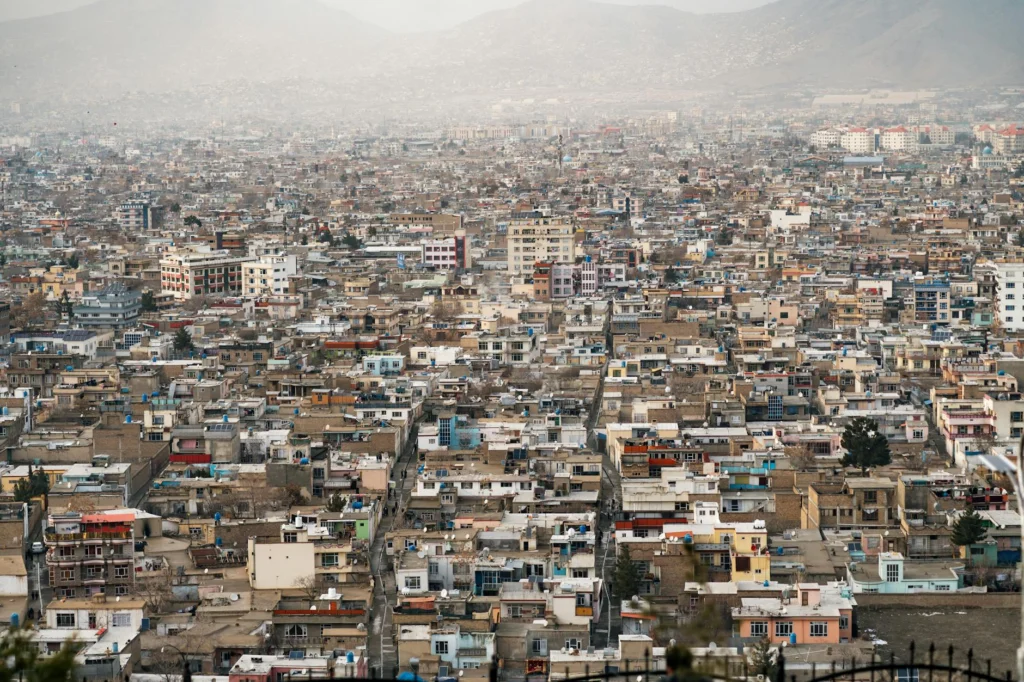
The Pakistan Kabul airstrike on a 2,000-bed drug rehabilitation hospital on March 16 killed at least 408 people and injured 265 more, according to Afghan officials. Islamabad says it hit military installations. The truth of that specific claim remains contested. What is not contested: two nuclear-armed neighbors are conducting sustained aerial warfare against each other, and the conflict has received a fraction of the international attention it warrants.
The Pakistan Kabul Airstrike: What Happened
Three explosions hit the Omar Addiction Treatment Hospital in Kabul’s Police District 9 at approximately 9 PM local time on Monday, March 16. The facility, built on the grounds of the former NATO Camp Phoenix where U.S. forces once trained the Afghan National Army, housed roughly 3,000 patients at the time of the strike. Afghan deputy government spokesman Hamdullah Fitrat reported the casualty figures. Government spokesman Zabihullah Mujahid called the attack “a crime against humanity.”
Pakistan’s Ministry of Information dismissed the allegations as “false and aimed at misleading public opinion,” stating its forces “precisely targeted military installations and terrorist support infrastructure” in Kabul and Nangarhar province. Pakistani officials claimed “visible secondary detonations after the strikes clearly indicate the presence of large ammunition depots.” Video footage shared with CBS News showed the hospital engulfed in flames, but did not appear to show secondary explosions or gunfire following the initial blast, contradicting Pakistan’s claims about ammunition storage.
By March 17, rescue workers were still pulling bodies from rubble. Ambulance driver Haji Fahim, who arrived at the scene shortly after the explosions, described finding “everything was burning, people were burning.” A patient named Ahmad told Al Jazeera: “The whole place caught fire. It was like doomsday. My friends were burning in the fire, and we could not save them all.” Baryalai Amiri, a 38-year-old mechanic searching for his brother who had been admitted 25 days earlier, said: “We are not given the proper information. So far, we don’t know where he is.”
The Hospital Pakistan Says Does Not Exist
The Omar Addiction Treatment Hospital, also known as Omid (“Hope”) Hospital, is a vast rehabilitation center for people battling addiction on the grounds of a former NATO camp.
That crisis is enormous. A United Nations Office on Drugs and Crime survey found only 82 operational treatment facilities across the entire country, many acutely short of qualified medical personnel, essential supplies, and funding, with over 72 percent operating at or near full capacity. The Omar Hospital, with its 2,000-bed capacity, represented a significant portion of the nation’s entire treatment infrastructure.
Pakistan’s claim that the site housed military equipment depends on the assertion that the Taliban co-located weapons with thousands of vulnerable civilians in a medical facility. Afghanistan says the hospital and the adjacent former military base are separate sites. Reuters has not been able to independently verify the casualty numbers.
The War Nobody Is Covering
The Pakistan Kabul airstrike on the hospital is the deadliest single incident in a conflict that has been escalating since late February 2026 and has its roots in tensions stretching back to the Taliban’s return to power in August 2021. At least 75 clashes between Pakistani and Afghan forces have been documented since 2021. The current phase is different in scale and intent.
The sequence: On February 16, a suicide bombing killed eleven Pakistani security personnel. On February 21-22, Pakistan launched airstrikes in Afghanistan’s Nangarhar, Paktika, and Khost provinces, targeting what it described as TTP and ISIS-K camps. On February 26, the Afghan Taliban attacked Pakistani military bases near the border. On February 27, Pakistan bombed Kabul, Kandahar, and Paktia provinces, marking the first time Pakistan had conducted strikes on Afghanistan’s urban areas. Pakistan’s Defence Minister Khawaja Asif declared the two countries were now in “open war.” Pakistan launched a sustained military campaign spanning multiple Afghan provinces.
By March 2, at least 146 civilian casualties had been documented in Afghanistan. By March 13, Pakistan claimed to have killed 663 Taliban fighters. Afghanistan’s Defense Ministry reported over 100 Pakistani soldiers killed. Now, a single Pakistan Kabul airstrike may have more than doubled the civilian casualty figure.
Why Pakistan Is Doing This
The stated reason is the Tehrik-e-Taliban Pakistan, or TTP: a militant group that emerged in 2007 from Pakistani jihadistsRelating to armed groups that justify violence through a militant interpretation of Islamic religious concepts. who had fought alongside Afghan forces against the U.S. invasion, then turned against Islamabad when Pakistan sided with Washington. The TTP has intensified attacks inside Pakistan, particularly in the border provinces of Khyber Pakhtunkhwa and Balochistan. Pakistan accuses the Afghan Taliban of providing safe haven to TTP fighters and demands a crackdown. Kabul denies this.
The structural problem is that the Afghan Taliban and the TTP are organizationally separate but share, as the Council on Foreign Relations describes them, “deep ideological, social and linguistic ties.” Both are Pashtun, both Islamist, both products of the same decades of warfare. The Afghan Taliban appears unwilling to suppress the TTP both because of prior affiliations and because cracking down risks pushing TTP fighters toward ISIS-Khorasan Province, a rival that threatens the Taliban’s own grip on power.
Pakistan is not wrong that TTP attacks originating from Afghan soil are a genuine security threat. But the gap between “we have a legitimate security concern” and “we bombed a hospital full of drug addicts” is the gap this conflict lives in. Pakistan has treated its counterterrorism operations in Afghanistan with a familiar playbook: the target is always described as military infrastructure, the civilian casualties are always denied or minimized, and independent verification is always difficult.
The Durand Line Problem
Underneath the TTP dispute lies a deeper, older grievance. The Durand Line, the 2,611-kilometer border between the two countries, was drawn by British colonial diplomat Mortimer Durand in 1893. Afghanistan has never formally recognized it, viewing it as an imposed colonial demarcation that illegitimately divided ethnic Pashtun areas. Pakistan treats it as an international border. This is not an academic dispute. It shapes everything: troop deployments, refugee flows, cross-border kinship networks that make “sealing the border” a fantasy, and the fundamental question of whether Pakistan has the right to conduct military operations in territory it considers foreign versus territory Afghanistan considers historically its own.
A Qatar-brokered ceasefire in October 2025 briefly paused the fighting. Saudi Arabia attempted mediation by year’s end. Both efforts collapsed. The collapse is itself revealing: the countries that typically broker South Asian disputes, including Pakistan’s other difficult neighbor, Iran, either lack leverage or lack interest.
Why the World Is Not Watching
The international response has been notable for its restraint. China, which has $65 billion invested in Pakistan through the China-Pakistan Economic Corridor, offered mediation and de-escalation support. India condemned Pakistan’s actions while quietly strengthening its own relationship with the Taliban. Russia, the first nation to formally recognize the Taliban government in July 2025, has said little. The U.S. Trump administration backed Pakistan’s right to self-defense while suggesting potential conflict resolution.
The United Nations Assistance Mission in Afghanistan urged restraint and political dialogue. Amnesty International called for independent investigations into civilian harm. Neither has enforcement power.
Several factors explain the muted coverage. Afghanistan exhausted Western media attention during the 2021 withdrawal. The Taliban government generates limited sympathy in Western capitals. Pakistan is a nuclear-armed state with a large military, and confronting it carries diplomatic costs. The concurrent Iran crisis and ongoing conflicts in Ukraine and Gaza compete for the same editorial space. And the victims in this case, thousands of drug addicts in a treatment facility in a country most Western policymakers have written off, do not generate the political pressure that drives sustained international engagement.
After the Pakistan Kabul Airstrike: What Comes Next
Pakistan’s military campaign in Afghanistan has now stretched into its fourth week with no signs of stopping. Islamabad appears committed to a sustained campaign rather than the sporadic border skirmishes that characterized the previous five years. The Kabul airstrike, if the Afghan casualty figures are even approximately accurate, represents the kind of escalation that hardens positions rather than opening negotiations.
The drug addiction crisis that the Omar Hospital was built to address will not pause for the war. The millions of Afghans struggling with substance use disorders, many of them now also coping with the trauma of aerial bombardment, have one fewer place to seek treatment. The facility that was destroyed represented not just beds and buildings but one of the country’s few functioning attempts to address a crisis that overwhelms its remaining treatment infrastructure.
The conflict between Pakistan and Afghanistan is producing civilian casualties, destroying infrastructure, and destabilizing a region that includes two nuclear powers, multiple active militant organizations, and critical Chinese economic investments. The Pakistan Kabul airstrike on a hospital is not an isolated event; it is a symptom of a conflict that deserves the same sustained international scrutiny applied to other ongoing wars. It is not receiving it.