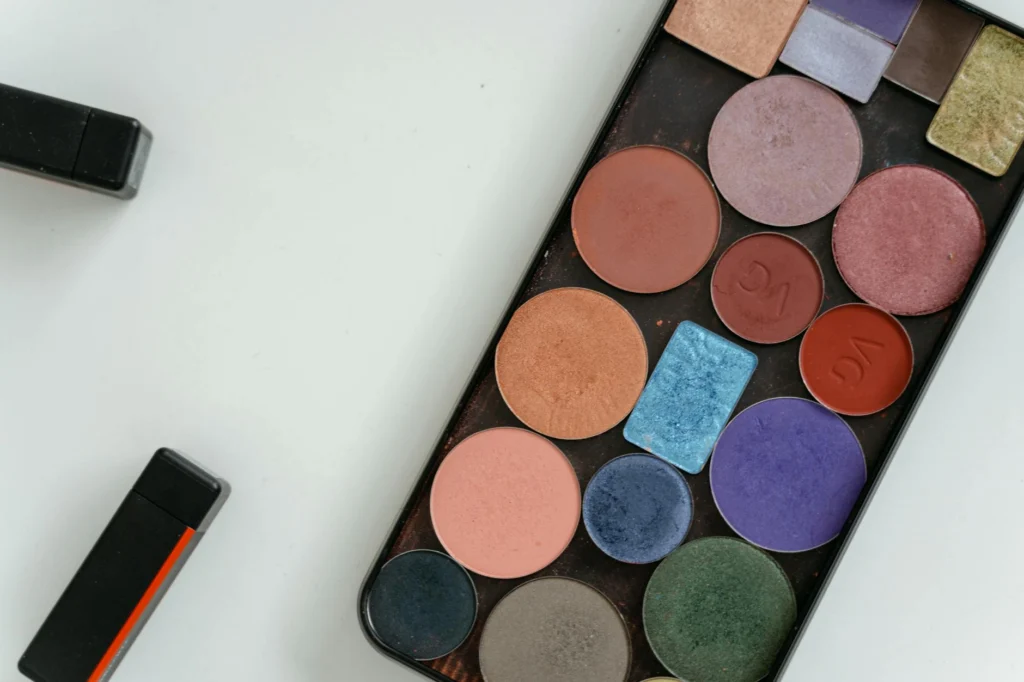
The boss asked for this one, and it is a genuinely fascinating assignment: a history not of wars or empires, but of the persistent, cross-civilizational human urge to grind up minerals and smear them on our faces.
The global cosmetics industry was valued at roughly $425 billion in 2025, according to Precedence Research. That number is staggering, but the impulse behind it is ancient. Cosmetic palettes for grinding pigments have been found in Egyptian tombs dating to the Predynastic Period, around 6,000 years ago. The containers have changed. The desire has not.
The Ancient World: Paint as Power
The earliest known cosmetics come from ancient Egypt, where both men and women of all social classes wore makeup. KohlA dark eye cosmetic made by grinding minerals such as galena or malachite into powder mixed with oil. Used for thousands of years across ancient Egypt, Mesopotamia, and beyond. eyeliner, made from ground galenaA lead-sulfide mineral ore that was the primary ancient source of both lead and silver. Smelting it produced far more lead than silver as a byproduct. and malachite, was so central to daily life that the Book of the Dead required the deceased to be “painted with eye-paint” before they could speak certain spells in the afterlife. Cosmetics were not vanity in the modern sense. They were spiritual, medical, and social all at once: kohl protected against eye infections, creams shielded skin from the desert sun, and appearance signaled one’s worthiness before the gods.
The practice was not limited to Egypt. The Sumerians in Mesopotamia wore kohl eyeliner as early as 3500 BCE, applied to men, women, and even children. The Greeks gave us the word “cosmetics” itself, from kosmetika, though their version referred primarily to preparations that protected hair, face, and teeth rather than embellishment. The Romans borrowed heavily from both traditions, adding their own extravagances: Poppaea, wife of Emperor Nero, bathed daily in ass’s milk, maintaining a herd of 500 donkeys for the purpose.
The Medieval Church vs. the Human Face
When Christianity became the dominant cultural force in Europe, makeup fell under deep suspicion. Medieval clerics equated paint and powder with harlotry, and cosmetics were banned outside of brothels for stretches of time. But the Church created a contradiction it could not resolve: women were also expected to be attractive to their husbands to prevent adultery. The compromise was the birth of the “natural look,” achieved through anything but natural means. Wheaten flour soaked for 15 days and mixed with rosewater was patted onto skin to create a pale complexion. The irony of spending hours to look effortlessly beautiful is, it turns out, medieval.
The Poison Years
The Renaissance and early modern period brought cosmetics roaring back into fashion, but with a lethal catch. The most popular foundation in Europe was Venetian ceruseA white paste made from lead carbonate, widely used as a skin foundation from the Renaissance through the 18th century. Long-term use caused lead poisoning and organ damage., a thick white paste made from white lead. It delivered a smooth, luminous complexion. It also caused organ damage, hair loss, and death.
Modern research from McMaster University has found that many lead makeup formulations were actually subtler and more natural-looking than we tend to imagine. But certain recipes were far more toxic than others. The mixture attributed to Queen Elizabeth I, a simple blend of white lead and vinegar, allowed lead to pass through the skin in dangerously high quantities.
The Victorian era did not improve matters. Beauty columns in Harper’s Bazaar recommended coating the face with opium overnight and washing with ammonia in the morning. Mercury was applied to the eyes. Sears & Roebuck sold “Dr. Rose’s Arsenic Complexion Wafers,” marketed as “perfectly harmless,” for women who wanted paler skin. The wafers were, of course, filled with arsenic.
Hollywood and the Modern Industry
The transformation of makeup from a private (and frequently dangerous) ritual into a regulated consumer product happened largely because of two forces: Hollywood and tragedy.
Max Factor, a Polish immigrant who had worked for Czar Nicholas’s Royal Household, opened a beauty studio in Los Angeles in 1908. In 1914, he introduced Supreme GreasepaintAn oil-based makeup originally formulated for stage actors to withstand heat and bright lights without cracking. Max Factor developed a lighter, flexible version for cinema in 1914., a flexible makeup designed specifically for film actors, replacing the thick theater greasepaint that cracked under studio lights. By the 1920s, he had launched cosmetics lines for the general public, coining the very term “make-up” and transforming it from something considered tacky into something desirable.
On the regulatory side, the 1938 Federal Food, Drug, and Cosmetic Act brought cosmetics under federal oversight in the United States for the first time. The law was catalyzed by a mass poisoning event in which an untested antibiotic containing diethylene glycol killed over 100 people.
What Has Changed and What Has Not
The ingredients are safer. The regulatory framework exists (though it took 84 years for the cosmetics provisions to be meaningfully updated, with the 2022 Modernization of Cosmetics Regulation Act). The industry is enormous. But the underlying dynamics are remarkably persistent: cosmetics remain entangled with status, gender, health claims, and the tension between artifice and authenticity. The medieval “natural look” has a direct descendant in today’s “no-makeup makeup” trend. The ancient Egyptian practice of applying kohl for both beauty and eye protection finds a modern echo in SPF-infused foundations. The desire to look a certain way, and the willingness to endure discomfort or risk to get there, has not changed in six thousand years.
Egypt: Where Cosmetics Met the Divine
The archaeological record for cosmetics in ancient Egypt stretches from the Predynastic Period (c. 6000 BCE) through Roman Egypt (30 BCE to 646 CE), covering the entire span of Egyptian civilization. Both men and women of all social classes wore makeup, though the wealthier could afford better products. Cosmetics were manufactured by professionals and sold in marketplaces, with cheaper variants likely made at home.
The morning routine of an ancient Egyptian involved washing, applying a cream (an early sunscreen), and then applying makeup. The focus was on the eyes. As Egyptologist Helen Strudwick has noted, eyes were “outlined with green or black eye paint to emphasize their size and shape.” Green malachite paste was used until the middle of the Old Kingdom, then replaced by black kohlA dark eye cosmetic made by grinding minerals such as galena or malachite into powder mixed with oil. Used for thousands of years across ancient Egypt, Mesopotamia, and beyond. produced from the mineral galenaA lead-sulfide mineral ore that was the primary ancient source of both lead and silver. Smelting it produced far more lead than silver as a byproduct.. Kohl was created by grinding galena, malachite, and other ingredients into a powder and mixing them with oil or fat to produce a cream, stored in stone or faience pots kept in cases of wood, ivory, or precious metal. Some of the most elaborate artifacts found in Egyptian tombs are these kohl cases, which were intricately carved works of art.
But cosmetics were not merely decorative. The Book of the Dead stipulated that Spell 125 could not be spoken unless one was “clean, dressed in fresh clothes, shod in white sandals, painted with eye-paint, anointed with the finest oil of myrrh.” The gods themselves were depicted wearing eye makeup, and cosmetics were standard grave goods. Research on Egyptian lead-based eye paint has revealed genuine effects on the body’s immune system, reducing the risk of eye infections. During the Middle Kingdom, around 4,000 years ago, wealthy women practiced routines that would be recognizable in any modern spa: exfoliating skin, wearing hydrating face masks, and even waxing with a mixture of honey and sugar.
Cosmetic tools and palettes also carried spiritual significance. Containers were decorated with symbols of rejuvenation. Fish-shaped palettes were popular, likely because the tilapia was associated with fertility. The painted-eye symbol was one of the components of the Egyptian hieroglyph for beauty.
Greece and Rome: Kosmetika, Morality, and 500 Donkeys
The Greeks gave us the word “cosmetics,” derived from kosmetika, though the term originally referred to preparations that protected hair, face, and teeth. The word for beautifying makeup was to kommotikon. Greek perfumes are documented as far back as the Middle Bronze Age (14th to 13th century BCE) and appear in Homer’s Iliad and Odyssey.
Greek women used rouge made from red ochre, eyeliner and eyebrow paint from kohl powder (containing soot, antimony, saffron, or ash), and white lead to achieve pale skin. Pale skin signified status: it indicated that a woman lived indoors rather than laboring in the sun. Homer describes Helen of Troy as “white-armed Helen,” and Athena enhances Penelope’s beauty to make her appear “whiter than sawn ivory.” But the use of cosmetics carried moral ambiguity. In Xenophon’s Oeconomicus, Ischomachus criticizes his wife for applying white lead and alkanet juice, calling it deceptive. He advises her that true beauty comes from domestic labor, a prescription that conveniently reinforced traditional gender roles.
Cosmetics were widespread nonetheless. Hetairai (paid companions) wore bold kohl and rouge as professional tools. Even religious contexts were affected: an inscription from the cult of Demeter and Kore at Patras explicitly forbade cosmetics within the sanctuary, with violators required to clean the temple as atonement.
The Romans inherited Greek cosmetic traditions and added characteristic excess. Poppaea, wife of Emperor Nero, bathed daily in ass’s milk, a practice requiring a herd of 500 donkeys. Ovid recorded face-cream recipes involving eggs, barley, narcissus bulbs, honey, ground vetch, wheat flour, and powdered antlers. White lead dissolved in vinegar was used to whiten skin, despite the Romans being fully aware that lead was poisonous. They used it as a poison. The cosmetic application was a conscious trade-off, not ignorance.
In the Roman world, cosmetics were largely a female concern. Men who spent too much time on their appearance were mocked. Emperor Otho was ridiculed for shaving daily and applying a dough face pack. Some male writers dismissed makeup as the province of prostitutes, but women of all classes continued the practice regardless.
The Medieval Paradox: Sin, Marriage, and the First “Natural Look”
The rise of the medieval Church transformed cosmetics from a routine practice into a moral battlefield. Male clerics equated paint and powder with harlotry. As historian Catherine Hokin has documented, cosmetics were “banned for quite some time outside brothels.” The logic was straightforward: if an unadorned woman was already a temptation, an enhanced woman posed an unacceptable danger to male virtue.
But the Church needed marriage to function. If wives were too plain, husbands might stray, undermining the social order. So clerics began making exceptions, and women began bending the rules. The result was the birth of the “natural look,” a concept that has never gone away. Unlike the visible cosmetics of Egypt and Rome, medieval faces aimed for subtlety. Skin preparation might begin with strawberry juice to remove redness or a wet amethyst crystal rubbed against blemishes. The all-important pale complexion was achieved with wheaten flour soaked in water for 15 days, strained, crystallized, mixed to a paste with rosewater, and patted on with cloth.
Lips and cheeks were colored with “ladies red powder” made from dried safflowers, angelica leaves, or brazilwood chips soaked in rosewater. A twelfth-century poem complained that church statues were going undecorated because women had used up all the paint.
Men were not exempt from vanity. According to Medievalists.net, “nearly all cosmetics documented for men revolve around hair loss and covering greys in order to appear youthful.” The tale of Amadeus VII of Savoy serves as a cautionary example: in 1391, he used an ointment for his thinning hair and died shortly after at 31. His physician was accused of poisoning him.
Medical writers contributed their own confusion. The great Persian physician Avicenna (980 to 1037 CE) saw no reason to separate cosmetics from medicine and freely mixed the two in his Canon of Medicine. Galen (129 to 216 CE) had drawn a firm line between medical treatments (decoratio) and mere beautification (ars comptoria), but most medieval practitioners followed Avicenna’s lead until the fourteenth century.
The Renaissance Through Victoria: Beauty Worth Dying For
As Europe’s aristocracy grew wealthier and more status-conscious, cosmetics returned with force. The preferred foundation of the Renaissance was Venetian ceruseA white paste made from lead carbonate, widely used as a skin foundation from the Renaissance through the 18th century. Long-term use caused lead poisoning and organ damage., manufactured by placing lead sheets into clay pots partially filled with vinegar, sealing them for weeks, and allowing lead acetate to form lead carbonate. The result was a smooth white paste that adhered beautifully to skin. Long-term use caused organ damage, intellectual impairment, bone deterioration, kidney failure, and death.
Queen Elizabeth I is the most famous user, and the formulation attributed to her, a simple mixture of white lead and vinegar, has been shown by modern researchers at McMaster University to be particularly dangerous. Their spectrometry studies found that this specific recipe allowed lead to pass through the skin “in much higher quantities than other recipes.” It is suspected that the widespread hair loss among women of status during the sixteenth century, which gave rise to the Elizabethan beauty ideal of a high forehead, was itself a consequence of lead poisoning.
But the McMaster research also revealed something surprising: most white lead makeup was far subtler than the bright white mask we see in movies and stage productions. On pale skin, the color change was often minimal. The makeup increased diffuse light reflectance, creating a soft-focus effect that blurred blemishes, essentially an early version of what modern foundations promise. Maria Gunning, Countess of Coventry, is said to have refused to stop wearing her lead foundation even as she lay dying from its effects.
The Victorian era added new horrors. Mrs. S.D. Powers, writing the enormously popular “Ugly Girl Papers” column in Harper’s Bazaar, advised readers to coat the face with opium overnight and wash with ammonia in the morning. Mercury was recommended as a nightly eye treatment for sparse eyelashes. Sears & Roebuck sold Dr. Rose’s Arsenic Complexion Wafers, advertised as “perfectly harmless,” for women seeking paler skin. The actress Lola Montez warned that women in Bohemia who bathed in arsenic springs achieved “a transparent whiteness” but were “obliged to keep it up the rest of their days, or death would speedily follow.” Arsenic was addictive, and women knew it was toxic. They used it anyway.
The “painted” woman of Victorian England lived under strict constraints: once you applied enamel (thick white paint), you could not smile, because the paint would crack. You could never switch back to a “natural” look, because everyone would see the skin damage underneath. Virginie Gautreau, immortalized in Sargent’s Madame X, painted indigo veins over her enamel to simulate the appearance of translucent skin. These women, as perfumer and lecturer Alexis Karl has observed, “were literally living pieces of art.”
Max Factor, Hollywood, and the Birth of Modern Makeup
The modern cosmetics industry owes much of its existence to Maksymillian Faktorowicz, a Polish-born wigmaker who escaped Russia’s anti-Semitic laws and landed in Los Angeles in 1908. Working with the nascent film industry, he recognized that theater greasepaintAn oil-based makeup originally formulated for stage actors to withstand heat and bright lights without cracking. Max Factor developed a lighter, flexible version for cinema in 1914. was unsuitable for cinema: thick, uncomfortable, and prone to cracking under harsh lights.
In 1914, he introduced Supreme Greasepaint, a flexible formula in twelve shades, made specifically for film actors. In 1918, he released Color Harmony, the first mass-market makeup designed for a range of skin tones, “remarkably inclusive for its time, as it was the first mass-market makeup suitable for women of different ethnicities,” according to ASU FIDM Museum. He coined the term “make-up” and launched the first commercial line for everyday women in the 1920s, branding it “Society MakeUp” to connote elegance.
Before Factor, wearing makeup on the street was considered vulgar. After him, it was aspirational. Women saw actresses in Motion Picture and Photoplay magazines, saw the order forms for Max Factor products, and realized they could have “Max Factor delivered from Hollywood right to my front door step in Kansas.” Factor, as author Erika Thomas has noted, “single-handedly altered the reputation of cosmetics from something viewed as tacky and tawdry to a luxurious and elegant product.”
Regulation: Better Late Than Never
For most of human history, you could put anything in a cosmetic and sell it. That changed, at least in the United States, on June 25, 1938, when President Franklin D. Roosevelt signed the Federal Food, Drug, and Cosmetic Act (FDCA). The law was not primarily about cosmetics. It was catalyzed by a mass poisoning: a Tennessee company had marketed Elixir Sulfanilamide, an untested antibiotic using diethylene glycol (a chemical analogue of antifreeze) as a solvent, killing over 100 people across 15 states. The resulting public outrage pushed the bill through Congress, and cosmetics were brought under federal oversight for the first time.
The cosmetics provisions of the 1938 Act then remained essentially unchanged for 84 years. It was not until 2022 that the Modernization of Cosmetics Regulation Act (MoCRA) meaningfully updated the framework, requiring manufacturers to register facilities, list ingredients, and report serious adverse events.
Continuities Across Six Millennia
The materials have changed. Lead has been replaced by titanium dioxide. Arsenic wafers are no longer sold at Sears. The regulatory apparatus, while imperfect, exists. But the underlying dynamics are remarkably stable.
Cosmetics remain entangled with status. Pale skin signified wealth and indoor life in classical Greece, Renaissance Europe, and Victorian England. The medieval “natural look,” born of religious restriction, is the direct ancestor of today’s “no-makeup makeup” trend. The ancient Egyptian practice of applying kohl for both beauty and medical protection finds its modern echo in SPF-infused foundations and vitamin-enriched concealers.
The moral debates have not gone away either. Xenophon’s Ischomachus, criticizing his wife’s makeup as deception in the fourth century BCE, would find plenty of company in any contemporary comment section. The tension between authenticity and artifice, between looking good and admitting that you tried, is as old as the cosmetic palette itself.
Perhaps the most telling continuity is the willingness to accept risk. Women in ancient Rome knew that white lead was poison; they used it as both cosmetic and murder weapon. Victorian women knew arsenic was toxic and addictive. Modern consumers occasionally accept ingredients whose long-term effects are uncertain. The calculus has always been the same: the perceived benefit of looking a certain way, measured against costs that feel abstract until they are not.
Six thousand years of evidence suggest that this is not a problem to be solved. It is a feature of being human.