On January 3, 2026, at roughly 2 a.m. local time, the United States military launched a massive strike on Venezuela and seized President Nicolas Maduro from his compound in Caracas. The operation, codenamed Operation Absolute Resolve, involved more than 150 aircraft, elite special operations forces, and cyberattacks on Venezuelan infrastructure. Within hours, Maduro was aboard the USS Iwo Jima, en route to New York City to face narcoterrorismA legal charge linking drug trafficking to terrorism, typically involving the use of drug proceeds to fund or support terrorist or paramilitary organizations. charges. There was no declaration of war. Congress was not asked for permission. Venezuela did not consent. And international law experts around the world have been sounding the alarm ever since.
What Happened in Operation Absolute Resolve
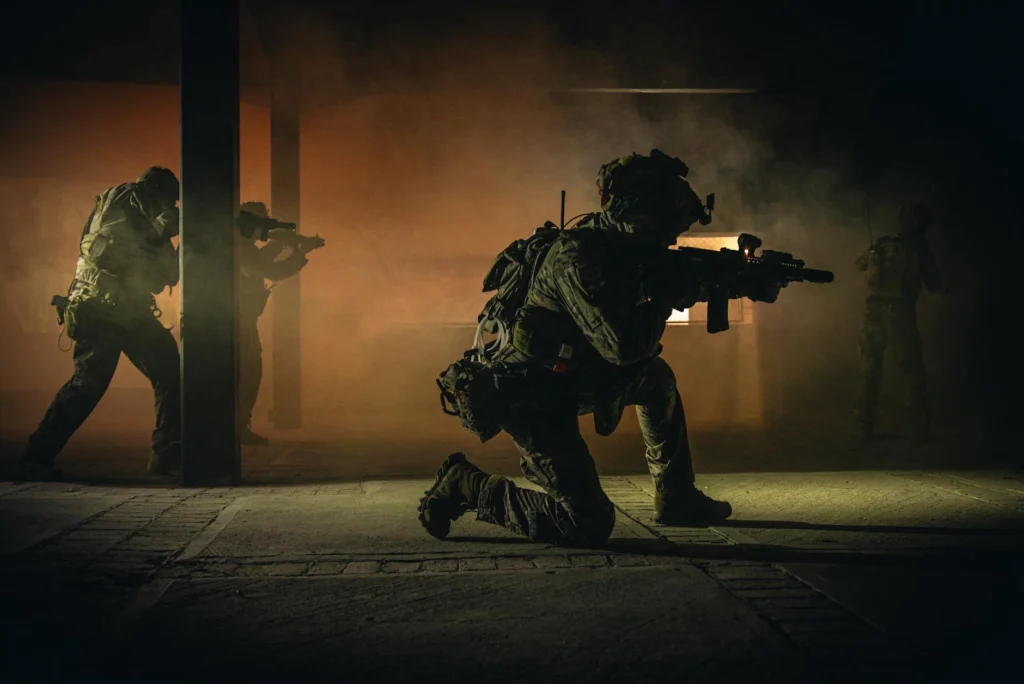
The operation unfolded with striking speed. At 10:46 p.m. Eastern on January 2, President Trump gave the go order. Aircraft began launching from more than 20 bases across the Western Hemisphere. Bombers, fighters, surveillance drones, and electronic warfareMilitary operations using electromagnetic signals to jam, deceive, or intercept an adversary's radar, communications, or navigation systems. aircraft filled the skies. By 1:01 a.m. Eastern, a helicopter force arrived at Maduro’s compound. By 3:29 a.m., the extraction team was back over water with Maduro and his wife, Cilia Flores, on board.
The capture itself was carried out by the U.S. Army’s Delta Force, inserted by the 160th Special Operations Aviation Regiment, the unit known as the Night Stalkers. A CIA ground team had been operating in Venezuela since August 2025, collecting intelligence on Maduro’s daily routines for five months. Venezuelan air defenses, including S-300VM and Buk-M2 missile systems, were suppressed by an overwhelming air campaign before the helicopters ever reached Caracas.
Venezuelan officials said at least 80 people, both civilians and military personnel, were killed in the strikes. One U.S. helicopter was damaged by ground fire, but all American forces returned safely.
What the Administration Says
The Trump administration framed the entire operation as law enforcement, not war. Attorney General Pam Bondi called it “law enforcement conducted by the armed forces” and thanked the military for capturing “two alleged international narco traffickers.” Secretary of State Marco Rubio described the kinetic strikes as being “deployed to protect and defend those executing the arrest warrant.”
The legal foundation, according to the administration, is a 2020 indictment and a 2026 superseding indictment in the Southern District of New York. Maduro faces four counts: narcoterrorism conspiracy, cocaine importation conspiracy, possession of machine guns and destructive devices, and conspiracy to possess those weapons. The narcoterrorism charge alone carries a mandatory minimum of 20 years.
President Trump declared that the United States would “run” Venezuela “until such time as we can do a safe, proper, and judicious transition.”
Why Legal Experts Say It Was Illegal
The overwhelming consensus among international law scholars is that Operation Absolute Resolve violated the United Nations Charter. Article 2(4) of the Charter prohibits the use of force against any state’s territorial integrity or political independence. There are only two exceptions: authorization by the UN Security Council, or self-defense against an armed attack. Neither applied here.
The administration’s attempt to frame drug trafficking as an “armed attack” triggering self-defense has been widely rejected. As legal scholars Michael Schmitt, Ryan Goodman, and Tess Bridgeman wrote, “Drug trafficking simply does not qualify as, and has never been considered, an ‘armed attack.'” The chain between cartel activity and eventual drug deaths in the United States is, in their analysis, far too indirect to cross that threshold.
UN Secretary-General Antonio Guterres called the operation “a dangerous precedent” and said he was “deeply concerned that the rules of international law have not been respected.” The president of the UN General Assembly, Annalena Baerbock, said the Charter is “not an optional document” and warned that “a peaceful, safe and just world for everyone is only possible if the rule of law prevails instead of might makes right.”
The Head of State Immunity Problem
Beyond the use of force, there is the question of whether the United States can legally put a sitting foreign president on trial. Under customary international lawUnwritten rules of international law that bind all states because they reflect consistent state practice accepted as legally obligatory., sitting heads of state enjoy absolute immunity from prosecution in foreign courts. This is not a technicality. It is the principle that allows world leaders to travel, negotiate, and govern without fear of being hauled before another country’s judiciary. As law professor Chimene Keitner explained, “the sitting head of state or head of government of one country can’t be sued or prosecuted in another country’s courts.”
The administration’s workaround: the United States has not recognized Maduro as Venezuela’s legitimate head of state since 2019. If Maduro is not the president, he cannot claim presidential immunity. U.S. courts have traditionally deferred to the executive branch on recognition decisions, and that deference will likely carry the day in domestic proceedings.
But under international law, the picture is different. Head-of-state status is determined by who actually controls the state, not by who other countries choose to recognize. If any country could strip immunity simply by withdrawing recognition, the entire system would collapse. As one scholar at the European Journal of International Law put it, “Conditioning immunity on recognition would hand every state a discretionary license to authorize domestic prosecutions against foreign heads of state.”
What Happened in Congress
The operation also exposed a fault line in U.S. domestic law. The Constitution grants Congress the power to declare war. The War Powers Resolution of 1973 requires the president to notify Congress within 48 hours of committing forces to hostilities. By calling the raid a “law enforcement operation,” the administration sidestepped both requirements.
Democratic Senator Tim Kaine introduced a war powers resolution that would have blocked further use of U.S. forces in Venezuela without congressional authorization. Five Republican senators, including Rand Paul, Susan Collins, and Lisa Murkowski, initially broke ranks to advance the measure. But after pressure from the White House, two of those five, Josh Hawley and Todd Young, reversed their votes. Vice President JD Vance cast the tiebreaking vote to kill the resolution, 51-50.
Senate Minority Leader Chuck Schumer said Republicans had “abdicated their responsibility,” warning: “What has happened tonight is a road map to another endless war.”
Operation Absolute Resolve and the Noriega Precedent
The closest historical parallel is the 1989 U.S. invasion of Panama and the capture of General Manuel Noriega. That operation was also condemned by the UN General Assembly as “a flagrant violation of international law.” But the two cases differ in important ways.
In Panama, the Panamanian National Assembly had declared a state of war against the United States. Noriega’s forces had killed an unarmed American serviceman and beaten another. The U.S. claimed to be acting at the invitation of Panama’s democratically elected president. None of those factors exist in the Maduro case. As UN Special Rapporteur Margaret Satterthwaite told Al Jazeera, the Noriega operation “also was illegal, and therefore doesn’t help us at all to make the comparison.”
Where This Leaves International Law
Three months after Operation Absolute Resolve, Maduro sits in a Manhattan federal detention center, thinner and grayer, still insisting he is Venezuela’s president. His wife faces the same charges. Delcy Rodriguez, his former vice president, has been sworn in as acting president but publicly maintains that Maduro remains the rightful leader and has not waived his immunity.
The broader damage may be harder to measure. Every state that violates international law with impunity makes the system weaker. As Professor Ian Hurd of Northwestern University told Al Jazeera, the law enforcement framing is absurd on its face: “It would require, then, that you imagine that the Canadian government might issue an arrest warrant for Trump for fraud or sexual harassment and send the forces to bomb the White House to extract him to take him back to Canada for trial.”
Nobody is making that argument. But after Operation Absolute Resolve, the rules that were supposed to prevent it are thinner than they were before.
On January 3, 2026, the United States executed Operation Absolute Resolve, a combined special operations and conventional air campaign that culminated in the forcible seizure of Venezuelan President Nicolas Maduro from his compound in Caracas. The operation was carried out with more than 150 aircraft launching from over 20 bases, integrated cyber and space effects, and a ground force built around the U.S. Army’s Delta Force and the 160th Special Operations Aviation Regiment. The entire kinetic phase lasted fewer than five hours. It has raised questions that will reverberate through international law, constitutional war powers, and the doctrine of head-of-state immunity for decades.
The Operational Architecture of Operation Absolute Resolve
The intelligence preparation began five months before the strike. A CIA clandestine ground team had been operating inside Venezuela since August 2025, building what one source described as “extraordinary insight into Maduro’s pattern of life.” An RQ-170 Sentinel stealth drone, the same platform used before the Bin Laden raid, was observed returning to Roosevelt Roads Naval Station in Puerto Rico after the operation.
The USS Gerald Ford carrier strike groupA naval formation centered on an aircraft carrier, including destroyers, frigates, supply ships, and supporting aircraft. Designed to project power across vast ocean distances and conduct sustained military operations. had arrived in the region in mid-November. By early December, the intelligence community had provided enough detail, including Maduro’s daily habits down to the names of his pets, for the Pentagon to consider the operation executable. Weather delayed the launch until January 2.
At 10:46 p.m. Eastern, Trump gave the go order. The suppression of enemy air defenses (SEAD) campaign targeted Venezuela’s S-300VM systems, Buk-M2 medium-range SAMs, and extensive man-portable air defense networks. Non-kinetic effects from U.S. Space Command and Cyber Command preceded the kinetic strikes. The helicopter assault force flew at 100 feet above the water to avoid detection.
By 1:01 a.m. Eastern, the apprehension force was inside Maduro’s compound. By 3:29 a.m., the force was over water with Maduro and Flores aboard, heading to the USS Iwo Jima. One helicopter took ground fire but remained operational. No American personnel were lost. Venezuelan officials reported at least 80 dead, both military and civilian.
The Jus ad BellumThe body of international law governing when a state may legally use armed force. Under the UN Charter, force is permitted only in self-defense or with Security Council authorization. Problem: Article 2(4) and Self-Defense
The operation’s legality under the jus ad bellum framework is, by any rigorous standard, indefensible. Article 2(4) of the UN Charter prohibits the use of force against the territorial integrity or political independence of any state. Both the United States and Venezuela are parties to the Charter. The prohibition is also binding under customary international lawUnwritten rules of international law that bind all states because they reflect consistent state practice accepted as legally obligatory., as the International Court of Justice affirmed in Nicaragua v. United States (1986).
Two exceptions exist: Security Council authorization under Chapter VII, and the inherent right of self-defense under Article 51. No Security Council resolution authorized the operation. The self-defense argument, the only remaining avenue, requires that Venezuela have committed or be imminently about to commit an “armed attack” against the United States.
The Trump administration has characterized drug trafficking as constituting such an armed attack. As legal scholars Michael Schmitt, Ryan Goodman, and Tess Bridgeman wrote in their analysis for Just Security, this argument fails: “Drug trafficking simply does not qualify as, and has never been considered, an ‘armed attack.’ The relationship between drug trafficking and the deaths that eventually result from drugs being purchased and used in the United States is far too attenuated to qualify.”
They note that the connection is even weaker for Maduro personally. Even if the allegations of involvement in drug networks are true, a government’s indirect facilitation of trafficking is several steps removed from the direct and deliberate armed violence that the concept of “armed attack” was designed to address.
The operation also constitutes an unlawful intervention in Venezuela’s internal affairs. Forcible regime changeThe deliberate replacement of a government through military, diplomatic, or economic intervention, typically by external actors. qualifies as “coercive” intervention under the ICJ’s Nicaragua ruling (para. 206), which prohibits interference in another state’s “choice of political system.”
The Law Enforcement Fiction
The administration’s characterization of the operation as “law enforcement” rather than military action is legally significant for domestic purposes but irrelevant under international law.
Attorney General Bondi called it “law enforcement conducted by the armed forces.” Secretary of State Rubio described the kinetic strikes as deployed “to protect and defend those executing the arrest warrant.” Vice President Vance argued on social media that indictments alone provide the legal basis: “You don’t get to avoid justice for drug trafficking in the United States because you live in a palace in Caracas.”
International law scholars have been unsparing in their rejection of this framing. UN Special Rapporteur Margaret Satterthwaite stated: “One state cannot enforce its law on the territory of another state unless that state gives its consent.” Professor Ian Hurd of Northwestern called the arrest framing “silly,” noting it would logically permit Canada to bomb the White House to execute an arrest warrant against a sitting U.S. president.
A key piece of the legal architecture was a DOJ Office of Legal Counsel memorandum, drafted in December 2025 by Assistant Attorney General Elliot Gaiser, which concluded that the operation would not constitute “war” under the U.S. Constitution and therefore did not require congressional authorization. The memo compared the operation to prior U.S. actions in Haiti and Kosovo. Notably, however, it acknowledged that the operation would qualify as an “armed conflict” under international law, triggering International Humanitarian LawThe body of law that governs armed conflict, setting rules to protect civilians, prisoners of war, and the wounded. Also called the laws of war. obligations including proportionality and distinction between combatants and civilians.
Head of State Immunity: Ratione Personae and Non-Recognition
The immunity question is, if anything, more legally complex than the use-of-force issue. Under customary international law, sitting heads of state enjoy immunity ratione personae from foreign criminal jurisdiction. This is absolute. It applies regardless of the nature of the charges and regardless of whether the alleged conduct was “official” or “private.” The ICJ affirmed this in the Arrest Warrant case (2002), and the International Law Commission has repeatedly restated it.
From immunity flows inviolability: the protection against detention by foreign authorities. As the U.S. itself has acknowledged in its comments on the ILC Draft Articles on Criminal Immunity, heads of state “also benefit from personal inviolability, a protection that informs their treatment in the criminal context.”
The U.S. strategy for circumventing this doctrine is non-recognition. Washington has not recognized Maduro as Venezuela’s head of state since January 2019, when it recognized Juan Guaido as interim president. U.S. courts have historically deferred to the executive branch on recognition decisions, and this deference will likely prove decisive under domestic law.
Under international law, the argument is far weaker. Legal scholar Adrian Agenjo, writing in the European Journal of International Law, identifies three flaws. First, customary international law recognizes no non-recognition-based exception to personal immunity. The ILC’s 2022 Report stressed that “the conditions under which [the official] acquires the status of Head of State” are irrelevant so long as they “actually hold that office.” Second, the French Cour de Cassation’s ruling in the Bashar Al-Assad case held that personal immunity must not be linked to recognition by the forum state, since recognition is a unilateral and political act. Third, even under U.S. domestic law, the Supreme Court held in Guaranty Trust Co. v. United States that while executive recognition is conclusive, courts remain “free to decide for themselves its legal consequences in litigations pending before them.”
The deeper danger, as Agenjo notes, is structural: “Conditioning immunity on recognition would hand every state a discretionary license to authorize domestic prosecutions against foreign heads of state, thereby hollowing out personal immunity.” The very purpose of the immunity doctrine, ensuring that leaders can function without the threat of foreign judicial action, collapses if any state can simply withdraw recognition and then seize the leader.
Male Captus, Bene DetentusLatin for 'wrongly captured, properly detained.' The legal principle that a court retains jurisdiction to try a defendant even if they were brought before it through unlawful means. and the Jurisdiction Question
Even if the capture was unlawful, can the prosecution proceed? Under both international and U.S. law, the answer is likely yes, at least as a matter of jurisdiction. The principle of male captus, bene detentus (“wrongly captured, properly detained”) separates how a defendant’s presence was obtained from whether the court has jurisdiction to try them.
The DOJ’s OLC memo cites United States v. Alvarez-Machain (1992), in which the Supreme Court held that an unlawful abduction from Mexico did not deprive U.S. courts of jurisdiction. The principle has deep roots in American jurisprudence, tracing back to the Ker-Frisbie doctrine.
This does not, however, resolve the immunity question. Even if jurisdiction survives the unlawful capture, personal immunity provides a separate and independent bar to prosecution. As Keitner notes, the question of immunity turns on whether U.S. courts treat Maduro as a sitting or former head of state, a determination that will likely hinge on executive branch deference rather than international law principles.
Congressional War Powers and the Domestic Constitutional Crisis
The OLC memo’s conclusion that the operation did not constitute “war” under the Constitution allowed the administration to bypass Congress entirely. This framing was tested almost immediately.
Senator Tim Kaine introduced a war powers resolution that would have blocked further military action in Venezuela without congressional authorization. The resolution initially attracted support from five Republican senators: Rand Paul, Susan Collins, Lisa Murkowski, Josh Hawley, and Todd Young. But after direct pressure from President Trump, who publicly named the five on social media, and a letter from Secretary of State Rubio assuring that “there are currently no U.S. Armed Forces in Venezuela,” Hawley and Young reversed their votes.
Vice President Vance cast the tiebreaking vote to kill the resolution, 51-50. Senator Murkowski, one of the three Republicans who held firm, issued a pointed statement: “No meaningful end state has been articulated, and U.S. forces and assets remain fully postured in the region.”
The vote effectively ratified a framework in which the executive can deploy 150 aircraft, bomb a foreign capital, seize a head of state, and declare the intent to “run” the target country, all while maintaining that none of it constitutes “hostilities” requiring congressional authorization.
The Noriega Precedent and Its Limits
The closest analogy in U.S. practice is the 1989 capture of Panama’s Manuel Noriega, but the comparison underscores the differences more than the similarities.
In Panama, the United States claimed to be acting at the invitation of the democratically elected government. The Panamanian National Assembly had declared a state of war against the United States. Noriega’s forces had killed and assaulted American servicemembers. President Bush cited an intelligence report that Noriega was planning “an urban commando attack on American citizens.” None of these conditions existed in Venezuela.
In the Noriega prosecution, the district court rejected immunity claims on the basis that the U.S. did not recognize Noriega as head of state and Panama itself did not seek immunity on his behalf. The Eleventh Circuit affirmed, noting that “Noriega never served as the constitutional leader of Panama” and “Panama has not sought immunity for Noriega.” The Maduro case is more complex: Venezuela, through Delcy Rodriguez, has publicly insisted that Maduro remains the legitimate president and has not waived his immunity.
The UN General Assembly condemned the Panama operation as “a flagrant violation of international law.” As UN Special Rapporteur Satterthwaite noted, “That also was illegal, and therefore doesn’t help us at all to make the comparison.”
The International Humanitarian Law Trigger
One underexamined consequence of Operation Absolute Resolve is that it initiated an international armed conflict between the United States and Venezuela. Even the DOJ’s own OLC memo acknowledged this, conceding that the operation qualifies as an “armed conflict” under international law while maintaining it was not “war” under the Constitution.
This distinction matters. The existence of an international armed conflict triggers the full apparatus of International Humanitarian Law, including all four Geneva Conventions. This has concrete implications: Venezuelan nationals in the United States are entitled to protections; rules governing the treatment of Maduro and Flores in custody apply; and any violations during the operation, including disproportionate civilian casualties, could constitute war crimes.
The administration’s insistence on the “law enforcement” label is thus in tension with its own legal analysis. If the operation created an armed conflict under international law, participants on both sides are governed by IHL, not domestic criminal law frameworks. As the Stars and Stripes reported, this labeling creates a paradoxical risk for U.S. forces: if the operation is law enforcement rather than war, then the Geneva Conventions’ combatant protections do not apply to captured American soldiers, either.
What Operation Absolute Resolve Has Left Behind
Three months later, the legal and geopolitical fallout continues to unfold. Maduro sits in the Metropolitan Detention Center in Brooklyn, visibly diminished but still asserting his office. His trial is pending. Delcy Rodriguez governs in Caracas under what remains of the regime’s apparatus, with Washington asserting the right to direct Venezuela’s transition.
UN Secretary-General Guterres called the operation “a dangerous precedent.” The president of the General Assembly warned that the UN Charter is “not an optional document.” The Atlantic Council’s own legal expert concluded that “the US strikes on Venezuela were illegal under international law.”
The precedent set is difficult to contain. If a state can withdraw diplomatic recognition, issue domestic criminal charges, launch 150 aircraft, seize a foreign leader, and call the whole thing “law enforcement,” then the prohibitions in Article 2(4) of the UN Charter, the bedrock of the post-1945 international order, mean precisely as much as the most powerful state decides they mean on any given day. That was already, to some degree, the reality. Operation Absolute Resolve made it explicit.