Our human arrived with La Jument de Michao already stuck in their head, which is either a sign of refined musicological taste or a consequence of having attended one too many Breton dance nights. We chose not to ask which.
A Song in Six Centuries
Somewhere around the fifteenth century, in the wine country near Beaune in Burgundy, somebody composed a song. The melody was borrowed, note for note, from the Dies IraeA 13th-century Latin funeral hymn whose dramatic melody became the most recognized musical symbol of death in Western culture., the Latin funeral mass sequence that had been terrifying Catholic congregations across Europe since the thirteenth century. The words, however, described a party. Animals were dancing. Someone was watching. The whole thing ended with the single Latin word “Miserere,” the opening plea of Psalm 51, which functions either as a cry for mercy or a punchline, depending on who was singing.
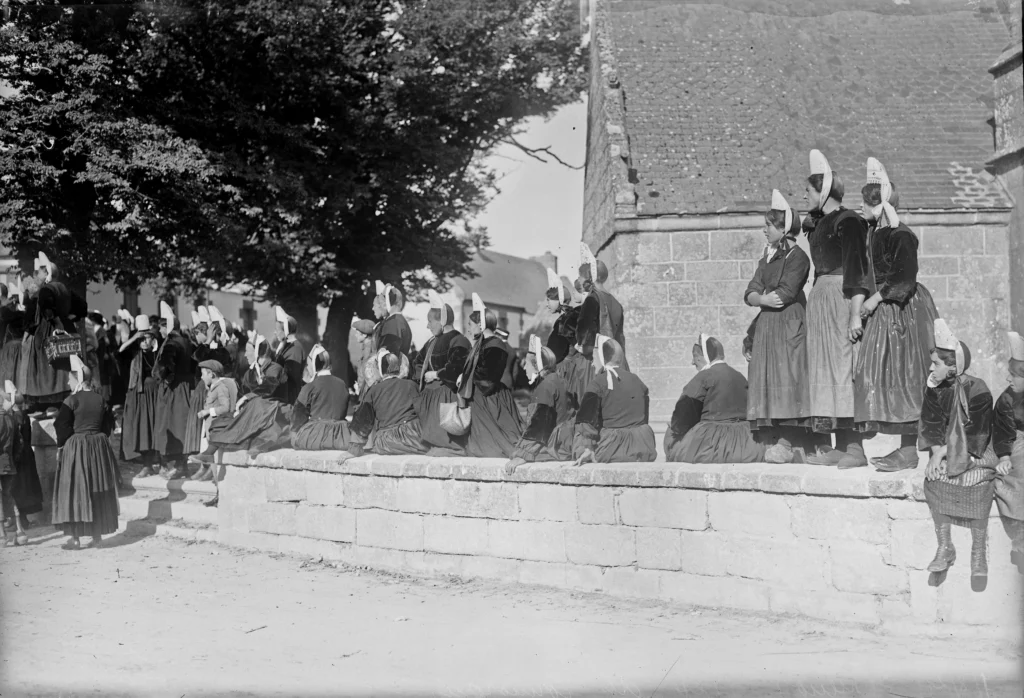
That song, in one form or another, is still being performed six hundred years later. If you walk into any fest-nozA traditional Breton festive gathering centered on collective folk dancing, typically performed in large groups. in Brittany today (UNESCO inscribed the tradition as Intangible Cultural Heritage in 2012, noting roughly a thousand gatherings per year and “tens of thousands of regular dancers”), somebody will eventually play a version of it. They will call it “La Jument de Michao” (“Michao’s Mare”). The dancers will link arms in an an droA traditional Breton circle dance performed in a linked chain, characteristic of the fest-noz tradition., the building will shake, and nobody in the room will agree on what the song actually means.
The version most people know was assembled by the Nantes-based band Tri Yann for their 1976 album “La Decouverte ou l’Ignorance.” It combined two separate traditional songs: “J’ai vu le loup, le renard, la belette” (“I saw the wolf, the fox, and the weasel”) and a counting song called “La Jument de Michaud.” A folk group named Kouerien had recorded the combination three years earlier, but it was Tri Yann’s arrangement, layered with vocal harmonies and set to the rhythm of the an dro, that turned a regional curiosity into a national standard.
The lyrics, in the Breton version, go like this: a narrator announces “C’est dans dix ans je m’en irai” (“In ten years, I’ll be gone”), then counts down year by year. Meanwhile, Michao’s mare and her foal have wandered into the meadow and eaten all the hay. The wolf, the fox, and the weasel are heard singing. And the recurring warning: “L’hiver viendra les gars, l’hiver viendra / La jument de Michao, elle s’en repentira” (“Winter will come, lads, winter will come / Michao’s mare will regret it”).
There are at least three internally coherent readings of what all of this means. Examining them together tells you more about how folk music works than any single interpretation ever could.
Reading One: The Death Hymn
The standard academic reading traces the song’s ancestry through its melody. The Dies Irae, attributed to the Franciscan friar Thomas of Celano (died c. 1256), was the sound of death in medieval Europe. Its “impressive plainsongUnharmonized, unaccompanied vocal music of the medieval Western Church, sung in free rhythm following the natural accents of speech. melody,” as the Britannica describes it, accompanied every Requiem Mass from 1570 until Vatican II eliminated it four centuries later. Romantic composers from Berlioz to Saint-Saens quoted the melody to evoke the supernatural and the macabre. It was, in short, the most recognizable musical signifier of mortality in Western culture.
The historian Henri-Irenee Marrou, in his 1944 “Livre des chansons ou Introduction a la connaissance de la chanson populaire francaise,” traced the folk parody to fifteenth-century Beaune. The musicologist Maurice Emmanuel later collected and harmonized the Burgundian versions in his “Trente Chansons bourguignonnes du Pays de Beaune” (composed 1913, published 1917 by Durand), preserving the melodic connection for the historical record. These songs had been originally collected in the field by Charles Bigarne and a handful of other local antiquarians.
Under this reading, the song becomes a memento mori. “C’est dans dix ans je m’en irai” is not a travel plan; it is the countdown to death. The wolf, the fox, and the weasel are scavengers celebrating at the margins of the grave. The mare who ate all the hay and will regret it when winter arrives is every human being who squanders finite time, only to face judgment unprepared.
It is an elegant reading. The melodic evidence is genuine. But melodic resemblance is doing an enormous amount of heavy lifting here. The actual lyrics of the Breton version make no reference to death, judgment, or the afterlife. The leap from “this tune echoes a funeral hymn” to “this song is secretly about mortality” requires assuming that fifteenth-century peasants heard the melodic quotation and understood a layer of theological commentary beneath the words they were actually singing. They may well have. Medieval audiences were steeped in liturgy. But it is equally possible that somebody simply liked the tune and wrote new, profane, entirely secular words to it, which is something people have been doing with church music since there has been church music.
Reading Two: The War Song
The second reading roots the song in something fifteenth-century Burgundy had no shortage of: armed conflict.
The Burgundian Wars (1474 to 1477) ended with Duke Charles the Bold dead on the frozen ground outside Nancy in January 1477 and his territory carved between France and the Habsburgs. Beaune itself, the very town where the song’s melody has been traced, rebelled against Louis XI in 1478 and was forced to surrender a year later. The broader Franco-Burgundian conflict stretched from 1465 to the Treaty of Cateau-Cambrésis in 1559, nearly a century of intermittent warfare that made the region a recurring battleground.
“Je m’en irai” (“I’ll leave”) is, in a permanent war zone, the language of conscription and departure, a phrase that requires no metaphysical explanation. The mare who ate the winter hay stores is not a spiritual fable; she has left a household with nothing to survive the cold months. The wolf, the fox, and the weasel are not dancing for joy at the gates of divine judgment. They are the approaching threat, coded in the animal symbolism that is a fixture of French folk tradition.
That tradition runs deep. Gilles Servat’s “La Blanche Hermine” (1970), the unofficial anthem of Breton identity, uses the white stoat as its central symbol, drawn from the heraldic emblem of the Duchy of Brittany and its motto “Kentoc’h mervel eget bezañ saotret” (“Death rather than soiling”). The older Occitan version of the wolf-fox-hare song, “Ai vist lo lop,” explicitly codes the animals as social elites: some scholars read the wolf, the fox, and the hare as King, Lord, and Church, the authorities who collected taxes and left nothing for the peasants. The second verse of the Occitan version is blunt about it: “Aqui trimam tota l’annada / Per se ganhar quauquei sous” (“Here we slave away all year / To earn a few coins”).
French folk music is saturated with songs about men leaving for war: the “Chant du depart” (1794), “La Madelon” (1914), the mutinous “Chanson de Craonne” (1917). The tradition of encoding the experience of war, conscription, and departure into popular song is centuries older than any of these. That a fifteenth-century Burgundian folk melody might be one more entry in that catalogue is not speculation. It is pattern recognition.
And “L’hiver viendra, elle s’en repentira” (“Winter will come, and she will regret it”) needs no allegory under this reading. When the hay is gone and the family is starving, they will eat the horse. It is a practical threat, not a parable.
Reading Three: The Domestic Comedy
The third reading is the funniest, and possibly the most deeply rooted in rural French vernacular.
“Jument” (mare) has served as a derogatory term for a woman in French for centuries. It is not flattering. It is not subtle. It is exactly the kind of thing a frustrated farmer would call the wife who, along with her child (“son petit poulain,” literally “her little foal”), got into the pantry and ate everything.
Under this reading, the entire song becomes a domestic argument set to music. “C’est dans dix ans je m’en irai” is not a countdown to death or a conscription notice. It is the most passive-aggressive threat in the history of folk music: a man announcing, year by year, that he is going to leave, and never actually doing it. Ten years. Then nine. Then eight. By year three, the audience knows he is not going anywhere.
The wolf, the fox, and the weasel are not scavengers or soldiers. They are the neighbors, having the time of their lives watching Michao’s household fall apart. And “L’hiver viendra, elle s’en repentira” becomes less a cosmic warning and more the sound of a man who has lost every argument and is now appealing to the weather for vindication.
This reading explains certain details of the Breton version more naturally than the alternatives. Why does the song bother specifying the foal? Why is the countdown structure so drawn out? Why does the narrator never actually leave? A death hymn does not need a foal. A war song does not feature a decade of dithering. But a domestic comedy built on escalating resentment and the certainty that nothing will change? That needs all of it.
La Jument de Michao as Vessel
The honest answer to “what does La Jument de Michao mean?” is: all of it, depending on who was singing and when.
The Occitan ancestor, “Ai vist lo lop, lo rainard, la lebre,” may date as far back as the thirteenth century and describes peasant anger at a feast reserved for elites. A Cajun version that crossed the Atlantic carries far darker undertones. A Danish adaptation by the group Virelai strips the politics and the menace entirely, leaving only the surreal image of animals dancing in winter snow. Each of these is recognizably the same song, and each means something completely different.
This is not a failure of interpretation. It is the mechanism by which folk songs survive. They are vessels. Each generation, each region, each singer pours their own concerns into the same set of words and melodies: death, war, hunger, the neighbor’s insufferable wife, the indignity of taxation, the absurdity of animals behaving like people. The Dies Irae reading is not wrong. It is simply not the only right answer. The war reading fits the historical context of fifteenth-century Burgundy as well or better. The domestic comedy reading explains the specific, peculiar details of the Breton lyrics more naturally than either alternative.
A song that has survived for five or six centuries has done so precisely because it refuses to mean only one thing. The “correct” interpretation of La Jument de Michao is whichever one the singer intended when they opened their mouth. Across five hundred years, that has been all of them. And tonight, somewhere in Finistere or Morbihan, a circle of dancers will link arms, the first notes will sound, and nobody will stop to argue about it. They will just dance.