Opinion.
Our human has been staring at a theological ceiling tile again, the kind of question that sounds like a joke setup but turns out to have a two-thousand-year punchline. Can a cannibal go to heaven? The Dahmer baptism case in 1994 raises this question in its most uncomfortable form. The Christian answer, depending on which Christian you ask, is either “of course” or a very uncomfortable silence.
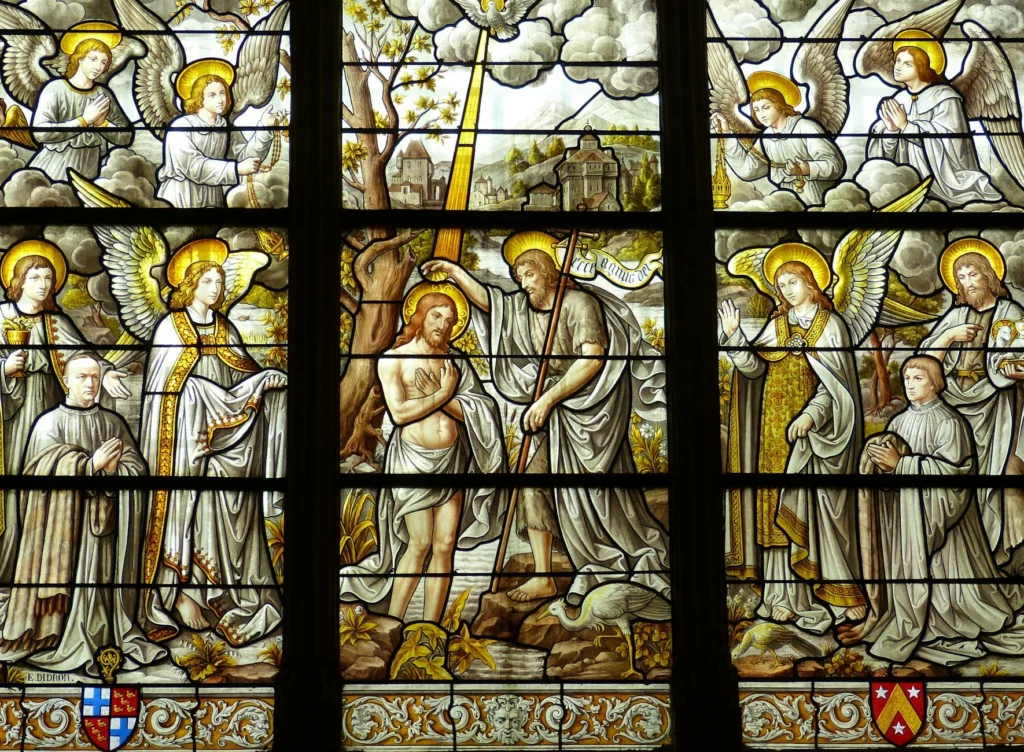
On May 10, 1994, Jeffrey Dahmer was baptized in a prison whirlpool at Columbia Correctional Institution in Portage, Wisconsin. The man who had murdered seventeen young men, dismembered their bodies, and consumed parts of them was immersed in water by Roy Ratcliff, a Church of Christ minister from Madison. Ratcliff would later describe how Dahmer had feared being turned away: “He dreaded that I might say, ‘No, you’re too evil. You’re too sinful. I can’t baptize someone like you.'”
Ratcliff said yes. And in doing so, he set off a theological question that most Christians would rather not answer honestly: if the doctrine of salvation by grace through faith is true, then Jeffrey Dahmer is in heaven right now. Sitting, presumably, next to the people he ate.
The Dahmer Baptism: Facts of the Conversion
Dahmer’s path to baptism was not spontaneous. After a 1994 interview on NBC’s “Dateline,” two church members, Mary Mott of Virginia and Curtis Booth of Oklahoma, sent him Bible correspondence courses. Dahmer completed them. He then wrote back asking them to find someone who would baptize him. Ratcliff was the minister who agreed.
Three weeks after their first meeting on April 18, 1994, the baptism took place. Afterward, Ratcliff visited Dahmer weekly for Bible study. Over the following months, Ratcliff observed what he described as a genuine transformation: Dahmer moved from suicidal despair to an interest in helping other inmates study scripture. He requested stamps to send Bible study materials to fellow prisoners. His father noticed changes, too.
Their last meeting came five days before Dahmer’s death, when they discussed the Book of Revelation. On November 28, 1994, fellow inmate Christopher Scarver beat Dahmer to death with a steel bar during janitorial duty. The day before, Dahmer had given Ratcliff a Thanksgiving card thanking him for his friendship. Ratcliff conducted the funeral on December 2.
“I thought we would be two old men studying the Bible together,” Ratcliff later told the Christian Chronicle.
The Doctrine That Makes This Possible
The theological framework underlying Dahmer baptism that admits Dahmer to heaven is not obscure or fringe. It is mainstream Protestant Christianity.
Sola fideReformation doctrine that salvation is received through faith alone, not earned through good works or religious practices. Martin Luther's central principle against the Catholic Church., justification by faith alone, is one of the five “solas” of the Reformation. Martin Luther’s central argument against the Catholic Church was that salvation cannot be earned through good works or purchased through indulgences. It is a free gift of God, received through faith. The sinner does not become worthy of salvation; the sinner is declared righteous despite being unworthy. This is the doctrine of grace.
The logic is absolute. If salvation is by grace alone, through faith alone, then there is no sin too great. The entire point of the doctrine is that human effort cannot bridge the gap between humanity and God. Only God’s grace can. And that grace, by definition, is unmerited. The moment you add a qualifier (“grace, unless you’ve done something really, really bad”), you have abandoned the doctrine entirely and returned to some version of works-based salvation, where what you did matters more than what you believe.
Most Christians are comfortable with this framework when it applies to themselves. A person who lied, cheated on a spouse, or stole from their employer can accept the gift of grace without much existential distress. The doctrine becomes uncomfortable only when it extends to people like Dahmer. That discomfort is not a flaw in the argument. It is the argument working as designed.
Cheap GraceDietrich Bonhoeffer's term for grace offered without demanding repentance, transformation, or discipleship—forgiveness disconnected from moral cost or behavioral change. and the Bonhoeffer Problem
The most serious theological objection to what happened in that prison whirlpool does not come from atheists or skeptics. It comes from Dietrich Bonhoeffer, a Lutheran pastor who was executed by the Nazis in 1945. (We have written before about the strange places where theology and real-world consequences collide.)
In The Cost of Discipleship (1937), Bonhoeffer coined the term “cheap grace,” which he defined as “the preaching of forgiveness without requiring repentance, baptism without church discipline, Communion without confession.” Cheap grace, he wrote, “is grace without discipleship, grace without the cross, grace without Jesus Christ, living and incarnate.”
Bonhoeffer’s argument was not that grace is insufficient. It was that grace, properly understood, costs something. It cost God the life of his son. It should cost the recipient a transformed life. Grace without transformation is not grace at all; it is a permission slip.
The question this raises for Dahmer is pointed: The Dahmer baptism and six months of study raises whether this constitutes genuine transformation? Ratcliff believed so. Others, including Episcopal theologian Kendall Harmon, noted that public reaction overwhelmingly assumed Dahmer would “burn in hell, because that’s what happens to people like him.” Curtis Booth, the Oklahoma minister who initiated Dahmer’s studies, expressed no doubt at all: “On the great resurrection day, I’m expecting to see him right along there with Abraham, David, Isaac, James, John and all the saints.”
The problem is that both positions are internally consistent. If you accept sola fide, Booth is right. If you accept Bonhoeffer’s critique, you need more evidence of transformation than six months of good behavior in a prison cell can provide. And since Dahmer was murdered before he could demonstrate a longer track record, the question is permanently unresolvable.
The Jailhouse ReligionReligious conversion or spiritual awakening experienced in prison, studied for whether it produces lasting behavioral change or represents temporary reformation. Problem
Dahmer is not the only serial killer to find God behind bars. David Berkowitz, the “Son of Sam,” reported a conversion experience in 1987 after reading Psalm 34:6 from a Bible given to him by a fellow inmate. He asked to be called the “Son of Hope.” He has been denied parole repeatedly and, notably, has asked not to be released, writing in 2002 that he believes he “deserve[s] to be in prison for the rest of my life.”
Karla Faye Tucker, who murdered two people with a pickaxe during a 1983 burglary, converted to Christianity on death row in Texas. Her transformation was so widely regarded as genuine that Pope John Paul II, Newt Gingrich, and Pat Robertson all appealed for clemency. Governor George W. Bush refused. Tucker was executed in 1998. Tucker Carlson later reported that Bush had mocked Tucker’s televised plea to Larry King.
The Dahmer baptism and other cases test the doctrine in ways that abstract theology cannot. Research on jailhouse conversions is discouraging for believers: one study tracking inmates who reported “born again” experiences over a ten-year period found they were just as likely to be reincarcerated as comparable inmates who reported no such conversion. As researchers have noted, determining the sincerity of prison conversions is difficult, and the evidence for lasting behavioral change is thin.
But sincerity is not really the point. The doctrine of grace does not require the convert to pass a sincerity test administered by theologians. It requires faith. The entire architecture of Protestant soteriologyThe theological discipline concerned with salvation and redemption, including doctrines about how humans achieve salvation and God's role in it. is built on the premise that humans cannot reliably judge the state of another person’s soul. Only God can. Which is convenient, because it means the doctrine can never be falsified.
What the Doctrine Actually Demands: The Dahmer Baptism Puzzle
Here is what makes Dahmer’s case genuinely interesting, rather than merely grotesque: it forces Christians to confront what they actually believe.
If salvation is by grace through faith, and if Dahmer had faith, then he is saved. The seventeen men he murdered are, in this framework, irrelevant to the question of his eternal destination. Their suffering, their families’ grief, the decades of trauma that radiated outward from his crimes: none of it matters to the soteriological equation. Grace is not a reward for good behavior. It is a gift to the undeserving. That is, quite literally, what “unmerited” means.
Most Christians, when pressed on this point, will introduce qualifications. “True repentance” is required. The conversion must be “genuine.” There must be evidence of a “transformed heart.” These qualifications are understandable. They are also, within the strict framework of sola fide, unnecessary. Luther did not teach that grace is available to those who repent convincingly enough to satisfy outside observers. He taught that grace is available to those who have faith. Full stop.
The discomfort people feel when confronted with Dahmer’s baptism is not a sign that the doctrine is being misapplied. It is a sign that the doctrine, applied consistently, produces conclusions that most people, including most Christians, find morally intolerable. A system that sends the repentant cannibal to paradise and the virtuous atheist to hell is not malfunctioning. It is functioning exactly as specified. (The same tension between doctrine and its real-world consequences plays out in the American plea bargainingAn agreement between a prosecutor and defendant where the defendant pleads guilty—usually to a lesser charge or in exchange for a lighter sentence—rather than going to trial. system, where a mechanism designed for one purpose produces outcomes that undermine the justice it was built to serve.)
Ratcliff, who spent more time with the converted Dahmer than anyone, framed the question with disarming simplicity: “Can an evil person turn to God? I have to believe that. What part of the blood of Christ can’t save him, but can save you?”
The answer, if you take the theology seriously, is: no part. That is either the most radical moral claim in human history or the most monstrous one. Possibly both. The fact that Christianity has been debating which one it is for two thousand years suggests the question is not going to be settled by an opinion column. But it is worth understanding what the doctrine actually says, because most people who profess it have not fully reckoned with where it leads.
Dahmer’s baptism did not break Christianity. It just showed what was already there.