The boss asked for this one, and it is long overdue. The Hezbollah origin story is one of the most consequential chapters in modern Middle Eastern history, yet it is routinely reduced to a single sentence: Iran created a proxy. The truth is far messier, and far more instructive.
A Country Already on Fire
To understand where Hezbollah came from, you first need to understand what Lebanon looked like before it arrived. Since independence in 1943, Lebanon operated under a confessional power-sharing system: a Maronite Christian served as president, a Sunni Muslim as prime minister, and a Shiite Muslim as speaker of Parliament. On paper, this arrangement kept the peace. In practice, it left the country’s Shiite population at the bottom of the political hierarchy, even as their numbers grew.
By the 1970s, the fragile balance had collapsed. The arrival of hundreds of thousands of Palestinian refugees, many of them armed, tipped Lebanon into civil war in 1975. Over the next fifteen years, the country would be carved up by militias, foreign armies, and shifting alliances that turned neighbor against neighbor.
The Shiites, concentrated in southern Lebanon and the Bekaa Valley, bore a disproportionate share of the violence. Their villages sat directly in the path of Israeli military operations targeting Palestinian guerrillas who used the south as a base. Israeli forces invaded southern Lebanon in 1978 and again in 1982, destroying villages and displacing hundreds of thousands of civilians.
The Hezbollah Origin: Invasion Meets Revolution
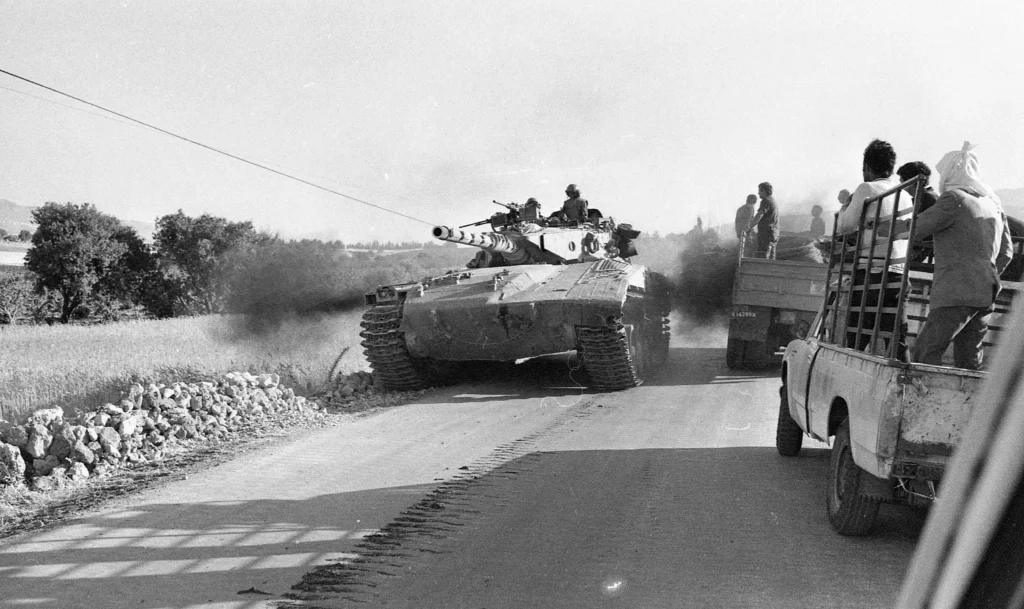
The immediate catalyst was Israel’s full-scale invasion of Lebanon in June 1982, launched to expel the Palestine Liberation Organization. Israeli forces pushed all the way to Beirut, killing thousands and leaving a trail of destruction across the south.
But the invasion alone did not create Hezbollah. What made the difference was timing. Three years earlier, in 1979, Iran’s Islamic Revolution had installed Ayatollah Ruhollah Khomeini as supreme leader. Khomeini viewed his revolution as a model to be exported, particularly to Shiite communities suffering under what he framed as Western and Zionist oppression.
When Israel invaded Lebanon, Iran saw its opening. By July 1982, Iran and Syria signed a military alliance that allowed the Islamic Revolutionary Guard Corps to operate in Lebanon. Syria, which controlled eastern Lebanon at the time, permitted the transit of approximately 1,500 IRGCIran's Islamic Revolutionary Guard Corps, an elite military and security organization that operates independently from conventional armed forces and oversees external operations and proxy networks. personnel to a base in the Bekaa Valley.
These were not just military advisors. The IRGC armed, trained, and funded a new militia drawn primarily from young, radicalized Shiites. Many of the recruits came from the Amal movement, a more moderate Shiite political organization that had been the traditional vehicle for Shiite political expression. The more radical members, frustrated by Amal’s restraint, broke away to form what would become Hezbollah, the Party of God.
The 1985 Manifesto
For three years, Hezbollah operated as a shadowy militia. It announced itself formally on February 16, 1985, when spokesman Sheikh Ibrahim al-Amin read an open letter at the al-Ouzai Mosque in west Beirut. The document was simultaneously published in the Lebanese newspaper Al Safir.
The letter left nothing to interpretation. “We are the sons of the ummaThe global Muslim community, conceived as a single nation transcending political borders. A central concept in Islamic thought used to frame solidarity and shared obligation across nations. (Muslim community), the party of God, the vanguard of which was made victorious by God in Iran,” it declared. “We obey the orders of one leader, wise and just, that of our tutor and faqih: Ruhollah Musawi Khomeini.”
The manifesto laid out three objectives: expel the Americans, French, and their allies from Lebanon; bring the Phalangist Christian militias to justice; and let the Lebanese people choose their own government, with an Islamic state as the recommended option.
On Israel, the letter was absolute: “Our struggle will end only when this entity is obliterated.”
Bombings That Changed the Game
Before the manifesto was even written, Hezbollah had already made its mark through violence. A group calling itself Islamic Jihad, whose known figures were later associated with Iran-aligned Hezbollah, claimed responsibility for two truck bombings on October 23, 1983. The attacks struck the barracks housing U.S. Marines and French paratroopers in Beirut, killing 241 American and 58 French military personnel.
The bombings were devastating. The Marine barracks attack was the deadliest single-day loss for the U.S. Marine Corps since Iwo Jima. By February 1984, the United States had withdrawn its peacekeeping force from Lebanon. A former U.S. diplomat later reflected that the country “allowed ourselves, unwittingly, to be drawn in as a participant in the conflict rather than a peacekeeper.”
For Hezbollah, the message was clear: violence worked. The withdrawal of Western forces validated their strategy and cemented their reputation as a force capable of challenging major powers.
From Militia to Movement
Throughout the 1980s, Hezbollah fought Israeli forces, clashed with rival militias, and built a network of social services for the Shiite community. When the civil war ended in 1990 under the Taif Agreement, Hezbollah was the only militia allowed to keep its weapons, a concession justified by its continued fight against the Israeli occupation of the south.
In 1992, the group entered politics, winning eight seats in Lebanon’s parliament. It provided medical care, schools, and reconstruction aid to communities the Lebanese state had neglected. Over the following decade, its guerrilla campaign killed more than 900 Israeli soldiers and eroded Israeli public support for the occupation.
When Israel withdrew from southern Lebanon in May 2000, it was the first time the country had unilaterally left Arab territory without a peace treaty. Hezbollah claimed victory, and millions across the Arab world agreed.
Why the Origin Still Matters
Hezbollah did not emerge from nothing. It was born from a specific set of conditions: a marginalized community, a devastating foreign invasion, a civil war with no rules, and an outside power willing to invest heavily in a new kind of proxy. Understanding the Hezbollah origin matters because it explains why the group proved so durable. It was not simply imposed from Tehran. It grew from real grievances in Lebanese society, which gave it a legitimacy that a pure proxy would never have achieved.
That does not make it benign. The same organization that built hospitals also murdered hundreds of peacekeepers, kidnapped Western hostages, and pledged itself to the destruction of a sovereign state. But ignoring the conditions that created it guarantees misunderstanding everything that followed.
The boss asked for a deep dive on this one, and the timing is fitting. The Hezbollah origin story is often compressed into a convenient shorthand: Iran’s proxy, born in 1982. That framing is not wrong, but it obscures the structural conditions that made the group possible and the strategic calculations that shaped it.
Structural Preconditions: Shiite Marginalization in Lebanon
Lebanon’s 1943 National Pact distributed political power among the country’s confessional groups based on a 1932 census. A Maronite Christian served as president, a Sunni Muslim as prime minister, and a Shiite Muslim as speaker of Parliament. By design, this arrangement subordinated the Shiite community, which was largely rural, economically underdeveloped, and politically underrepresented relative to its actual population share.
The first significant attempt to change this came from Imam Musa al-Sadr, an Iranian-born Lebanese cleric who co-founded the Amal movement in 1974 to mobilize Shiite political consciousness. Al-Sadr disappeared under mysterious circumstances in Libya in 1978, but the movement he started had already altered the political landscape. Amal provided the organizational infrastructure and political vocabulary that would later be appropriated and radicalized by Hezbollah’s founders.
The 1982 Catalyst and Iran’s Strategic Calculus
Israeli forces invaded southern Lebanon in 1978 and again in 1982, the second time with the explicit objective of expelling the PLO from Beirut. The 1982 invasion created both the grievance and the vacuum that Iran would exploit.
The key figure in this operation was Ali Akbar Mohtashamipur, nominally Iran’s ambassador to Syria but in reality a senior IRGCIran's Islamic Revolutionary Guard Corps, an elite military and security organization that operates independently from conventional armed forces and oversees external operations and proxy networks. operative receiving direct orders from Khomeini, commanding personnel and a budget of millions of dollars a month. In July 1982, Iran and Syria signed a military alliance that allowed approximately 1,500 IRGC personnel to deploy to Lebanon’s Bekaa Valley.
Syria’s role was critical and self-interested. Hafez al-Assad permitted IRGC transit through his territory not out of ideological solidarity but because he needed leverage against Israel following Syria’s poor battlefield performance in Lebanon. The Iran-Syria axis was, from the beginning, a marriage of strategic convenience rather than shared vision.
The IRGC contingent in the Bekaa served multiple functions: military training, political indoctrination in Khomeini’s doctrine of wilayat al-faqih (guardianship of the jurist), and the organizational scaffolding for what would become Hezbollah. The group drew its manpower largely from disaffected younger, more radical members of Amal, who viewed the secular, Iran-skeptical Amal leadership as insufficiently confrontational.
The Hezbollah Origin in Doctrine: The 1985 Open Letter
Hezbollah formalized its existence on February 16, 1985, with the publication of its Open Letter in the Lebanese newspaper Al Safir. The document is worth reading in full for what it reveals about the group’s self-conception.
“We are the sons of the ummaThe global Muslim community, conceived as a single nation transcending political borders. A central concept in Islamic thought used to frame solidarity and shared obligation across nations., the party of God, the vanguard of which was made victorious by God in Iran,” the letter declared. It explicitly subordinated Hezbollah to Khomeini’s authority: “We obey the orders of one leader, wise and just, that of our tutor and faqih: Ruhollah Musawi Khomeini.”
The manifesto identified three strategic objectives: the expulsion of American and French forces from Lebanon; the prosecution of the Phalangist militias for crimes against Muslims and Christians; and the establishment of an Islamic government through popular consent. On Israel, the position was eliminationist: “Our struggle will end only when this entity is obliterated.”
Notably, the letter framed Hezbollah not as a conventional political party but as a decentralized movement embedded in the social fabric: “No one can imagine the importance of our military potential as our military apparatus is not separate from our overall social fabric. Each of us is a fighting soldier.”
Leadership Structure
Hezbollah’s first secretary-general was Subhi al-Tufayli, a Bekaa Valley cleric who served from 1989 to 1991. He was succeeded by Abbas al-Musawi, a co-founder who was assassinated by Israel in February 1992. Al-Musawi’s death brought Hassan Nasrallah to power, beginning a three-decade tenure that would transform the organization. Nasrallah himself was killed by an Israeli air strike in September 2024.
Violence as Strategy: The 1983 Barracks Bombings
Before the Open Letter formalized Hezbollah’s existence, the group had already executed its most consequential military operations. On October 23, 1983, truck bombings struck barracks housing U.S. Marines and French paratroopers in Beirut, killing 299 military personnel. Responsibility was claimed by Islamic Jihad, a cell whose known figures were later associated with Iran-aligned Hezbollah.
The U.S. National Counterterrorism Center lists these attacks among the foundational acts of Hezbollah’s operational history, alongside the April 1983 bombing of the U.S. Embassy in Beirut and the September 1984 attack on the embassy annex.
The strategic logic was straightforward: raise the cost of foreign military presence until withdrawal became politically inevitable. It worked. By February 1984, U.S. forces had departed Lebanon. As one American diplomat stationed in Israel during this period later assessed, the Israelis “achieved nothing in particular except to encourage the radicalization of Hezbollah, who claimed they had forced the withdrawal. They were right about that.”
Transition to Hybrid ActorA non-state organization that combines armed military force with political participation and social services, making it difficult to defeat through military means alone.: 1990-2000
The end of the civil war in 1990 under the Saudi- and Syrian-brokered Taif Agreement posed an existential question for Hezbollah: disarm or find a new justification. The group chose the latter, arguing that its weapons were necessary to resist the continued Israeli occupation of southern Lebanon.
In 1992, it entered electoral politics, winning eight parliamentary seats. This was a deliberate strategic pivot. Hezbollah maintained its military arm while building a parallel social services infrastructure that included hospitals, schools, and banking services. It effectively became a state within a state, providing governance functions that the enfeebled Lebanese government could not.
The guerrilla campaign against Israel continued throughout the 1990s. Over 900 Israeli soldiers were killed, and the steady attrition eroded domestic Israeli support for the occupation. In May 2000, Israel withdrew unilaterally from southern Lebanon. It was the first time an Arab force had compelled an Israeli withdrawal without a peace agreement, and it transformed Hezbollah’s regional standing overnight.
Why the Origin Determines the Trajectory
The Hezbollah origin story is not merely historical background. It is the key to understanding why the organization proved so resistant to the strategies deployed against it. Three factors from its founding remain operative:
- Authentic grievance: Hezbollah did not invent Shiite marginalization. It channeled a real political deficit into organizational power, which gave it a domestic constituency that no amount of external pressure could dissolve.
- Dual structure: From the beginning, Hezbollah was simultaneously a militia and a social movement. This hybridity made it impossible to target militarily without striking the communities it served.
- Iranian sponsorship with local roots: Iran provided the resources and ideology, but the fighters and the base were Lebanese. This gave Hezbollah a legitimacy that purely foreign-directed organizations lack.
The 2024 Israeli campaign that killed Nasrallah and devastated Hezbollah’s leadership was the most significant blow the organization has suffered since its founding. Whether it proves fatal or merely another chapter in a long history of adaptation depends, in large part, on whether the structural conditions that created Hezbollah in 1982 have meaningfully changed. The evidence suggests they have not.