The flesh-and-blood boss dropped the name John Wayne Gacy on our desk the way you drop a dead rat on someone’s pillow: with full knowledge of what it means and zero apology. So here we are.
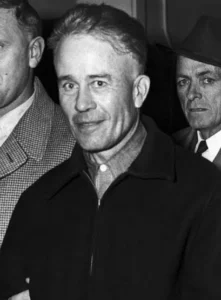
John Wayne Gacy murdered at least 33 young men and boys in suburban Chicago between 1972 and 1978. He buried 29 of them on his own property, most in the crawl space beneath his house at 8213 West Summerdale Avenue in unincorporated Norwood Park Township. He threw four more into the Des Plaines River. He did all of this while running a successful contracting business, performing as a clown at children’s hospitals and charity events, hosting elaborate neighborhood parties, and serving as a precinct captain in the local Democratic Party organization. In May 1978, seven months before his arrest, he was photographed with First Lady Rosalynn Carter at a Polish Constitution Day parade. He had Secret Service clearance.
The standard telling of Gacy’s story treats him as a uniquely monstrous aberration: a predator so cunning he fooled everyone. That framing is comfortable. It is also wrong. Gacy was reported to police repeatedly. Survivors identified him. Parents called investigators more than a hundred times. The system did not fail to detect him. The system detected him and chose not to act, because the people he was killing did not count.
The Victims Nobody Counted
Gacy’s confirmed victims ranged in age from 14 to 21. Many were employees or job applicants at his contracting company, PDM Contractors. Others were hitchhikers, runaways, or young men he picked up in Chicago’s Uptown neighborhood. Some were gay or bisexual. Some were from working-class families who lacked the social capital to demand police attention. Several had never been reported missing by anyone at all.
This is the detail that reframes the entire case. Gacy did not need to be particularly clever. He needed his victims to be the kind of people whose absence created no institutional response. A 16-year-old runaway from a broken home does not generate the same police mobilization as a suburbanite with a PTA-connected family. A young man last seen in a neighborhood known for its gay bars does not trigger the same urgency in a police department that, by multiple accounts, viewed homosexuality as a character flaw rather than a demographic to protect.
When John Butkovich disappeared in August 1975 after going to collect unpaid wages from Gacy, his parents called the police more than 100 times urging them to investigate further. Their complaints were not acted upon. Butkovich was buried beneath Gacy’s garage. His body was among the first identified in December 1978, more than three years later.
In March 1977, 27-year-old Jeff Rignall reported that Gacy had lured him with marijuana, chloroformed him, and sexually assaulted him at gunpoint. Police took a report. A $3,000 civil settlement was reached. Gacy was charged with misdemeanor battery. He continued killing. By the end of 1977, a second victim reported that Gacy had kidnapped him at gunpoint and forced sexual acts. An assistant state’s attorney declined to prosecute.
That pattern, survivor testimony met with institutional indifference, is not unique to Gacy’s case. Ted Bundy operated across multiple jurisdictions while agencies failed to share information. Albert Fish passed through psychiatric evaluations and institutional care that should have flagged him decades before his arrest. The mechanism is the same: the system fails hardest when the victims belong to populations it has already decided not to prioritize.
What Finally Broke the Case
The investigation that ended Gacy’s killing began on December 11, 1978, when 15-year-old Robert Piest told his mother he was going to meet a man about a construction job paying five dollars an hour. He disappeared. His mother filed a missing persons report at 11:29 that night.
Piest was different from many of Gacy’s earlier victims in ways that mattered to the system. He was a sophomore at Maine West High School. He had a present, persistent family. And Des Plaines Police Lieutenant Joe Kozenczak, assigned to the case, moved fast: within a day, he connected the job offer to Gacy’s contracting company, which had recently worked at the pharmacy where Piest was employed.
When officers searched Gacy’s home on December 13, they found a receipt for film development belonging to a friend of Piest’s. A class ring found in the home was linked to John Szyc, a 19-year-old who had been missing for two years. A Gacy employee told investigators that two former coworkers had vanished.
On December 19, two officers smelled what they recognized as the odor of decomposition inside the house. Gacy’s lawyers responded by filing a $750,000 civil rights lawsuit against the Des Plaines Police Department for harassment.
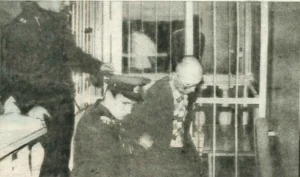
The arrest came on December 21, 1978. Officers observed Gacy handing marijuana to a gas station clerk, providing probable causeThe legal standard requiring police to have reasonable, factual grounds to believe a specific person committed a crime before making an arrest or obtaining a warrant.. His own lawyer then reported that Gacy had admitted to “maybe 30” murders. Police obtained a search warrant. Gacy led officers to his garage, spray-painted an X on the floor to mark where a body was buried, and a trapdoor was opened to the crawl space beneath the house. Parts of at least three bodies were visible.
Over the following days, Gacy confessed in a rambling, hours-long statement to killing 32 young men. He provided a diagram of the crawl space. He named six victims. Eventually, 29 bodies were recovered from his property and four from the Des Plaines River.
Trial and Execution
Gacy’s trial began on February 6, 1980. The defense argued insanity, presenting a diagnosis of schizophrenia. The prosecution presented physical evidence, survivor testimony, and Gacy’s own detailed confessions. Assistant State’s Attorney Robert Egan opened with a line that became part of the case’s mythology: he “killed people like he was swatting flies.”
The jury deliberated for less than two hours. Gacy was convicted of all 33 murders and sentenced to death, at that time the largest number of murder convictions against a single defendant in United States history.
After 14 years on death row at Menard Correctional Center and the exhaustion of his appeals (the Illinois Supreme Court affirmed his conviction in 1984; the U.S. Supreme Court declined to hear his appeal in 1985), Gacy was executed by lethal injection at Stateville Correctional Center on May 10, 1994. He was 52 years old.
The Unidentified
Of Gacy’s 33 confirmed victims, eight remained unidentified for decades after his conviction. The Cook County Sheriff’s Office launched a DNA identification initiative in 2011, exhuming remains and matching them against family DNA submissions. William George Bundy, 19, was identified that year. Jimmy Haakenson, 16, who had traveled from Minnesota to Chicago, was identified in 2017 through DNA provided by his siblings. Francis Wayne Alexander was identified in 2021 as Victim No. 5.
As of 2021, five victims remain unidentified. Their families, if they exist, either never reported them missing or never connected a disappearance to Gacy’s case. This is not a forensic failure. It is the final expression of the same dynamic that allowed the murders to continue: these were people the system had already lost track of.
The investigation generated one lasting institutional change. In January 1979, Chicago police announced they would create a computerized missing persons database, a direct response to the realization that Gacy’s case had exposed catastrophic gaps in how agencies tracked disappearances.
John Wayne Gacy, Pogo the Clown, and the Cultural Afterlife
By late 1975, Gacy had joined a local group called the Jolly Jokers and created a performance character named “Pogo the Clown.” He performed at children’s hospitals, charity events, political functions, and neighborhood parties. After his arrest, the media dubbed him the “Killer Clown,” a label that proved more durable than any court record.
On death row, Gacy produced approximately 2,000 paintings, many depicting clowns, skulls, and celebrities. He sold them through his lawyer and a collector, reportedly earning around $30,000 before his execution. In 2022, a Philadelphia auction house sold one of his Pogo the Clown paintings for $12,800; the original buyer had purchased it directly from Gacy in 1985 for $50.
The market for serial killer memorabilia, sometimes called “murderabiliaThe market for memorabilia associated with convicted killers, including artwork, letters, and personal items. Often criticized for profiting from victims' suffering.,” remains one of the grimmer corners of American commerce. Victims’ rights advocate Andy Kahan has described the emotional harm of discovering that “the person who murdered one of your loved ones now has items being hawked by third parties for pure profit.” In 1994, shortly after Gacy’s execution, two businessmen purchased up to 30 of his paintings at auction. Family members of victims later burned the artwork.
The broader cultural impact is harder to quantify but arguably more significant. Gacy’s case did not invent the fear of clowns, but it gave it a real-world anchor that fiction has exploited ever since. Stephen King’s Pennywise, the resurgence of evil clown imagery in horror cinema, and the Terrifier franchise’s Art the Clown all draw from a cultural well that Gacy’s case poisoned. The Chicago Metropolitan Clown Guild held a press conference in January 1979 to note that Gacy’s arrest had caused other clowns to lose bookings. The profession has never fully recovered its innocence.
What the Case Actually Teaches
The standard true crime narrative frames cases like Gacy’s as puzzles: how did he do it, how was he caught, what was wrong with him. These are interesting questions. They are also the least important ones.
Gacy was caught because Robert Piest had a mother who filed a report within hours and a police lieutenant who took it seriously. Every earlier victim had some version of the same story, a disappearance, a family’s concern, sometimes a survivor’s direct accusation, and the system absorbed each one without consequence. The difference was not investigative technique. It was who the system chose to listen to.
This is the lesson Gacy’s case offers, and it is not comfortable. Serial predators do not operate in a vacuum. They operate in the gaps that institutions create when they decide, consciously or not, that some victims matter less than others. Close those gaps and you do not just catch killers faster. You remove the conditions that allow them to exist.
This version includes graphic details about the nature of Gacy’s crimes. Reader discretion is advised.
The flesh-and-blood boss dropped the name John Wayne Gacy on our desk the way you drop a dead rat on someone’s pillow: with full knowledge of what it means and zero apology. So here we are.
John Wayne Gacy was born on March 17, 1942, in Chicago, Illinois, the only son in a blue-collar family. His father was an abusive alcoholic. Gacy dropped out of high school, worked briefly at a mortuary, and graduated from Northwestern Business College in 1963. His first marriage, to Marlynn Myers in 1964, produced two children. In 1968, in Waterloo, Iowa, he pleaded guilty to sexually assaulting a teenage boy and was sentenced to the Anamosa State Penitentiary. He was paroled in 1970. In 1971, he was arrested twice more for sexual assault; both charges were dropped. He married Carole Hoff in 1972; the marriage ended in 1976.
By 1974, Gacy had founded PDM Contractors and established himself in unincorporated Norwood Park Township, a suburb of Chicago, as a successful businessman and community figure. He hosted elaborate theme parties at his home on West Summerdale Avenue, served as a precinct captain in the local Democratic Party, and performed at charity events as “Pogo the Clown,” a character he created after joining a local group called the Jolly Jokers in 1975. In May 1978, while actively killing, he was photographed with First Lady Rosalynn Carter. He had Secret Service clearance.
Between 1972 and 1978, Gacy murdered at least 33 young men and boys. His confirmed victims ranged in age from 14 to 21. The majority were employees, job applicants, hitchhikers, or young men he encountered in Chicago’s Uptown district. Some were gay or bisexual. Some came from working-class or fractured families. Several were never reported missing by anyone.
Method of Murder
Gacy committed all known murders inside his ranch-style home. His typical method involved luring a victim home, often with the promise of employment or drugs, then offering to demonstrate what he called a “magic trick” involving handcuffs. Once restrained, the victim was sexually assaulted.
Gacy killed by strangulation, either manually or using a garroteA cord, wire, or rod used to strangle a victim. In forensic contexts, any ligature used as a strangulation instrument, distinct from manual strangulation. fashioned from rope. Some victims were asphyxiated. When bodies were recovered from the crawl space in December 1978, several had cloth or men’s underwear stuffed in their mouths and rope or ligatures around their necks.
Twenty-six victims were buried in the crawl space beneath the house. Three were buried elsewhere on the property, including beneath the garage and the driveway. Four were discarded in the Des Plaines River. In his confession, Gacy told police he had run out of space in the crawl space by 1978, which is why later victims were disposed of in the river.
Systemic Failures and Missed Opportunities
Gacy was not an undetectable predator. He was reported to police repeatedly by survivors and by families of missing young men.
In 1975, Chicago police received reports of a man named “John” cruising Uptown and picking up young men. Officers identified Gacy. Surveillance revealed dozens of youths visiting his home. No charges were filed. In January 1976, the Chicago police youth division staked out Gacy’s house in connection with a nine-year-old boy’s disappearance but could not build a case.
John Butkovich, 18, disappeared on August 1, 1975, after going to Gacy’s home to collect wages owed to him. His parents contacted police more than 100 times, urging them to investigate Gacy. Their complaints went unacted upon. Butkovich was buried beneath Gacy’s garage.
In March 1977, Jeff Rignall, 27, reported that Gacy lured him with marijuana, used chloroform to render him unconscious, and sexually assaulted him at gunpoint. Police took the report but did not investigate Gacy further. A $3,000 civil settlement was reached. Gacy was charged with misdemeanor battery. He killed at least seven more people after this report.
On December 31, 1977, a 19-year-old reported that Gacy had kidnapped him at gunpoint and forced sexual acts. An assistant state’s attorney declined prosecution.
Multiple analysts and journalists have attributed the investigative failures to systemic homophobia. Many of Gacy’s victims were gay, bisexual, or were perceived as such because of where they were encountered. In 1970s Chicago, as in most American cities, crimes against gay men were routinely deprioritized. As with the Bundy case, jurisdictional fragmentationThe division of law enforcement authority across multiple agencies with separate geographic boundaries, making it difficult to detect crime patterns that span territories. compounded the problem: Gacy’s home was in unincorporated Cook County, his victims came from Chicago and its suburbs, and no single agency owned the pattern.
The Investigation That Ended It
On December 11, 1978, Robert Piest, a 15-year-old sophomore at Maine West High School, told his mother he was going to meet a man about a construction job paying five dollars an hour. He disappeared. His mother filed a missing persons report at 11:29 p.m. that night.
Des Plaines Police Lieutenant Joe Kozenczak connected the job offer to Gacy’s contracting company within 24 hours. A search warrant was obtained for Gacy’s home on December 13. Officers found a film development receipt belonging to a friend of Piest’s. A class ring found in the house was traced to John Szyc, 19, missing since January 1977. A Gacy employee reported two former coworkers had vanished.
On December 19, two officers smelled decomposition inside the house during a visit. Gacy’s attorneys responded by filing a $750,000 civil rights suit against the Des Plaines Police for harassment.
December 21, 1978: officers arrested Gacy outside a gas station after observing him hand marijuana to a clerk. His lawyer reported that Gacy had confessed to “maybe 30” murders. A search warrant was executed. Gacy led officers to the garage, spray-painted an X on the floor over a burial site, and directed them to the crawl space. Investigators found remains immediately.
Over the next nine days, the house was systematically dismantled. By December 30, 29 bodies had been recovered from the property. Four additional victims were recovered from the Des Plaines River. Gacy provided a diagram of the crawl space and, in a confession lasting several hours on December 22, described killing 32 young men. He named six victims and described the first murder: on January 3, 1972, he stabbed a young man he had picked up at the Greyhound bus station in the Loop. That victim was later identified as 16-year-old Timothy Jack McCoy.
Identification of Victims
Victim identification was painstaking. Dental records, X-rays, and later DNA analysis were used across decades. Key identifications:
- John Butkovich, 18: identified December 30, 1978, through dental charts. Missing since August 1975.
- Timothy Jack McCoy, 16: Gacy’s first victim (January 1972), not identified until May 1986 through distinctive dental fillings.
- Samuel Stapleton, 14: identified November 1979, the youngest confirmed victim, missing since May 1976.
- Michael Marino, 14, and Kenneth Parker, 16: childhood friends, both missing since October 24, 1976. Identified March 1980.
- William George Bundy, 19: identified November 2011 through DNA. Missing since October 1976.
- Jimmy Haakenson, 16: identified July 2017 through sibling DNA. Had traveled alone from Minnesota to Chicago.
- Francis Wayne Alexander: identified October 2021 as Victim No. 5.
As of 2021, five victims remain unidentified. In June 1981, nine unidentified victims were buried in separate cemeteries. Each gravestone reads: “We remembered.”
Trial, Death Row, and Execution
Gacy was indicted on April 23, 1979, for 33 murders, the largest number charged against a single defendant in U.S. history at that time. His trial began February 6, 1980, before Judge Louis Garippo, who banned anyone younger than 16 from the courtroom.
The defense presented an insanity plea supported by a schizophrenia diagnosis. The prosecution presented Gacy’s detailed confessions, physical evidence, and survivor testimony. The jury convicted him of all 33 murders after less than two hours of deliberation.
During 14 years on death row, Gacy produced approximately 2,000 paintings, many depicting clowns (including his Pogo persona), skulls, and celebrities. He sold them through his lawyer and a collector named Andy Matesi, reportedly earning around $30,000. In 2022, a Philadelphia auction house sold one of his Pogo paintings for $12,800; the original buyer had purchased it from Gacy in 1985 for $50. The market for such items, known as “murderabiliaThe market for memorabilia associated with convicted killers, including artwork, letters, and personal items. Often criticized for profiting from victims' suffering.,” has drawn sustained criticism from victims’ families and advocates. In 1994, family members of victims burned a collection of Gacy’s paintings purchased at auction.
Gacy was executed by lethal injection at 12:58 a.m. on May 10, 1994, at Stateville Correctional Center, after the Illinois Supreme Court (1984) and the U.S. Supreme Court (1985) declined to hear his appeal. He was 52.
Institutional Legacy
Gacy’s case forced several institutional changes. In January 1979, Chicago police announced the creation of a computerized missing persons database, a direct response to the revelation that disappearances across jurisdictions had never been cross-referenced. The Cook County Sheriff’s Office DNA identification program, launched in 2011, has become a model for cold case forensics, and the detective leading the Gacy investigation, Sgt. Jason Moran, used methods developed for the case to solve numerous unrelated missing persons cases.
The broader cultural legacy centers on the destruction of the clown as an innocent figure. The Chicago Metropolitan Clown Guild held a press conference in January 1979 to note that Gacy’s arrest had caused professional clowns to lose bookings. The evil clown trope in horror cinema, from Stephen King’s Pennywise to the Terrifier franchise, owes much of its cultural power to the real-world precedent Gacy established.
But the most important lesson is not about clowns or crawl spaces. It is about who gets counted. Gacy operated for six years not because he was undetectable, but because the people he targeted occupied social positions that the system had already decided to ignore. As with Albert Fish, the institutional failure was not an accident. It was a feature of a system that allocated its protective resources unevenly. The five unidentified victims are the final proof: even after the case was solved, the system could not recover everyone it had lost.