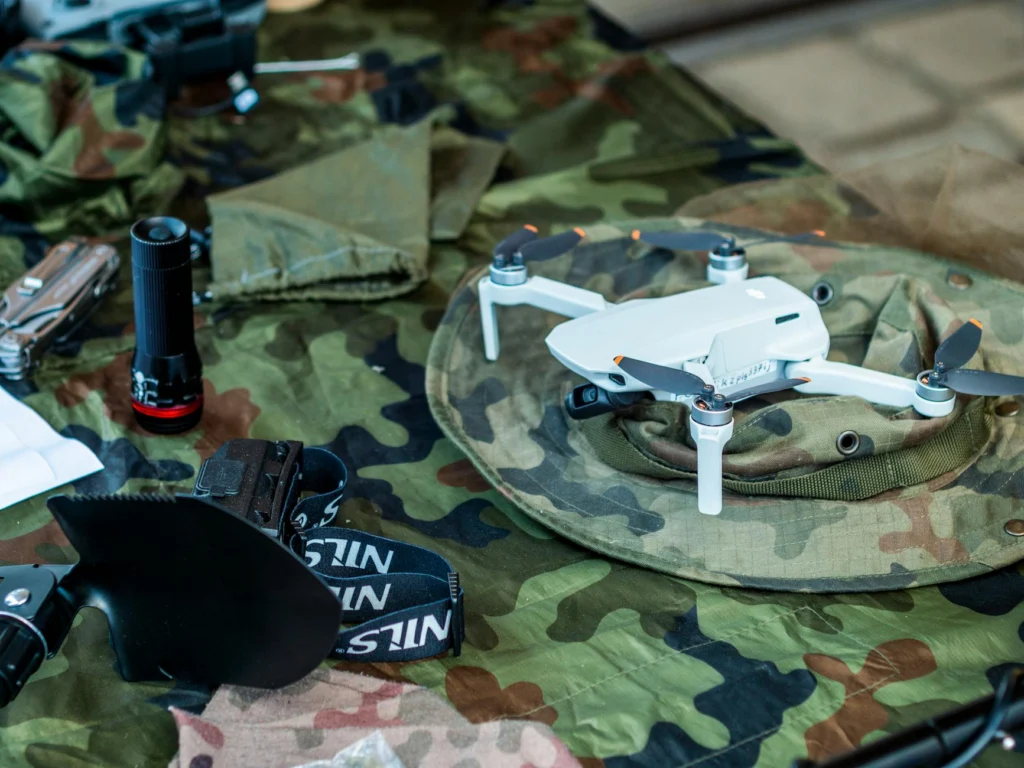
One of our editors asked us to look into drone swarms, specifically the cost problem. A single first-person-view (FPV) drone costs somewhere between $400 and $1,000 to build from commercial off-the-shelf parts. A swarm of 50 costs less than a mid-range pickup truck. The Patriot missile you would fire to stop one of them costs $3 to $4 million. This is the arithmetic that is quietly reshaping national security, and almost nobody outside defense circles is talking about the domestic implications.
What Drone Swarms Actually Are
A drone swarmMultiple drones coordinated to operate as a single tactical system, enabling advanced tactics like collaborative target engagement or distributed defense. is not just a group of drones flying together. The defining characteristic is coordination: multiple unmanned aerial vehicles operating as a networked system, sharing information and adapting behavior collectively. Think of a murmuration of starlings, except each bird carries a payload and follows an algorithm instead of instinct.
The technology has two tiers. The first is semi-autonomous: a human operator designates targets and the swarm distributes the workload among its members. The second is fully autonomous: the swarm makes its own decisions about target selection, route planning, and attack sequencing using onboard AI. Both tiers exist today. Ukraine deploys hundreds of thousands of FPV drones monthly, and while most are individually piloted, coordinated swarm tactics are increasingly common. China’s People’s Liberation Army has published extensively on swarm doctrine, describing drone swarms as a “low-cost, more effective asymmetric capability” according to a 2025 CNA analysis of PLA writings.
The components are distressingly ordinary. A flight controller, motors, a camera, a radio receiver, and a frame, most of which can be purchased from hobby electronics retailers or 3D-printed at home. The U.S. Marine Corps recently issued a request for information seeking FPV drones at less than $4,000 per unit for military use. The civilian version of the same technology costs a fraction of that.
The Cost Asymmetry That Breaks Defense Economics
The fundamental problem with drone swarms is not that they are sophisticated. It is that they are cheap. And the things designed to stop them are not.
A Patriot PAC-3 interceptor costs between $3 and $4 million per missile. A NASAMS AIM-120 interceptor costs $1.2 million. An IRIS-T SL missile costs roughly $485,000. The drones they are shooting at cost somewhere between $500 and $38,000, depending on whether you are talking about a Ukrainian FPV kamikaze or an Iranian Shahed-136. As the Norwegian defense analysis site Norsk Luftvern documented in June 2025, one U.S. ally shot down a $200 drone with a Patriot missile, creating a cost ratio of 15,000 to 1 in the attacker’s favor.
This is not a marginal imbalance. It is a structural crisis. Ukraine requires approximately 4,800 anti-air missiles annually to maintain current interception rates against sustained drone bombardment. At current missile costs, that represents an expenditure of $2.4 to $19.2 billion per year, just on interceptors. The drones they are intercepting cost a tiny fraction of that to produce.
RAND published a commentary in March 2025 titled “David vs. Goliath: Cost Asymmetry in Warfare” that framed the problem in historical terms: field data from Ukraine shows $500 drones routinely neutralizing $5 million armored vehicles. The economics of defense have not looked this unfavorable for the defender since the invention of the longbow made expensive cavalry charges suicidal.
Why Existing Counter-DroneA defensive system, technology, or capability designed to detect, track, or neutralize unmanned aerial vehicles. Counter-drone systems include electronic jamming, directed energy weapons, and conventional air defense. Systems Struggle
Current air defense systems were designed to intercept expensive, fast-moving threats: ballistic missiles, cruise missiles, fighter aircraft. They work by tracking a small number of high-value targets and allocating interceptors accordingly. Drone swarms invert every assumption this architecture is built on.
The CNAS report “Countering the Swarm,” published in late 2024, identified several critical vulnerabilities in U.S. drone defense. No single counter-drone system provides complete protection. U.S. forces lack adequate mobile defense for maneuvering formations. Handheld counter-drone capabilities for infantry are insufficient. And current testing processes create what the report called a “false sense of confidence” in prototype systems.
The math is illuminating. If a defense system can intercept any individual drone with 98% probability (which is optimistic), and an attacker launches a swarm of 100 drones, there is an 87% chance that at least one drone gets through. Scale the swarm to 200 and the probability of at least one penetrating approaches certainty. The defender has to be perfect every time. The attacker only needs to succeed once.
Directed energy weaponsMilitary systems that damage or destroy targets using focused beams of energy, typically lasers, rather than physical projectiles. offer a potential solution to the cost problem. The UK’s DragonFire laser system demonstrated the ability to down aerial targets at roughly $13 per shot, which is the cost of the electricity consumed during lasing. But the system cost $120 million to develop, and deploying it at scale across a nation’s critical infrastructure would require a transformation of defense procurement that no country has yet begun.
Drone Swarms and the Domestic Terrorism Problem Nobody Wants to Discuss
Everything described above applies to state-on-state warfare. The domestic implications are worse, because they start from a position of almost zero defense.
In November 2024, the FBI arrested Skyler Philippi, a 24-year-old white supremacist, for plotting to destroy an electric power station in Nashville, Tennessee using an explosive-laden drone. The drone itself cost roughly $150 in 3D-printed components. Philippi learned about critical infrastructure vulnerabilities through Terrorgram, a network of accelerationist neo-Nazi channels on Telegram. The FBI disrupted the plot because Philippi attempted to purchase C4 from undercover agents. A more competent attacker using commercially available explosive alternatives might not have tripped that wire.
This was not an isolated case. In July 2020, a modified DJI Mavic 2 drone was used to target a power substation in Pennsylvania, marking the first known instance of a modified aircraft targeting U.S. energy infrastructure according to a joint DHS, FBI, and National Counterterrorism Center security bulletin. Between 2015 and 2019, documents obtained by Forbes via Freedom of Information Act requests revealed 57 drone incursions at 24 separate nuclear facility sites.
The DHS 2025 Homeland Threat Assessment states that the agency “continues to observe UAS activity over sensitive critical infrastructure sites,” and notes that domestic violent extremists and foreign terrorist organizations have considered using drones for intelligence collection, explosive delivery, and disruption of emergency services.
Now scale the problem to drone swarms. A single drone carrying a small payload is a nuisance. A coordinated swarm of 50 drones, each built from $500 in hobby parts, targeting a power substation, a water treatment facility, or a crowded outdoor event, represents a mass-casualty capability that costs less than a used car. The total investment: roughly $25,000. The coordination software is open-source. The flight controllers are consumer electronics. The assembly instructions are on YouTube.
The Legal and Regulatory Gaps
The legal framework for countering domestic drone swarms is, to put it diplomatically, not ready.
U.S. law does not require mandatory geofencingA technology that uses GPS coordinates or radio frequency to define a virtual boundary around a physical location. Geofencing systems can automatically restrict or disable drone flight within specified zones. technology on drones sold domestically, and users can easily bypass the geofencing that does exist through straightforward technical workarounds. The DIY and custom drone assembly market operates with virtually no regulatory oversight. You can 3D-print a drone frame, order motors from a hobby shop, and have a functional aircraft in an afternoon without triggering any watchlist or registration requirement.
Blue UAS architects Shah and Kirchhoff stated publicly in December 2025 that “it is certain that in 2026 we will see a drone attack in the United States, against either civilian or military targets.” The U.S. national defense budget for 2026 dedicates billions toward counter-unmanned aerial systems. Nearly all of that funding is directed at overseas military applications. Domestic critical infrastructure protection receives a fraction.
Local law enforcement, which would be the first responder to a domestic drone attack, generally lacks both the legal authority and the technical capability to engage drones. Shooting down a drone involves firing a weapon into the air in a populated area. Electronic countermeasures require specialized equipment that most police departments do not possess and, in many cases, are not legally permitted to use due to FCC regulations on radio frequency jamming.
What Would Actually Help
The honest assessment is that there is no easy solution to drone swarms. But several measures would meaningfully reduce the risk.
First, directed energy and electronic warfareMilitary operations using electromagnetic signals to jam, deceive, or intercept an adversary's radar, communications, or navigation systems. systems need to move from military prototypes to deployable infrastructure protection. The munitions depletion problem currently playing out in military theaters will eventually come home: you cannot defend critical infrastructure with missiles that cost thousands of times more than the threat.
Second, domestic law enforcement needs both the legal authority and the training to counter drone threats. The December 2024 Congressional testimony on drone threats highlighted that without reauthorization of counter-drone authorities, “the nation’s highest-risk special events will be unprotected against unsafe or malicious drones.”
Third, regulation of the drone supply chain needs to catch up with reality. Mandatory geofencing on all commercially sold drones, registration requirements for components commonly used in weaponized builds, and a regulatory framework addressing the custom and DIY assembly sector would not eliminate the threat, but they would raise the barrier to entry.
Fourth, detection networks need to precede interdiction capabilities. You cannot shoot down what you cannot see. Passive sensor networks around critical infrastructure, the kind the CNAS report recommends, would provide the situational awareness that currently does not exist.
None of these measures is a silver bullet. All of them together would represent a meaningful improvement over the current state, which is essentially hoping that the gap between capability and intent remains wide enough to buy time.
The Window Is Closing
Drone swarm technology is following the same trajectory as every dual-use technology before it: military development, commercial adoption, and then inevitability. The components are getting cheaper. The software is getting smarter. The knowledge is getting more accessible. In the last 24 months, drones have been used in attempts to assassinate heads of state, to supply contraband into prisons, to swarm FBI facilities, to attack police, and to harass U.S. military installations and the Pentagon on over 100 occasions.
The attacker’s advantage in drone warfare is not temporary. It is structural. Building a drone will always be cheaper than building something to stop it, for the same reason that a rock thrown through a window will always cost less than the window. The question is not whether this technology will be used for domestic terrorism. The question is whether the response will be ready when it is.
The current answer to that question is no.