Opinion.
You were probably told in school that 0.999… (repeating forever) equals 1. Not approximately. Not “close enough.” Exactly equal. The proof is elegant, widely accepted, and completely circular. It tells us something true about a system we invented. It tells us nothing about discrete realityThe hypothesis that space, time, and matter exist as indivisible minimum units rather than as infinitely divisible continuous quantities. Supported by some interpretations of quantum physics..
The Proof That Proves Itself
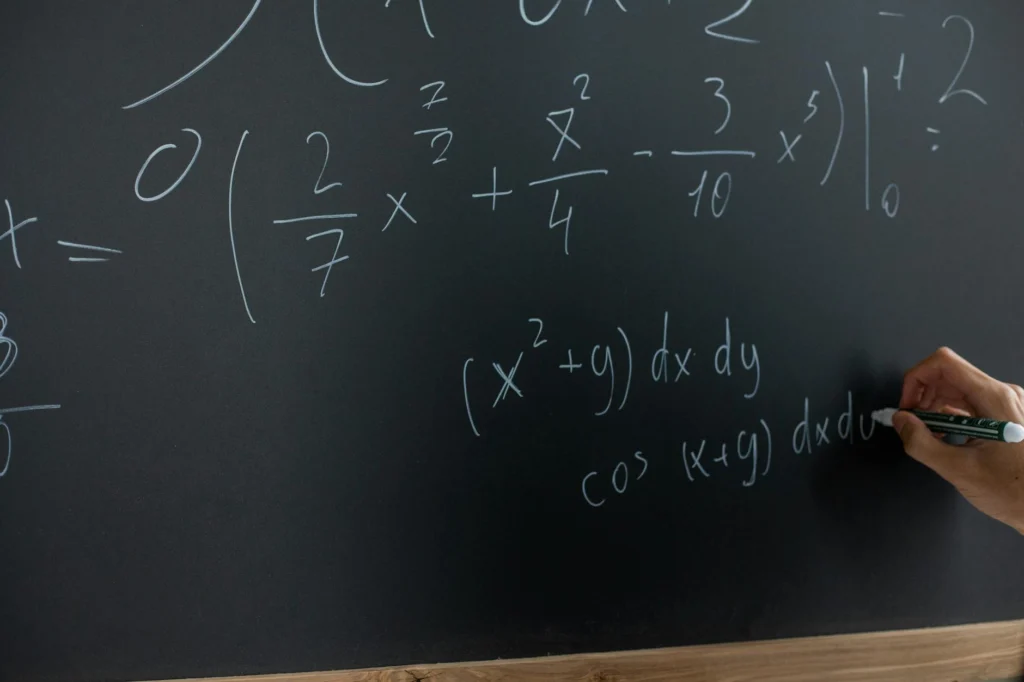
Here is the standard argument. Let x = 0.999… Then 10x = 9.999… Subtract: 10x − x = 9. So 9x = 9, and x = 1. Clean. Satisfying. And it assumes exactly what it claims to prove.
The move “let x = 0.999…” only works if you accept that an infinite decimal is a coherent object with a definite value. That acceptance is not free. It comes from the axioms of real analysisA branch of mathematics that rigorously defines concepts like limits, continuity, and infinite sequences using precise axioms. It provides the formal foundation for calculus and most of modern mathematics., a branch of mathematics built in the 19th century specifically to formalize the infinite. The real numbers are defined as the completion of the rationals, meaning every convergent sequence gets a limit, and limits are defined as equalities. The proof that 0.999… = 1 is valid because the system was constructed to make it valid. This is not a discovery about the universe. It is a property of a map we drew.
Maps and Territories: What the Distinction Means
Alfred Korzybski’s phrase “the map is not the territory” is one of the most useful ideas in epistemology, and one of the most ignored in mathematics education. A map is a model. It simplifies, it compresses, it makes navigation possible. But it also introduces artifacts: features that exist on the map but not in the landscape it represents.
Real analysis is a map. An extraordinarily useful one. It lets engineers build bridges, physicists calculate orbits, and economists model markets (with varying degrees of success). But the number line it describes, infinitely divisible, perfectly continuous, with no smallest gap between any two points, is an artifact of the model. Whether discrete reality itself has this property is a separate question entirely. And increasingly, physics suggests the answer is no. Discrete reality is not a fringe hypothesis. It is where the evidence points.
Continuous vs. Discrete: Ramps and Staircases
For readers who have not encountered this distinction formally, it is simpler than it sounds. Imagine a ramp and a staircase, both going from the ground floor to the second floor. The ramp is continuous: you can stop at any point along it, and there is always a spot between any two spots. The staircase is discrete: you are on one step or another, and there is nothing between them.
Now imagine zooming into a photograph. At normal viewing distance, it looks smooth, continuous, like a window onto the world. Zoom in far enough and you see pixels: tiny squares of single colors, with hard edges between them. The smoothness was never there. It was a product of your distance from the data.
The entire framework of real analysis, and by extension most of modern mathematics, assumes the ramp. It models space, time, and quantity as continuous: infinitely divisible, with no smallest unit, no pixel, no bottom. The question is whether reality is a ramp or a staircase. And modern physics keeps finding stairs.
Physics Finds the Pixels
Start with the Planck length: approximately 1.616 × 10⁻³⁵ meters. This is the scale at which our best theories of gravity and quantum mechanics simultaneously apply, and simultaneously break. Below this length, the concept of “distance” as we understand it may not be meaningful. It is not merely that we cannot measure smaller. The mathematics of quantum gravity suggests there may be nothing smaller to measure. Space itself may be granular at this scale, like a fabric with a weave you can see only under the most extreme magnification.
Energy is already known to be discrete. Planck’s original insight, the one that launched quantum mechanics in 1900, was that energy is not emitted continuously but in packets (quanta). This was not a mathematical convenience. It was the only hypothesis that matched experimental data on black-body radiation. The universe, at least in this domain, turned out to be a staircase.
Loop quantum gravity, one of the leading candidates for a theory of quantum gravity, goes further. It models spacetime itself as a network of discrete nodes and links, not a smooth continuum. If this framework (or something like it) is correct, then the continuous, infinitely divisible space that real analysis assumes does not exist at the most fundamental level. The number line is a map of a territory that is not smooth. The implication for discrete reality is significant: our most precise mathematical tools may be modeling something that isn’t there.
Newton Knew the Map Was Leaking
This tension is not new. Isaac Newton, whose calculus formalized the continuous mathematics we still use, was aware that his models drifted. His orbital mechanics predicted planetary positions with impressive but imperfect accuracy. The residual errors accumulated over time. Newton attributed the necessary corrections to divine intervention: God, he argued, periodically adjusted the planets to keep the solar system stable.
We tend to treat this as a quaint religious footnote. It is actually an honest admission that the model was an approximation. Laplace later removed the need for divine corrections with his perturbation theory, and the narrative became “Newton was right, he just needed better math.” But the deeper point survives: the model was always an approximation of something more complex. We built modern mathematics on Newton’s foundation and gradually forgot it was a foundation, not bedrock. As research on expert disagreement shows, the frameworks we inherit shape the conclusions we reach, often invisibly.
What Discrete Reality Means for Mathematics
If space is fundamentally discrete, a set of consequences follows. An infinitely divisible line does not correspond to anything in the physical world. Limits, the backbone of calculus, are tools for navigating a continuous model that discrete reality does not obey at its base layer. The convergence of 0.999… to 1 is a theorem about a mathematical space that may have no physical counterpart. It is true in the same way that the rules of chess are true: internally consistent, completely authoritative within the game, and not a claim about anything outside it.
This does not make real analysis useless. It makes it a map. An extraordinarily good map, one that has enabled centuries of engineering, physics, and technology. But a map whose smoothness is a feature of the cartography, not the terrain. When we say 0.999… = 1, we are saying something true about our model of numbers. Whether the universe contains anything that behaves like 0.999… is a question mathematics cannot answer, because mathematics built the system in which the question resolves to “yes.” The concept of discrete reality asks us to hold both truths simultaneously: the map works, and the map is not the territory.
The Circle at the End of the Argument
Follow this thread to its conclusion. If space is discrete at the smallest scale, then there is no such thing as a perfect curve. A curve requires continuity: an unbroken line with no gaps, no steps, no pixels. In a discrete reality, every curve is an approximation, a polygon with edges too small to see, a staircase pretending to be a ramp.
Pi, the ratio of a circle’s circumference to its diameter, is defined in terms of a perfect circle. If perfect circles do not exist in discrete reality (if every physical “circle” is actually a many-sided polygon at the Planck scale), then pi is not a measurement of anything real. It is a measurement of an idealization. A property of the map.
The circle is the foundation of trigonometry, which is the foundation of wave mechanics, which is the foundation of quantum physics, which is the field telling us that reality is discrete. There is a pleasing irony in this: the mathematics of circles led us to discover that circles might not exist.
We built a continuous mathematics to model a discrete universe. The model works brilliantly at human scales, just as pixels look smooth from across the room. But the smoothness was always ours, never the universe’s. The number line is a beautiful drawing of a place that has edges we chose to erase. Zero point nine repeating equals one, inside the drawing. Outside it, the question does not apply.
Circles aren’t real.
Sources
- Stanford Encyclopedia of Philosophy: Quantum Gravity. Overview of arguments for discrete spacetime, including loop quantum gravity and Planck-scale granularity.
- Encyclopaedia Britannica: Planck Length. Reference entry on the Planck scale and its significance as a potential minimum meaningful distance.
- Wolfram MathWorld: Real Number. Technical definition of the real numbers as the completion of the rationals, the axiomatic foundation discussed in this article.