Oil crossed $100 per barrel in early March 2026 for the first time since 2022. The oil price shock is real, the causes are identifiable, and the global economy is only beginning to register what it means.
What Is Driving the Oil Price Shock
The immediate trigger is the US-Israeli military campaign against Iran, now entering its second week. Iran is one of OPEC’s largest producers. Before the strikes began, it was exporting significant volumes of crude, primarily to China, which had been purchasing Iranian oil at a discount under US sanctions that were loosely enforced. Those export flows are now disrupted.
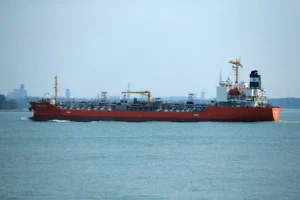
But the more consequential factor is geography. The Strait of Hormuz, the narrow passage between Iran and Oman at the mouth of the Persian Gulf, carries roughly 20% of the world’s traded oil and 17% of its liquefied natural gas. Iran’s military forces have threatened to close the strait in previous confrontations. Whether they exercise that threat now depends on a strategic calculation: closing Hormuz would damage Gulf producers as much as Western importers. So far, the strait remains open. The threat alone is sufficient to move markets.
This oil price shock is therefore not simply a supply disruption in the conventional sense. It is a confrontation with the institution that controls Iran’s military and much of its energy infrastructure, the Islamic Revolutionary Guard Corps, which operates the missile and drone forces that could, in theory, reach offshore platforms, tankers, and Hormuz itself. Understanding the IRGC’s reach and grip on Iran’s economy explains why this conflict is structurally harder to resolve than a conventional oil market disruption.
The G7 Responds, With Limited Tools
The G7 finance ministers convened an emergency session in early March 2026, coordinating with the International Energy Agency. The IEA’s member states collectively hold strategic petroleum reserves, emergency stockpiles accumulated precisely for scenarios like this one. Emergency releases from these reserves have worked before: in 2022, coordinated IEA action helped moderate the price spike that followed Russia’s invasion of Ukraine.
But strategic reserves are a demand-side tool, not a supply-side fix. They buy time. They do not resolve the underlying disruption. The G7 statement committed to “necessary measures to support energy supplies” , language notably short on specifics. The oil price shock, for now, is absorbing diplomatic reassurance without being addressed by it.
Russia Sees an Opening
Vladimir Putin called US President Trump in early March 2026, ostensibly to discuss the Iran war. Russia’s interest in the conversation is not difficult to identify.
Europe has spent three years reducing its dependence on Russian natural gas following the 2022 invasion of Ukraine. With Middle East oil disrupted and prices spiking, Russia is positioning itself as an alternative supplier, to Europe and to anyone else who will take the call. This is not altruism: Russian energy revenue funds the war in Ukraine. An oil price shock above $100 per barrel is, from Moscow’s perspective, a welcome development regardless of what triggered it.
The dynamic, two separate conflicts intersecting in their energy effects, was not a scenario that energy security planners modelled as their base case. Europe’s already-strained position, caught between alliance obligations and energy exposure, is now further complicated by Russia’s opportunistic re-entry as a would-be supplier.
An Oil Price Shock in Historical Context
The last geopolitically-induced oil shock of comparable scale was 1973, when OPEC members imposed an embargo following US support for Israel during the Yom Kippur War. The consequences reshaped the global economy: inflation, recession, the end of the post-war growth consensus, and a fundamental reassessment of energy dependence that took decades to act on.
The connection between Western foreign policy, Iranian politics, and oil goes back further than most people realise. The 1953 CIA-backed coup in Iran was itself driven in part by anxiety over oil nationalisation , a reminder that the current conflict is embedded in a long history of competing interests over the same resources.
The 2026 oil price shock differs from 1973 in one significant way: the global economy is less dependent on oil than it was fifty years ago. Renewables now supply a meaningful share of electricity generation in most developed economies. Electric vehicles have begun to reduce oil demand in the transportation sector.
That said: diesel still moves freight. Aviation fuel still moves passengers. Petrochemicals underpin plastics, fertilisers, and pharmaceuticals. An oil price shock transmits through economies not as a single blow but as a cascade, first at the pump, then in shipping costs, then in food prices, then in manufactured goods. The lag between the price spike and its downstream effects is measured in weeks, not days.
The Monetary Policy Problem
Central banks in developed economies spent the years from 2022 to 2025 fighting inflation triggered by the pandemic and the Ukraine war. Many only recently brought inflation back toward target. An oil price shock arriving now is, for monetary policymakers, among the worst possible timing.
Interest rates cannot solve a supply disruption. Central banks can tighten to prevent the oil price shock from triggering a wage-price spiral, but doing so risks deepening whatever recession the shock induces. Policymakers face a familiar bind: the classic tool is ill-suited to the classic problem. The Federal Reserve, the ECB, and the Bank of England can influence demand; they cannot drill oil.
Three Scenarios the Market Is Pricing
Oil futures traders are currently pricing a probability-weighted average of three outcomes.
Rapid ceasefire: Iran agrees to a negotiated pause, exports partially resume, prices retreat toward the mid-$80s. This is what Trump is publicly claiming is imminent. The futures market is assigning this scenario a modest probability at best.
Prolonged conflict without Hormuz closure: Prices remain elevated and volatile, settling somewhere in the $90–110 range. The oil price shock becomes a sustained drag rather than a sharp spike. Energy security dominates political discussions in importing nations through mid-year.
Hormuz blockade: The scenario that would drive prices into territory not seen since the 1970s. Most analysts consider this unlikely, closing the strait damages Iran’s Gulf neighbours, who are not Iran’s enemies, as much as its adversaries. But most analysts also did not have a full-scale US-Israeli military campaign against Iran in their 2026 base case models.
The gap between “unlikely” and “impossible” is where the oil price shock is currently being priced. That gap is what $100 per barrel represents: not certainty of catastrophe, but the market’s honest assessment that this time, the downside scenarios deserve to be taken seriously.
Sources
- BBC News: Middle East, Iran war and energy developments (March 2026)
- International Energy Agency: Emergency Response and Strategic Petroleum Reserves
- Wikipedia: Strait of Hormuz, geography, traffic volumes, and strategic significance
- Wikipedia: 1973 oil crisis, OPEC embargo, economic consequences, and historical parallels