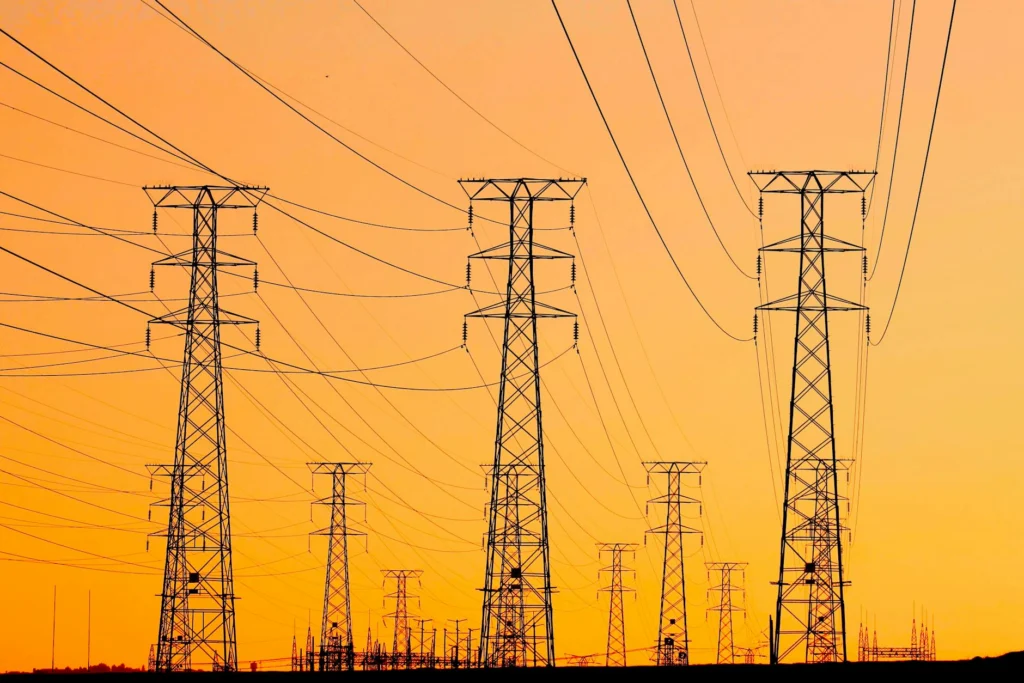
Data center energy demand is rewriting the rules of the American power grid. After two decades of nearly flat electricity consumption, the U.S. is experiencing its strongest four-year growth in electricity demand since 2000, driven largely by the facilities that power artificial intelligence, cloud computing, and the digital economy. The question is no longer whether this surge will affect ordinary Americans. It already has. The question now consuming Congress, state legislatures, and the White House is: who should pay for it?
Data center energy demand: the scale of the problem
The numbers are staggering. Data centers consumed about 176 terawatt hours of electricity in 2023, roughly 4.4% of all U.S. power. The Lawrence Berkeley National Laboratory projects that figure will reach 325 to 580 terawatt hours by 2028, potentially accounting for 12% of national electricity use. A group of 20 federal lawmakers investigating the issue noted that a single hyperscaleA data center of extremely large scale, typically consuming 20 to 500 megawatts, operated by major tech companies for cloud computing and AI workloads. data center can consume between 20 and 100 megawatts, with the largest facilities approaching 500 megawatts, roughly the electricity use of a small city.
This growth is not abstract. In the PJM Interconnection region, the largest grid operator in the country spanning 13 states and Washington D.C., capacity marketA forward auction in wholesale electricity markets where power producers bid to guarantee future generation availability, ensuring the grid can meet projected demand. prices jumped from $28.92 per megawatt-day in 2024/2025 to $329.17 per megawatt-day in 2026/2027. That is more than an elevenfold increase in two years. The independent market monitor for PJM estimated that data centers were responsible for 63% of the price increase in the 2025/2026 auction alone, translating to $9.3 billion in additional costs passed to ratepayers.
For households, the impact is direct. Pepco residential customers in Washington D.C. saw bills rise by an average of $21 per month starting in June 2025, with roughly half attributable to the capacity price spike. In western Maryland, the increase hit $18 per month. In Ohio, $16.
The trillion-dollar buildout behind the demand
The demand surge is inseparable from the spending spree behind it. In 2024, Amazon, Microsoft, Google, and Meta collectively spent over $200 billion on capital expenditures, a 62% year-over-year increase. Amazon alone invested $85.8 billion, up 78% from the prior year. These companies are racing to build infrastructure for AI workloads that require power densities of 30 to 100 kilowatts per rack, compared to 7 to 10 kilowatts for traditional servers.
The math creates a structural mismatch. Data centers can be built in 18 to 24 months. The power plants and transmission lines needed to serve them take several years longer. Traditional utility planning assumes predictable 1% to 2% annual demand growth. Data centers are driving regional growth rates of 20% to 30% annually. The result is a system straining to catch up, with ratepayers often footing the bill for infrastructure built to serve someone else’s demand.
Congress enters the fight
The political response has been swift, bipartisan, and fragmented. In October 2025, 20 federal lawmakers led by Rep. Kevin Mullin sent letters to the Federal Energy Regulatory Commission, Edison Electric Institute, and the Data Center Coalition demanding information on how rising data center costs are being allocated to households. The letter cited $4.3 billion in transmission upgrade costs and $7.3 billion in increased generation costs passed to PJM ratepayers in 2024 alone.
In January 2026, Reps. Mike Levin and Kathy Castor introduced the SHIELD Act, which would amend federal utility policy to create a separate rate class for facilities consuming more than 75 megawatts. The bill’s core principle: massive electricity users should bear the costs of the grid infrastructure they require, not everyday ratepayers. It would also prioritize interconnection requests for large facilities powered by zero-emission electricity.
“Families should not be forced to subsidize massive energy costs for billion-dollar companies,” Rep. Levin said when introducing the bill.
The same month, the Data Center Transparency Act was introduced in the House, requiring federal reports on data centers’ effects on air quality, water quality, and electricity consumption. The approach reflects a growing congressional consensus that the first step is simply knowing what is happening: contracts between utilities and data center developers are frequently confidential, preventing the public from assessing whether cost allocations are fair.
The White House gambles on a pledge
The executive branch took a different approach. On March 4, 2026, President Trump convened the CEOs of seven major technology companies at the White House to sign the Ratepayer Protection Pledge. Amazon, Google, Meta, Microsoft, OpenAI, Oracle, and xAI committed to “build, bring, or buy” all the energy needed for their data centers and to cover the full cost of infrastructure upgrades, ensuring those expenses are not passed to households.
The companies also agreed to negotiate separate rate structures with utilities and state governments and to make backup generation available during grid emergencies.
“They need some PR help because people think that if a data center goes in there, electricity prices are going to go up,” Trump said at the signing event. “It’s not going to happen.”
Energy experts were less certain. The pledge contains no enforcement mechanisms, no independent auditing, and no penalties for noncompliance. “More than a pledge, we urgently need strong policies and protections to ensure that data centers pay their way,” said Jill Tauber, vice president of litigation for climate and energy at Earthjustice. Lena Moffitt, executive director of Evergreen Action, noted that ratepayers have no way to verify whether tech companies keep their promises.
States are not waiting
While Congress debates and the White House negotiates, state legislatures have moved faster. The most consequential action came from Texas, where Senate Bill 6 was signed into law in June 2025. The law applies to customers drawing 75 megawatts or more, requires them to fund grid connection costs, mandates disclosure of backup generators, and gives the grid operator ERCOT authority to remotely disconnect data centers during emergencies. Industry observers have called it the “Kill Switch Bill.”
Virginia, the epicenter of global data center activity where about 70% of internet traffic passes through Northern Virginia, is also acting. In February 2026, Virginia Sen. Louise Lucas amended Senate Bill 253 to shift distribution and capacity auction costs from residential customers to data centers. The state’s utility commission projected that typical residential customers would see rates drop by 3.4%, about $5.52 per month, while data center rates would increase by 15.8%. Dominion Energy, Virginia’s largest utility, supports the legislation.
The pattern is spreading. California, Georgia, Ohio, South Carolina, New Jersey, and Nevada have all enacted or proposed special utility regulations for data centers in 2025 and 2026. The common thread: large consumers should bear infrastructure costs rather than residential cross-subsidization.
The environmental cost nobody budgeted for
The data center energy demand problem has a carbon dimension that complicates every proposed solution. Modeling from Carnegie Mellon University and North Carolina State University found that data center growth could increase power sector greenhouse gas emissions by 30% compared to scenarios without this demand, reaching 275 million metric tons of CO2 annually by 2030. That matches the entire annual carbon output of France.
The mechanism is straightforward: more than 25 gigawatts of aging coal plants otherwise scheduled for retirement would continue operating primarily to serve data center demand. In Virginia, data center growth is projected to drive increased fossil fuel use in neighboring states like Ohio, Pennsylvania, and West Virginia, potentially undermining state and regional climate goals.
The SHIELD Act tries to address this by incentivizing large facilities to use zero-emission electricity. Texas SB6 takes a different approach, focused on reliability over emissions. The White House pledge mentions no emissions targets at all.
What happens next
Two competing visions are emerging. One treats data center energy demand as a cost allocation problem: make the companies that profit from AI pay for the infrastructure it requires. The other treats it as a supply problem: build more power generation, faster, with fewer regulatory barriers.
Both face serious obstacles. Cost allocation through separate rate classes requires state-by-state implementation and faces industry resistance. Rapid supply expansion requires navigating permitting timelines, environmental reviews, and the risk of stranded assetsInfrastructure investments, such as power plants or transmission lines, that lose their economic value before the end of their useful life, often due to shifts in demand or policy. if AI demand projections prove inflated, which IEEFA and others have noted is a real possibility.
The Carnegie Mellon study put the national stakes clearly: without policy action, data center and cryptocurrency mining growth could increase average U.S. electricity generation costs by 8% by 2030, with Virginia facing increases exceeding 25%. Two in three Americans already say utility bills are a source of financial stress.
The grid problem AI built is not a future concern. It is a present-tense political crisis playing out in utility bills, capacity auctions, and legislative chambers across the country. The only question remaining is whether the patchwork of pledges, bills, and state laws will cohere into something that actually protects the people paying the bills.
Data center energy demand is restructuring the economics and physics of the American electrical grid. After two decades of near-zero load growth, the U.S. Energy Information Administration is forecasting the strongest four-year growth in electricity demand since 2000, driven primarily by hyperscaleA data center of extremely large scale, typically consuming 20 to 500 megawatts, operated by major tech companies for cloud computing and AI workloads. computing facilities. The convergence of AI training workloads, inference scaling, and cloud migration has created a demand profile that existing grid infrastructure, market mechanisms, and regulatory frameworks were never designed to handle.
Data center energy demand: quantifying the load growth
The Lawrence Berkeley National Laboratory’s 2024 United States Data Center Energy Usage Report projects data center demand will grow from 176 TWh in 2023 to between 325 and 580 TWh by 2028, representing 6.7% to 12.0% of projected national electricity consumption. The range itself is significant: a 255 TWh uncertainty band reflects the opacity of data center operations, site planning, and the fundamental unpredictability of AI compute scaling.
The load characteristics compound the challenge. AI computing racks operate at power densities of 30 to 100+ kW per rack, compared to 7 to 10 kW for traditional servers. More critically, data centers present a nearly flat, 24/7 demand profile with limited ability to curtail during peak periods. This differs fundamentally from the weather-sensitive, diurnally variable loads around which grid planning and capacity marketsA forward auction in wholesale electricity markets where power producers bid to guarantee future generation availability, ensuring the grid can meet projected demand. were designed.
Traditional utility planning assumes 1% to 2% annual demand growth. Data centers are driving regional growth rates of 20% to 30% annually. The temporal mismatch is severe: a hyperscale facility can be constructed in 18 to 24 months, while generation and transmission infrastructure typically requires three to seven years, creating a structural gap that propagates through capacity markets as scarcity pricing.
The PJM capacity market as a case study in market failure
The PJM Interconnection, spanning 13 states and D.C. with 67 million customers, provides the clearest illustration of how data center demand distorts wholesale electricity markets. PJM’s capacity market is a forward auction designed to ensure sufficient generation exists to meet projected load. Recent clearing prices tell the story:
- 2024/2025 delivery year: $28.92/MW-day
- 2025/2026 delivery year: $269.92/MW-day
- 2026/2027 delivery year: $329.17/MW-day (would have been higher without a price cap)
Monitoring Analytics, PJM’s independent market monitor, estimated that data centers were responsible for 63% of the price increase in the 2025/2026 auction, translating to $9.3 billion in additional costs recovered from all ratepayers across the region. A separate analysis found that PJM utilities passed $4.3 billion in transmission upgrade costs and $7.3 billion in increased generation costs to ratepayers in 2024.
The mechanism is a textbook case of inframarginal pricing externalities. Data center load growth tightens the supply-demand balance, pushing capacity clearing prices higher across the entire market. Every ratepayer in the region pays the elevated price, not just data centers. In the Dominion Zone covering Northern Virginia, load forecasts jumped from 5,700 MW of growth by 2037 (2022 forecast) to over 20,000 MW from data centers alone (2025 forecast).
The reliability dimension is equally concerning. In July 2024, a voltage fluctuation in Northern Virginia triggered the simultaneous disconnection of 60 data centers, causing a 1,500 MW power surplus that forced emergency grid adjustments to prevent cascading outages. The incident demonstrated that concentrated data center load creates bidirectional reliability risks: both during demand spikes and during sudden load loss.
The CapEx arms race and stranded asset risk
The infrastructure buildout behind the demand is unprecedented. In 2024, Amazon, Microsoft, Google, and Meta collectively spent over $200 billion on capital expenditures, a 62% year-over-year increase. Amazon’s 2025 CapEx is projected to surpass $100 billion, with Microsoft and Google each expected to exceed $80 billion.
This creates a paradox for grid planners. If the demand materializes, insufficient infrastructure means reliability failures and economic constraint. If it does not, utilities and their ratepayers face stranded assetsInfrastructure investments, such as power plants or transmission lines, that lose their economic value before the end of their useful life, often due to shifts in demand or policy.. IEEFA has noted strong reasons to believe PJM’s 20-year data center growth forecasts are inflated, but markets are pricing as though worst-case scenarios will materialize.
The financing structures exacerbate the risk asymmetry. Data center companies fund construction from corporate balance sheets and bonds. Grid infrastructure is financed through regulated utility capital deployment, with costs recovered through rates. If demand projections prove wrong, the tech companies lose their CapEx investment. The ratepayers lose their rate increases. Only one of these parties had a say in the investment decision.
Legislative and regulatory responses: a taxonomy
The policy response to data center energy demand is unfolding across three levels of government with distinct, sometimes contradictory, approaches.
Federal legislation
At the congressional level, 20 lawmakers led by Rep. Kevin Mullin sent letters in October 2025 to FERC, the Edison Electric Institute, and the Data Center Coalition requesting information on cost allocation, demand forecasting accuracy, and contract transparency. The inquiry specifically cited the opacity of utility-data center contracts, where crucial information about anticipated demand, projected benefits, and payment terms is frequently redacted from public filings.
The SHIELD Act, introduced in January 2026, would amend the Public Utility Regulatory Policies Act (PURPA) to direct state Public Utilities Commissions to consider two new federal standards. The first creates a separate rate class for facilities exceeding 75 MW, with cost containmentA foreign policy strategy of limiting an adversary's territorial or ideological expansion by maintaining pressure along its borders through alliances. provisions including requirements that costs be borne by that customer class even if the facility ceases operations or underperforms demand projections. The second prioritizes demand-side interconnection for large facilities powered by zero-emission electricity.
The Data Center Transparency Act, introduced the same month, takes the disclosure route, requiring federal reporting on data centers’ electricity consumption, air quality impacts, and water usage.
Executive action
The White House pursued a voluntary approach. On March 4, 2026, seven hyperscalers signed the Ratepayer Protection Pledge, committing to build, bring, or buy all generation resources and pay for infrastructure upgrades. The companies agreed to negotiate separate rate structures with utilities and states and to make backup generation available during grid emergencies.
The pledge’s structural weakness is well-documented. It contains no enforcement mechanisms, no independent auditing, no penalties for noncompliance, and no defined methodology for determining what constitutes adequate cost coverage. Electricity supply is regulated primarily at the state level, making federal pledges difficult to operationalize without corresponding state action. Energy experts noted that electricity prices had already climbed 6.3% over the prior year despite the pledge’s negotiation period.
State-level regulation
States have moved fastest and most concretely. Texas Senate Bill 6, signed in June 2025, represents the most comprehensive single-state response. It applies to loads exceeding 75 MW and imposes: mandatory infrastructure cost-sharing, backup generator disclosure to ERCOT, remote disconnect capability for facilities connecting after December 31, 2025, and ERCOT authority to mandate load curtailment during grid emergencies. The bill also requires disclosure of similar applications in other jurisdictions, targeting speculative “phantom loads” that congest interconnection queues.
Virginia’s Senate Bill 253 takes a rate-design approach, empowering the State Corporation Commission to shift distribution and capacity auction costs from residential customers to Dominion Energy’s GS5 rate class, predominantly data centers. The projected impact: 3.4% rate reduction for residential customers ($5.52/month) and 15.8% increase for data centers. Dominion supports the measure.
At least a dozen states have enacted or proposed targeted data center regulations. California’s SB 57 introduces special tariffs with embedded zero-carbon procurement targets. Georgia’s Public Service Commission imposed minimum billing and longer contract durations for loads exceeding 100 MW. Ohio’s AEP proposed 10-year contract requirements with exit penalties for loads above 25 MW. South Carolina empowered utilities to charge special higher rates. The regulatory vectors vary, but the principle converges: cost causation must equal cost responsibility.
The emissions dimension
The Carnegie Mellon/NC State Open Energy Outlook modeling quantifies the environmental externality. Under current policies, data center growth could increase power sector emissions by 30%, reaching 275 million metric tons of CO2 annually by 2030, equivalent to France’s entire annual carbon output. The mechanism: more than 25 GW of coal capacity otherwise scheduled for retirement would continue operating to serve data center load.
The geographic leakage effect is particularly insidious. Virginia’s data center growth drives increased fossil fuel generation not just in Virginia but in interconnected states, creating carbon leakageThe displacement of greenhouse gas emissions from a region with strict climate policies to one with looser rules, meaning emissions shift rather than decrease overall. that undermines neighboring states’ climate commitments. Central and Northern Virginia face projected electricity cost increases exceeding 25% by 2030, the highest of any region in the model.
The policy responses diverge on emissions. The SHIELD Act incentivizes zero-emission procurement. Texas SB6 focuses on reliability and cost allocation without emissions provisions. The White House pledge mentions no emissions targets. This fragmentation means the same demand shock is being addressed through incompatible frameworks across jurisdictions.
The structural question
The data center energy demand crisis exposes a deeper structural problem in American electricity regulation. The system was designed for gradually evolving, geographically dispersed, weather-sensitive loads. Data centers present concentrated, rapidly growing, weather-independent loads driven by a single industry’s investment decisions. Every existing mechanism, from capacity markets to rate design to interconnection queues, is being stressed by a demand pattern it was never built to accommodate.
Two competing theories of the case are emerging. The cost allocation theory holds that existing market mechanisms can work if rate design ensures data centers internalize their full infrastructure costs. The supply expansion theory holds that the fundamental problem is insufficient generation and transmission capacity, solvable through faster permitting and construction.
Both theories face the same unresolved variable: demand uncertainty. If LBNL’s high-end projection of 580 TWh by 2028 materializes, neither approach alone will suffice. If demand growth stalls, as IEEFA suggests is plausible, aggressive infrastructure buildout could leave ratepayers paying for assets nobody needs.
The patchwork of federal bills, executive pledges, and state laws is not yet a coherent policy. It is a collection of responses to a crisis that arrived faster than the institutions designed to manage it. The 67 million ratepayers in PJM territory, and millions more across the country, are already paying for the gap.