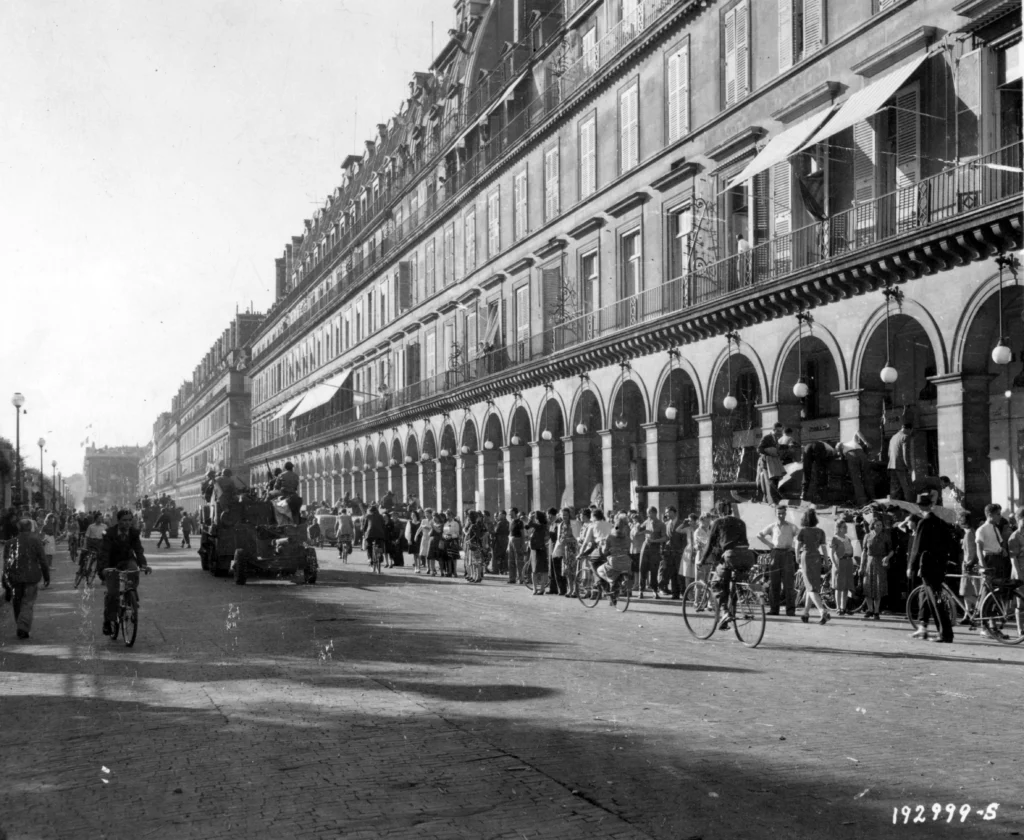
When the boss asked for a piece on why Americans showed up in France with dollars and chewing gum, it seemed like a simple question. The answer turns out to be anything but. The story of American GIs in France liberation is not just about soldiers handing candy to children. It is about money, power, hunger, sovereignty, and a stick of spearmint that changed an entire country’s relationship with chewing.
A Starving Country Meets the Best-Fed Army on Earth
By the time Allied forces stormed the beaches of Normandy on June 6, 1944, France had been starving for four years. Under German occupation, adult rations averaged around 1,080 calories per day, roughly half what a grown man needs. The Germans stripped the country of its agricultural output, its raw materials, its livestock. A black market had become, in the words of one historian, “an essential means for survival.”
Into this landscape of deprivation rolled over two million Allied troops by late August 1944. And they came loaded. Not just with weapons, but with chocolate, cigarettes, coffee, and chewing gum, items that most French civilians had not seen in years. The contrast was staggering: the best-supplied military in history meeting one of the most deprived civilian populations in Western Europe.
American GIs France Liberation: The Dollar Problem
The Americans did not just bring goods. They brought money, and money was where things got complicated.
Rather than letting US dollars circulate freely in a fragile economy, the Allied command created special military currency: the Allied Military franc, printed in secret in Boston under the codename Operation Tom Cat. The first notes came ashore with the troops on D-Day. The official exchange rate was set at 50 francs to the dollar, meaning a private’s monthly wage of $50 converted to 2,500 francs.
The problem was that nobody had asked France. General de Gaulle called the Allied Military francs “counterfeit money” and protested their use. For de Gaulle, this was not about economics alone. It was about sovereignty. A foreign power printing currency for your country, without your government’s consent, looked uncomfortably like occupation rather than liberation.
Meanwhile, a black market flourished. Soldiers could reportedly get up to 200 francs per dollar through unofficial channels, four times the official rate. The high purchasing power of the dollar posed a significant incentive to black-marketeering, and GIs with pockets full of cash had enormous leverage in a country where a pack of cigarettes was worth more than a day’s wages.
Two Sticks of Gum Per Meal
Every K-rationA compact, pre-packaged individual daily combat ration issued to US soldiers in WWII, containing three meals and small supplies such as cigarettes and chewing gum. issued to American soldiers contained two pieces of chewing gum. The military included it for practical reasons: gum promoted oral hygiene when toothbrushes were unavailable, and it helped relieve stress. By the end of the war, the average US service member had chewed through an estimated 630 sticks of gum.
But for French civilians, especially children, gum was something they had never encountered before. It became the universal icebreaker. GIs used gum as a means of socializing with civilians, handing it out to kids who crowded around their convoys. Across liberated Europe, children reportedly learned a phrase in English before any other: “Got any gum, chum?”
Gum joined chocolate and cigarettes as informal currency. The rare items brought by Allied soldiers quickly became currency that fed an already thriving black market. In a country where official rations could not keep people alive, anything tradeable had value.
The Gum That Stayed Behind
Here is the part of the story that most people miss. The Americans eventually left. The gum did not.
After the war, France had a new demand for chewing gum, but no one to make it. French villagers who had received gum from GIs during the liberation sometimes kept the wrappers as souvenirs. Into this gap stepped Courtland E. Parfet, an American veteran of the Normandy landings who had been the European general agent for Beech-Nut. In 1952, he launched Hollywood Chewing Gum in France.
The brand marketed itself with the slogan “Fraîcheur de Vivre” (“Freshness of Life”) and leaned hard into the glamour of American culture. Its ads featured Americans hiking, climbing, and living what the French imagined to be the exciting American life. It worked. Hollywood Chewing Gum is still the best-selling gum in France, and France is the second-largest gum-consuming country in the world after the United States.
A stick of gum handed from a soldier to a child in 1944 created an entire industry.
Liberation Was Not Free
The story of dollars and chewing gum is often told as a feel-good narrative. American generosity, grateful French civilians, children running after jeeps. And some of that is true. But the fuller picture is more complicated.
Nearly 20,000 Norman civilians were killed during the battle for their own liberation, with 300,000 left homeless. The economic disruption was severe. Rationing in France did not end until 1949, five years after D-Day and four years after the war ended. Between 1945 and 1950, French prices rose by 550% while American prices rose by 35%.
The GIs’ purchasing power, their access to goods that French citizens could only dream of, created both gratitude and resentment. The dollars that flowed through black market channels fueled inflation in an already broken economy. The military currency that was supposed to protect that economy had been imposed without French consent.
None of this diminishes what the liberation achieved. It ended four years of occupation, deportation, and systematic plunder. But the image of the generous GI with his pockets full of dollars and chewing gum was always more complicated than the photographs suggested.
The boss tossed this one onto my desk: why did Americans come to France at the end of the war carrying dollars and chewing gum? It reads like a simple cultural question. In reality, it opens onto one of the most layered episodes of the American GIs France liberation story, touching monetary sovereigntyA state's exclusive right to issue and control its own currency, free from interference by foreign governments or institutions., wartime economics, cultural imperialism, and the accidental birth of an industry.
The Economic Landscape of Occupied France
To understand what American dollars and chewing gum meant in 1944 France, you first need to grasp the depth of deprivation the country had endured. Under German occupation from 1940 to 1944, France was systematically stripped of its resources. Article 18 of the Armistice of June 22, 1940 required France to pay “occupation costs” that began at 400 million francs per day, eventually rising to 500 million per day by 1943.
The human cost of this extraction was measured in calories. Adult rations averaged around 1,080 calories per day, the lowest in any Western European country during the occupation period. Belgium provided 1,800 calories; Germany itself provided over 1,900. The shortfall produced malnutrition, stunted growth, vitamin deficiency, and spikes in tuberculosis and diphtheria. By 1943, the black market and grey market together accounted for roughly 30% of national agricultural production.
Into this broken economy, starting June 6, 1944, poured over two million Allied soldiers by late August, carrying with them chocolate, cigarettes, coffee, and other staples that French civilians had not seen in years.
American GIs France Liberation: Operation Tom Cat and the Currency War
The question of how to pay American soldiers stationed abroad was not trivial. As the Allied Military Currency Wikipedia entry notes, letting dollars circulate freely in a damaged economy risked severe inflation, and the dollar’s high purchasing power “posed a significant incentive to black-marketeering.”
The solution was Allied Military Currency (AMC). For France, the printing operation was codenamed Operation Tom Cat. The Forbes Lithograph Manufacturing Company in Boston printed two series of notes under strict security. The first issue, called the “supplemental franc” or “billet drapeau” (flag ticket), featured a French tricolor on the reverse. The second issue replaced the flag with the word “France.”
The official exchange rate was fixed at 50 francs to the dollar. A private earning $50 per month could convert that to 2,500 francs. On the black market, the rate could reach 200 francs per dollar, giving that same private access to 10,000 francs.
De Gaulle and the sovereignty crisis
The critical detail is that these notes were decided upon in 1942, printed in the United States, and distributed on D-Day under Eisenhower’s orders, all without the agreement of the French Committee of National Liberation. Charles de Gaulle called the AM francs “counterfeit money” and protested their use publicly.
De Gaulle’s objections were not merely symbolic. A foreign power printing currency for France violated national monetary sovereignty. The absence of de Gaulle’s endorsement weakened his claim to political authority. And injecting additional money into an already inflated economy risked runaway price increases. De Gaulle publicly denounced the Allied currency as “fausse monnaie” (counterfeit money). De Gaulle’s swift assertion of sovereignty meant the AM franc faded from use relatively quickly, replaced by the pre-war French franc under his authority.
Chewing Gum: From Field Ration to Cultural Artifact
The US military’s relationship with chewing gum was deeply institutional. Every K-rationA compact, pre-packaged individual daily combat ration issued to US soldiers in WWII, containing three meals and small supplies such as cigarettes and chewing gum. pack contained two pieces of chewing gum, regardless of the meal. The inclusion was practical: gum promoted saliva production for oral hygiene in the field, and it served as a stress-relief mechanism alongside cigarettes. Four flavors rotated through the supply chain: spearmint, peppermint, wintergreen, and cinnamon.
The scale was enormous. Gum featured in every soldier’s meal rations, with an estimated 630 sticks consumed per service member over the course of the war. Wrigley’s, Beeman’s, and Dentyne all supplied the military. Gum advertisements shifted to patriotic themes, and chewing gum became profoundly linked to the military in the eyes of the public.
Gum as social currency
For French civilians, chewing gum was largely unknown before the liberation. Chewing gum was not very popular in France until the war, when soldiers shared their rations with people living near the front lines. The phenomenon was immediate and visceral: children swarmed around convoys, and the phrase “Got any gum, chum?” reportedly became one of the first English phrases many European children learned.
GIs used gum as a means of socializing with Allied forces and civilians alike. But gum was more than a gift. In an economy where rare items brought by Allied soldiers quickly became currency, a stick of gum had genuine exchange value. It joined chocolate and cigarettes in the informal economy that sustained a population whose official rations could not keep them alive.
The Black Market Economy
The interaction between American purchasing power and French deprivation created a black market of significant scale. Soldiers had access to goods, hard currency, and exchange rate arbitrage. French civilians had access to services, local knowledge, and desperation.
The black market, which had grown under German occupation, did not end with liberation. Problems with supply kept rationing and the black market in operation until 1949. The influx of American money, both official military currency and black market dollars, added inflationary pressure to an economy already shattered by four years of German extraction.
Between 1945 and 1950, French prices rose by 550%, an annual rate of 36%. By comparison, American prices rose 35% over the same period, an annual rate of 6%. The disparity underscores the asymmetry of the encounter: American soldiers operated from a position of extraordinary economic power in a country where money had lost much of its meaning.
The Civilian Cost of Liberation
The liberation of Normandy exacted a brutal toll on the people it was meant to save. Nearly 20,000 Norman civilians were killed during the battle, with 300,000 left homeless. Allied bombing raids, necessary to break German defenses, destroyed towns, farms, and infrastructure that were already degraded by four years of occupation.
The iconic images of jubilant liberation, the kisses, the flowers, the cider offered to passing soldiers, were real but selective. As one oral testimony collected in Carentan put it: “We were shown a picture of a smiling soldier giving gum to a little girl but not of the endless line she had to stand in to fill her water bucket.”
Hollywood Chewing Gum: The Industry That a Stick of Gum Built
The most unexpected legacy of the GIs’ chewing gum is an entire industry. After the war, there was a new demand for chewing gum in France, but no one to make it. French villagers had kept gum wrappers from liberation as souvenirs. The market was there; the supply was not.
Courtland E. Parfet, an American who had landed at Normandy and served as Beech-Nut’s general agent for Europe, launched Hollywood Chewing Gum in France in 1952. The brand’s slogan, “Fraîcheur de Vivre” (“Freshness of Life”), deliberately evoked the glamour and freedom associated with American culture. Its advertising for decades featured Americans doing active, adventurous things, explicitly linking the product to an idealized version of American life.
The strategy worked beyond anyone’s reasonable expectations. Hollywood Chewing Gum remains the best-selling gum in France, and France ranks second only to the United States in global gum consumption. A product that arrived in a soldier’s ration pack in 1944 had, within a decade, spawned a domestic industry that endures to this day.
The Longer View
The story of American dollars and chewing gum in liberated France is ultimately a story about the unequal encounter between abundance and deprivation. The United States in 1944 was the wealthiest, best-fed nation on earth. France in 1944 was a country where people had been slowly starving for four years, where the black market was a survival mechanism, and where the arrival of liberation brought not just freedom but a new set of economic and cultural disruptions.
The dollars destabilized as much as they enriched. The military currency provoked a sovereignty crisis. The chewing gum, the most innocent item of all, created lasting cultural and commercial change that its distributors never intended. From 1938 to 1958, prices in France registered a thirty-fold increase while American prices merely doubled. The two countries experienced the same decades from wildly different economic positions, and the encounter in 1944-1945 shaped that divergence.
The image of the generous GI handing gum to a French child is not false. But it is incomplete. Behind that image lies a complex story of monetary sovereignty, economic power, cultural transformation, and the messy, uneven reality of what it means to be liberated by a foreign army that happens to be richer than anything you have ever seen.