A single uranium fuel pellet, not much larger than a sugar cube, contains as much energy as one tonne of coal. Stack a few hundred thousand of those pellets inside a steel vessel, split their atoms in a controlled chain reaction, and you can power a city for years without burning a single gram of fossil fuel. In 2024, nuclear reactors generated electricity totaling a record 2,667 terawatt-hours worldwide, more than any year in history. Here is how that process works, from raw material to the socket in your wall.
It Starts With Uranium
Uranium is a heavy metal found in rocks around the world. Natural uranium contains two main forms: uranium-238 (the vast majority) and uranium-235 (less than 1%). Only uranium-235 can sustain a chain reaction in conventional reactors, so the raw material must first be enriched to increase the proportion of U-235, typically to about 3-5%.
At a fuel fabrication facility, enriched uranium is converted into uranium dioxide (UO2) powder. This powder is pressed into small cylindrical pellets and sintered into a dense ceramic form. Each pellet is just under one centimeter in diameter and slightly over one centimeter long.
These pellets are stacked inside long tubes made of a corrosion-resistant zirconium alloy. Each sealed tube is a fuel rod. Typically, more than 200 fuel rods are bundled together into a fuel assembly. A reactor core contains a couple hundred of these assemblies, depending on the plant’s power level.
Splitting the Atom: How Nuclear Reactors Generate Electricity
The core principle is nuclear fissionThe splitting of a heavy atomic nucleus, such as uranium-235, into two smaller nuclei, releasing a large amount of energy and additional neutrons.. When a slow-moving neutron strikes a uranium-235 nucleus, the nucleus splits into two smaller nuclei (for example, barium and krypton) and releases two or three additional neutrons. Those neutrons go on to split more uranium atoms, creating a self-sustaining chain reaction.
Each fission event releases about 200 million electron volts (MeV) of energy, mostly as kinetic energyThe energy an object possesses due to its motion. A mass moving at high speed carries kinetic energy proportional to its mass and the square of its velocity, determining its destructive capacity upon impact. of the fission fragments. Since these fragments can only travel a microscopic distance through solid fuel, their kinetic energy converts directly into heat. That heat is the engine of every nuclear power plant.
Controlling the Reaction
A nuclear reactor is not a bomb. The chain reaction is carefully controlled to produce a steady, predictable amount of heat.
Two systems make this possible. First, the fuel rods sit in water, which acts as a moderator: it slows down the fast-moving neutrons produced by fission to speeds where they are far more likely to trigger another fission event. Second, control rods made of neutron-absorbing materials like boron, silver, and cadmium can be inserted into the core to soak up neutrons and slow the reaction, or withdrawn to speed it up.
There is also a built-in safety feature in the physics itself. A small fraction of neutrons from fission are released with a slight delay. These delayed neutrons are the crucial factor that makes a reactor controllable, giving operators time to adjust the reaction rate rather than chasing instantaneous changes.
From Heat to Steam to Spinning Turbines
Once fission generates heat, the rest of the process is conceptually simple: boil water, make steam, spin a turbine.
There are two main designs used in commercial reactors worldwide:
Pressurized Water Reactors (PWRs) are the most common type globally, accounting for more than 80% of the world’s operating nuclear fleet. In a PWR, water in the reactor core is kept under enormous pressure (about 155 atmospheres) to prevent it from boiling, even though it reaches roughly 320°C. This superheated water flows through a heat exchanger called a steam generator, where it heats a separate, lower-pressure water supply. That secondary water boils into steam, which drives the turbine. The primary and secondary water circuits never mix.
Boiling Water Reactors (BWRs) take a more direct approach. Water is pumped through the reactor core, heated by fission, and boils directly into steam inside the reactor vessel. That steam goes straight to the turbine. Fewer components, but the steam that touches the turbine has been inside the reactor, which complicates maintenance.
In both designs, the steam spins a turbine connected to an electrical generator, converting mechanical energy into electricity.
From the Generator to Your Home
The generator in a nuclear power plant typically produces electricity at 15,000 to 24,000 volts. That is far too low for long-distance transmission. A step-up transformer at the plant boosts the voltage to 225,000 to 400,000 volts, which allows electricity to travel hundreds of kilometers over the grid with minimal energy loss. Closer to your home, step-down transformers reduce the voltage back to usable levels.
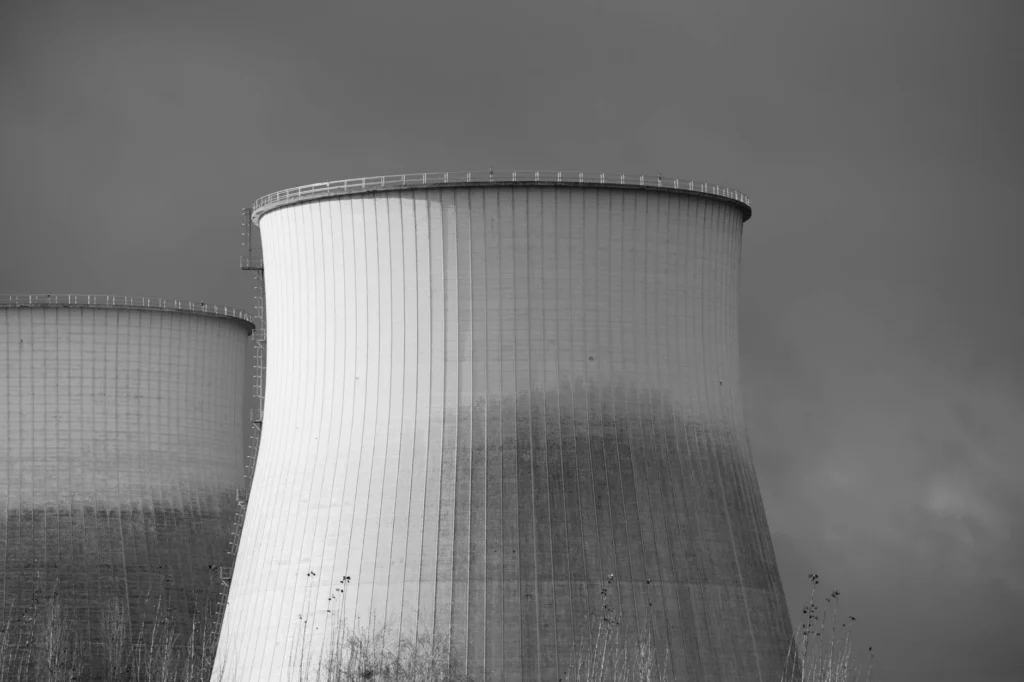
After passing through the turbine, the spent steam must be cooled back into water so it can be reheated and used again. This is the job of the condenser, which is fed by a separate cooling water source, either a river, the ocean, or large cooling towers that release the waste heat as water vapor into the atmosphere. Those iconic plumes rising from nuclear plant towers are not smoke; they are steam.
How Much Energy Are We Talking About?
The numbers are striking. A typical reactor needs about 27 tonnes of fresh fuel each year. A coal plant producing the same amount of electricity would burn more than two and a half million tonnes of coal.
In 2024, the global fleet of 440 reactors ran at an average capacity factor of 83%, meaning they produced 83% of the maximum electricity they theoretically could have. That is higher than any other major electricity source. The same report found that nuclear energy helped avoid 2.1 billion tonnes of CO2 emissions compared to equivalent coal generation.
The tradeoff? Only about a third of the heat generated by fission actually becomes electricity. The rest is waste heat, carried away by the cooling system. This is not unique to nuclear; it is a fundamental limit of all heat engines, governed by the laws of thermodynamics.
A single uranium dioxide fuel pellet, roughly 8 mm in diameter and 10 mm long, contains as much energy as one tonne of coal. The energy density of fissileDescribes materials like uranium-235 or plutonium-239 that can sustain a nuclear chain reaction when struck by slow (thermal) neutrons. uranium-235 is approximately 82 TJ/kg, roughly 3.4 million times that of coal. In 2024, the world’s nuclear fleet set a generation record: 2,667 TWh from 440 operable reactors. This article traces the complete energy conversion chain by which nuclear reactors generate electricity, through each thermodynamic and electrical stage.
Fuel Fabrication: From UF6 to Ceramic Pellets
The fuel cycle begins with uranium hexafluoride (UF6), the chemical form used in enrichment. At a fabrication facility, UF6 is heated to gaseous form, then chemically processed into uranium dioxide (UO2) powder. The conversion can follow either a dry route (UF6 reacted with steam and hydrogen in a rotary kiln) or a wet route (UF6 dissolved in water, precipitated as ammonium diuranate or ammonium uranyl carbonate, then reduced to UO2).
The UO2 powder is pressed at several hundred MPa into cylindrical pellets and sintered at approximately 1,750°C under a reducing argon-hydrogen atmosphere. The result is a dense ceramic with precisely controlled dimensions and microstructure. For light water reactors, the uranium is enriched to up to about 4.8% U-235.
Pellets are loaded into tubes of zirconium alloy (zircaloy), chosen for its low neutron absorption cross-section and high corrosion resistance. Each tube is flushed with helium, pressurized to several MPa, and sealed by precision welding. A plenum space above the pellet stack accommodates thermal expansion and fission gas buildup.
These sealed fuel rods are assembled into rigid lattice structures. An 1,100 MWe PWR core typically contains 193 fuel assemblies, comprising over 50,000 fuel rods and some 18 million fuel pellets. A standard PWR assembly uses a 17×17 rod lattice, stands 4 to 5 meters tall, weighs about half a tonne, and includes vacant positions for control rod insertion and instrumentation.
Nuclear FissionThe splitting of a heavy atomic nucleus, such as uranium-235, into two smaller nuclei, releasing a large amount of energy and additional neutrons.: The Energy Source
When a thermal neutron (kinetic energyThe energy an object possesses due to its motion. A mass moving at high speed carries kinetic energy proportional to its mass and the square of its velocity, determining its destructive capacity upon impact. ~0.025 eV, velocity ~2 km/s) is captured by a U-235 nucleus, the resulting U-236 compound nucleus is highly unstable. It splits into two fission fragments (typically with mass numbers distributed around 95 and 135) and releases 2 to 3 neutrons, with an average of 2.45 neutrons per fission event.
The total energy release averages about 200 MeV (3.2 x 10⁻¹¹ J) per fission. The energy budget breaks down as follows:
- ~85% as kinetic energy of fission fragments (converted to heat within micrometers of the fission site)
- ~2.5% as kinetic energy of prompt neutrons
- ~2.5% as prompt gamma radiation
- ~10% as delayed energy from beta decay of fission products and subsequent gamma emission
The fission products (isotopes of barium, krypton, strontium, cesium, iodine, xenon, and others) are highly radioactive and continue to produce decay heat even after the chain reaction stops. This is why reactor cooling must continue after shutdown: immediately after scram, the fuel still generates about 6% of full-power heat, and even after one year, typical used fuel produces about 10 kW of decay heat per tonne.
How Nuclear Reactors Generate Electricity: Neutronics and Reactor Control
Sustaining a controlled chain reaction requires maintaining criticalityThe condition in a nuclear reactor where each fission event produces exactly one neutron that triggers another fission, sustaining a steady chain reaction.: the state where exactly one neutron from each fission event goes on to cause another fission. The key mechanisms:
Moderation. Fast neutrons from fission (~2 MeV, ~20,000 km/s) have a very small fission cross-section for U-235. They must be slowed to thermal energies (~0.025 eV) where the fission cross-section becomes very large. In light water reactors, ordinary water serves as the moderator, slowing neutrons through elastic collisions with hydrogen nuclei.
Control rods. Rods of neutron-absorbing materials can be inserted into the reactor core to reduce the reaction rate or withdrawn to increase it. PWRs typically use silver-indium-cadmium alloys (80% Ag, 15% In, 5% Cd), while BWRs use boron carbide (B4C). The alloy composition exploits different neutron absorption resonance energies for broad-spectrum capture.
Delayed neutrons. About 0.66% of neutrons from U-235 fission are delayed, emitted seconds to minutes after fission through beta decay of certain fission products. The longest-lived delayed neutron group has a half-life of about 56 seconds. This small fraction is what makes reactors controllable on human timescales. Without delayed neutrons, the reactor period (the time for power to change by a factor of e) would be a fraction of a millisecond, making mechanical control impossible.
Burnable absorbers. Fresh fuel with high enrichment would produce excessive initial reactivity. Gadolinium oxide or zirconium diboride is incorporated into selected fuel pellets to absorb neutrons early in the fuel’s life. As these absorbers are consumed by neutron capture, they progressively release reactivity to compensate for fuel depletion, enabling longer operating cycles between refueling.
Thermodynamic Conversion: The Rankine CycleA thermodynamic cycle used in steam power plants: water is heated to produce steam that drives a turbine, then the steam is condensed and recirculated.
The heat from fission drives a Rankine steam cycle, the same thermodynamic principle behind coal and gas-fired steam plants. The critical difference is the heat source.
Pressurized Water Reactors operate with a two-loop system. The primary coolant (water at ~15.5 MPa, ~155 atmospheres) flows through the core and heats to approximately 320°C without boiling. It transfers this heat through U-tube steam generators to a secondary loop, where lower-pressure water boils to produce steam at approximately 6 MPa and 275°C. This nearly saturated steam (quality x ≈ 0.995) enters the high-pressure turbine stage.
After the high-pressure stage, the steam passes through moisture separator-reheaters to remove water droplets and raise the steam temperature before entering the low-pressure turbine stages. Without reheating, low-quality steam would erode turbine blades. The exhausted steam enters the condenser at approximately 0.008 MPa (well below atmospheric pressure), partially condensed at a quality near 90%.
Boiling Water Reactors simplify the system by producing steam directly inside the reactor vessel. The operating pressure is lower (~7 MPa vs ~15.5 MPa for PWRs), and the steam goes directly to the turbine. This eliminates the steam generator but means the turbine island must be designed to handle slightly radioactive steam (primarily from N-16 activation of water).
The theoretical maximum (Carnot) efficiency for a typical PWR, with a hot reservoir at ~549 K and cold reservoir at ~315 K, is about 42.6%. Real-world irreversibilities (friction, heat losses, non-ideal expansion) reduce actual thermal efficiency to approximately 33%. This means a 3,000 MWth reactor produces roughly 1,000 MWe of electrical output. The remaining two-thirds of the thermal energy is rejected as waste heat through the condenser and cooling system.
Electrical Conversion and Grid Integration
The turbine shaft drives a synchronous generator, typically producing three-phase alternating current at the grid frequency (50 Hz or 60 Hz depending on region). The generator output voltage is typically 15-24 kV.
A generator step-up (GSU) transformer immediately boosts this to 225,000 to 400,000 volts for high-voltage transmission. The physics is straightforward: higher voltage means lower current for the same power, and resistive losses in transmission lines are proportional to current squared (P = I2R). Long-distance transmission at high voltage is essential for delivering power economically to load centers.
Nuclear plants typically operate as baseload generators. Their global average capacity factor of 83% in 2024 is the highest of any major electricity source, reflecting both the physics (a reactor core has fuel for 12-18 months between refueling outages) and the economics (high capital cost, low fuel cost, favoring continuous operation).
The Waste Heat Problem and Plutonium Bonus
The two-thirds of thermal energy rejected as waste heat is not a design flaw; it is a consequence of the second law of thermodynamics. The efficiency ceiling is set by the temperature difference between the steam and the condenser. Nuclear plants operate at lower steam temperatures than modern coal or gas plants (which can reach 600°C+), limiting their Carnot efficiency. Supercritical water reactor designs, still in development, aim to push operating pressures above 22.1 MPa and could achieve thermal efficiencies of 45%.
Meanwhile, the reactor performs an additional trick. Neutron capture by U-238 produces plutonium-239, which is itself fissile. Over a typical three-year fuel cycle, Pu-239 contributes roughly one-third of the total energy output. The reactor effectively creates and burns a second fuel as it operates.
In 2024, this entire conversion chain helped avoid 2.1 billion tonnes of CO2 emissions compared to equivalent coal generation. The physics has not changed since the first reactor went critical in 1942. What has changed is scale, precision, and the growing recognition that splitting atoms remains one of the most concentrated energy sources available to civilization.