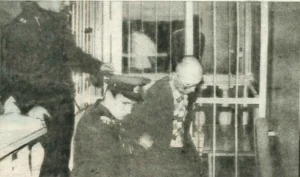
Albert Fish was arrested six times, sent to Bellevue Hospital for psychiatric observation more than once, and released each time as “disturbed but sane.” Between those evaluations, he murdered at least three children over a span of four years in New York City and its suburbs. The case is remembered for the horror of his crimes, but the real story is the institutional failure: a man with an extensive record of violence and documented psychiatric abnormality cycling through systems that could not hold him, while the gap between “disturbed” and “criminal” was filled by victims.
On a Sunday afternoon in early June 1928, a slight, grey-haired man who called himself Frank Howard arrived at the Budd family apartment on West 15th Street in Manhattan. He had come, he said, to offer a job to 18-year-old Edward Budd, who had placed a classified ad in the New York World seeking work in the country. The man was polite, well-dressed, and reassuring. Before leaving, he persuaded Edward’s parents to let him take their 10-year-old daughter, Grace, to a birthday party that afternoon. Grace Budd was never seen alive again.
Who Albert Fish Was
Hamilton Howard Fish was born on May 19, 1870, in Washington, D.C. His father, Randall Fish, was 75 years old at the time and died of a heart attack at the Baltimore and Potomac Railroad Station on October 16, 1875, when Albert was five. His mother, unable to care for the children alone, placed him in Saint John’s Orphanage in Washington.
The orphanage was formative in the worst sense. Fish later described systematic physical abuse by staff: children stripped, beaten, and whipped in front of other students. “We were unmercifully whipped,” he recalled. It was there, by his own account, that he began to associate pain with pleasure, a connection that would define the rest of his life.
His family history compounded the damage. Mental illness ran through the Fish family with striking density: an uncle suffered from mania, a brother was confined in a state mental hospital, a half-brother had schizophrenia, his sister Annie was diagnosed with an unspecified “mental affliction,” and his mother experienced auditory and visual hallucinations. This is not offered as excuse. It is offered as context for what the psychiatric and criminal justice systems were dealing with, and what they repeatedly failed to act on.
Three Confirmed Victims
Fish was convicted of one murder and confessed to two others. He claimed far more, telling investigators he had killed a child in every U.S. state. That claim was never substantiated. What investigators confirmed was enough.
Francis McDonnell, age 9. On July 14, 1924, Francis went missing after playing with friends in Port Richmond, Staten Island. His body was found in a wooded area near his home. He had been sexually assaulted and strangled with his own suspenders. Witnesses, including Francis’s mother, reported seeing a strange older man with grey hair in the area. Fish was not connected to this killing until after his 1935 trial, when he confessed.
Billy Gaffney, age 4. On February 11, 1927, Billy disappeared from the hallway of his Brooklyn apartment building while playing with two other children. A three-year-old witness said “the boogey man” took him. Police did not take the statement seriously. A Brooklyn trolley motorman later identified Fish from a newspaper photograph as the man he had seen that day, struggling to quiet a crying boy with no jacket. Billy Gaffney’s body was never recovered.
Grace Budd, age 10. Taken from her family on June 3, 1928, under the pretense described above. Fish brought her to an abandoned property called Wisteria Cottage at 359 Mountain Road in Irvington, New York, where he killed her. The details of what followed are a matter of court record and Fish’s own confession; they are addressed in the detailed version of this article for readers who want the full case file.
Six Years of Silence
After Grace Budd’s disappearance, police pursued the wrong man. Charles Edward Pope, a building superintendent, was arrested and spent 108 days in jail before being found not guilty. The investigation stalled.
Fish, meanwhile, continued his life. He had been arrested six times prior to the Budd case for offenses including grand larceny and sending obscene letters. He had been sent to Bellevue Hospital for psychiatric observation more than once. Each time, he was evaluated and released. Each time, the system concluded he was “disturbed but sane.” Each time, nothing happened.
The case broke on November 11, 1934, when the Budd family received an anonymous letter. It was written on stationery bearing the small hexagonal emblem of the New York Private Chauffeur’s Benevolent Association. The letter described, in explicit detail, what Fish had done to their daughter six years earlier. Detective William King traced the stationery to a rooming house at 200 East 52nd Street: a chauffeur had taken some of the letterhead home and left it when he moved out. The landlady confirmed that Fish had recently vacated that room. King staked out the address, and on December 13, 1934, Fish returned. He was arrested.
The Trial and the Sanity Question
Fish’s trial began on March 11, 1935, in White Plains, New York, before Judge Frederick P. Close. The prosecution was led by Elbert T. Gallagher and Thomas D. Scoble. The defense, represented by James Dempsey and Frank J. Mahony, mounted an insanity plea.
The central question was not what Fish had done. He had confessed. The question was whether he understood the nature of his actions, the standard established by the M’Naghten Rule, the legal test for insanity used in New York at the time. Under M’Naghten, a defendant is legally insane only if, at the time of the act, they did not know the nature of what they were doing or did not know it was wrong.
The prosecution’s psychiatrist, Dr. Charles Lambert, described Fish as “a psychopathic personality without a psychosis,” meaning he had a disordered personality but was not detached from reality in the way the insanity defenseA legal argument that a defendant should not be held criminally responsible because they were unable to understand the nature or wrongfulness of their actions due to mental illness. required. The defense’s expert, Dr. Fredric Wertham, the senior psychiatrist at Bellevue Hospital, disagreed completely. Wertham had examined Fish extensively and concluded: “However you define the medical and legal borders of sanity, this certainly is beyond that border.”
Wertham’s testimony was so graphic that Judge Close ordered women removed from the courtroom before allowing him to continue. His clinical findings were extraordinary: he documented what he identified as eighteen distinct paraphiliasA pattern of recurring sexual interest in unusual objects, situations, individuals, or scenarios, classified as a psychiatric condition when it causes distress or impairs functioning. in Fish’s psychological profile, a catalog of compulsions that Wertham said represented “every sexual abnormality” recognized by psychiatric science at the time. X-rays taken during Fish’s examination revealed approximately two dozen needles embedded in his pelvic region, in varying stages of decay, which Fish had inserted into himself over the years.
The jury was not persuaded by the insanity defense. After deliberating for roughly four hours, they found Fish guilty of first-degree murder. He was sentenced to death. Albert Fish was executed by electrocution at Sing Sing prison on January 16, 1936, at the age of 65.
What the Fish Case Actually Demonstrates
Albert Fish is often reduced to a catalog of horrors, the kind of case that exists in popular culture primarily as a test of how much a reader can stomach. That framing misses what makes the case genuinely significant.
The institutional failure is the story. Fish interacted with the criminal justice system and the psychiatric system repeatedly over decades. He was arrested, evaluated, hospitalized, and released, multiple times. A man with an extensive history of violence, documented psychiatric abnormality, and escalating behavior was returned to the community again and again because no mechanism existed to do otherwise. The Bellevue evaluations found him “disturbed but sane,” a phrase that captures the entire problem: the legal definition of sanity and the clinical reality of dangerous mental illness occupied entirely different categories, and the gap between them was filled by children.
This is not a uniquely historical problem. The tension between legal sanity (knowing right from wrong) and clinical dangerousness (posing a serious risk of harm) persists in modern criminal law. The M’Naghten Rule, or variants of it, remains the standard in many jurisdictions. The question the Fish case posed in 1935, what happens when someone is clearly mentally ill but legally sane, has not been resolved. It has merely been inherited.
The Andrei Chikatilo case in the Soviet Union demonstrated a parallel failure: ideological assumptions about who could commit such crimes allowed a killer to operate for twelve years. In Fish’s case, the failure was not ideological but structural. The systems designed to identify and contain dangerous individuals were not built to communicate with each other, and the gap between “disturbed” and “criminal” was wide enough for a serial predator to pass through repeatedly.
The David Parker Ray case, decades later, would echo the same pattern: warnings ignored, systems failing to connect information across jurisdictions, victims accumulating in the silence between institutions.
A Note on Dr. Wertham
Fredric Wertham is better known today for his 1954 book Seduction of the Innocent, which argued that comic books caused juvenile delinquency and led to the creation of the Comics Code Authority. That later work has been widely criticized as methodologically flawed and culturally damaging. But in 1935, Wertham was doing something more rigorous: conducting a detailed psychiatric evaluation of a genuinely dangerous individual and presenting findings that were ahead of what the legal system was prepared to hear. His testimony in the Fish trial was clinically thorough and professionally courageous. The jury rejected it, but that rejection says more about the limitations of the M’Naghten standard than about the quality of Wertham’s work.
Reader discretion advised. This version includes specific details from court records, confessions, and psychiatric testimony that some readers may find disturbing. The general version above covers the same case without graphic content.
Albert Fish was arrested six times, sent to Bellevue Hospital for psychiatric observation more than once, and released each time as “disturbed but sane.” Between those evaluations, he murdered at least three children over a span of four years in New York City and its suburbs. His case would become one of the most extensively documented examples of serial predation and institutional failure in American criminal history.
On a Sunday afternoon in early June 1928, a slight, grey-haired man who called himself Frank Howard arrived at the Budd family apartment on West 15th Street in Manhattan. He had come, he said, to offer a job to 18-year-old Edward Budd, who had placed a classified ad in the New York World seeking work in the country. The man was polite, well-dressed, and reassuring. Before leaving, he persuaded Edward’s parents to let him take their 10-year-old daughter, Grace, to a birthday party that afternoon. Grace Budd was never seen alive again.
Origins: Washington, D.C., 1870-1890
Hamilton Howard Fish was born on May 19, 1870, in Washington, D.C. His father, Randall Fish, was a 75-year-old former riverboat captain who died of a heart attack at the Baltimore and Potomac Railroad Station on October 16, 1875. Albert was five. His mother, unable to support the family, placed him in Saint John’s Orphanage in Washington, where he would remain until nearly age nine. He adopted the name “Albert” to escape the nickname “Ham and Eggs” given to him by other children.
The orphanage practiced routine corporal punishment that, by Fish’s account and by the standards of any era, constituted systematic abuse. Staff members stripped children, beat them severely, and forced other students to watch. Fish later told psychiatrists that it was in this environment that he first experienced sexual arousal in response to physical pain, a pattern of masochistic association that would persist and intensify for the rest of his life.
The family psychiatric history was severe. Fish’s uncle had mania. One brother was confined to a state mental hospital. A paternal half-brother suffered from schizophrenia. His sister Annie was diagnosed with a “mental affliction.” Three other relatives carried mental illness diagnoses. His mother experienced both auditory and visual hallucinations. This is a genetic and environmental loading that modern forensic psychiatry would flag immediately. In the 1870s and 1880s, it simply went unaddressed.
The Three Confirmed Murders
Francis McDonnell (July 14, 1924)
Nine-year-old Francis McDonnell failed to return home after playing with friends in Port Richmond, Staten Island. His body was found in nearby woods, hanging from a tree. He had been sexually assaulted and strangled with his own suspenders. An autopsy documented extensive lacerations to his legs and abdomen; his left hamstring had been almost entirely stripped of flesh.
Witnesses, including Francis’s mother, described an older man with grey hair who had been seen in the area, a description that would earn Fish the nickname “The Grey Man.” Police investigated but made no arrest. Fish was not connected to this murder until he confessed in 1935, after his trial for the Budd killing.
Billy Gaffney (February 11, 1927)
Four-year-old Billy Gaffney disappeared from the hallway of his Brooklyn apartment building while playing with two other children, including three-year-old Billy Beaton. When asked what happened, Beaton said “the boogey man took him.” Police dismissed the statement.
After Fish’s arrest and photograph appeared in newspapers, a Brooklyn trolley motorman named Joseph Meehan identified Fish as the man he had seen on February 11, 1927, trying to quiet a crying, jacketless small boy whom he dragged on and off the trolley. Billy Gaffney’s body was never recovered.
Fish later provided investigators with a detailed account of what he had done to Gaffney, a confession that included descriptions of dismemberment and cannibalism. The specificity of the confession, combined with the trolley identification, left investigators with no doubt about his guilt, but without a body, he was never formally charged.
Grace Budd (June 3, 1928)
Fish arrived at the Budd home on May 28, 1928, posing as Frank Howard, a farmer from Farmingdale, Long Island. He was ostensibly there to hire Edward Budd. He returned on June 3, this time claiming his sister was hosting a children’s birthday party, and asking if Grace could attend. The parents agreed. Fish took Grace by train to Westchester County and then to Wisteria Cottage, an abandoned house at 359 Mountain Road in Irvington, New York, which he had previously scouted.
At the cottage, according to his confession and the court record, Fish strangled Grace to death. He then dismembered her body using a handsaw and, over the following nine days, consumed portions of the remains, which he prepared with onions, carrots, and strips of bacon. He buried the remaining bones behind the cottage. Police recovered them in 1934 after his arrest.
The Letter That Broke the Case
On November 11, 1934, six years after Grace’s murder, the Budd family received a letter. It was unsigned but written in a hand that investigators would later match to Fish. The letter described, in graphic detail, what Fish had done to Grace. It was written on stationery bearing the hexagonal emblem of the New York Private Chauffeur’s Benevolent Association (N.Y.P.C.B.A.).
Detective William King of the Missing Persons Bureau traced the stationery. A chauffeur at the association confirmed he had taken some letterhead home and left it at his former rooming house at 200 East 52nd Street. The landlady there told King that a man matching Fish’s description had recently vacated a room. King staked out the building, and on December 13, 1934, arrested Fish when he returned.
Fish confessed almost immediately. He told detectives he had originally gone to the Budd home intending to target Edward, planning to tie him up, mutilate him, and leave him to bleed to death. When he met Grace, he changed his plan.
The Trial: March 11-22, 1935
The trial took place in White Plains, New York, before Judge Frederick P. Close. Prosecutors Elbert T. Gallagher and Thomas D. Scoble argued that Fish’s detailed, coherent confessions demonstrated he understood the nature of his actions and knew they were wrong, meeting the M’Naghten standard for legal sanity. Defense attorneys James Dempsey and Frank J. Mahony argued insanity.
The prosecution’s psychiatric expert, Dr. Charles Lambert, classified Fish as “a psychopathic personality without a psychosis”: personality-disordered but not psychotic, and therefore legally sane.
The defense called Dr. Fredric Wertham, senior psychiatrist at Bellevue Hospital. Wertham had conducted an extensive evaluation and concluded that Fish was, by any reasonable definition, insane. His testimony was so detailed and so disturbing that Judge Close ordered women removed from the courtroom before it could continue.
Wertham documented eighteen distinct paraphiliasA pattern of recurring sexual interest in unusual objects, situations, individuals, or scenarios, classified as a psychiatric condition when it causes distress or impairs functioning. in Fish’s psychological profile, a comprehensive catalog that included, among others, sadism, masochism, cannibalism, pedophilia, and self-mutilation. He described Fish’s practice of inserting needles into his own body; X-rays taken during the evaluation revealed approximately two dozen needles embedded in Fish’s pelvic region, in varying stages of corrosion, that Fish had placed there over the years. Wertham concluded: “However you define the medical and legal borders of sanity, this certainly is beyond that border.”
Fish himself described his compulsions with a clarity that undercut the prosecution’s argument about his rationality while simultaneously, paradoxically, supporting it. He told Wertham he believed God had commanded him to torture and mutilate children, a delusion that had been present since at least 1924. He described himself as “a man of passion” and used the metaphor: “The horse ran but the fire went with him.” He also told Wertham, “there are lots of us,” suggesting an awareness that others shared his compulsions.
The jury deliberated for approximately four hours. They found Fish guilty of first-degree murder. One juror reportedly told the press that the jury believed Fish was insane but deserved to die anyway, a statement that, if accurate, represents a jury explicitly nullifying the legal standard they were instructed to apply.
Execution: January 16, 1936
Albert Fish was executed by electrocution at Sing Sing prison on January 16, 1936. He was 65 years old. He reportedly told guards that electrocution would be “the supreme thrill, the only one I haven’t tried.” His last written communication was described as a note filled with obscenities. Neither statement suggests a man who had achieved anything resembling insight or remorse.
The Institutional Failure
The most significant dimension of the Fish case is not the crimes themselves but the system’s repeated failure to prevent them. Fish’s criminal record began in 1903 with a grand larceny conviction. He was arrested six times over the following decades for offenses including sending obscene letters and petty theft. At least half of these arrests occurred around the time of Grace Budd’s abduction. He was sent to Bellevue Hospital for psychiatric observation multiple times and was consistently evaluated, documented as disturbed, and released.
The phrase that recurs in these evaluations is “disturbed but sane.” It captures the precise failure: the legal threshold for involuntary commitment or criminal responsibility required psychosis (detachment from reality) or an inability to distinguish right from wrong. Fish was delusional, compulsive, and dangerous, but he could hold a conversation, maintain employment, and articulate his understanding that society considered his acts wrong. He crossed no legal threshold. And so, each time, the system returned him to the community.
The wrongful arrest of Charles Edward Pope, who spent 108 days in jail for Grace Budd’s disappearance, illustrates the other side of the failure: while the guilty man walked free because institutions could not process his obvious danger, an innocent man was incarcerated because the investigation lacked the tools and information to look in the right direction.
This pattern, a known dangerous individual cycling through systems that cannot hold him while investigative resources are spent on the wrong targets, is not unique to the 1920s. The Chikatilo case in the USSR demonstrated how ideological blind spots could produce the same outcome. The David Parker Ray case showed that even in late-twentieth-century America, warnings could be filed and forgotten across jurisdictions for over a decade. The mechanism differs; the result is the same.
The M’Naghten Problem
The Fish trial is a case study in the limitations of the M’Naghten Rule, the legal standard for insanity that asks whether the defendant knew the nature and quality of their act and whether they knew it was wrong. Fish knew what he was doing. He planned his crimes with care, selected his victims deliberately, and took steps to avoid detection. By M’Naghten’s standard, this is sanity.
But Wertham’s evaluation described a man in the grip of delusions (believing God commanded him to kill), suffering from multiple severe psychiatric disorders, and engaging in compulsive self-harm so extreme that he had embedded metal in his own body. The gap between “legally sane” and “clinically well” was, in Fish’s case, a chasm. The jury’s reported private acknowledgment that they believed Fish was insane but voted to convict anyway suggests they understood this, and chose retribution over the legal standard they were sworn to apply.
Modern forensic psychiatry has developed more nuanced frameworks, including the concept of “guilty but mentally ill,” adopted by some U.S. states, which allows conviction while acknowledging psychiatric illness. Whether this would have changed Fish’s outcome is debatable. What it changes is the honesty of the process: it no longer forces a jury to pretend that a clearly mentally ill defendant is “sane” in order to achieve a guilty verdict.