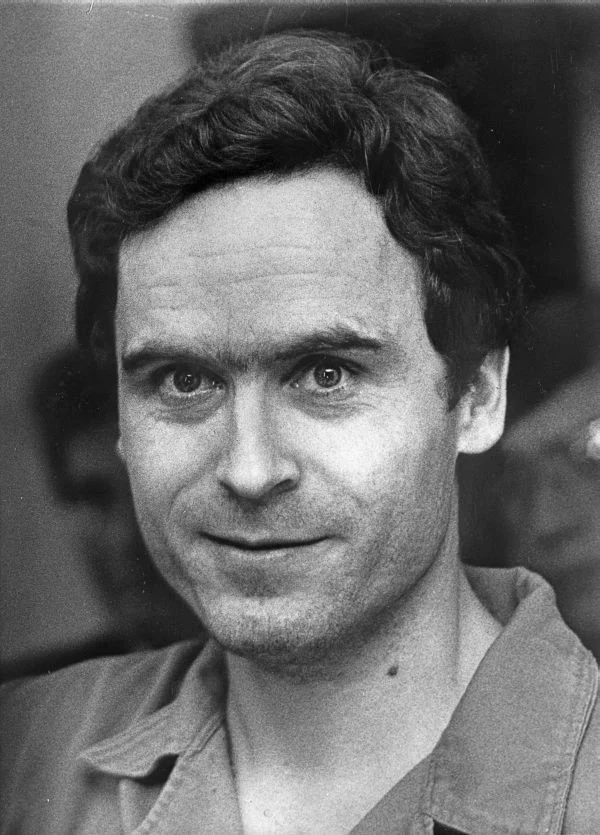
On the night of January 14, 1978, a man walked through a back door with a broken lock at the Chi Omega sorority house on the campus of Florida State University in Tallahassee. He killed two women and brutally assaulted three others before disappearing into the dark. The Ted Bundy evasions that led to this night are a case study in systemic failure. The attacker had arrived in Florida two weeks earlier, having crawled through a hole in the ceiling of a Colorado jail cell, caught a bus to Denver, flown to Chicago, and worked his way south by train, stolen car, and bus.
His name was Ted Bundy. He had already been arrested, tried, and jailed for kidnapping. He had already escaped custody once before. Law enforcement in at least four states had investigated him as a suspect in serial murders. And none of it had been enough to stop him.
The standard Ted Bundy narrative focuses on his charm, his good looks, his ability to seem normal. These things were real, but they were not what made the Ted Bundy evasions possible. What kept Bundy free for years, across at least seven states and a confirmed thirty murders, was a set of systemic failures so fundamental that his case would eventually force American law enforcement to rebuild how it tracks violent criminals.
The Geography of Evasion
Bundy’s killing began in Washington State in early 1974. Over the next eighteen months, young women disappeared from college campuses and recreation areas across Washington and Oregon. Witnesses at Lake Sammamish State Park in July 1974 described a young man with his arm in a sling who called himself “Ted” and asked women to help him carry a sailboat to his car. Two women vanished that day.
A composite sketch was published. Tips flooded in, sometimes two hundred per day. Several people who knew Bundy personally, including his girlfriend Elizabeth Kloepfer and crime writer Ann Rule (who had worked alongside him at a crisis hotline), reported him as a possible suspect. Detectives dismissed the tips. A clean-cut law student with no criminal record did not fit the profile they expected.
In September 1974, Bundy enrolled at the University of Utah Law School in Salt Lake City. The disappearances in Washington slowed. New ones began in Utah, Idaho, and Colorado. Investigators in each state worked their cases independently. There was no mechanism for a detective in Salt Lake City to know that a detective in Seattle was looking at the same suspect for a strikingly similar pattern of crimes.
This was not negligence. It was the normal state of American law enforcement in the 1970s. Police departments operated within their jurisdictions. There was no national database for linking violent crimes across state lines, no standardized way to share suspect information between agencies, and no institutional culture that encouraged it. Bundy did not need to be a criminal genius to exploit this. He just needed to drive. The Ted Bundy evasions were, at their core, geographic.
The First Arrest and What It Revealed
In August 1975, a Utah Highway Patrol officer pulled Bundy over in his Volkswagen Beetle after noticing the car cruising slowly through a residential neighborhood at 2:30 in the morning. Inside the car, the officer found handcuffs, a ski mask, a crowbar, coils of rope, and an ice pick.
Bundy explained the items away. He was charged with evading a police officer and released. But the arrest put him on the radar of a detective named Jerry Thompson, who linked Bundy to the attempted kidnapping of Carol DaRonch, a young woman who had escaped after Bundy, posing as a police officer, had handcuffed her and tried to force her into his car. DaRonch identified Bundy in a lineup.
In February 1976, Bundy was convicted of aggravated kidnapping and sentenced to one to fifteen years. He was already a suspect in multiple homicides across three states. Colorado authorities obtained an indictment for the murder of Caryn Campbell, a nurse who had vanished from a ski lodge in Snowmass in January 1975 and whose body was found a month later near Aspen.
In January 1977, Bundy was extradited to Colorado. What happened next would expose a different kind of systemic vulnerability: the intersection of defendants’ rights, underfunded jails, and institutional complacency.
The Aspen Courthouse Escape
Bundy chose to represent himself in the Campbell murder case, a legal right that granted him access to the Pitkin County Courthouse law library to prepare his defense. On June 7, 1977, during a recess, he was left unshackled in the library while his guard stepped out. He opened a second-story window and jumped.
He landed hard, spraining his ankle, but shed an outer layer of clothing and limped through Aspen as roadblocks were being set up on its outskirts. He hiked south onto Aspen Mountain, broke into a hunting cabin, and stole food, clothing, and a rifle. For the next several days he wandered the mountains, cold and injured, missing trails and doubling back. On June 13, sleep-deprived and in pain, he drove a stolen car back into Aspen, where two officers noticed him weaving between lanes and pulled him over.
Six days of freedom. It was embarrassing for Pitkin County but ultimately contained. Bundy was returned to custody and transferred to the Garfield County Jail in Glenwood Springs, considered more secure. It was not.
The Glenwood Springs Escape
Over the following months, Bundy acquired a hacksaw blade and $500 in cash, reportedly smuggled by visitors. He studied the jail’s layout and discovered a structural weakness: a light fixture in the ceiling of his cell that, once removed, gave access to a crawl space above. The crawl space connected to a jailer’s apartment.
He began a deliberate weight loss program. Over several weeks he dropped roughly thirty pounds, enough to squeeze his frame through the approximately one-square-foot opening. On the night of December 30, 1977, he stacked books and clothing under his blankets to simulate a sleeping body, removed the light fixture, hoisted himself into the crawl space, crawled to the jailer’s apartment (the jailer and his wife were out for the evening), changed into civilian clothes, and walked out the front door.
The jail’s skeleton holiday crew did not discover he was missing until around noon the next day, more than fifteen hours later. By then Bundy was on a bus to Denver. From Denver he flew to Chicago, took a train to Ann Arbor, Michigan, stole a car, drove to Atlanta, and caught a bus to Tallahassee, Florida, arriving on January 8, 1978.
He was free, anonymous, and on the other side of the country from every agency looking for him. The Ted Bundy evasions had entered their final and most dangerous phase.
Florida: The Final Murders
Under the alias “Chris Hagen,” Bundy rented a room near the Florida State University campus. He survived on shoplifting and stolen credit cards. Whatever restraint or calculation had characterized his earlier crimes dissolved. On the night of January 14 and into the early morning of January 15, he entered the Chi Omega sorority house through a door with a faulty lock and attacked four women in their beds. Margaret Bowman and Lisa Levy were killed. Karen Chandler and Kathy Kleiner survived with severe injuries. Later that same night, he assaulted another FSU student, Cheryl Thomas, in a nearby apartment.
Three weeks later, on February 9, Bundy abducted twelve-year-old Kimberly Leach from her junior high school in Lake City, Florida. Her remains were found seven weeks later in a pig farrowing shed near the Suwannee River, thirty-five miles from where she had been taken.
Bundy’s time in Florida lasted barely five weeks. On February 15, 1978, Pensacola police officer David Lee pulled over a stolen Volkswagen Beetle. The driver gave a false name, then ran. Lee caught him after a brief struggle. It was Ted Bundy.
Ted Bundy Evasions: Why the System Failed
The failures that enabled Bundy’s years of killing were not primarily about any single detective’s mistake or any single jail’s poor construction. They were structural.
No interstate crime linkage. In the 1970s, police departments had no standardized way to connect patterns of violent crime across jurisdictions. A detective in Seattle investigating disappearances could not easily learn that a detective in Salt Lake City was seeing the same pattern, or that Colorado authorities had linked similar cases to the same suspect pool. Bundy exploited this by moving. Each state effectively started from zero.
Profile bias. Multiple people reported Bundy by name, including his own girlfriend. Detectives receiving hundreds of tips per day filtered them through assumptions about what a serial killer should look like. Bundy, a well-spoken, college-educated white man with no prior adult criminal record, did not match. This was not an intelligence failure; it was a pattern recognition failure. The profile in investigators’ heads was wrong, and the unreliability of assumptions about criminal appearance is a problem that persists in law enforcement to this day.
Custodial complacency. Both of Bundy’s escapes exploited institutional laziness. In Aspen, a murder suspect was left unshackled with access to an open window. In Glenwood Springs, a known escape risk was housed in a cell with an exploitable ceiling, given enough unsupervised time to diet his way through a crawl space, and not checked for fifteen hours. These were not sophisticated security breaches. They were the predictable results of understaffed, overconfident custody systems.
Social engineering before the term existed. Bundy used fake injuries, false identities, and manufactured authority (posing as a police officer, a photographer, a fellow student) to approach victims and to navigate institutions. He represented himself in court not because it was a sound legal strategy (it was not, and it contributed to his conviction) but because it gave him access, freedom of movement within the courthouse, and the appearance of a reasonable, intelligent man wrongly accused. This persona worked until it didn’t.
What Changed Because of Bundy
Bundy was convicted of the Chi Omega murders in July 1979 and of Kimberly Leach’s murder in February 1980. He was sentenced to death for both. Over the following decade, he attempted to use confessions as leverage to delay his execution, eventually admitting to thirty murders across seven states before his execution on January 24, 1989. Investigators believe the actual number is higher; criminologist Matt DeLisi has argued it may exceed one hundred.
The systemic failures his case exposed contributed directly to reforms that reshaped American law enforcement. In 1985, the FBI launched the Violent Criminal Apprehension Program (ViCAP), a centralized database designed to link patterns of violent crime reported by local agencies across the country. The concept had been discussed at a 1983 Senate hearing on serial murder, where the Bureau also introduced plans for the National Center for the Analysis of Violent Crime (NCAVC). Both were, in significant part, responses to cases like Bundy’s, where serial offenders operated across jurisdictions that could not communicate with each other.
Bundy’s Florida trial also advanced forensic science. The prosecution’s case relied in part on bite mark analysis, one of the first high-profile uses of this forensic technique in an American criminal trial. Odontologist Richard Souviron matched bite marks on Lisa Levy’s body to Bundy’s distinctive dental impressions, providing physical evidence that supplemented eyewitness testimony.
His escapes prompted reforms to detention facility design, security protocols for inmate transport, and restrictions on pro se defendants’ access to unsecured areas. His case also fueled the victims’ rights movement: the federal Victims of Crime Act of 1984, which established funding for victim services and allowed victim impact statements during sentencing, drew momentum from high-profile serial murder cases of the era.
The Myth of the Charming Predator
The popular image of Ted Bundy as an exceptionally charming, brilliant predator who outsmarted law enforcement through sheer cunning deserves scrutiny. Bundy was articulate and presentable. He was not a mastermind. His courthouse escape was an open window. His jail escape was an unmaintained ceiling and a skeleton crew. His years of freedom were the product of fragmented policing, not superhuman evasion.
The danger of the “charming psychopath” narrative is that it obscures the systemic causes. If Bundy was simply too clever to catch, then there is nothing to fix. If the real problem was that American law enforcement had no way to share information across state lines, that institutional failures can protect serial killers for years regardless of the killer’s intelligence, then there is something to fix, and some of it has been fixed, and some of it has not.
Bundy confessed to thirty murders. The actual number is unknown and will remain so. What is known is that he was reported by name, by people who knew him personally, years before his first arrest, and that this was not enough. The system was not designed to catch someone who killed in one state and moved to the next. Bundy did not break the system. He walked through gaps that were already there.
This version includes more specific details about Bundy’s methods and crimes. Reader discretion is advised.
On the night of January 14, 1978, a man entered the Chi Omega sorority house at Florida State University through a back door with a broken lock. In the space of roughly fifteen minutes, he bludgeoned four sleeping women with a piece of oak firewood, sexually assaulted two of them, strangled one with a nylon stocking, and left bite marks on another’s body. Two women died: Margaret Bowman, twenty-one, and Lisa Levy, twenty. Two survived with shattered jaws, crushed skulls, and permanent injuries. The attacker then walked eight blocks to another apartment and assaulted a fifth woman, Cheryl Thomas, fracturing her skull and causing permanent hearing loss.
The man had arrived in Tallahassee fourteen days earlier, traveling under the name Chris Hagen. He had come from Colorado, where he had been jailed for murder, by crawling through a one-square-foot hole in a jail ceiling and taking a bus, a plane, a train, a stolen car, and another bus across the width of the country. His name was Ted Bundy. He was thirty-one years old. Ted Bundy evasions of law enforcement had been ongoing since 1974. He had been arrested, convicted, incarcerated, and had escaped custody twice. None of it had been enough.
What enabled the Ted Bundy evasions across seven states was not superhuman cunning. It was a set of systemic failures so basic that his case would eventually force American law enforcement to rebuild its infrastructure for tracking violent crime.
The Pattern: Washington and Oregon, 1974
Bundy’s first confirmed murder was in February 1974 in Washington State, though he later hinted at earlier killings he refused to detail. Over the next eighteen months, young women disappeared from college campuses and recreation areas across Washington and Oregon. The disappearances followed a pattern: the victims were young, typically college-aged, with long hair parted in the middle. Several had last been seen with a young man who had his arm in a sling or his leg in a cast, asking for help carrying something to his car.
At Lake Sammamish State Park on July 14, 1974, a man calling himself “Ted” approached multiple women asking for help loading a sailboat onto his Volkswagen Beetle. Two women, Janice Ott and Denise Naslund, left with him and were never seen alive again. Their remains were discovered two months later in a wooded area four miles from the park, along with the remains of other unidentified victims.
A composite sketch circulated. Tips came in at a rate of two hundred per day. Elizabeth Kloepfer, Bundy’s longtime girlfriend, called the police and identified him. So did Ann Rule, a crime writer and former coworker at a crisis hotline. So did a professor at the University of Washington and an employee at the Department of Emergency Services. Detectives, overwhelmed with leads and operating on the assumption that a serial predator would not be a clean-cut law student with no criminal record, set Bundy’s file aside.
In September 1974, Bundy moved to Salt Lake City to attend the University of Utah Law School. The Washington disappearances stopped. Utah, Idaho, and Colorado cases began.
The Jurisdictional Void
Each state’s investigators worked in isolation. There was no national database for violent crime patterns, no standardized protocol for cross-jurisdictional information sharing, and no institutional habit of checking whether an unsolved series in one state matched an unsolved series in another. A detective in King County, Washington, had no efficient way to compare notes with a detective in Summit County, Colorado. Both might be looking at the same suspect for crimes with the same signature, and neither would know.
This was not an anomaly. It was how American policing was designed: local, decentralized, jurisdictionally bounded. The system worked acceptably when criminals operated in one area. For a mobile serial killer, it created a landscape of blind spots. Bundy did not need to be especially intelligent to exploit this. Ted Bundy evasions were geographic before they were psychological. He needed a car and a willingness to cross state lines.
The Utah Arrest and Colorado Extradition
On August 16, 1975, a Utah Highway Patrol officer stopped Bundy’s Volkswagen Beetle at 2:30 a.m. after watching it cruise through a residential neighborhood with its headlights off. The search of the car turned up handcuffs, a ski mask, rope, a crowbar, an ice pick, and trash bags.
Bundy provided explanations for each item. He was charged with evading a police officer. But Detective Jerry Thompson connected him to the attempted kidnapping of Carol DaRonch, who had escaped the previous November after Bundy, posing as a plainclothes officer named “Officer Roseland,” handcuffed her and attempted to force her into his car. DaRonch identified Bundy in a lineup. In February 1976, he was convicted of aggravated kidnapping and sentenced to one to fifteen years.
Colorado authorities, who had been building a circumstantial case linking Bundy to the murder of Caryn Campbell at a Snowmass ski lodge in January 1975, obtained an indictment. In January 1977, Bundy was extradited to Aspen. He immediately petitioned to represent himself, a legal right that would grant him exactly the access he needed.
Escape One: The Courthouse Window
On June 7, 1977, during a pretrial hearing recess at the Pitkin County Courthouse, Bundy was left unshackled in the second-floor law library. His guard stepped away. Bundy moved behind a bookcase, opened a window, and jumped approximately twenty-five feet to the ground, spraining his right ankle on impact.
He shed an outer layer of clothing to change his appearance and limped through Aspen as roadblocks were set up on the town’s outskirts. He hiked south onto Aspen Mountain, broke into a hunting cabin, and took food, clothing, and a rifle. Over the following days he attempted to reach Crested Butte on foot but became lost in the forest, missing trail markers repeatedly. He broke into a camping trailer near Maroon Lake for supplies, then, disoriented and exhausted, walked back north toward Aspen.
On June 13, cold, sleep-deprived, and hobbled by his injured ankle, he stole a car and drove into Aspen. Two deputies noticed the vehicle weaving between lanes and pulled him over. Six days of freedom, ending in a DUI stop. Bundy was returned to custody and transferred to the Garfield County Jail in Glenwood Springs.
Escape Two: The Ceiling
Over the next six months, Bundy planned his second escape with methodical patience. He acquired a hacksaw blade and approximately $500 in cash, reportedly smuggled by visitors. He studied the jail’s layout and identified a critical vulnerability: a metal light fixture in the ceiling of his cell that could be removed, revealing access to a crawl space that connected to the jailer’s apartment directly above.
The opening was roughly one square foot. Bundy began deliberately losing weight, cutting his caloric intake until he had shed approximately thirty pounds from his already lean frame. He practiced the climb on multiple occasions, replacing the fixture each time to conceal the opening.
On the evening of December 30, 1977, Bundy stacked books and clothes under his blankets to simulate a sleeping body, removed the ceiling fixture, and pulled himself into the crawl space. He crawled to the jailer’s apartment (the jailer and his wife were out for the evening), dropped down, changed into civilian clothes found in a closet, and walked out the front door into the night.
The jail was running a skeleton crew for the holiday. Guards relied on visual checks through a cell door window; the decoy was convincing enough. Bundy’s absence was not discovered until approximately noon on December 31, between fifteen and seventeen hours after his escape. By then, he had caught a bus to Denver. From Denver he boarded a flight to Chicago. From Chicago he took a train to Ann Arbor, Michigan. In Ann Arbor he stole a car and drove south to Atlanta. In Atlanta he caught a Trailways bus to Tallahassee, arriving on January 8, 1978.
He was over two thousand miles from every agency searching for him, in a state where he had no criminal history, no known associates, and no file.
Tallahassee and Lake City
Under the name Chris Hagen, Bundy rented a room in a boarding house near the FSU campus. He shoplifted food and clothes. He stole credit cards from purses in shopping carts. Whatever discipline had characterized his earlier crimes, the period following his escape appears to have been marked by escalating recklessness and loss of control.
The Chi Omega attacks on January 14-15, 1978, were disorganized, frenzied, and left multiple living witnesses. Nita Neary, a Chi Omega sorority member returning home late, saw a man leave through the front door carrying a club and later identified Bundy’s profile.
Three weeks later, on February 9, Bundy drove a stolen van to Lake City, approximately 150 miles east of Tallahassee, and abducted twelve-year-old Kimberly Leach from her junior high school. She had been sent back to her homeroom to retrieve a forgotten purse and never arrived. Her partially decomposed remains were found seven weeks later beneath a collapsed pig shed near the Suwannee River, thirty-five miles from Lake City.
On February 15, Pensacola police officer David Lee ran the plates on a Volkswagen Beetle and found it was stolen. He pulled the driver over. The man gave the name Richard Burton. When Lee began to arrest him, the man ran. Lee tackled him after a brief struggle. Ted Bundy’s five weeks of freedom in Florida were over.
Ted Bundy Evasions: Structural Failures, Not Criminal Genius
The popular narrative presents Bundy as an exceptionally charming predator who outwitted law enforcement through sheer brilliance. The record supports a different reading. Bundy was presentable, articulate, and willing to lie constantly. He was not a mastermind. His evasions succeeded because of systemic vulnerabilities, not personal genius.
Fragmented policing. No mechanism existed for linking violent crime patterns across state lines. Washington detectives, Utah detectives, and Colorado investigators could all suspect the same man and have no efficient way to coordinate. Each jurisdiction effectively started its investigation from scratch. The FBI later addressed this with the Violent Criminal Apprehension Program (ViCAP), launched in 1985, which was designed specifically to connect patterns reported by different agencies, a problem that cases like Bundy’s and the seventeen-year hunt for the Unabomber made impossible to ignore.
Cognitive bias in suspect evaluation. Bundy was reported by name, by four separate people who knew him personally, during the Washington investigation. Detectives receiving two hundred tips per day filtered them through assumptions: a serial killer should have a criminal record, should appear dangerous, should not be enrolled in law school. These assumptions were wrong. The same kind of profile bias allowed Andrei Chikatilo to evade Soviet investigators for twelve years, in part because an early suspect was wrongfully convicted based on what investigators believed a serial killer should look like.
Custodial negligence. Neither of Bundy’s escapes required sophisticated planning. The first was an open window in a room where a murder suspect was left unshackled. The second was an unmaintained ceiling fixture, a crawl space that connected to a residential apartment, and a fifteen-hour gap between checks on a prisoner who had already escaped once. After the Glenwood Springs escape, reforms were introduced to detention facility design, inmate monitoring protocols, and security procedures for self-represented defendants, precisely because the failures were so basic that they demanded institutional response.
Social engineering as survival strategy. Bundy used manufactured personas the way a burglar uses a crowbar: as a tool for getting through doors. He posed as police officers to isolate victims, feigned injuries to elicit help, used fake names and stolen identities to remain anonymous. He represented himself in court not because it was sound legal strategy (it contributed directly to his conviction; he had not finished law school) but because it granted him physical access to the courthouse’s unsecured areas. His charm was functional, not exceptional. It worked because institutions were not designed to question someone who looked and sounded like he belonged.
What Bundy’s Case Built
Bundy was convicted of the Chi Omega murders in July 1979 and of Kimberly Leach’s murder in February 1980. He received three death sentences. Over the next nine years on death row, he attempted to leverage confessions for stays of execution, eventually admitting to thirty murders across seven states. Criminologist Matt DeLisi, in a 2023 analysis, argued the actual number may exceed one hundred. Bundy was executed on January 24, 1989, at Florida State Prison.
The institutional legacy is more durable than the notoriety. ViCAP, the NCAVC, improvements to the National Crime Information Center (NCIC), and eventually the Combined DNA Index System (CODIS) all drew momentum from the failures Bundy’s case exposed. The bite mark evidence used in his Florida trial, presented by odontologist Richard Souviron, was one of the first high-profile applications of forensic odontology in American criminal proceedings, advancing the integration of forensic science into prosecution.
The Victims of Crime Act of 1984, which created federal funding for victim services and established the right to victim impact statements during sentencing, was fueled in part by the wave of public attention that high-profile serial murder cases generated during this period.
None of this brought anyone back. But the question that Bundy’s case forces is not “how was he so clever?” It is: why did a system exist in which a man could be named by his own girlfriend, convicted of kidnapping, suspected of serial murder in four states, and still be housed in a jail with a removable ceiling? The answer is structural. The Ted Bundy evasions exposed it, and the reforms that followed were structural too. Whether they are sufficient is a question that every unsolved serial case since has continued to test.