Why did the drone that hit Cyprus on March 2 land on what is technically British soil? The answer involves the British bases Cyprus has hosted since 1960, a 66-year-old treaty, the last vestiges of empire, and a legal grey zone that no one expected to matter this much.
At 00:03 local time on March 2, 2026, a Shahed-type drone struck a hangar at RAF Akrotiri on the southern coast of Cyprus. The damage was minor. No one was injured. But the implications were not minor at all, because the drone did not hit Cypriot territory. It hit British sovereign territory, a legally distinct entity that exists because of a deal struck when Cyprus gained independence in 1960.
Most coverage described the target as a “British base in Cyprus.” That framing is technically correct but obscures the more important point: Akrotiri and Dhekelia are not bases on someone else’s land. They are British soil. Understanding why they exist, what legal framework governs them, and what an attack on them actually triggers is the story most outlets missed.
What the British Bases Cyprus Retained Actually Are
The British bases Cyprus retained after independence consist of two areas: Akrotiri, on the southern coast near Limassol, and Dhekelia, on the southeastern coast near Larnaca. Together they cover 98 square miles, roughly 3% of the island’s total land area. Approximately 18,000 people live within their boundaries, including around 11,000 Cypriots and 7,000 UK military and civilian personnel.
They are classified as a British Overseas Territory. They have their own legal system, distinct from both the United Kingdom and the Republic of Cyprus. The Sovereign Base Area Administration reports to the British Ministry of Defence, not the Foreign, Commonwealth, and Development Office. They are not colonies, not leased land, and not NATO installations. They are, in international law, sovereign British territory located 3,200 kilometres from London.
The UK does not own most of the land within the bases. About 60% is privately owned, primarily by Cypriot citizens. Around 20% is UK Ministry of Defence property, and the remaining 20% is Crown land administered by the base authority, including the Akrotiri Salt Lake, forests, and roads.
Why Britain Kept Them After Independence
The British bases Cyprus hosts today exist because of the Treaty of Establishment, signed on August 16, 1960, when Cyprus gained independence from Britain. The treaty, registered with the United Nations as Treaty 5476, is explicit: Article 1 states that the territory of the Republic of Cyprus comprises the island “with the exception of the two areas defined in Annex A to this Treaty, which areas shall remain under the sovereignty of the United Kingdom.”
Britain wanted them for strategic geography. Cyprus sits at the eastern edge of the Mediterranean, within striking distance of the Suez Canal, the Levant, and the Persian Gulf. RAF Akrotiri has served as a staging post for British military operations in Iraq, Libya, Syria, and most recently Gaza. Over 600 surveillance flights linked to Israel’s operations in Gaza launched from Cyprus during the first two years of that conflict, according to Al Jazeera reporting.
The strategic logic in 1960 was the same as it is today: an unsinkable aircraft carrier in a region where geography dictates power projection. The 1953 CIA-MI6 coup against Iran’s government had demonstrated just seven years earlier how central the eastern Mediterranean was to Western operations in the Middle East.
Appendix O of the treaty included a British commitment not to develop the sovereign base areas “for other than military purposes” and not to administer them as colonies. Article 2 obliges the Republic of Cyprus to cooperate in ensuring the “security and effective operation” of the bases. Legal scholars have compared the arrangement’s uniqueness to only two other cases in modern international law: the US presence in the Panama Canal Zone and at Guantanamo Bay.
What the Drone Strike Actually Hit
The Shahed drone that struck Akrotiri on March 2 hit the runway area and a military hangar. Cypriot President Nikos Christodoulides confirmed the drone was Iranian. Cyprus Foreign Minister Constantinos Kombos said it was launched by Hezbollah from Lebanon. British fighters stationed at the British bases in Cyprus, two Typhoons and an F-35, scrambled within hours. They intercepted two additional drones heading toward the island later that day. Greek F-16s intercepted two more Iranian drones in Lebanese airspace on a trajectory toward Cyprus.
The strike came in direct response to US-Israeli airstrikes on Iran launched on February 28, which killed Supreme Leader Ali Khamenei. On March 1, UK Prime Minister Keir Starmer authorised American use of British bases for strikes on Iranian missile and launch sites, while explicitly prohibiting their use against political or economic targets in Iran. The drone arrived roughly three hours after that decision became operational.
It was the first strike on RAF Akrotiri since 1986.
The Article 5 Question That Nobody Wanted to Answer
An attack on British sovereign territory would, in most scenarios, raise the question of NATO’s collective defence clause. Article 5 of the North Atlantic Treaty states that an armed attack on one member shall be considered an attack on all. Britain is a NATO member. The territory that was struck is under British sovereignty.
But the situation is more complicated than that. Cyprus is one of only four EU member states that is not a NATO member. The British bases Cyprus hosts are British territory on a non-NATO island. NATO Secretary General Mark Rutte stated that the alliance is “not itself involved” in Middle East operations, though it was committed to defending NATO territory “if necessary.”
No formal Article 5 consultation occurred. NATO sources described the incident as “quite small.” The European Union also did not activate its own mutual defence clause, Article 42.7. A European Commission spokesperson said there had been “no specific discussion” about triggering it, adding that “it seems to be very clear the Republic of Cyprus was not the target.”
This framing was deliberate. As we covered in our analysis of Europe’s alliance entanglements in the Iran conflict, the distinction between an attack on a member state and an attack on a member state’s overseas territory gives everyone involved the political space to avoid escalation. Whether that space is legally sound or merely convenient is a question no government wanted tested in March 2026.
The response came instead through bilateral channels. Greece deployed two frigates and four F-16s. France committed eight warships, two helicopter carriers, and the nuclear-powered aircraft carrier Charles de Gaulle with its 20 Rafale fighter jets to the eastern Mediterranean. By March 5, Italy, the Netherlands, and Spain had also contributed forces. The practical effect was a collective defence response without the collective defence label.
Cyprus Did Not Ask for This
President Christodoulides was emphatic: “All the competent services of the republic are on alert and in full operational readiness.” He stressed repeatedly that Cyprus does not participate in military operations against Iran. The Commission’s assessment that “the Republic of Cyprus was not the target” was exactly the line Nicosia needed.
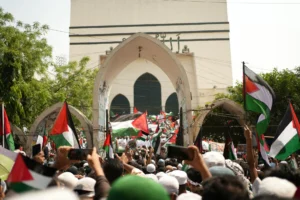
But the distinction rang hollow on the ground. Protests erupted in Limassol under the banner “British Bases Out.” Activist Melanie Steliou told Al Jazeera: “The bases are a remnant of the colonial and imperialist empire of Britain. To me, Cyprus was never truly decolonised.”
The practical grievance is straightforward. Tourism accounts for approximately 14% of Cypriot GDP. Flight cancellations following the drone strikes created immediate economic disruption. Residents within the base areas reported fear and confusion. Parents organized new protest actions. The perception that the government had failed to inform or lead during the crisis intensified domestic anger.
The underlying tension is older. The British bases Cyprus has endured have been a source of friction since 1960. They sit on some of the island’s most strategically valuable coastline. Cypriot governments have periodically called for their return. The 2004 Annan Plan for reunification included provisions for reducing the base territory. It was rejected in a referendum on other grounds, but the base question has never been resolved.
What This Means Going Forward
The UK deployed the air-defence destroyer HMS Dragon and additional counter-drone capabilities to Akrotiri in the days following the strike. The RAF moved further F-35s, radar systems, and counter-drone defences to the base. Defence Minister John Healey confirmed the UK terror threat level was “under review,” with the current assessment remaining at “substantial,” meaning an attack is considered likely.
Prime Minister Starmer’s position has been consistent if narrow: “We are not joining these strikes, but we will continue with our defensive actions in the region.” Middle East Minister Hamish Falconer was more explicit: “The UK is not at war.”
Labour MP John McDonnell warned of historical parallels with the 2003 Iraq invasion, which cost 179 British lives. The comparison is imprecise but the concern is not: Britain is providing military infrastructure for a war it says it is not fighting, on sovereign territory it says was not really targeted, under a collective defence framework it says was not technically triggered.
The British bases Cyprus inherited from empire were designed for a world where power projection meant having territory near the action. That world has not changed. What has changed is that the action now reaches back.