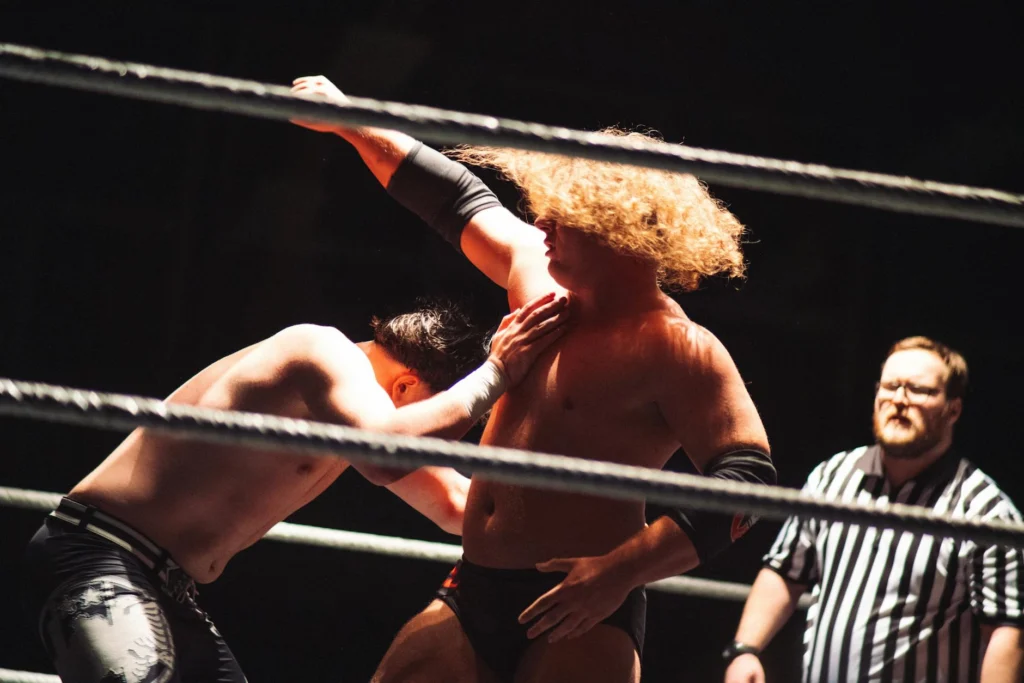
On May 24, 2026, at AEW’s Double or Nothing in Louis Armstrong Stadium[s], Chris Jericho, 55,[s] launched himself off the top turnbuckle to the outside of the ring, moments after Shelton Benjamin, 50,[s] executed a flip dive over the top rope.[s] Chris Jericho and Shelton Benjamin were not there as nostalgia acts. They were central figures in the largest Stadium Stampede in AEW history, working alongside The Elite and The Hurt Syndicate.[s] What they represent is something the wrestling industry has rarely managed to construct deliberately: a wrestling career renaissance engineered through narrative control rather than physical preservation.
The 35-Year Wrestling Career Renaissance Formula
Jericho, at 55 with 35 years in the business, has articulated a philosophy that explains his longevity more convincingly than any exercise regimen.[s] “The only thing that matters is creativity, personality, charisma,” he said in a March 2026 interview. “That’s what makes you become a big star in the business. It doesn’t matter the moves that you do.”[s]
This is not retrospective justification. Jericho has built his career on narrative patience. His feud with MJF in AEW ran for 366 days, a deliberately constructed year-and-a-day arc that defied the industry’s tendency toward quick payoffs.[s] His advice to critics demanding faster resolutions: “Shut the fuck up and let me tell my story when it’s done.”[s]
The pattern extends through his entire career. A Back Sports Page analysis framed Jericho’s 1999-to-2005 WWE run as a cycle of relentless reinvention that ended in burnout, creative block, and mental exhaustion.[s] He walked away. Two years later, he returned sharper and darker. From AEW’s inception in 2019, he became a fixture through multiple reinventions: The Inner Circle, The Jericho Appreciation Society, The Learning Tree.[s] An analyst at Back Sports Page put it directly: “Chris Jericho understands timing, narrative, and leverage better than almost anyone in wrestling history.”[s]
Shelton Benjamin and the Cost of Suppression
Benjamin’s wrestling career renaissance follows a different trajectory: decades of suppression followed by belated permission to exist as himself. Speaking with Renee Paquette in late 2024, Benjamin said he had “definitely” felt “suppressed…underutilized” in his career.[s] The contrast with AEW, in his telling, is permission-based: he said AEW had given him “the opportunity to show fans who I really am, what I really can do” and added, “I really love that I can really be me here in AEW.”[s]
On Jericho’s podcast in early 2025, Benjamin described his AEW reception with genuine surprise, calling it “a bit of a career resurgence” and saying he “wasn’t really expecting it to go as well as it is.”[s] He acknowledged fan tribalism as a feared obstacle, given his WWE history, but said the people he had worked with in AEW had been “incredibly cooperative, amazing, helpful.”[s]
By May 2026, Benjamin was reflecting on the gap between his career and those of his contemporaries with clear-eyed awareness. “When we talk about the other guys in my class, the industry and the company really taxed them. They gave their lives to this business in huge ways and they were in all of these amazing matches for years and years on end,” he told the Casual Conversations podcast. “I’ve always had the same opportunities as them. I’ve had the opportunity to do the same type of thing, but I haven’t had the same opportunities that they have.”[s] The distinction matters: same talent pool, different allocation of creative investment.
Benjamin has granted his closest friends, including MVP and the New Day, explicit permission to tell him when to stop. “I’ve got more time behind me than in front of me, so I want to make it count.”[s]
The Hurt Syndicate as Cultural Infrastructure
Benjamin’s wrestling career renaissance is inseparable from The Hurt Syndicate, the faction he shares with MVP and Bobby Lashley. In an October 2025 Andscape profile marking the group’s one-year AEW anniversary, MVP articulated what makes the group resonate: “We’re not playing a role; we are three legit grapplers who can get down and are actually friends. Fans see that.”[s]
The Hurt Syndicate carries explicit cultural weight beyond its in-ring function. MVP recalled a statement from Lashley that reframed his own thinking: “He wants to normalize Black champions in wrestling. That struck a chord with me because you don’t say Michael Jordan is a six-time Black NBA champion.”[s] The group presents well-dressed Black men operating as CEO figures rather than stereotypes, a deliberate departure from wrestling’s history.
Crucially, the trio frames their endgame as infrastructure rather than dominance. MVP said the group’s creative goal was to develop new champions by elevating younger talent at the trio’s expense. “You don’t make new stars by doing jobs; you make new stars by doing business.”[s] Both Lashley and Benjamin intend AEW to be their final home.[s]
AEW’s Veteran Framework and the Wrestling Career Renaissance
AEW’s handling of veterans like Jericho and Benjamin reflects a deliberate organizational philosophy. A February 2026 Last Word on Pro Wrestling analysis categorized AEW’s veteran talent into three distinct roles: teachers, attractions, and narrative anchors.[s] Jericho functions primarily as a narrative anchor, though with mixed reception at times. “His role shifts depending on the needs of the roster. At his best, he provides structure and visibility to newer acts.”[s]
The analysis identified a key principle: “AEW’s success with veteran talent depends on restraint and role clarity. When veterans are expected to do everything, problems arise.”[s] The company, the piece argued, “treats experience as infrastructure, not a shortcut. Veterans are not there to relive past glories. They are there to support the present while shaping the future.”[s]
Tony Khan’s April 9, 2026 confirmation that Jericho had signed a new multi-year AEW deal illustrates the framework’s appeal.[s] “Staying in AEW is not the comfortable choice people think it is,” one analysis noted. “It forces you to remain relevant without relying on nostalgia. You have to keep creating.”[s] In AEW, Jericho operates with “creative space, influence, and flexibility”; the same analysis called him “part of the ecosystem.”[s]
Tony Khan, AEW’s CEO, frames the Jericho booking philosophy through explicit narrative logic. Explaining the Jericho vs. Ricochet match at Dynasty 2026, Khan identified the common thread: “Two wrestlers who really, when they embraced their darker side… their careers took off. When they both really embraced their personalities and opened their mouths and started running their mouths, both of them just their careers took off.”[s] Khan has followed Jericho’s career for over 30 years, since a 1995 tape of Jericho versus Ultimo Dragon.[s]
The Longevity Problem
Jericho’s concern for modern wrestlers centers on whether they can replicate his durability. “What worries me about the guys working today is here I am at 55, 35 years in, with still some career left to go,” he told GamesHub in a 2026 interview. “I don’t know if it’s a year, two years, four years, I’m not sure.”[s] The anxiety behind his wrestling career renaissance is structural: “I don’t know how many of the guys working now will have the option to go 35 years. Hopefully all of them. But you can already see what serious injuries do, a bad neck surgery changes everything.”[s]
His diagnosis is blunt: “The longevity may be harder to sustain when there’s so much emphasis on the physical at the expense of charisma and character.”[s] The wrestling career renaissance formula, in Jericho’s telling, requires understanding which moves are worth the risk, a lesson he learned in León, Mexico, when a botched dive taught him he was not invincible.[s]
What Renaissance Reveals
The Stadium Stampede finish, with Jericho pinning Kaun after reclaiming the Lionsault, followed by a tribute to the late Sabu, captured the strange layering of professional wrestling’s relationship to time.[s] A 55-year-old and a 50-year-old, surrounded by a multigenerational field, still central to the narrative. Not because they can still do everything, but because they understand what matters.
The wrestling career renaissance that Jericho and Benjamin represent is not about defying age. It is about having spent enough years learning that character work, narrative patience, and authentic relationships outlast athletic peaks. Benjamin says AEW lets him be himself after years of feeling suppressed. Jericho chooses creative control over guaranteed nostalgia. Both have found an organization willing to treat them as infrastructure rather than attractions.
The implications extend beyond wrestling. Any performance discipline that privileges youth faces the same question: what happens when the veterans figure out how to remain relevant on their own terms? The answer, in AEW’s case, involves restraint, role clarity, and the recognition that experience is a resource to be deployed, not a liability to be managed.