Strike a match and you witness combustion chemistry at its most familiar: fuel, atmospheric oxygen, and heat combine to produce light, heat, and a cascade of molecular transformations. Even relatively simple combustion can involve hundreds of distinct chemical species and thousands of fundamental reactions. In one methane-burning molecular dynamics simulation, researchers recorded 798 different chemical reactions over a 1-nanosecond run.[s] Combustion chemistry governs everything from the warmth of a campfire to how aircraft stay airborne, yet the mechanisms remain invisible to the naked eye.
Fire Is a Process
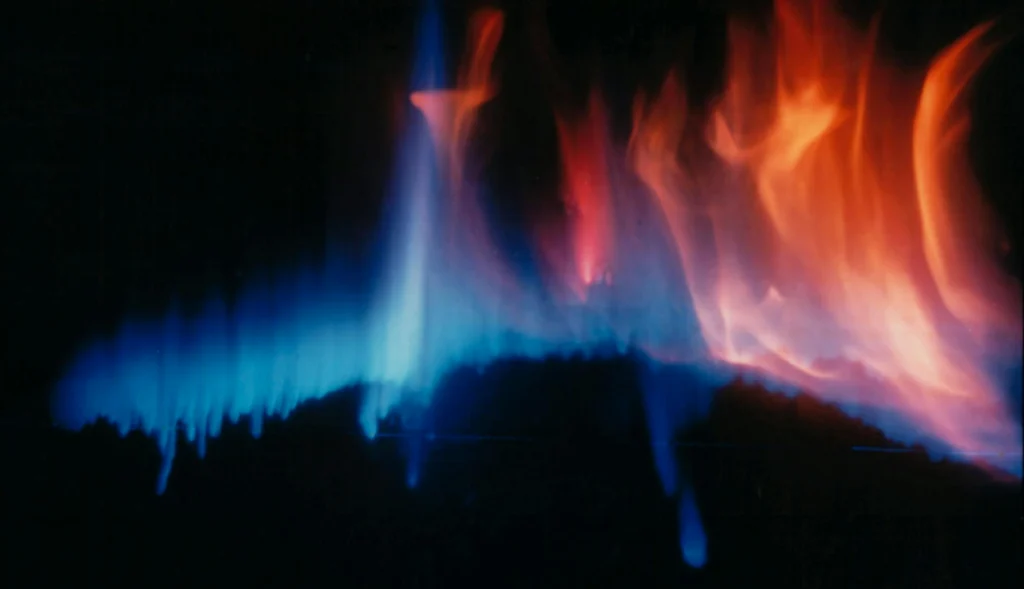
Fire is not a solid, liquid, gas, or plasma. Fire is a process: a type of chemical reaction called combustion.[s] In many yellow or orange hydrocarbon flames, the visible glow comes largely from incandescent soot particles carried upward by hot gases, while cleaner blue flames emit light mainly from excited radicals and molecules. The process converts chemical energy stored in fuel molecules into heat and light, along with new molecules like carbon dioxide and water vapor.
Combustion chemistry requires three ingredients, known in everyday air-fed fires as the fire triangle: fuel (something to burn), an oxidizer (typically oxygen, though chlorine, fluorine, and similar species can also support combustion), and activation energy (a spark or heat source).[s] Remove any one and the fire extinguishes. Water works by removing heat; smothering works by removing oxygen; firebreaks work by removing fuel.
The Chain Reaction
Once ignition begins, combustion chemistry becomes self-sustaining through chain reactions. The initial heat breaks chemical bonds in fuel molecules, creating highly reactive fragments called radicals. These radicals attack other fuel molecules and oxygen, generating more radicals in a branching chain that releases heat at each step. The heat sustains the reaction, which produces more radicals, which release more heat.
The products depend on oxygen supply. With sufficient oxygen, hydrocarbon combustion produces carbon dioxide and water vapor. With insufficient oxygen, incomplete combustion can produce carbon monoxide (toxic) and carbon particles, including soot.[s][s]
Why Combustion Chemistry Matters
Combustion systems utilize the energy released by these reactions for transportation, electric power generation, and heating applications.[s] The outcome in terms of useful work and harmful emissions depends on the molecular structure of the fuel.[s] Engine designers manipulate combustion chemistry to maximize efficiency while minimizing pollutants. Understanding these reactions also informs fire safety, climate science, and the development of cleaner fuels.
Exothermic Oxidation
Combustion involves highly exothermic chemical reactions between a fuel and an oxidizer.[s] A typical combustion event contains hundreds of chemical species and thousands of fundamental reactions.[s] In the methane study, researchers used molecular dynamics at 0.1-femtosecond time steps to resolve fast elementary reactions. The 798-reaction dataset comes from a 1-nanosecond neural network simulation of 100 methane molecules and 200 oxygen molecules at 3000 K.[s]
Initiation: H-Abstraction
Combustion chemistry begins with an initiation step that creates the first radical species. For methane, combustion starts with hydrogen abstraction by molecular oxygen, generating methyl (·CH₃) and hydroperoxyl (HOO·) radicals.[s] That initiation step breaks a C-H bond. Once radicals form, they propagate the chain reaction by abstracting hydrogen from additional fuel molecules.
Simulations of aliphatic hydrocarbon functional groups highlight three important radical species: atomic oxygen (·O), hydroxyl (·OH), and atomic hydrogen (·H). The ·O radical promotes oxidation, while ·OH and ·H act as key initiators in the combustion process.[s]
Autoxidation: The Engine Mechanism
A key low-temperature ignition pathway in combustion engines is autoxidation: a chain reaction initiated by peroxy radical formation (ROO·) and propagated via H-atom transfers (“H-shift” isomerization), forming carbon-centered radicals.[s] The sequence ROO· → ·QOOH followed by oxygen addition (·QOOH + O₂ → ·OOQOOH) repeats to form progressively oxygenated species. The propensity for multi-step autoxidation governs fuel ignition timing in engines.[s]
Product Formation
The interaction of oxygen atoms with carbon chains generates oxygen-containing radicals and peroxide radicals. These subsequently decompose and oxidize into CO₂ and CO.[s] The pathway from formaldehyde to CO₂ proceeds through formyl radicals (·CHO) losing hydrogen to form CO, which then reacts with ·OH to produce CO₂ via a transient COOH intermediate.[s]
Soot Inception
When combustion chemistry proceeds with insufficient oxygen, soot forms. Soot particles are carbonaceous nanoparticles from incomplete combustion of hydrocarbons.[s] Their precursors, polycyclic aromatic hydrocarbons (PAHs), cluster through physical rather than chemical processes. Van der Waals forces link PAH molecules (C₂₂-C₄₂) into dimers and larger clusters under flame conditions.[s] Direct experimental evidence confirms that soot inception is initiated by physical dimerization rather than covalent bonding.[s]
The NOx Trade-off
Combustion conditions present a fundamental trade-off. High temperatures that promote soot oxidation also drive thermal NOx formation.[s] In jet-fuel spray combustion, conditions that decrease one pollutant concentration increase the other.[s] Aircraft combustor designers navigate this constraint through approaches such as staged combustion and lean premixing.