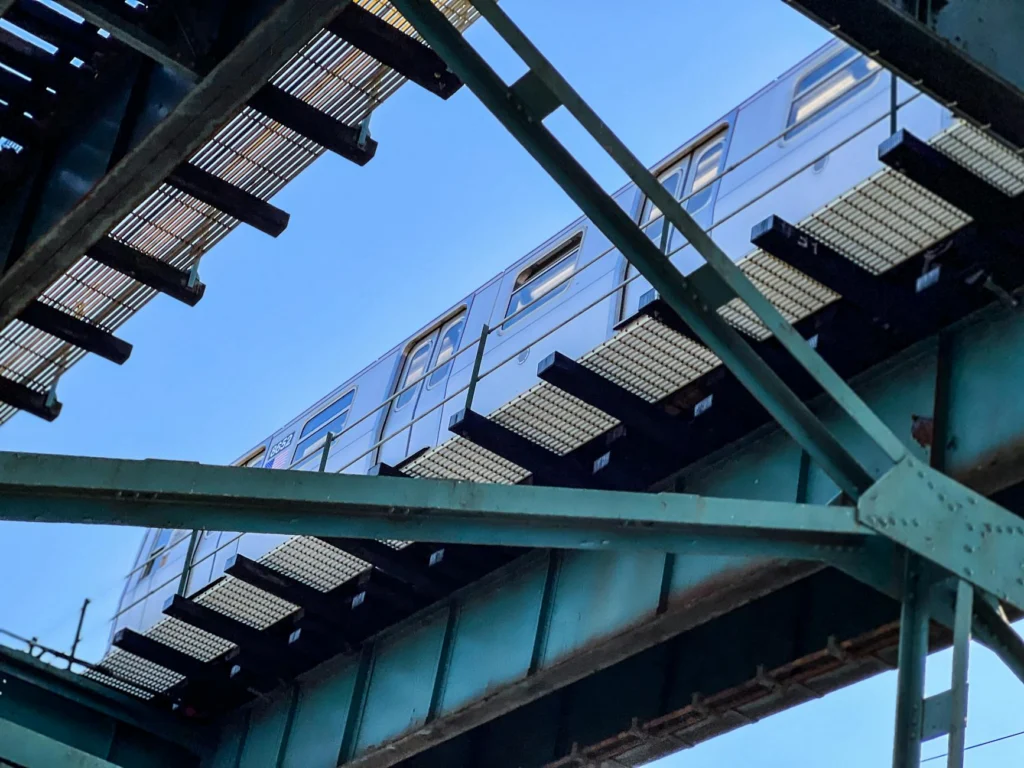
On Friday, May 22, 2026, a 14-year-old boy died on the Williamsburg Bridge after falling from a J train while subway surfing.[s] An 18-year-old riding with him was taken to Bellevue Hospital in critical condition. This was the second consecutive Friday that subway surfing was reported on that line at the same location on the bridge.
The official response will follow the script: calls for awareness campaigns, condemnation of social media, deployment of more drones. None of this will address why these children keep dying, because the city has no interest in addressing it. Subway surfing deaths are not failures of awareness. The kids know it is dangerous. That is the point. These deaths are failures of design and neuroscience we understand well enough to act on.
The Physics of a Predictable Death
The Williamsburg Bridge kills subway surfers through a specific mechanism: low-hanging structural beams that pass within feet of the train roof. “It’s a notorious hot spot. I nicknamed it the ‘Death Bridge,'” a former surfer named Michael told the New York Daily News. “Low beams get everybody.”[s]
Michael quit subway surfing in 2023 after his friend, 15-year-old Zachary Nazario, was killed on that same span. “He got distracted after his girlfriend called his name and he looked away. The beam struck him.”[s] Last October, two teenage girls were found dead atop the last car of a J train after it crossed the Williamsburg Bridge, each with severe head injuries from beam strikes.
The kill mechanisms are consistent across more than a century of subway surfing deaths: beam collisions, falls between cars, electrocution from third rail contact, and collisions with tunnel walls and infrastructure. Wikipedia’s global registry of train-surfing casualties documents these same causes from New York to Rio de Janeiro to Berlin.[s] The physics are not mysterious. Train roofs are not designed for human passengers. Infrastructure clearances assume no one is standing on top. The deaths follow directly from these facts.
The Neuroscience of Adolescent Risk
Here is what the city’s awareness campaigns cannot overcome: the adolescent brain does not process risk the way an adult brain does. This is not a metaphor or a generalization. It is measurable biology.
A 2025 UCLA study published in Nature Neuroscience used optogenetics to map how the prefrontal cortex communicates with the amygdala at different ages. In adult mice, activating the prefrontal-to-amygdala pathway increased threat avoidance. In adolescent mice, inhibiting that pathway increased avoidance, suggesting the circuit’s role flips across ages.[s] The neural circuit that enforces caution in adults appears to operate differently during adolescence.
The limbic system, which processes emotion and reward, develops years before the prefrontal cortex, which handles executive control and consequence assessment.[s] Adolescent-development researcher Laurence Steinberg likens this to “engaging a powerful engine before the braking system is in place.”[s]
This is why telling teenagers that subway surfing is dangerous accomplishes little. “People, especially kids, who subway surf are quite aware it’s dangerous. That’s the whole point!” says David King, a professor at Arizona State University.[s] The danger is not a deterrent. The danger is the product. A campaign featuring Cardi B saying “Stop subway surfing!” is asking the adolescent brain to do something it is less equipped to do reliably: override the reward signal from risk with a rational assessment of consequences.
“The kids know it is dangerous already. They are not good at assessing risk, because they are kids,” King told Newsweek.[s]
The Convenient Villain: Social Media
The city prefers to blame TikTok. It is a useful deflection. But the evidence that social media causes subway surfing is thin at best.
Subway surfing deaths date back to 1904, the year the subway opened.[s] Between 1989 and 2011, New York recorded 13 deaths and 56 injuries from train-surfing, all before TikTok existed.[s] “Any person with a passing understanding of New York City subway culture knows that riding outside the train predates social media,” the New Yorker observed. “It was long an activity associated with outer-borough kids, Black kids, brown kids, their deaths already budgeted.”[s]
“Watching videos of subway surfing may or may not make kids more likely to do so. People watch videos of all kinds of things that they don’t attempt to do,” King notes. “I’m open to the idea that social media might play a role, but that is far from proven and should be treated with skepticism at this point.”[s]
Blaming algorithms is politically convenient because it shifts responsibility from city infrastructure to Silicon Valley. But subway surfing deaths long predate TikTok, and the same basic hazards – exterior train access, elevated structures, tunnels, and fixed infrastructure – keep recurring. The problem is not the phone in a teenager’s pocket. The problem is the train under their feet.
What Would Actually Work
Trains in Hong Kong and Dubai are not easily climbable. “They have streamlined bodies, lack handles on the outside and don’t open between cars.”[s] The design makes roof access physically difficult. Reducing roof access reduces the opportunity for roof deaths.
The MTA has experimented with rubber tubing barriers between train cars on the 7 line, restricting climbing routes. But these experiments remain small-scale. The agency has ruled out some physical interventions, citing cost and complexity. “Listen, you have to be able to do work on top of a train car,” MTA CEO Janno Lieber said at a press conference. One train operator who lost a passenger to a subway surfing death offered a simpler solution: lock the doors between cars while trains are in service.[s]
Branislav Dimitrijevic, an engineering professor at the New Jersey Institute of Technology, acknowledges the core issue: “There’s so many stories in transportation where things can be fixed, but they cost a lot of money.”[s]
Surveillance Instead of Solutions
What the city has chosen instead is drones. The NYPD launched a targeted drone program in November 2023, using 4K cameras and long-range zoom to spot surfers and alert stations to stop trains. The city calls these interventions “saves” or “rescues.”[s]
In July 2025, the mayor’s office said the NYPD had recorded 32 reported aided cases and 16 confirmed deaths from subway surfing since tracking began in 2022. Those removed in 2025 had an average age of 15; in prior years, the youngest person removed from a train for subway surfing was nine years old.[s] Six people died in 2024, up from five in 2023. Arrests rose to 229, up from 135.[s] The city said the drone program would continue. The deaths have continued.
“Adams calls the arrests of surfers ‘saves’ or ‘rescues.’ He is right that the arrests potentially save lives,” the New Yorker acknowledged. “But it is also true that his administration is wrapping invasive surveillance in the apolitical packaging of saving teen-agers from their addled selves.”[s]
The racial dynamics are unavoidable. The New Yorker linked Police Commissioner Jessica Tisch’s broader surveillance operations to “the herding of more than a thousand underaged, overwhelmingly Black and Latino New Yorkers into gangs within a ‘Criminal Group Database.'”[s] The subway surfing crackdown provides cover for this expansion. Children’s deaths become justification for systems that will outlast the crisis.
The Choice We Keep Making
We know why subway surfing deaths happen. Adolescent brains are wired to seek risk. Low beams on the Williamsburg Bridge can strike people standing on a train roof. The gap between cars provides a climbing route that design could eliminate.
We know how to make roof access harder. Design trains that are difficult to climb, as Hong Kong and Dubai have done. Lock doors between cars. Install physical barriers. These solutions cost money. Drones and awareness campaigns are the path the city has chosen, and the cost still falls on children.
A 14-year-old died on Friday after climbing onto the exterior of a J train on a bridge that former surfers describe as a low-beam danger spot. He will not be the last. The city will express condolences, announce more drone deployments, and blame social media. Then another child will climb onto another train, and the physics will do what physics does.
This is not a mystery. Subway surfing deaths are a budget decision. We have decided that redesigning trains is too expensive, and that subway surfing deaths are an acceptable cost. We should at least have the honesty to say so.