When you crack an egg into a hot pan, you witness a dramatic molecular transformation. Within seconds, transparent liquid becomes opaque solid. The cooking heat chemistry at work here operates on scales invisible to the naked eye, disrupting and reorganizing the weak bonds that hold proteins together. Understanding these reactions transforms cooking from guesswork into precision.
Cooking Heat Chemistry: Four Transformations That Build Flavor
Every time you apply heat to food, you trigger a cascade of molecular changes. Four important reactions explain many of the visible changes: proteins unfold and solidify, sugars and amino acids combine to create brown colors and complex flavors, starches absorb water and thicken, and fats break down into aromatic compounds. These processes work together, and understanding them gives you control over the final result.
When Proteins Unfold: The Science of Cooking Meat and Eggs
Proteins are molecular machines folded into precise three-dimensional shapes. Heat disrupts this folding. The process, called denaturation, involves breaking weak internal bonds, specifically hydrogen bonds and hydrophobic interactions that maintain a protein’s structure[s]. Once these bonds break, proteins unfold into looser, more random structures. Most become insoluble in the process.
Cooking heat chemistry operates at specific temperatures for different proteins. In fresh pork, myosin shows a denaturation peak at 54.2°C, while actin’s peak appears around 77.4°C[s]. This helps explain why meat cooked near 57°C has a different texture than meat cooked to 75°C: lower-temperature cooking changes myosin more than actin, while higher-temperature cooking affects both.
Egg white offers a clear demonstration. Raw egg white is transparent and liquid because its proteins float freely in water. Heat causes these proteins to unfold and tangle with each other, forming a solid white mass. This transformation is irreversible[s]. You cannot unfry an egg because the protein bonds have reorganized permanently.
The Maillard Reaction: Where Flavor and Color Are Born
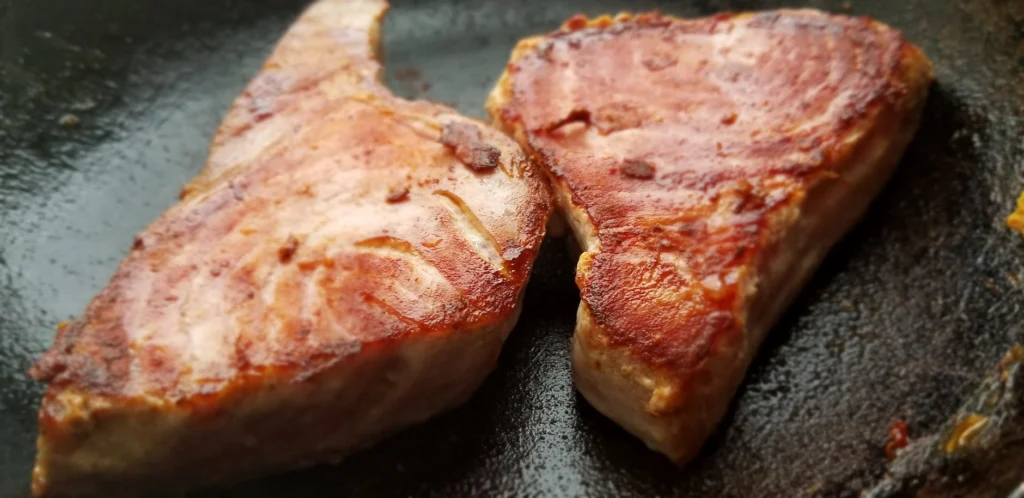
The golden-brown crust on bread, the complex aroma of roasted coffee, the savory notes of seared steak: all draw heavily on this class of reactions. The Maillard reaction occurs when amino acids and reducing sugars combine under heat[s]. This creates many compounds responsible for the flavors and colors we associate with cooked food.
What begins as a simple nucleophilic attack of an amine onto a carbonyl group cascades into parallel and subsequent reactions occurring simultaneously[s]. The products include volatile compounds you can smell, such as pyrazines (nutty, roasted notes), thiazoles, and furans, as well as non-volatile melanoidins that create brown coloration[s].
A 2026 metabolomics study of glucose and amino acids in model emulsions annotated over 500 compounds across Maillard and oxidation reaction systems[s]. The cooking heat chemistry produced different profiles depending on reactant location, temperature, and the amino acid-sugar pairing.
The reaction is strongly shaped by temperature, residence time, and water activity[s]. That is why boiled food rarely browns when water-rich surfaces stay near 100°C, while roasted or fried food can brown as surfaces dry and heat further. Controlling this reaction means controlling much of what makes cooked food taste cooked.
Starch Gelatinization: How Heat Thickens Your Sauces
Starch granules are crystalline structures held together by hydrogen bonds. When heated in water, these bonds begin to break. The heat energy causes carbohydrate chains to vibrate, disrupting the hydrogen bonds between amylose and amylopectin molecules[s]. Water rushes into the gaps, causing granules to swell.
Different starches gelatinize at different temperatures. Flour begins the process between 51°C and 60°C. Corn starch requires higher heat, starting around 62°C and completing around 95°C[s]. This is why flour thickens sauces faster at lower temperatures while corn starch needs sustained high heat.
When heated starch cools, the molecules begin to reassociate in a process called retrogradation. The carbohydrates link with each other rather than with water, forcing moisture out of the gel[s]. This explains why leftover rice becomes hard and why bread goes stale over time. Understanding cooking heat chemistry at the starch level helps predict and control these textural changes.
Lipid Oxidation: The Hidden Flavor Builders
Fats do more than add richness; they generate flavor. When unsaturated fatty acids encounter oxygen and heat, they produce hydroperoxides that break down into aldehydes, alcohols, and ketones[s]. These volatile compounds contribute significantly to how cooked food smells and tastes.
Frying, cooking, and grilling can generate hundreds of compounds from lipid degradation, Maillard reactions, or Strecker degradation[s]. Lipid-derived volatiles can interact with Maillard and Strecker products, creating flavor profiles more complex than any one process could produce alone. The sizzle of bacon, the aroma of roasted chicken, the distinctive smell of butter in a hot pan: all involve lipid oxidation working alongside other cooking heat chemistry reactions.
Not all lipid oxidation is desirable. The same reactions that create pleasant aromas can also produce off-flavors when they proceed too far or under the wrong conditions. Linoleic and linolenic acid oxidation can yield hexanal, an aldehyde with a strong grassy odor that contributes to beany off-notes in some foods[s].
When Reactions Interact
These four processes rarely occur in isolation. When you roast a chicken, proteins in the skin denature while Maillard reactions brown the surface. Fats render and oxidize, contributing to aroma. If you serve the chicken with a pan sauce thickened with flour, starch gelatinization joins the sequence. The cooking heat chemistry of the complete dish involves all four transformations working in concert.
Control over any one reaction means control over a specific aspect of the final product. Control over all four means understanding why recipes work and how to modify them deliberately rather than by accident.
Cooking Heat Chemistry: Molecular Mechanisms of Thermal Food Processing
Thermal processing of food initiates four primary classes of chemical transformation: protein denaturation, non-enzymatic browning (Maillard reactions), starch gelatinization and retrogradation, and lipid oxidation. Each operates through distinct mechanisms with characteristic temperature dependencies and product profiles. The interplay between these reactions determines the sensory properties of cooked food.
Protein Denaturation: Structural Collapse Under Thermal Stress
Native proteins maintain their three-dimensional conformations through networks of weak noncovalent bonds, including hydrogen bonds, hydrophobic interactions, and van der Waals forces. Denaturation involves breaking these linkages[s]. The process converts ordered secondary structures into disordered conformations, with denatured proteins typically exhibiting looser, more random structures and becoming insoluble.
Differential scanning calorimetry studies on meat proteins reveal discrete thermal transitions. Fresh pork exhibits three endothermic peaks corresponding to myosin denaturation at 54.2°C, sarcoplasmic and connective tissue proteins at 62.9°C, and actin at 77.4°C[s]. Cooking heat chemistry at temperatures below 60°C primarily affects myosin while preserving actin structure; temperatures above 75°C denature both.
FTIR spectroscopy reveals the structural consequences. Commercial high-temperature cooking decreases the proportion of α-helix structures while increasing β-sheet and random coil content[s]. The proportion of β-sheet structures increases with temperature due to thermal aggregation and restructuring of unfolded proteins[s]. This aggregation underlies the textural changes that distinguish raw from cooked meat.
Plant proteins behave differently. Most are globular and do not spontaneously align under thermal stress; instead, they may form amorphous or crumbly masses[s]. This structural difference explains why plant-based meat analogues often lack the fibrous texture of animal muscle despite similar protein content.
The Maillard Reaction: Non-Enzymatic Browning Cascades
The Maillard reaction initiates with nucleophilic attack by amino groups (from amino acids, peptides, or proteins) on carbonyl groups (primarily from reducing sugars)[s]. This condensation triggers parallel and subsequent reactions occurring simultaneously, generating a vast array of low and high molecular mass compounds[s].
Subsequent pathways produce early-stage Amadori products, α-dicarbonyl compounds, Strecker aldehydes, and other low- and high-molecular-mass compounds. The α-dicarbonyl compounds are highly reactive intermediates tied to both desirable color and flavor and the formation of advanced glycation end-products[s][s].
Volatile products include sulfur-, nitrogen-, and oxygen-containing heterocycles such as pyrazines, thiazoles, and furans, as well as Strecker aldehydes[s]. Non-volatile products range from early-stage Amadori compounds to advanced glycation end-products and melanoidins, the brown polymeric pigments[s].
Metabolomic analysis of glucose-amino acid model systems has annotated over 500 compounds across Maillard and oxidation reaction systems[s]. The reaction generates desirable sensory qualities, creating flavor, aroma, color, and texture in thermally processed foods while improving shelf life[s]. However, cooking heat chemistry via Maillard pathways also generates harmful compounds including acrylamide, N⁶-carboxymethyllysine, furans, and heterocyclic amines[s].
Key parameters controlling reaction kinetics include pH (which influences nucleophilic group concentration), temperature, water activity, and residence time[s]. The spatial localization of reactants also affects product profiles: segregation versus co-encapsulation of amino acids and sugars yields distinct compound distributions[s].
Starch Gelatinization and Retrogradation: Order-Disorder Transitions
Native starch granules contain two glucose polymers: amylose (linear α-1,4-linked chains) and amylopectin (branched structures with α-1,6 linkages). These molecules organize into semicrystalline granules with crystalline regions interspersed with amorphous zones[s]. Heat in the presence of water disrupts this organization through gelatinization.
When heat is applied, water molecules enter the amorphous regions, leading to gradual leaching of amylose[s]. Hydrogen bonds in both crystalline and amorphous regions break, allowing new hydrogen bonds to form between water and starch molecules[s]. The heat energy causes carbohydrate chains to vibrate, disrupting the bonds between amylose and amylopectin[s].
Gelatinization temperatures vary by starch source. Wheat flour gelatinizes between 51°C and 60°C; corn starch requires 62°C to 72°C with complete gelatinization at 95°C[s]. These differences reflect variations in granule size, amylose:amylopectin ratios, and chain branching patterns.
Retrogradation reverses the disorder. As gelatinized starch cools, molecules transition from disordered to ordered states[s]. Carbohydrates reassociate with each other rather than with water, contracting the matrix and forcing water out of the gel[s]. Short-term retrogradation involves rapid amylose reassociation; long-term retrogradation involves slower amylopectin reorganization over days to weeks.
Lipid Oxidation: Flavor Generation Through Fatty Acid Degradation
Lipids generate flavor through degradation to volatile compounds during heating, with products interacting with Maillard reaction and Strecker degradation products[s]. The primary pathway involves oxidation of unsaturated fatty acids, generating hydroperoxides that fragment into secondary products.
Oxidation of unsaturated fatty acids produces hydroperoxides that break down to odor-active aldehydes, alcohols, and ketones[s]. Polyunsaturated fatty acids with multiple methylene-interrupted double bonds are particularly susceptible. In omega-3-rich foods, propanal and acrolein can indicate oxidation; in omega-6-rich meat products, hexanal is a reliable indicator of flavor deterioration.
Thermal processing can generate hundreds of compounds from lipid degradation, Maillard reactions, or Strecker degradation[s]. These products interact, contributing to complex aroma profiles. Cooking heat chemistry through lipid pathways can form new volatile products through aldehyde participation in browning reactions, or can partially block volatiles from other sources.
Enzymatic lipid oxidation via lipoxygenase follows different kinetics. In plant proteins, lipoxygenase activity on linoleic and linolenic acid yields hexanal, a saturated aldehyde identified as a chief contributor to beany off-flavors[s]. This explains why legume-based proteins often carry characteristic grassy or green notes.
Integrated Thermal Processing: Reaction Networks in Real Foods
Actual cooking involves multiple simultaneous reactions with interdependent kinetics. Surface browning through Maillard chemistry proceeds while interior proteins denature. Fat renders and oxidizes while starches gelatinize when enough water is present. The final sensory profile emerges from this reaction network.
Process control requires understanding each component’s temperature dependency and how products from one reaction serve as substrates for others. Aldehydes from lipid oxidation can participate in Maillard reactions, and these interactions can create new volatile products or change which volatiles dominate. Mastering cooking heat chemistry means managing these interactions across the full range of thermal processing conditions.