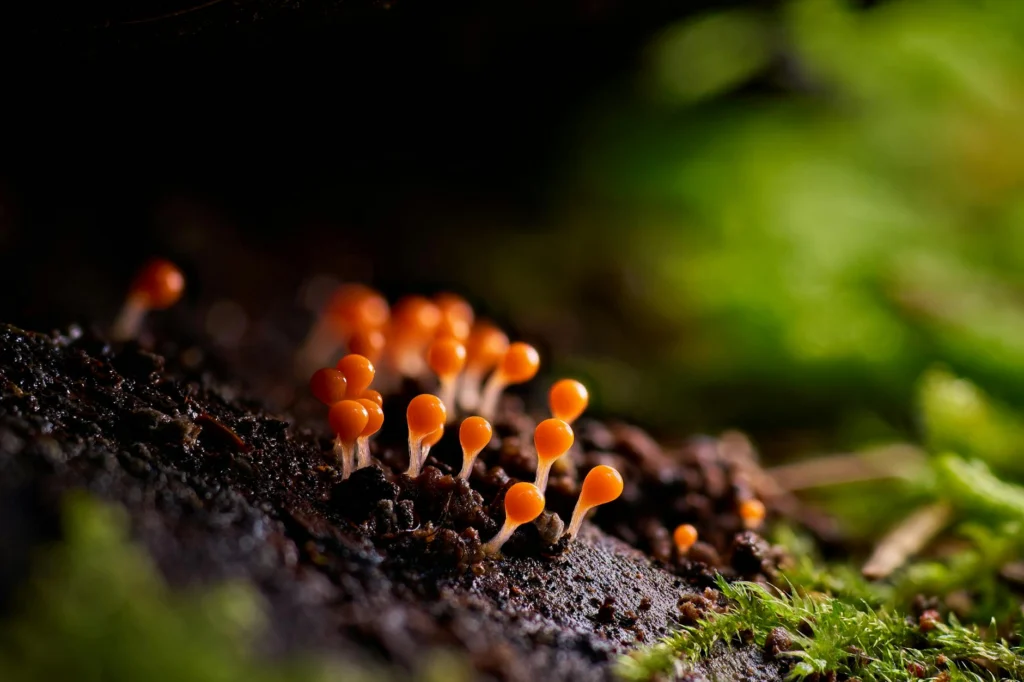
Mushroom spore dispersal operates through one of biology’s most elegant mechanisms: a surface-tension catapult that launches microscopic projectiles at speeds up to 1.8 meters per second[s]. The mushroom you see above ground is the fruiting body, the reproductive structure of a larger mycelial organism growing through soil, wood, or another substrate[s]. Understanding how fungi reproduce reveals a lineage that uses both sexual and asexual strategies.
The Hidden Life of Fungi
When you see a mushroom in a forest, you are looking at only a small fraction of the organism. The bulk of a fungus exists as mycelium, a network of thread-like structures called hyphae that spread through soil, wood, or other substrates. Mycelium acts like an inside-out stomach, secreting enzymes to break down and absorb nutrients from leaves, wood, and organic matter[s].
Fungi are neither plants nor animals. They obtain carbon by absorbing nutrients from nonliving organic substrates or living organic material; macromolecules are digested outside the fungal cell before the products are absorbed[s]. This feeding strategy allows fungi to colonize many kinds of soil, wood, and organic substrates.
From Spore to Mushroom
The fungal life cycle begins when a spore lands in a suitable environment with adequate moisture and nutrients. The spore then germinates, forming a germ tube, the first multicellular outgrowth from a single-celled spore[s]. This germ tube develops into hyphae, which branch and spread through the substrate, releasing digestive enzymes to fuel further growth.
As hyphae expand and interconnect, they form a colony called mycelium. The majority of a fungus’s life is spent in this mycelial state. When environmental conditions are right, including specific temperature, humidity, light levels, and carbon dioxide concentrations, the mycelium begins forming hyphal knots, also called primordia. These are the first visible structures that will eventually become mushrooms[s].
Sexual Reproduction: Two Become One
Fungi reproduce sexually through a process that differs significantly from plants and animals. Sexual reproduction typically involves the fusion of two haploid nuclei, a process called karyogamy, followed by meiotic division of the resulting diploid nucleus[s].
In many species, sexual reproduction begins when compatible hyphae or thalli meet and fuse. Some fungi require different mating types, a condition called heterothallism, which prevents self-fertilization and promotes genetic diversity. When compatible hyphae meet, their cell contents fuse in a process called plasmogamy[s].
In mushroom-forming fungi (basidiomycetes), something unusual happens: the two nuclei do not fuse immediately. Instead, they coexist as a pair within each cell, forming what is called a dikaryotic mycelium. This paired-nuclei state can persist for extended periods while the mycelium grows[s]. Karyogamy occurs later in the reproductive cycle, before meiosis produces basidiospores.
Asexual Reproduction: Going It Alone
Fungi do not always need a partner. Asexual reproduction allows a single individual to produce genetic duplicates without contributions from another organism. Spores can be produced directly through asexual methods or within specialized structures like sporangia[s].
Several asexual methods exist. Fragmentation occurs when mycelium breaks into segments, each capable of growing into a new individual[s]. Budding, common in yeasts, involves a new cell developing from a parent cell’s surface. Many fungi produce mitospores, asexual spores formed through cell division without genetic recombination.
Mushroom Spore Dispersal: The Catapult
The mechanism of mushroom spore dispersal in basidiomycetes represents a remarkable feat of biological engineering. Active spore discharge is powered by a droplet of fluid called Buller’s drop that forms on the spore surface[s].
The process works through surface tension. A mature spore sits on a slender projection called a sterigma. Water condenses on a small projection at the spore’s base, forming Buller’s drop. Simultaneously, a second drop forms on the adjacent spore surface. When these drops grow large enough to touch, they coalesce rapidly. This coalescence redistributes mass, imparting momentum that catapults the spore from its perch[s].
High-speed video analysis has captured these launches, revealing that spores travel at 0.1 to 1.8 meters per second over distances of 0.04 to 1.26 millimeters, equivalent to between 9 and 63 times the spore’s own length[s]. This may seem modest compared with other fungal dispersal methods, but in gilled mushrooms short-range discharge is enough to clear the fruiting body while avoiding spore loss inside it.
Mycelium Networks: Separating Fact from Fiction
The concept of the “wood wide web,” underground fungal networks connecting trees and facilitating communication, captured public imagination. But recent scientific scrutiny suggests the picture is more complicated.
Laboratory research has demonstrated that fungal hyphae can physically connect plants. In a 2025 study, Dark Septate Endophyte hyphae crossed air gaps to connect sorghum plants. Plants connected through the fungal network showed higher biomass than unconnected plants[s]. A water-soluble dye injected into donor plants was detected in receiver plant leaves only when plants were connected via the fungal network[s].
However, a 2023 review by ecologist Justine Karst and colleagues found that many dramatic claims about forest fungal networks run ahead of the evidence. Claims that common mycorrhizal networks are widespread in forests, improve seedling performance via resource transfer, or let mature trees preferentially send resources and defense signals to offspring were insufficiently supported or lacked peer-reviewed published evidence[s]. The review also found positive citation bias and overinterpreted results in the common mycorrhizal network literature[s].
Fungal networks exist, and controlled lab studies show they can move water-soluble tracer between plants[s]. But the stronger idea of forests as cooperative communities mediated by a helpful fungal internet remains scientifically unsubstantiated[s].
The Endless Cycle
Once mushroom spore dispersal has launched them into the air, spores face enormous odds. Most will land in unsuitable environments and perish. But the sheer numbers help ensure survival: fungi form and release vast quantities of spores[s]. Those that land on suitable substrate will germinate, grow into mycelium, and eventually produce their own fruiting bodies, completing the cycle.
The timing varies dramatically by species. Oyster mushrooms can colonize substrate and produce fruiting bodies in three to four weeks. Shiitake mushrooms grown on logs may take six to twelve months. Truffles can require over a decade from spore germination to fruiting[s].
Fungal Morphology and Nutrition
Macroscopic fungi represent a fraction of kingdom Fungi’s diversity. Filamentous fungi are characterized by vegetative cells called hyphae, which collectively form the thallus or mycelium. Primitive molds produce coenocytic hyphae (multinucleate cells without septa), while advanced forms produce septate hyphae with cross-walls that still allow cytoplasmic communication and nuclear migration[s].
Fungi obtain carbon from non-living substrates (saprophytes) or living material (parasites) by absorbing nutrients through the cell wall. Small molecules diffuse directly; macromolecules require preliminary extracellular digestion via proteolytic, glycolytic, or lipolytic enzymes[s].
Life Cycle Stages
Spore germination initiates when environmental moisture and nutrients are detected. The germ tube, the first multicellular outgrowth from a single-celled spore, differentiates through mitotic division[s]. The germ tube develops into hyphae that release digestive enzymes, eventually forming organized mycelial colonies.
Hyphal tip growth occurs apically through directed vesicle movement carrying wall precursors and synthetases. The regulation involves membrane-bound chitin synthetase, transported via microvesicles called chitosomes to sites of wall biosynthesis[s].
Fruiting body initiation requires specific environmental triggers. Primordium formation (hyphal knots) represents the first macroscopically visible reproductive structures[s].
Sexual Reproduction Mechanisms
Sexual reproduction typically involves karyogamy (fusion of two haploid nuclei) followed by meiotic division of the diploid nucleus[s].
Heterothallism requires interaction of different mating types. In Basidiomycota, plasmogamy and karyogamy are temporally separated: plasmogamy produces a dikaryotic cell containing paired nuclei, which persists through vegetative growth. Karyogamy occurs much later in the reproductive cycle[s]. Homothallism allows intrathallic nuclear fusion (homokaryosis).
Asexual Reproduction Pathways
Asexual reproduction proceeds via mitotic nuclear division. Methods include thallus fragmentation, where mycelial segments regenerate complete individuals[s], budding in yeasts and some filamentous forms, and blastic conidiogenesis from specialized conidiogenous cells.
Parasexuality provides genetic recombination in imperfect fungi lacking meiosis: diploid nuclei form within heterokaryotic haploid mycelium, multiply alongside haploid nuclei, segregate through mitotic crossing-over, and haploidize[s].
Mushroom Spore Dispersal Biomechanics
Ballistospore discharge in Basidiomycota utilizes a surface-tension catapult mechanism. The mature basidiospore attaches to a sterigma; prior to discharge, this connection loosens, reducing separation force requirements[s].
The launch process involves three stages: (1) Buller’s drop formation via water condensation on the hilar appendix, concurrent with adaxial drop formation on the adjacent spore surface; (2) sustained condensation causing drop expansion until contact; (3) rapid coalescence causing mass redistribution that imparts momentum, launching the spore[s].
High-speed video analysis quantifies mushroom spore dispersal parameters: launch velocities of 0.1 to 1.8 m/s, discharge distances of 0.04 to 1.26 mm (9 to 63 spore lengths)[s]. For Aleurodiscus oakesii, calculations showed that approximately 9% of total surface free energy in Buller’s drop converts to launch kinetic energy.
Spore size constrains mushroom spore dispersal range. The cited survey identified Aleurodiscus gigasporus as producing the largest basidiospores on record and the largest putative ballistospores (34 × 28 μm, volume 14 pL, mass 17 ng), with a predicted range of 1.83 mm. The same study identified Hyphodontia latitans among the smallest recorded ballistospores (3.5 × 0.5 μm, volume 0.5 fL, mass 0.6 pg), with a predicted range of only 4 μm, equivalent to a single spore length[s].
Viscous forces dominate at these scales (Reynolds numbers ≤1.0), and Stokes’ law accurately models drag forces[s].
Mycelial Network Evidence
Recent laboratory work provides preliminary evidence that Common Fungal Networks may extend beyond classical mycorrhizal associations. Dark Septate Endophyte (Alternaria alternata) hyphae crossed 3 mm air gaps to physically connect Sorghum bicolor plants. Receiver plants in the no-access Impermeable treatment had significantly lower biomass than donor plants (p < 0.001), while donor-receiver biomass differences were not significant in the Permeable network treatment (p = 0.28)[s].
Tracer experiments using acid fuchsin dye injected into donor plant leaves detected dye in receiver leaves only in the Permeable treatment condition where DSE networks connected plants[s]. This provides preliminary evidence that non-mycorrhizal fungi can form functional plant-connecting networks, adding another dimension to fungal biology beyond mushroom spore dispersal.
However, a review by Karst et al. found that key “wood wide web” claims lack robust support. Claims that common mycorrhizal networks are widespread in forests and that resource transfer through those networks improves seedling performance were insufficiently supported, while the claim that mature trees preferentially send resources and defense signals to offspring through CMNs had no peer-reviewed published evidence[s]. DNA-based network identification has been performed on only two of approximately 70,000 tree species globally[s].
Electrical Signaling
Electrophysiological studies detect localized ion currents within mycelium, occurring in specific areas in response to food sources. Membrane channels mediate ion transport, though their molecular nature differs from animal ion channels[s]. Whether these signals constitute a communication mechanism remains unestablished[s].