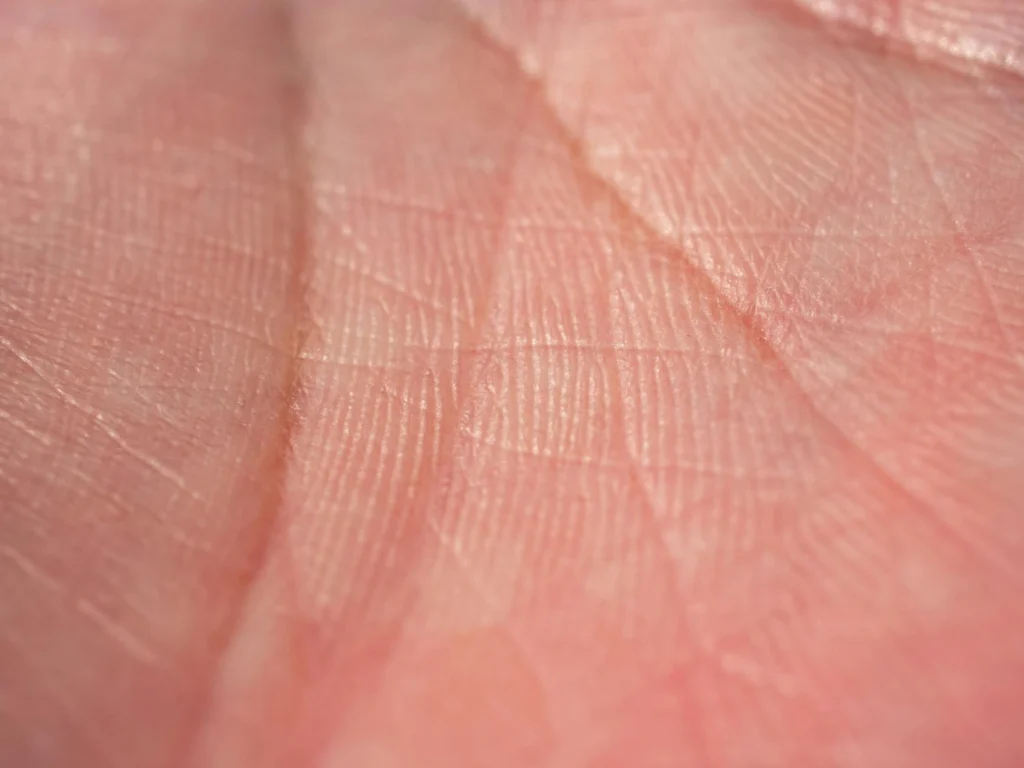
Fingerprint minutiae matching is a core method of human identification, from unlocking your phone to investigating cold cases. Friction ridge patterns are established before birth, usually persist through life, and vary enough that no two individuals with the same ridge arrangements have been found, although the reliability of any comparison still depends on the quality of the impressions being compared.[s]
The core insight is straightforward: fingerprints contain small ridge features called minutiae, and the probability of two unrelated people sharing the same configuration of these features can become extremely small under a statistical model.[s] In the simplified independence calculation used below, 12 corresponding minutiae with an illustrative single-minutia probability of 0.06 gives a likelihood ratio on the order of 4×10¹⁴. That number is a model result, not a universal courtroom rule.
The Four Fundamental Patterns
Fingerprint patterns are commonly grouped into broad classifications such as arches, ulnar loops, radial loops, and whorls, with some prints falling along a continuum between simple labels.[s] Developmental research supports a Turing-style reaction-diffusion basis for ridge formation, and a 2025 arXiv model shows how a Schnakenberg-type system can generate those broad classes and minutiae-like structures.[s][s] Classification depends in part on the presence and position of delta structures, triangular formations where ridge lines diverge.
Arches have no deltas and flow in smooth waves across the fingertip. Loops have one delta and form curved patterns that enter and exit on the same side of the finger. Whorls generally contain two deltas and form circular or spiral patterns around a central core. Galton categorized prints into arches, loops, and whorls in 1892; Juan Vucetich built early fingerprint files in the 1890s; and Edward Henry published his classification system in 1900.[s]
Fingerprint Minutiae Matching Fundamentals
Within these broad patterns lie the minutiae, the microscopic ridge characteristics that make fingerprint minutiae matching possible.[s] The three basic minutiae types are ridge endings (where a ridge stops), bifurcations (where one ridge splits into two), and islands (short ridges standing alone). These combine into more complex formations like hooks, crossovers, and bridges.
Forensic identification requires comparing not just minutiae types but their relative positions within the overall pattern.[s] Modern practice does not use one universal point-count minimum. Fixed thresholds were used historically: a 12-point rule was used in America in the early 1900s and abandoned by the FBI in the 1940s, while England, Wales, and Scotland later moved away from 16-point standards toward nonnumeric evaluation.[s][s]
The Probability Mathematics
Fingerprint minutiae matching can be expressed in probabilistic frameworks associated with work by David Stoney, Christophe Champod, and later likelihood-ratio models.[s] A simplified version treats individual minutiae as approximately independent events, meaning the probability of multiple features matching by chance equals the product of their individual probabilities.
The calculator cited here uses single-minutia probabilities ranging from 0.05 for rare features to 0.10 for common ridge endings.[s] Using the illustrative value 0.06, finding 12 corresponding minutiae gives a random match probability of approximately 0.06 raised to the 12th power. The likelihood ratio, which compares the probability of seeing this evidence if the prints came from the same person versus different people, is approximately 4.6×10¹⁴ before any case-specific adjustments.[s]
ENFSI’s 2015 fingerprint manual recognizes numerical, holistic, and probabilistic approaches, while its broader evaluative-reporting guideline recommends likelihood ratios when forensic findings are evaluated against competing propositions.[s][s]
Automated Fingerprint Identification Systems
Since the introduction of Automated Fingerprint Identification Systems in the 1980s and the FBI’s Integrated Automated Fingerprint Identification System in the late 1990s, fingerprint minutiae matching has scaled to massive databases.[s] These systems extract minutia templates from fingerprint images and compute similarity scores using ridge orientation fields and minutia neighborhoods.
Before submitting a print for an AFIS search, examiners must manually encode the print’s features in a format the system understands.[s] The system then returns a ranked list of candidate matches, which human examiners verify. A September 2025 ROC summary of its NIST ELFT submission reported a 386-second search across an estimated 30 million-print gallery.[s]
Latent prints lifted from crime scenes pose particular challenges. These partial, degraded impressions can be difficult biometric evidence to process.[s] AFIS integration has enhanced the accuracy and speed of fingerprint matching while addressing challenges from partial or contaminated samples.[s]
Deep Learning Approaches
Recent advances in deep learning have expanded fingerprint matching methods. Unlike traditional approaches that rely on explicitly extracted minutiae points, convolutional neural networks can learn complex features directly from raw fingerprint images.[s]
The ENET-EMHSA model, combining EfficientNet architecture with Multi-Head Self-Attention mechanisms, reported accuracy rates of 99.57% to 99.86% on FVC 2000, 2002, and 2004 benchmark datasets while maintaining low error rates.[s] In March 2026, NIST announced completed annotations for SD 302, about 10,000 latent fingerprint images from 200 volunteers, to help train human examiners and AI algorithms.[s]
The Human Factor: Bias and Error
The Brandon Mayfield case demonstrates that even professional forensic experts remain susceptible to cognitive biases that produce critical errors.[s] In 2004, FBI examiners matched a latent print from the Madrid train bombings to Mayfield, an Oregon attorney, based on what they considered unusually high correspondence. Spanish authorities disagreed, and Mayfield was eventually exonerated when another suspect was identified.
Studies document multiple interacting bias sources in forensic decision-making: confirmation bias, where examiners interpret ambiguous evidence to support initial hypotheses, and contextual bias, where case information unrelated to the fingerprint itself affects judgment.[s] Procedural safeguards like blind verification, where a second examiner reviews the match without knowing the first examiner’s conclusion, can reduce these errors.
Implications for Justice
Fingerprint minutiae matching remains a widely used forensic identification method, but the mathematics reveals important nuances. The likelihood ratios are only as reliable as the assumptions, data, and impression quality underlying them. The National Research Council warned in 2009 that uniqueness of ridge skin does not by itself prove that two impressions can always be reliably distinguished.[s]
AFIS performance is usually reported with benchmark-specific measures such as false acceptance rate, false rejection rate, ROC curves, or equal error rate, and results depend on image quality, gallery size, and threshold choice.[s] Real-world performance on partial latent prints can fall short of ideal benchmark conditions. Quality assessment tools like NIST’s OpenLQM return a 0-100 assessment of print quality to help examiners triage prints with the most usable detail.[s]
The mathematics of fingerprint identification offers strong but not absolute certainty. Understanding these probabilities matters for courts, juries, and anyone whose freedom might depend on the ridges of their fingertips.
Fingerprint minutiae matching is a mathematical component of biometric identification, employing probabilistic frameworks to quantify the evidential strength of ridge correspondence. Under simplified independence assumptions, minutiae configurations can yield very small random match probabilities, but real forensic conclusions depend on impression quality, feature interpretation, and verification.
A simplified probabilistic model treats minutia matching as approximately independent Bernoulli trials.[s] For k corresponding minutiae with single-minutia match probability p_m, the random match probability approximates p_m^k. With the calculator’s illustrative p_m range of 0.05 to 0.10, and k=12, this yields RMP on the order of 10^-15 for p_m=0.06.[s]
Pattern Formation: Reaction-Diffusion Dynamics
Developmental research reports that fingerprint ridge spatial patterning is established by a Turing reaction-diffusion system involving EDAR, WNT, and BMP signaling.[s] A 2025 arXiv paper presents a Schnakenberg-type model with anisotropic diffusion matrices following ridge orientations that generates minutiae-like structures with statistical distributions consistent with real fingerprints.[s]
The model numerically reproduces all four basic classifications: arches, ulnar loops, radial loops, and whorls, plus derived forms.[s] The convex domain mimics fingertip geometry, and third-degree nonlinearity in the Schnakenberg interaction produces the bifurcations and ridge endings critical for fingerprint minutiae matching. This mathematical framework explains why minutiae emerge naturally from the physics of pattern formation rather than requiring explicit encoding.
Minutiae Taxonomy and Spatial Encoding
Minutiae comprise ridge endings, bifurcations, and islands as primitives.[s] Higher-order features (hooks, crossovers, bridges) derive from spatial proximity of primitives. Forensic encoding captures type, (x,y) position, ridge direction θ, and quality score for each minutia.
Minimum point-count rules varied historically by jurisdiction, but modern practice does not use a single universal threshold. The FBI abandoned the U.S. 12-point rule in the 1940s, and England, Wales, and Scotland later moved away from 16-point standards toward nonnumeric evaluation.[s][s] ENFSI’s 2015 fingerprint manual recognizes numerical, holistic, and probabilistic approaches, and its evaluative-reporting guideline uses likelihood ratios to express evidential strength when competing propositions are evaluated.[s][s]
Fingerprint Minutiae Matching: The Likelihood Ratio Framework
The Bayesian likelihood ratio LR = P(E|H_p) / P(E|H_d) compares evidence probability under prosecution hypothesis (same source) versus defense hypothesis (different sources). For minutiae-based matching:
Under approximate independence, LR ≈ 1/(p_m^k × penalty), where the penalty term accounts for unmatched minutiae in the latent print. With k=12 and p_m=0.06, the simplified calculation yields LR approximately 4.6×10^14 before case-specific adjustments.[s]
AFIS systems compute similarity scores and generate score distributions for genuine and impostor pairs. The ROC curve plots True Acceptance Rate against False Acceptance Rate across thresholds; AUC quantifies discriminative power. Equal Error Rate (EER), where FAR equals FRR, is a single-point accuracy metric, but operational error rates depend on the system, dataset, threshold, and quality of the latent print.[s]
AFIS Architecture and Computational Constraints
AFIS deployment began in the 1980s; the FBI’s IAFIS launched in the late 1990s.[s] Examiners encode latent prints into minutia templates before submission, with encoding schemas varying between vendors and requiring re-encoding for cross-jurisdictional searches.[s]
NIST ELFT (Evaluation of Latent Fingerprint Technologies) benchmarks measure 1-to-N search performance.[s] A September 2025 ROC summary of its NIST ELFT submission reported a 386-second search across an estimated 30 million-fingerprint gallery, compared with an 8,029-second average for other Western vendors in that summary.[s]
Latent prints pose difficult matching problems: partial coverage, degraded quality, and distortion from deposition surface geometry.[s] Quality assessment tools such as NIST NFIQ 2 and OpenLQM help assess print quality and triage prints unlikely to yield useful AFIS results.[s]
Deep Learning for End-to-End Matching
Convolutional neural networks bypass explicit minutiae extraction by learning discriminative features directly from raw images.[s] The ENET-EMHSA architecture combines EfficientNetB4 for spatial feature extraction with Multi-Head Self-Attention for feature weighting. Preprocessing includes CLAHE for contrast enhancement and ESRGAN for super-resolution.
Performance reported on FVC benchmark datasets (2000, 2002, 2004) reaches 99.57%, 99.72%, and 99.86% accuracy with correspondingly low EER.[s] The attention mechanism assigns importance weights to different ridge regions, learning to focus on high-information minutiae areas. NIST’s completed SD 302 annotations cover about 10,000 latent images from 200 volunteers and provide training data for human examiners and AI models.[s]
Cognitive Bias in Expert Interpretation
The Brandon Mayfield case (2004) exemplifies cognitive vulnerability in fingerprint minutiae matching: FBI examiners identified Mayfield as the source of a Madrid bombing latent print, a conclusion Spanish authorities rejected.[s] Post-hoc analysis identified confirmation bias (interpreting ambiguous features to match the hypothesis) and contextual bias (case information influencing perception of ridge correspondence).[s]
Blind verification protocols, where a second examiner evaluates without knowledge of the first examiner’s conclusion, reduce bias propagation. Context management procedures limit examiner exposure to non-fingerprint case information. Algorithmic AFIS matching reduces but does not eliminate bias, as training data may encode historical examiner judgments.
Limitations of the Independence Assumption
The simplified model’s power depends on assumptions about minutiae rarity and dependence. Real fingerprints exhibit spatial structure: ridge orientations constrain nearby minutiae positions, and certain minutia types can co-occur more frequently than chance. Violations can inflate random match probability estimates for highly correlated configurations.
The 2009 NRC report “Strengthening Forensic Science in the United States” warned that uniqueness and permanence of ridge skin do not by themselves establish that two impressions can always be reliably distinguished, and it called for more data on variation across people and across repeated impressions from the same person.[s] ENFSI guidance allows likelihood-ratio reporting, but it also requires disclosure of the data, expert knowledge, and assumptions behind the assignment.[s]
Understanding these mathematical foundations, and their constraints, remains essential for proper interpretation of fingerprint evidence in forensic contexts.