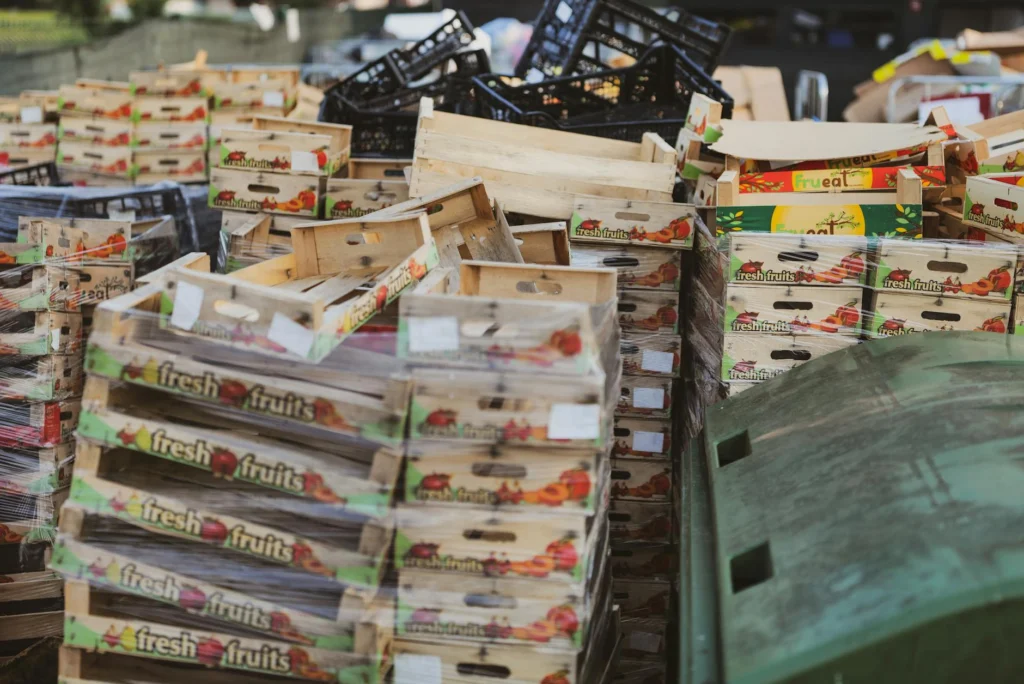
The world produces enough food to feed 10 billion people[s]. Yet 673 million go hungry[s]. This paradox sits at the heart of global food waste: the problem is not that we grow too little, but that we lose too much between farm and fork.
In 2022, humanity wasted 1.05 billion tonnes of food at the retail and consumer level alone[s]. That equals roughly one billion meals thrown away every single day[s]. Add the 13% of food lost between harvest and retail, and the picture becomes staggering: nearly a third of all food produced never reaches a human stomach.
Global Food Waste Happens Before You See It
Most people imagine food waste as leftovers scraped into bins. The reality is different. According to researchers at MIT, approximately 72% of food waste occurs at the supply chain level, before products ever reach consumers[s]. The remaining 28% happens in kitchens and restaurants.
In developing countries, the losses cluster early: crops rot in fields, spoil during transport, or decay in storage. In wealthy nations, the waste shifts downstream to supermarket shelves and household refrigerators. But the root cause remains consistent: infrastructure that cannot preserve perishable goods.
The Cold Chain Gap
Temperature control is the single biggest factor. The FAO estimates that 526 million tonnes of food, around 12% of global production, are lost or wasted due to insufficient refrigeration[s].
The disparity between regions is stark. Only about 10% of perishable foods worldwide are refrigerated[s]. In sub-Saharan Africa, farmers lose an estimated 37% of their harvest before it can be sold[s]. When a Kenyan cooperative gained access to refrigerated transport, their losses dropped dramatically and incomes rose 50%[s].
If developing countries reached the same level of cold chain infrastructure as wealthy nations, they could save 144 million tonnes of food annually[s]. Such infrastructure gaps drive much of global food waste in the regions that can least afford it.
When Looks Kill Food
Refrigeration is not the only culprit. Cosmetic standards imposed by retailers reject perfectly edible produce for minor blemishes. In Australia, nearly 14 million kilograms of fruit and vegetables are discarded annually because they fail appearance tests[s]. Farmers report that appearance is the most common reason commercial buyers reject their goods, outweighing concerns about ripeness or pest damage[s].
Half of surveyed farmers admit to screening out good produce before even offering it to buyers, anticipating rejection[s]. The result: food rots on farms while shelves display only photogenic specimens.
The Cost of Doing Nothing
Global food waste costs the world economy roughly $1 trillion annually[s]. It also generates 8-10% of global greenhouse gas emissions[s], nearly five times more than aviation[s]. Meanwhile, 470 million small-scale farmers lose an average of 15% of their income to post-harvest losses[s].
The arithmetic is clear: addressing global food waste would do more for food security than expanding production. The infrastructure exists. The technology exists. What remains is the will to deploy it where it matters most.
Global food systems produce sufficient calories to feed 10 billion people[s], yet 673 million remain chronically undernourished[s]. This disconnect reveals a fundamental misdiagnosis in food security policy: the constraint is not production capacity but post-harvest logistics. Global food waste represents a systems failure, not a farming failure.
UNEP’s 2024 Food Waste Index measured 1.05 billion tonnes of food wasted at consumer-facing stages (retail, food service, and households) in 2022[s]. FAO tracking adds another 13% lost between harvest and retail[s]. Combined, this means roughly 30-40% of all food produced never reaches human consumption, depending on methodology and commodity type.
Supply Chain Attribution of Global Food Waste
Consumer behavior receives disproportionate attention in waste reduction campaigns. However, MIT’s Center for Transportation and Logistics estimates that 72% of food waste occurs upstream in the supply chain, with only 28% attributable to end consumers[s].
The distribution of losses varies by development status. In emerging economies, waste concentrates in early stages: inadequate storage, poor handling protocols, and transport delays cause over-maturation and dehydration before products reach aggregation points. In developed markets, losses shift to retail overstocking and household spoilage, though infrastructure deficiencies persist even in OECD nations.
Cold Chain Infrastructure Deficits
Temperature management is the primary technical lever. FAO data indicates that 526 million tonnes of food, approximately 12% of global production, are lost specifically due to insufficient refrigeration[s].
The infrastructure gap is severe: only 10% of perishable foods worldwide are refrigerated at any point in the supply chain[s]. In Asia, an estimated 40% of food is lost at the post-harvest level[s]. In sub-Saharan Africa, roughly 37% of food is lost between harvest and retail, with losses heavily concentrated upstream rather than at the consumer level[s].
Field studies demonstrate the intervention potential. Shell Foundation research documented that first-mile cold storage reduced post-harvest losses by 25-50%[s]. A UNEP pilot in Kenya equipped a farming cooperative with refrigerated transport; their losses dropped from 40% to single digits, and farmer incomes increased 50%[s].
UNEP and FAO estimate that developing countries could save 144 million tonnes of food annually by reaching cold chain parity with developed nations[s].
Cosmetic Specifications and Buyer Rejection
Beyond infrastructure, market access barriers compound losses. Retail cosmetic standards systematically reject edible produce for appearance defects. Research in Australia found that nearly 14 million kilograms of fruit and vegetables are discarded annually on aesthetic grounds alone[s].
Farmer surveys indicate that appearance is the most common reason for commercial rejection, outranking ripeness or pest infestation[s]. The behavioral consequence is pre-emptive screening: 50% of farmers report culling produce they expect will be rejected, before even presenting it to buyers[s].
Economic and Climate Externalities
The macroeconomic burden of global food waste reaches approximately $1 trillion annually[s]. For every dollar invested in waste reduction, returns average $14; municipal-level investments yield up to $92 per dollar[s].
Climate impact is substantial: food loss and waste generate 8-10% of global greenhouse gas emissions[s]. If food waste were a country, it would rank as the third-largest emitter[s]. Rotting food in landfills contributes up to 14% of global methane emissions, a greenhouse gas 80 times more potent than CO2 over a 20-year horizon[s].
The 470 million small-scale farmers worldwide lose an average of 15% of their income to post-harvest losses[s]. Reducing this leakage would simultaneously improve food security, lower emissions, and boost rural livelihoods.
Intervention Priorities
The evidence points to clear priorities: first-mile cold chain deployment in high-loss regions, decentralized solar-powered cooling to bypass grid constraints, relaxation of cosmetic specifications at retail, and circular economy models that repurpose unavoidable waste into biogas or animal feed.
Japan and the UK demonstrate feasibility at scale, having reduced household food waste by 53% and 22% respectively[s]. The technical solutions exist; the bottleneck is capital deployment and policy coordination. Addressing global food waste is not primarily a research problem. It is an infrastructure investment problem with known returns.