A reader asked us to write about microplastics health risks. It is one of those topics where the gap between what the headlines say and what the science has actually established is wide enough to drive a truck through. So here is the current state of knowledge on microplastics health effects, organized by what we can say with confidence, what we cannot, and what remains genuinely unknown.
What Microplastics Are and Where They Come From
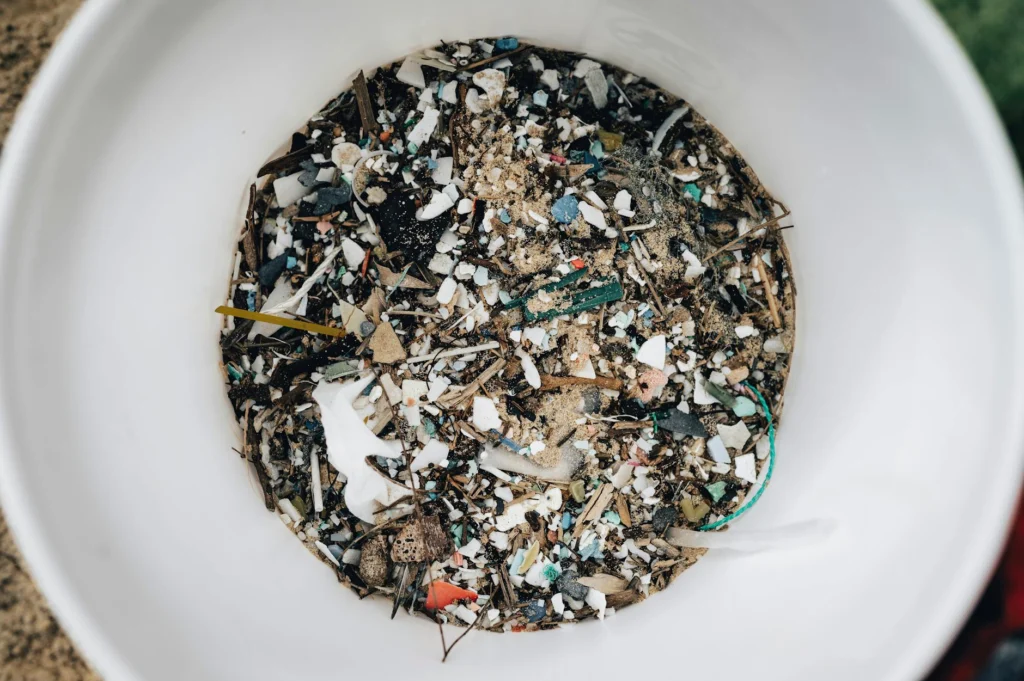
Microplastics are plastic fragments smaller than five millimeters. That upper limit is roughly the size of a sesame seed. Nanoplastics are smaller still, measured in billionths of a meter, two to three times the size of a virus. The distinction matters because nanoplastics can cross biological barriers that microplastics cannot.
They originate from two paths. Primary microplastics are manufactured small on purpose: the microbeads in exfoliating face wash, the pellets used as raw material in plastic manufacturing, the synthetic fibers that shed from polyester clothing every time you run the washing machine. Secondary microplastics come from the breakdown of larger plastic objects, degraded by UV radiation, mechanical abrasion, and time. A plastic bottle left in the sun does not biodegrade. It fragments into progressively smaller pieces that enter soil, water, and air.
Global plastic production now exceeds 400 million metric tons annually. Less than 10% of all plastic ever produced has been recycled. The rest is in landfills, the environment, or still in use. This is the supply side of the microplastics health problem, and it has been growing every year since the 1950s.
They Are Genuinely Everywhere
This part is not contested. Microplastics have been found in drinking water (both tap and bottled), sea salt, honey, beer, rice, fruits, vegetables, seafood, meat, and the air. They have been detected at the summit of Mount Everest, in Arctic sea ice, in the Mariana Trench, and in remote alpine lakes with no nearby human activity. Atmospheric transport carries them thousands of kilometers from any source.
In bottled water specifically, a 2024 study published in the Proceedings of the National Academy of Sciences using stimulated Raman scattering microscopy found an average of 240,000 micro- and nanoplastic particles per liter, around 90% of which were nanoplastics, roughly 100 times more than previous estimates that could only detect microplastics. The dominant polymer was polyamide (nylon), likely from the filtration process itself.
Tap water contains microplastics too, but at significantly lower concentrations. One widely cited estimate: people who drink only bottled water may ingest an additional 90,000 microplastic particles per year compared to about 4,000 for those who drink only tap water.
They Are Inside Us
Also not contested. Microplastics and nanoplastics have been detected in human blood, lung tissue, liver, kidney, placenta, testicles, heart tissue, lymph nodes, breast milk, semen, urine, and stool. As Stanford pediatric infectious diseases physician Desiree LaBeaud put it: “We are born pre-polluted.” Microplastics have been found in the placenta on both the fetal and maternal sides, and in meconium, the first stool of newborns.
The most striking recent finding involves the brain. A 2025 study published in Nature Medicine by toxicologist Matthew Campen and colleagues at the University of New Mexico found that human brain tissue contained substantially higher concentrations of microplastics than liver or kidney tissue. The dominant polymer was polyethylene, the plastic used in packaging and containers. The researchers identified particles at the nanometer scale, small enough to cross the blood-brain barrier.
More concerning: when the team compared brain tissue samples from 2016 to samples from 2024, plastic concentrations had increased by approximately 50%. That tracks with the continued growth in global plastic production and waste.
The Credit Card Claim: What 5 Grams Per Week Gets Right and Wrong
You have probably seen the headline: humans eat a credit card’s worth of plastic every week. This claim traces to a 2019 report commissioned by the World Wildlife Fund, based on a literature review by researchers at the University of Newcastle. The highest estimate in that review was 5 grams per week, roughly the mass of a credit card.
The claim is almost certainly a significant overestimate. Researchers at Wageningen University published a 2021 study that accounted for particle size ranges and shapes across the underlying data and arrived at a median estimate of approximately 4.1 micrograms per week for adults. That is roughly one million times less than 5 grams.
The truth is somewhere between these extremes, and the honest answer is that nobody yet knows exactly where. The Newcastle study used assumptions about average particle mass that produced inflated figures. The Wageningen study may undercount because detection methods at the time could not reliably capture the smallest nanoplastics. Both teams acknowledged these limitations. This is a textbook case of how methodological choices can predetermine research outcomes.
What is not in dispute: humans ingest microplastics regularly, through food, water, and inhalation. A 2019 study in Environmental Science and Technology estimated that Americans consume between 39,000 and 52,000 microplastic particles per year through food alone, rising to 74,000 to 121,000 when inhalation is included. The authors noted these were “likely drastic underestimates” because only about 15% of caloric intake had been studied for microplastic content at the time.
What We Know About Microplastics Health Effects
Here is where the distinction between “detected” and “harmful” becomes critical. The presence of microplastics in tissue does not automatically mean they are causing damage. Establishing causation in environmental health research is slow, expensive, and methodologically difficult, especially when the exposure is universal. You cannot run a randomized controlled trial comparing people exposed to microplastics with people who are not, because the unexposed group does not exist.
What laboratory and animal studies have established:
- Microplastics can trigger inflammatory responses and oxidative stress in cell cultures and animal models.
- They can carry adsorbed chemicals, including endocrine disruptors like bisphenols and phthalates, heavy metals, and persistent organic pollutants, into biological tissue.
- In animal studies, exposure has been associated with altered gut microbiome composition, reproductive effects, and immune system disruption.
- Nanoplastics ingested by pregnant animals have been shown to cross the placental barrier and reach fetal organs, including the brain.
What human observational studies suggest:
The strongest human evidence to date comes from a 2024 study published in the New England Journal of Medicine. Researchers led by Raffaele Marfella at the University of Campania examined atherosclerotic plaque removed during carotid endarterectomy surgery. Patients whose plaque contained detectable microplastics and nanoplastics had a 4.53 times higher risk of a composite endpoint (heart attack, stroke, or death) over a mean follow-up of 34 months, compared to patients whose plaque did not contain detectable plastics.
This is an association, not proof of causation. The authors were explicit about this. People with more microplastics in their arterial plaque may differ from those with less in ways the study did not measure. But the effect size is large, the journal is among the most rigorous in medicine, and the finding has accelerated microplastics health research considerably.
Other observational findings include correlations between microplastic exposure and markers of inflammation, oxidative stress, and endocrine disruption in human populations. Communities with higher environmental microplastic concentrations show higher rates of diabetes, hypertension, and stroke in ecological studies.
What We Know to Be False
“Microplastics are harmless because they just pass through you.” This is not supported by the evidence. While much ingested microplastic does transit the gastrointestinal tract, nanoplastics demonstrably cross biological barriers, including the gut wall, the blood-brain barrier, and the placental barrier. They accumulate in tissue. The UNM brain study showed increasing concentrations over time, not steady-state equilibrium.
“We eat a credit card of plastic every week.” As discussed above, this specific figure is not supported by the underlying science. The original study’s methodology has been credibly challenged, and more careful estimates are orders of magnitude lower. The claim persists because it is vivid and shareable, not because it is accurate.
“Microplastics are a new problem.” Plastic mass production began in the 1950s. Microplastic contamination of marine environments was first documented in scientific literature in the 1970s. The problem is not new. Our ability to detect and measure it is.
“Boiling water removes microplastics.” A 2024 study in Environmental Science and Technology Letters found that boiling and filtering tap water can reduce microplastic content by up to 90% in hard water, because calcium carbonate encapsulates plastic particles during boiling. But this works primarily in hard water, and the effectiveness for nanoplastics is uncertain.
What Remains Genuinely Unknown About Microplastics Health
The honest list is long:
- Dose-response relationship. At what concentration do microplastics health effects become clinically significant? We do not know. Animal studies use concentrations that may or may not reflect real human exposure.
- Which polymers are most harmful? Plastics are not one substance. Polyethylene, polypropylene, polystyrene, PET, nylon, and dozens of other polymers behave differently in biological systems. Some carry more adsorbed toxins than others. Systematic comparison is in early stages.
- Long-term accumulation dynamics. Do microplastics continue to accumulate in organs throughout life, or does the body eventually clear them? The UNM brain data suggests accumulation, but two time points eight years apart is not a lifetime trajectory.
- Cancer risk. Some plastic additives (styrene monomers, certain phthalates) are classified as possible or probable carcinogens. Whether microplastic exposure at real-world levels increases cancer risk in humans is unknown. One recent ecological study actually found a negative correlation between microplastic concentration and cancer rates, illustrating how far we are from clear answers.
- Synergistic effects. Microplastics carry other pollutants on their surface. Whether the combination is worse than either alone, and how this interacts with the more than 16,000 chemicals associated with plastic production, is largely unstudied in humans.
- Safe thresholds. No regulatory body has established a safe exposure limit for microplastics in food or water, because the data to set one does not yet exist.
- Neurodegenerative disease link. The UNM study found that brain tissue from individuals with dementia contained up to 10 times more microplastics than tissue from individuals without dementia. This is a correlation from a single study. It could mean microplastics contribute to neurodegeneration, or that a damaged blood-brain barrier (a feature of dementia) lets more particles through, or something else entirely.
What You Can Actually Do
Given the state of the evidence on microplastics health risks, the rational response is precaution without panic. Here is what the science supports:
- Drink tap water over bottled water when practical. The difference in microplastic particle count is substantial. Use a filter if you want additional reduction.
- Avoid microwaving food in plastic containers. Heat accelerates the release of micro and nanoplastics from plastic into food. Use glass or ceramic.
- Reduce single-use plastic where convenient. Not because one bag will hurt you, but because the aggregate production and disposal cycle is what fills the environment with fragments.
- Do not panic. The evidence of harm is preliminary. The evidence of exposure is solid. These are not the same thing. Acting as though they are serves nobody.
The uncomfortable position, and the honest one, is that we are running a global experiment on human exposure to synthetic polymers, and we will not have definitive results for years. The microplastics are already inside us. The question is what they are doing there, and the science is not yet able to give a complete answer. That uncertainty is not a reason to dismiss the risk. It is the risk. The pattern of trusted sources simplifying away inconvenient complexity applies here too: the reality is messier than either “harmless” or “apocalyptic,” and the messy version is the one worth understanding.
This article discusses health and environmental science topics. It is not medical advice. Consult a qualified healthcare professional for decisions about your health.