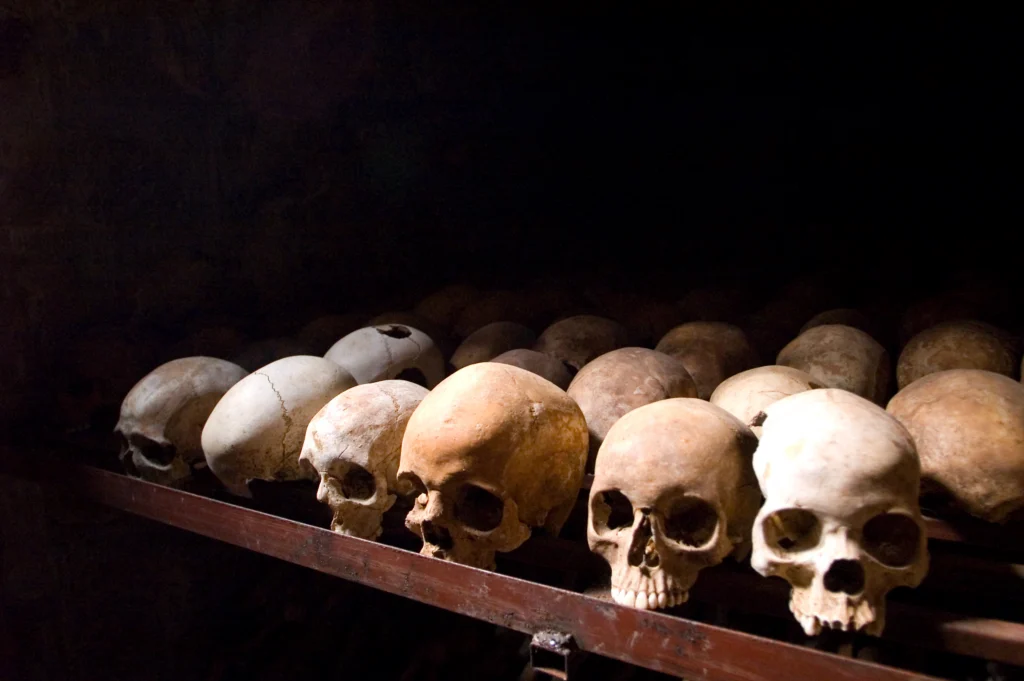
On January 11, 1994, Canadian General Roméo Dallaire, commander of the United Nations peacekeeping mission in Rwanda, sent a cable to UN headquarters in New York that has become one of the most consequential documents in modern diplomatic history. Citing a high-level informant inside the Interahamwe militia, Dallaire warned of an “anti-Tutsi extermination” plot.[s] The informant had described weapons caches hidden across Kigali, lists of Tutsi residents compiled for targeting, and militia members trained to kill at terrifying speed. The rwandan genocide warning signs could not have been clearer. Three months later, those same militia members led a 100-day slaughter that killed between 500,000 and one million people.
Rwandan Genocide Warning Signs: The Roots of a Foreseeable Catastrophe
The catastrophe did not begin in April 1994. Its foundations were laid decades earlier, when Belgian colonial administrators hardened the fluid social categories of Hutu and Tutsi into rigid racial identities, issuing ethnic identity cards in 1933 that determined access to education, employment, and political power.[s] After independence in 1962, the Hutu-dominated government maintained these cards and implemented anti-Tutsi discrimination that drove waves of Tutsi into exile. By the late 1980s, Tutsi refugees in Uganda had formed the Rwandan Patriotic Front (RPF), which invaded northern Rwanda in October 1990, setting off a civil war.
The war created a pretext for Hutu extremists to escalate anti-Tutsi hatred. In December 1990, the Hutu Power newspaper Kangura published the infamous “Hutu Ten Commandments,” a militant doctrine that branded all Tutsi as enemies and portrayed Tutsi women as agents of infiltration.[s] By mid-1993, Hutu radicals had launched Radio Télévision Libre des Mille Collines (RTLM), a station that blended popular music with dehumanizing propaganda, calling Tutsi inyenzi (cockroaches) and building the rhetorical architecture of genocide.[s]
In August 1993, peace talks produced the Arusha Accords, a power-sharing agreement between the Habyarimana government and the RPF. President Juvénal Habyarimana had already dismissed the accords as “scraps of paper.”[s] While diplomats congratulated themselves on the deal, Hutu extremists were distributing weapons. Human Rights Watch documented that the Rwandan Ministry of Defense had taken delivery of nearly $12 million in arms from Egypt and South Africa in 1992 alone, including 20,000 rifles and 20,000 hand grenades, far exceeding military needs.[s] These were weapons for a civilian army being assembled in plain sight.
The Genocide Fax and Rwandan Genocide Warning Signs That Were Suppressed
Dallaire’s January 1994 fax, now known as the “genocide fax,” was the most explicit rwandan genocide warning signs communicated directly to the institution charged with preventing such atrocities. His informant, Jean-Pierre Turatsinze, revealed that he had been ordered to register all Tutsi in Kigali “for their extermination” and was prepared to show UNAMIR the locations of weapons caches.[s] Dallaire requested authorization to raid the caches. The final line of his fax, written in French, read: “Peux ce que veux. Allons-y.” (Where there is a will, there is a way. Let’s go.)[s]
The response from New York was devastating. Kofi Annan, then head of UN Peacekeeping Operations, ordered that no arms cache raids take place and instructed Dallaire to strictly adhere to his existing mandate. Headquarters warned against “unanticipated repercussions” from taking preventive action.[s] Instead, Dallaire was told to share his intelligence with President Habyarimana, the very leader whose inner circle was arming the militias.
Dallaire sent further warnings on January 22, February 3, February 15, February 27, and March 13, 1994. Each was ignored.[s]
What Washington Knew
The United States was not ignorant. As early as 1993, CIA analysts had warned that if ethnic tensions in Rwanda were not resolved, the worst-case scenario could produce up to 500,000 deaths.[s] State Department officials, including Deputy Assistant Secretary Prudence Bushnell, visited Rwanda in late March 1994 and registered “deep concern over the mounting violence” and “the distribution of arms and arms caches.”[s]
None of it mattered. The Clinton administration was still reeling from the death of 18 American soldiers in Mogadishu, Somalia, in October 1993. Presidential Decision Directive 25 (PDD-25), drafted in the wake of Somalia, imposed strict conditions on US support for UN peacekeeping operations. Rwanda, a small landlocked country with no strategic resources, did not qualify.[s] Declassified documents show that US officials deliberately avoided using the word “genocide” because, under the 1948 Genocide Convention, acknowledging genocide would create a legal obligation to act.[s]
100 Days: The Cost of Ignoring Rwandan Genocide Warning Signs
On April 6, 1994, President Habyarimana’s plane was shot down over Kigali. Within hours, the killing began. RTLM urged Hutus to “go to work,” a euphemism for slaughtering their Tutsi neighbors.[s] The weapons UNAMIR had been forbidden from seizing were among those used against innocent civilians.[s]
On April 7, Presidential Guard soldiers murdered Prime Minister Agathe Uwilingiyimana and tortured and killed 10 Belgian UNAMIR peacekeepers assigned to protect her.[s] Belgium withdrew its remaining troops. On April 21, the UN Security Council voted to slash UNAMIR from 2,500 soldiers to just 270, choosing reduction over reinforcement while Rwandans were being massacred.[s]
General Dallaire was ordered three times to leave the country. Each time, he refused.[s] With his skeleton force, he sheltered an estimated 30,000 Rwandans, but he could not stop the genocide.[s]
The Security Council did not officially acknowledge genocide until June 22, 1994, more than two months into the killing.[s] By that point, the RPF had begun retaking the country by force. The genocide ended in mid-July, not because the international community intervened, but because the RPF won the war.
A Failure That Shaped International Law
The rwandan genocide warning signs were not ambiguous signals requiring expert interpretation. They were explicit reports from the ground, intelligence assessments predicting mass death, and visible preparations for extermination broadcast on the radio. Gregory Stanton, who later developed his influential framework on the stages of genocide, used Rwanda as a primary case study, demonstrating that every recognizable stage, from classification and symbolization to dehumanization and preparation, was present and documented well before April 1994.
In 2005, former US President Bill Clinton expressed regret for his personal failure to prevent the genocide.[s] The UN’s own inquiry concluded that the Security Council “bears a responsibility for its lack of political will to do more to stop the killing.”[s]
Rwanda’s legacy reshaped the international order. In 2005, UN member states adopted the Responsibility to Protect (R2P) doctrine, establishing that sovereignty cannot shield a government engaged in genocide from international action.[s] The question that Rwanda poses is not whether warning systems work, but whether the political will exists to act on what they reveal.
On January 11, 1994, Major General Roméo Dallaire, Force Commander of the United Nations Assistance Mission for Rwanda (UNAMIR), transmitted a cable classified “most immediate” to the Department of Peacekeeping Operations (DPKO) in New York. The cable, later designated the “genocide fax,” reported intelligence from an informant identified as a “top level trainer” of the Interahamwe militia. Dallaire warned of an “anti-Tutsi extermination” plot, requested authorization to raid weapons caches, and asked for protection for his source.[s] This document crystallized a pattern of rwandan genocide warning signs that had been accumulating for years.
Rwandan Genocide Warning Signs: Colonial Origins and Structural Preconditions
The structural preconditions for genocide in Rwanda were rooted in Belgian colonial policy. In 1933, Belgian administrators introduced ethnic identity cards that codified the categories of Hutu (approximately 85% of the population), Tutsi (14%), and Twa (1%) into rigid racial classifications. Where these identities had previously been somewhat fluid, with social mobility possible through cattle ownership and intermarriage, colonialism froze them into a caste system.[s]
Following independence in 1962, the Hutu-dominated government maintained ethnic ID cards and implemented systematic discrimination against Tutsi, driving successive waves of refugees into neighboring countries. The Rwandan Patriotic Front (RPF), formed by Tutsi exiles in Uganda, invaded Rwanda in October 1990. The civil war provided Hutu extremists with a framework for escalating anti-Tutsi rhetoric into eliminationist ideology.
The propaganda apparatus was central to this escalation. In December 1990, the Kangura newspaper published the “Hutu Ten Commandments,” which declared that any Hutu who married, employed, or befriended a Tutsi was a traitor.[s] By July 1993, Hutu Power elements had established RTLM, which combined entertainment programming with systematic dehumanization, referring to Tutsi as inyenzi (cockroaches) and broadcasting increasingly explicit calls for violence.[s]
Arms Procurement and Militia Training: The Material Rwandan Genocide Warning Signs
While Hutu Power media constructed the ideological justification, the Habyarimana regime assembled the material infrastructure for mass killing. Human Rights Watch’s exhaustive 1999 report, Leave None to Tell the Story, documented that even as the Arusha peace negotiations proceeded, the Rwandan Ministry of Defense acquired approximately $12 million in arms from Egypt and South Africa during 1992. The October 1992 purchase alone included 20,000 R-4 rifles and 20,000 hand grenades, quantities far exceeding the armed forces’ replacement needs for a 30,000-strong military losing perhaps a thousand deserters per year.[s]
These surplus weapons were distributed to communal police forces and, through them, to civilians. Burgomasters in several communes submitted requisition lists for automatic weapons and machine guns far in excess of their police contingents’ needs.[s] Simultaneously, Interahamwe recruits received training at remote camps, including Gabiro near the Akagera game park and in the Gishwati forest, visited on weekends by senior MRND officials.[s]
The Arusha Accords, signed in August 1993, were meant to end the civil war through power-sharing. President Habyarimana had already publicly denounced the agreement as “scraps of paper” in a November 1992 speech.[s] The international community’s lack of support for military demobilization provisions, combined with the Rwandan government’s refusal to implement key terms, rendered the accords a dead letter.[s]
The Genocide Fax and Institutional Failure at UN Headquarters
Dallaire’s informant, Jean-Pierre Abubakar Turatsinze, occupied a complex position. Half-Hutu and half-Tutsi, a convert to Islam in a predominantly Christian country, Turatsinze had served as an intermediary between the MRND party leadership and the Interahamwe. He revealed to Dallaire that he had been ordered to register all Tutsi in Kigali in preparation “for their extermination,” and claimed that his trained personnel “could kill up to 1,000 Tutsis” in 20 minutes.[s] He offered to reveal weapons cache locations in exchange for protection for himself and his family.[s]
Under-Secretary-General Kofi Annan and Assistant Secretary-General Iqbal Riza rejected Dallaire’s request to raid the caches, ordering him to share his intelligence with President Habyarimana instead, and to “strictly adhere to his mandate.” Later communications warned against “unanticipated repercussions.”[s] The institutional context for this decision is critical: the DPKO staff, numbering only a few hundred, were managing 17 missions and over 70,000 peacekeepers. With complex operations in Bosnia and Somalia consuming attention, Rwanda ranked low in the bureaucratic hierarchy.[s]
Dallaire transmitted additional warnings on five occasions between January 22 and March 13, 1994. His reports, as he later wrote, “seemed to keep vanishing into the abyss of non-action in New York.”[s]
US Intelligence, PDD-25, and the Deliberate Avoidance of the Word “Genocide”
American intelligence agencies tracked the rwandan genocide warning signs through their own channels. CIA analysts assessed that ethnic violence in Rwanda could produce up to 500,000 casualties.[s] Deputy Assistant Secretary Prudence Bushnell visited Rwanda in late March 1994, meeting personally with Habyarimana and registering US concern over “mounting violence” and arms distribution.[s]
These rwandan genocide warning signs were processed through a policy framework designed to prevent action. Presidential Decision Directive 25 (PDD-25), shaped by the Somalia debacle of October 1993, imposed conditions for US support of peacekeeping operations that no crisis in sub-Saharan Africa was likely to meet: clear threat to international security, available resources, a defined exit strategy, and domestic political support.[s] Declassified documents reveal that US officials consciously avoided the term “genocide.” One State Department document warned: “Be careful… Genocide finding could commit U.S.G. to actually ‘do something.'”[s]
The Security Council’s Role: Resolution 912 and the Withdrawal
On April 6, 1994, Habyarimana’s plane was shot down. Within hours, the Presidential Guard assassinated Prime Minister Agathe Uwilingiyimana. Ten Belgian UNAMIR peacekeepers assigned to protect her were disarmed, tortured, and killed.[s] Belgium withdrew its remaining contingent, and on April 21, the Security Council passed Resolution 912, reducing UNAMIR from 2,500 troops to 270.[s]
The historiographic record shows that the Security Council devoted approximately 80% of its Rwanda discussions to questions of how to withdraw peacekeepers, 20% to ceasefire negotiations, and no time at all to the ongoing genocide.[s] Rwanda’s own representative held a rotating seat on the Council, where he passed information about Western inaction back to the génocidaire government, reinforcing its sense of impunity.[s]
France, Rwanda’s closest Western ally, provides the most troubling case. E-International Relations’ analysis documented that French military officers had trained Interahamwe members as early as 1992, teaching militia techniques for detaining and disarming civilians.[s] France’s eventual military intervention in June 1994, Operation Turquoise, was motivated less by humanitarian concern than by the desire to halt the RPF’s advance and preserve French influence in francophone Africa.[s]
Dallaire, ordered three times to evacuate, refused each time. His remaining forces sheltered approximately 30,000 people.[s] The Security Council did not formally acknowledge genocide until June 22, 1994.[s]
Legacy: From Failure to R2P
The institutional reckoning was extensive. The UN’s 1999 Independent Inquiry concluded that the Security Council “bears a responsibility for its lack of political will to do more to stop the killing.”[s] Bill Clinton, visiting Rwanda in 2005, expressed “regret for my personal failure” to prevent the genocide.[s]
In 2005, the UN General Assembly unanimously adopted the Responsibility to Protect (R2P) doctrine, which holds that when a state manifestly fails to protect its population from genocide, the international community has a responsibility to act.[s] R2P was a direct product of Rwanda’s failure. Whether it has fundamentally changed the calculus of intervention remains contested, as subsequent crises in Darfur, Syria, and Myanmar have demonstrated.
The rwandan genocide warning signs remain a benchmark for scholars studying genocide prevention. Every stage that Gregory Stanton later codified in his framework on the stages of genocide, from classification to preparation to extermination, was visible in Rwanda months before April 1994. The historical record does not support a narrative of surprise or ignorance. It supports a narrative of knowledge, calculation, and conscious inaction.