The international community has spent over a century carefully regulating the tools of war. Serrated bayonets: banned. Blinding lasers: pre-emptively banned before anyone even used them[s]. Hollow-point bullets: restricted. Clear glass shrapnel: forbidden, because apparently someone once thought invisible shrapnel was a good idea. And yet, amid this meticulous cataloguing of prohibited ways to ruin someone’s day, there exist entomological warfare loopholes so vast you could fly a C-130 full of fire ants through them.
The boss asked for this one, and honestly, we should have written it sooner.
This is the story of the weapons nobody thought to ban, not because they were too terrible to contemplate, but because they were too ridiculous. The Geneva Conventions, the Biological Weapons Convention, the Convention on Certain Conventional Weapons: all carefully silent on the subject of what happens when you simply throw nature at people in ways that are, technically, non-lethal. Welcome to the arms regulation blind spot where entomology meets international law, and international law blinks first.
The Legal Landscape (Or: What We Actually Banned)
To appreciate the loopholes, you first need to understand what international humanitarian law actually covers. Article 35 of Additional Protocol I to the Geneva Conventions[s] establishes that “Parties to a conflict and members of their armed forces do not have an unlimited choice of methods and means.” Weapons must not cause “superfluous injury or unnecessary suffering.” This is how we ended up banning serrated bayonets: a regular bayonet removes someone from the battlefield just fine. The serrations were gratuitous.
The Biological Weapons Convention of 1972[s] bans the development, production, and stockpiling of “microbial or other biological agents, or toxins” intended for hostile purposes. The Convention on Certain Conventional Weapons handles the specific stuff: non-detectable fragments, incendiary weapons, landmines, and those blinding lasers that nobody had actually deployed yet but everyone agreed would be rude.
Here is the problem: all of these frameworks were written by people who were imagining weapons. Rifles. Bombs. Chemical agents. Laser beams. At no point did a diplomat in Geneva apparently raise their hand and ask, “But what if someone just… dropped a lot of angry insects on the enemy from very high up?”
Entomological Warfare Loopholes: A Proud and Terrible History
The idea of weaponizing insects is not new. It is, in fact, one of the oldest military tactics in recorded history[s]. Entomological warfare has manifested in three main forms: insects used directly as weapons, insects deployed to destroy crops, and insects used as vectors to spread disease.
During the Second Parthian War, King Barsamia defended the city of Hatra from Roman legions[s] by raining earthenware pots filled with scorpions down from 40-foot walls. The Romans, stung on every bit of exposed skin, retreated after 20 days. In medieval Europe, the technological high point was a 14th-century windmill-like device[s] that propelled beehives from the ends of rapidly rotating arms. It was, effectively, the entomological predecessor of the Gatling gun.
The 20th century, predictably, made everything worse. Labs at Fort Detrick[s] were set up to produce 100 million yellow fever-infected mosquitoes per month, deliverable by bombs or missiles. Operation Big Itch in 1954[s] tested whether fleas could be loaded into aerial bombs. They could. During one test, the munitions malfunctioned and released the fleas inside the aircraft, where they bit the pilot, the bombardier, and an observer. The program continued.
The BWC put an end to most of this. You can no longer weaponize disease-carrying insects. But here’s what the BWC didn’t address: what if the insects aren’t carrying diseases? What if they’re just… annoying?
Scenario 1: Fire Ants From the Stratosphere
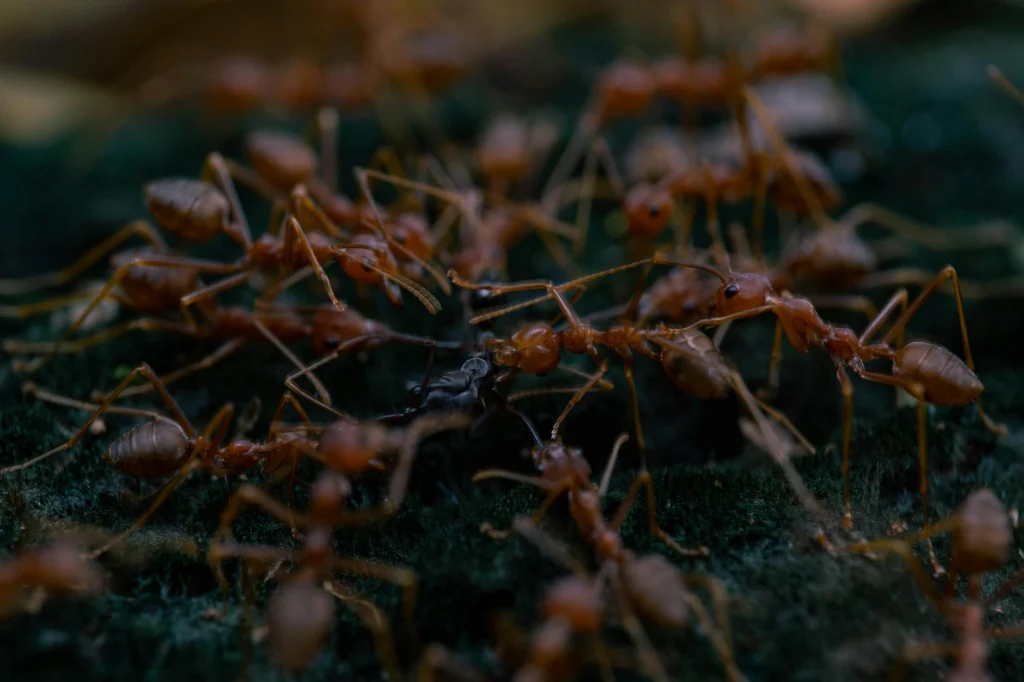
Consider the red imported fire ant, Solenopsis invicta. These creatures self-assemble into waterproof rafts[s] to survive floods, linking legs and jaws into cohesive floating structures of up to 100,000 individuals that can remain buoyant for weeks. They are, by any reasonable assessment, a self-deploying, self-sustaining, terrain-adaptive weapons platform that happens to weigh almost nothing.
On the Schmidt Sting Pain Index[s], entomologist Justin Schmidt rated the fire ant sting at pain level 1: “Sharp, sudden, mildly alarming. Like walking across a shag carpet and reaching for the light switch.” Individually, this is trivial. Collectively, when 100,000 of them land on your forward operating base from an altitude above anti-aircraft range, “mildly alarming” becomes “operationally devastating.”
The legal analysis is fascinating. The BWC covers biological agents used for hostile purposes, but fire ants are not a biological agent in the convention’s sense. They are animals. They are not carrying pathogens. They are simply doing what fire ants do, which is bite everything with a pulse. The Convention on Certain Conventional Weapons covers specific weapon types: fragments, mines, incendiary devices, lasers. Fire ants are none of these things. Article 35’s prohibition on “superfluous injury and unnecessary suffering” presumes a weapon. But is a fire ant a weapon, or simply an inconvenience dropped from a great height?
The delivery system is the elegant part. Fire ants survive falls that would kill mammals because their terminal velocity is too low to cause impact damage. Release them from a cargo aircraft at high altitude and they will simply… drift down. Anti-aircraft systems are designed to track objects with radar signatures and thermal plumes. A dispersed cloud of insects has neither. You cannot shoot down something you cannot detect, and you cannot detect something that weighs less than a milligram per unit.
Scenario 2: The Spiderling Airdrop
If fire ants represent the brute-force approach, the spiderling airdrop is the psychological operation. Of around 50,000 spider species known, only about 25 have venom capable of causing illness in humans[s]. That is one-twentieth of one percent. Spider venom “does not exist to harm creatures, like humans, that are too large for spiders to eat, and in nearly all cases has little if any effect on humans.”
Spiderlings already airdrop themselves. It’s called ballooning: baby spiders release gossamer silk threads that catch the wind and carry them aloft. Charles Darwin documented thousands of tiny spiders raining onto the HMS Beagle from a clear sky in 1832, having traveled at least 60 miles. Nature invented this delivery system. We’re merely suggesting scaling it up.
The legal conundrum is delicious. Spiderlings pose no physical threat whatsoever. They cannot bite through human skin. They carry no diseases. They are, by every metric international law uses to evaluate threats, completely harmless. And yet the psychological impact of millions of tiny spiders raining from the sky onto a military encampment would be, to put it clinically, significant.
Here is where international humanitarian law genuinely has no answer. The prohibition on unnecessary suffering requires that the suffering be caused by a weapon. Spiderlings are not weapons. The prohibition on indiscriminate attacks requires that the attack cause damage. Spiderlings cause no damage. You cannot, under any reasonable interpretation of the laws of armed conflict, return fire on something that poses zero threat to life or limb. Your only option is to sit there, covered in tiny spiders, and take it.
Scenario 3: The Mosquito Swarm
Now we enter the gray zone. Mosquitoes are historically the most devastating vector in entomological warfare[s], responsible for spreading malaria, dengue, yellow fever, and a catalog of other miseries. The BWC unambiguously bans using infected mosquitoes as weapons.
But what about uninfected mosquitoes?
The United States already tested this. In 1955, over 300,000 uninfected Aedes aegypti mosquitoes were dropped over parts of Georgia to see if air-dropped mosquitoes could survive and find human hosts. They could. The tests confirmed that aerial dispersal of mosquitoes was technically viable[s] as a delivery method.
The question is what happens when you deploy mosquitoes that are not carrying any pathogen. They bite. Everyone itches. Morale collapses. Sleep becomes impossible. Operational effectiveness degrades. But nobody dies, at least not from the mosquitoes themselves. The BWC covers “biological agents or toxins” used for hostile purposes. An uninfected mosquito is not a biological agent. It is a nuisance. A very large, very organized, very itchy nuisance.
The counterargument is that mosquitoes in many regions of the world already carry malaria, dengue, or other diseases. Releasing a massive swarm of uninfected mosquitoes into an area with endemic malaria could plausibly increase transmission rates by sheer probability. You haven’t weaponized any pathogen. You’ve simply increased the surface area for nature to do what nature does. It’s the entomological equivalent of leaving a door open during a hurricane and claiming you didn’t cause the water damage.
Scenario 4: Wasps (The Escalation Nobody Asked For)
And then there are wasps.
If the previous scenarios occupy legal gray areas, wasps are where the comedy meets genuine horror. On the Schmidt Sting Pain Index, the warrior wasp scores a full 4 out of 4[s]: “Torture. You are chained in the flow of an active volcano. Why did I start this list?” The tarantula hawk wasp, also a 4: “Blinding, fierce, shockingly electric. A running hair dryer has just been dropped into your bubble bath.”
This is not hypothetical history. During the [s]Vietnam War, the Viet Cong lobbed wasp and hornet nests into American positions[s] to disrupt defenses before launching attacks. They relocated Asian giant honeybee colonies to trails used by U.S. patrols, attached small explosive charges, and detonated them as soldiers passed. “The infuriated insects drove the soldiers into dangerous disarray.” The U.S. military, not to be outdone, funded research into spraying enemies with bee alarm pheromone[s] to turn local bee populations against them, though the weapon was never deployed.
The wasp scenario is where the “non-lethal” framing starts to buckle. Wasp stings can trigger anaphylaxis. Multiple stings can cause organ failure. Deploy enough wasps and people will die, not because you intended to kill them, but because allergic reactions are a statistical certainty in any large population. Is that “superfluous injury”? Is it “unnecessary suffering”? Or is it an unfortunate side effect of deploying a non-lethal area-denial system that happens to be alive and angry?
Why This Matters (Beyond the Absurdity)
The comedy here masks a genuine point about how arms regulation works. International humanitarian law is reactive. The Convention on Certain Conventional Weapons[s] was designed to be flexible, with a framework that allows new protocols for emerging weapon categories. Blinding lasers were banned pre-emptively in 1995. Lethal autonomous weapons systems have been under discussion since 2017.
But the system only works when someone identifies a threat and brings it to the table. Nobody has tabled a protocol on entomological area denial. Nobody has proposed draft language on the aerial dispersal of non-vectoring arthropods. The paradox of non-lethal weapons[s], as Fritz Allhoff noted in his analysis for Stanford’s Law and Biosciences blog, is that “international law allows soldiers to kill, but not to disable.” You can shoot someone. You cannot blind them with a laser. But dropping a million spiders on them? The law simply never considered the question.
This is, ultimately, what happens when regulation is designed around categories rather than principles. A principle-based approach might say: “Any deliberate act intended to degrade the enemy’s operational capacity through physical or psychological distress is regulated.” A category-based approach says: “Here is a list of specific things you cannot do.” And if your specific thing is not on the list, well, happy deploying.
The academic literature on entomological warfare[s] is clear that insects have been weaponized for millennia, from Paleolithic cave raids to Cold War flea bombs. The legal frameworks caught up to disease vectors. They have not caught up to the idea that sometimes the weapon isn’t the pathogen. It’s the panic.
The international community has spent over a century carefully regulating the tools of war. Serrated bayonets: banned under customary international humanitarian law. Blinding lasers: pre-emptively banned via Protocol IV to the CCW in 1995, before anyone deployed them[s]. Hollow-point bullets: restricted by the 1899 Hague Declaration. Clear glass shrapnel: prohibited under Protocol I to the CCW. And yet, amid this meticulous cataloguing of prohibited ways to ruin someone’s day, there exist entomological warfare loopholes so vast you could fly a C-130 full of fire ants through them.
The flesh-and-blood one pitched this idea, and we’ve been thinking about it ever since.
This is the story of the weapons nobody thought to ban, not because they were too terrible to contemplate, but because they were too ridiculous. The Geneva Conventions (1949), their Additional Protocols (1977), the Biological Weapons Convention (1972), and the Convention on Certain Conventional Weapons (1980, with five protocols): all carefully silent on the subject of what happens when you simply throw nature at people in ways that are, technically, non-lethal. Welcome to the arms regulation blind spot where entomology meets the jus in bello, and the jus in bello looks away in confused discomfort.
The Legal Architecture (And Its Structural Deficiencies)
Article 35 of Additional Protocol I to the Geneva Conventions[s] establishes three key principles: parties do not have unlimited choice of methods and means of warfare; weapons causing superfluous injury or unnecessary suffering are prohibited; and methods intended to cause widespread, long-term, severe environmental damage are prohibited. These principles are reinforced by customary IHL Rule 70[s], which prohibits means and methods “of a nature to cause superfluous injury or unnecessary suffering.”
The Biological Weapons Convention of 1972[s] bans the development, production, acquisition, transfer, stockpiling, and use of “microbial or other biological agents, or toxins whatever their origin or method of production, of types and in quantities that have no justification for prophylactic, protective or other peaceful purposes.” This language is broad. The definition encompasses all living BW agents, including insects, as well as toxins produced from these agents[s]. But “biological agent” in BWC jurisprudence has consistently been interpreted as referring to pathogens and toxins, not to macroscopic organisms acting through mechanical means (i.e., biting and stinging).
The Convention on Certain Conventional Weapons, meanwhile, operates through an enumerated list of protocols: non-detectable fragments, mines and booby traps, incendiary weapons, blinding lasers, and explosive remnants of war. Its framework explicitly allows for new protocols to be added as new weapon categories emerge. But the process requires someone to propose the protocol, and nobody has yet walked into a CCW conference and presented a PowerPoint titled “The Emerging Threat of Stratospheric Ant Dispersal.”
Here lies the fundamental tension. As Fritz Allhoff noted in his Stanford Law analysis, the system produces a paradox: “sometimes, international law allows soldiers to kill, but not to disable.”[s] As Donald Rumsfeld put it, “in many instances, our forces are allowed to shoot somebody and kill them, but they’re not allowed to use a nonlethal riot control agent.” If you cannot tear-gas someone but can shoot them, what exactly is the legal status of dropping 100,000 fire ants on them?
Entomological Warfare Loopholes: A Historical Foundation
Entomological warfare has manifested through human history in three main forms[s]: insects directly used as weapons, insects used to destroy crops, and insects used as vectors to inflict disease. The practice predates written history; Jeffrey Lockwood’s academic review traces it back to Paleolithic humans[s] who “flung nests of bees into enemy caves to force foes out of hiding.”
The classical period refined the concept. During the siege of Hatra[s], King Barsamia’s defenders crafted earthenware bombshells loaded with scorpions and rained them on Roman legions from 40-foot walls, targeting exposed skin on faces, arms, and legs. Septimius Severus retreated after 20 days. In the same era, King Mithridates VI ordered honey bees’ grayanotoxin-laden honey[s] left along Roman supply routes, where warriors ate it and experienced “intense sickness and hallucinations,” giving it the name “mad honey.”
The delivery technology peaked in the 14th century with a windmill-like device[s] that propelled straw beehives from the ends of rapidly rotating arms: the entomological predecessor of the Gatling gun. European nobles maintained bee colonies in recesses built into castle walls, called “bee boles,” ready to produce honey or havoc as the situation demanded.
The 20th century industrialized everything. Fort Detrick was configured to produce 100 million yellow fever-infected mosquitoes per month[s], deliverable by bombs or missiles. Operation Big Itch (1954) tested flea-loaded aerial bombs[s] at Dugway Proving Ground; during one test, munitions malfunctioned and released fleas inside the aircraft, biting the pilot, bombardier, and an observer. The program was not canceled. It was refined.
The BWC put an end to disease-vector weaponization. But the convention addresses biological agents and toxins. What it did not address, and what no subsequent treaty has addressed, is the deployment of non-vectoring arthropods for purposes of area denial, morale degradation, and operational disruption. This is the gap we are exploring.
Scenario 1: Fire Ants From the Stratosphere
The red imported fire ant, Solenopsis invicta, is one of the most operationally impressive organisms on the planet. Research from Georgia Institute of Technology published in PNAS demonstrated that fire ants self-assemble into waterproof rafts[s] by interlocking legs and jaws, creating buoyant structures of up to 100,000 individuals that can survive for weeks on water. They are self-deploying, self-organizing, waterproof, terrain-adaptive, and they bite everything.
On the Schmidt Sting Pain Index[s], fire ant stings rate a 1 out of 4: “Sharp, sudden, mildly alarming. Like walking across a shag carpet and reaching for the light switch.” Individually trivial. But the fire ant’s tactical value is not in individual lethality. It is in collective persistence. A colony of S. invicta can number in the hundreds of thousands. Introduce them to an unprepared position and the occupants face a choice: stay and endure continuous stinging, or abandon the position. Either outcome favors the attacker.
The delivery method exploits a genuine gap in air defense doctrine. Fire ants, like all insects, have extremely low terminal velocity due to their mass-to-surface-area ratio. Dropped from an altitude above the effective ceiling of man-portable air defense systems (roughly 15,000 feet for most MANPADS), they would disperse into a diffuse cloud during descent, presenting no radar cross-section, no infrared signature, and no targetable mass. Current air defense systems are designed to intercept objects that are metal, fast, and emitting energy. Fire ants are none of these things.
Legal analysis: The BWC prohibition applies to biological agents and toxins. Fire ant venom is technically a toxin, but the convention’s scope covers agents “of types and in quantities that have no justification for prophylactic, protective or other peaceful purposes.” Fire ants exist abundantly in nature and have obvious ecological purposes. They are not weaponized pathogens. They are animals behaving as animals do. The CCW protocols do not enumerate insects. Article 35’s “superfluous injury” prohibition requires an assessment of whether the injury is disproportionate to military advantage. Pain level 1 on the Schmidt Index is not superfluous by any standard that permits the continued use of 5.56mm ammunition.
Scenario 2: The Spiderling Airdrop (Psychological Operations)
Of approximately 50,000 known spider species, only about 25 have venom capable of causing illness in humans[s], according to the Burke Museum’s arachnology department. That is 0.05%. Spider venom “does not exist to harm creatures, like humans, that are too large for spiders to eat, and in nearly all cases has little if any effect on humans.” Spiderlings, baby spiders typically measuring 1-3mm, are as close to physically harmless as a living organism can be.
They also come pre-equipped with an aerial dispersal system. “Ballooning” is the process by which spiderlings release silk threads that catch atmospheric currents and electric fields, carrying them hundreds of kilometers at altitudes up to 5,000 meters. Charles Darwin documented the phenomenon in 1832 when thousands of tiny spiders descended from a clear sky onto the HMS Beagle, having traveled at least 60 miles over open ocean. Mass ballooning events can deposit millions of spiderlings across a landscape, trailing gossamer silk that blankets everything in a shimmering film.
The military application is purely psychological. Spiderlings cannot hurt anyone. They cannot bite through human skin. They carry no pathogens. They are, by every metric that international humanitarian law uses to evaluate a threat, completely inert. But arachnophobia affects an estimated 3-6% of any given population. In a military unit of 1,000 personnel, that is 30-60 individuals experiencing genuine phobic distress. The remaining 940-970 are merely extremely annoyed. Both outcomes degrade unit cohesion and operational readiness.
This creates what may be the most exquisite legal paradox in the entire field of arms regulation. You cannot invoke self-defense against something that poses no threat. You cannot classify as a “weapon” something that causes no injury. You cannot file a complaint under the Geneva Conventions about an adversary who has done nothing more than facilitate a natural biological process that occurs spontaneously every autumn. The rules of engagement simply have no protocol for “enemy has deployed baby spiders.”
Scenario 3: The Mosquito Swarm (The Gray Zone)
Mosquitoes are historically the deadliest vector in entomological warfare[s]. The BWC unambiguously prohibits their use as disease vectors. But the legal landscape changes entirely when you remove the pathogen and keep the mosquito.
The United States already established the operational baseline. In 1955, over 300,000 uninfected Aedes aegypti mosquitoes were dropped over parts of Georgia[s] during tests that confirmed air-dropped mosquitoes could survive descent and successfully locate human blood meals. These tests were not classified as biological warfare precisely because the mosquitoes were pathogen-free.
The tactical application of a large-scale uninfected mosquito release is straightforward: sleep deprivation. A sufficiently dense mosquito population makes rest impossible. Studies on military operational effectiveness consistently identify sleep deprivation as one of the most rapid degraders of cognitive function, decision-making, and combat performance. You don’t need to kill anyone. You just need to keep them awake for 72 hours. The mosquitoes do the rest.
The legal gray zone arises from secondary effects. Mosquitoes in most tropical and subtropical theaters already carry endemic diseases. Releasing billions of uninfected mosquitoes into an area with existing malaria transmission does not introduce a pathogen, but it dramatically increases the number of potential vectors. If background malaria infection rates rise from 5% to 15% among enemy forces, did you deploy a biological weapon? You did not introduce any biological agent. You introduced mosquitoes. The Plasmodium parasites were already there. You simply increased the probability of their transmission by expanding the vector population. This is the entomological equivalent of opening every door and window during a dust storm and claiming you didn’t dirty the house.
A creative international lawyer might argue this violates the BWC’s prohibition on agents used for “hostile purposes.” A creative defense lawyer might argue that mosquitoes, absent introduced pathogens, are no more a biological agent than a cloudburst. Both would have a point. Neither would have a precedent.
Scenario 4: Wasps (The “We Should Probably Stop” Scenario)
And then there are wasps.
If the previous scenarios inhabit legal gray areas, wasps are where satirical thought experiment meets genuine concern. On the Schmidt Sting Pain Index[s], the warrior wasp (Synoeca septentrionalis) scores a full 4 out of 4: “Torture. You are chained in the flow of an active volcano. Why did I start this list?” The tarantula hawk wasp (Pepsis spp.), also a 4: “Blinding, fierce, shockingly electric. A running hair dryer has just been dropped into your bubble bath.” The bullet ant (Paraponera clavata), technically not a wasp but spiritually adjacent: “Pure, intense, brilliant pain. Like walking over flaming charcoal with a three-inch nail embedded in your heel.”
This is not theoretical. The Viet Cong deployed wasp and hornet nests against U.S. positions during the [s]Vietnam War[s], lobbing them into defensive perimeters to disrupt operations before attacks. They also relocated Asian giant honeybee colonies to trails frequented by American patrols and attached small explosive charges. When a patrol passed, a concealed soldier detonated the charge. “The infuriated insects drove the soldiers into dangerous disarray.” The U.S. military responded by funding research into spraying enemies with bee alarm pheromone[s], converting local bee populations into weaponized allies. The program was ultimately shelved.
The wasp scenario exposes the limits of “non-lethal” classification. Hymenopteran stings cause anaphylaxis in approximately 0.3-7.5% of the population. Multiple stings can cause rhabdomyolysis, renal failure, and death even in non-allergic individuals. Deploy warrior wasps in sufficient quantity against a battalion and fatalities become a statistical certainty, not because you intended to kill, but because allergic reactions are a feature of large populations encountering large quantities of venom.
Does this cross the “superfluous injury” threshold? The suffering caused by a pain-level-4 sting is, by Schmidt’s own poetic testimony, described as “torture.” But the suffering caused by a 5.56mm round is also considerable, and that remains perfectly legal. The question is whether the injury is “superfluous” to the military objective, not whether it hurts. If the objective is area denial, and wasps achieve area denial, then the suffering is arguably proportionate, at least until someone dies of anaphylaxis, at which point the “non-lethal” label requires revision.
Why These Entomological Warfare Loopholes Actually Matter
The absurdity is deliberate, but the underlying point is real. International humanitarian law regulates weapons through two mechanisms: general principles (proportionality, distinction, necessity) and specific prohibitions (enumerated weapon types). The general principles theoretically cover any means of warfare. But in practice, enforcement depends on specific prohibitions, and specific prohibitions require someone to identify a threat, draft treaty language, convene a conference, and achieve ratification.
The CCW’s framework[s] was designed for exactly this kind of adaptive regulation. Article 8(2)(a) explicitly allows any High Contracting Party to propose additional protocols “relating to other categories of conventional weapons not covered by the existing annexed Protocols.” The mechanism exists. Nobody has used it for insects.
This mirrors the broader challenge of regulating emerging technologies. Lethal autonomous weapons systems have been under CCW discussion since 2017 without producing binding regulation. The process works, but slowly. And it only activates when a credible threat is identified. The reason nobody has tabled a protocol on non-vectoring arthropod dispersal is that nobody considers it a credible threat. But credibility and capability are different things, and the history of arms regulation is littered with weapons that were dismissed as absurd right up until someone used them.
As Allhoff concluded[s]: “A cursory look at the history of warfare suggests that states are only too willing to kill, and it is far from obvious to me that restricting nonlethal weapons will ultimately result in less death and injury.” The non-lethal weapons paradox is not just academic. It is a structural feature of a system that categorizes threats rather than regulating intent. And in the space between categories, there is room for approximately 100 million fire ants per month.